Sanctuary of Apollo, Delos: The Sacred Heart of the Ancient Greek World
The Sanctuary of Apollo on the island of Delos is one of the most important archaeological sites in Greece, a UNESCO World Heritage landmark accessible only by boat from Mykonos. Dating back at least to the 9th century BC, this open-air sanctuary sat at the religious and commercial center of the ancient Aegean world.
Quick Facts
- Location
- Delos Island, Cyclades, Greece — approx. 30–45 min by boat from Mykonos Town
- Getting There
- Day-trip boats depart from Mykonos Old Port; round-trip fare approx. €22–€25 (verify locally)
- Time Needed
- 3–5 hours to explore the sanctuary and surrounding site thoroughly
- Cost
- Site entry approx. €20 per adult (includes museum); guided tours from approx. €35 (verify current prices)
- Best for
- History enthusiasts, archaeology fans, travelers seeking depth beyond Mykonos's beach scene
- Official website
- whc.unesco.org/en/list/530
What the Sanctuary of Apollo Actually Is
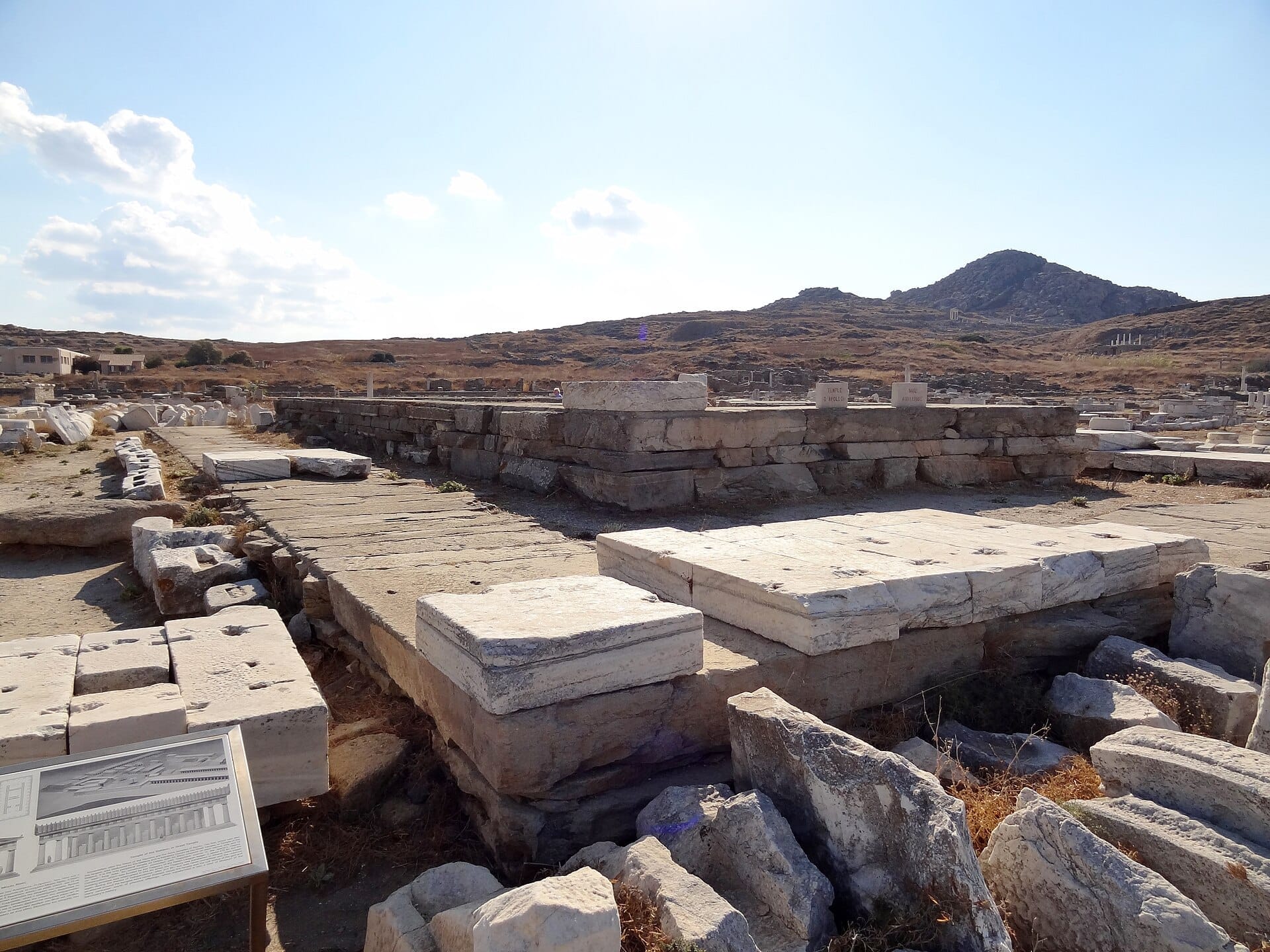
The Sanctuary of Apollo is the religious and ceremonial core of Delos, a tiny uninhabited island roughly 3.4 km² in size that once served as the beating heart of the ancient Aegean world. For centuries, pilgrims, merchants, and envoys from across the Greek world converged here to honor Apollo, the god of light, music, and prophecy. The sanctuary itself is a dense accumulation of temples, treasuries, stoas, and altars built up over roughly a millennium, beginning no later than the 9th century BC and reaching its peak between the 5th and 1st centuries BC.
The entire island of Delos was inscribed as a UNESCO World Heritage Site in 1990, with the sanctuary recognized as its defining monument. Unlike reconstructed sites or heavily managed heritage parks, Delos retains an extraordinary rawness: column drums lie where they fell, marble bases still bear inscriptions, and the scale of the sanctuary's ambition is legible even in ruin. There is no modern town here, no café beside the columns, no overnight accommodation. You arrive by boat, walk the site, and leave before sunset.
ℹ️ Good to know
The archaeological site of Delos, including the Sanctuary of Apollo, is generally open daily, 08:00–20:00 during the main season, with reduced hours in winter and occasional closures on certain holidays. These hours are subject to seasonal adjustment, so confirm with your boat operator or the Hellenic Ministry of Culture before traveling.
Getting There: The Boat from Mykonos
Access to Delos is only possible by boat, and the standard departure point is the Mykonos Old Port. The crossing takes approximately 30 minutes each way and operates as a structured day trip, meaning you will return on a boat scheduled for the afternoon. The round-trip fare is approximately €22–€25, separate from the site entrance fee of approximately €20. Check both prices locally before you go, as they are reviewed seasonally.
Boats typically run in the morning and return in the early-to-mid afternoon, which means your window on the island is fixed. This is not a place you can linger into the evening, and private boats cannot moor at Delos without official permission from the Greek Ministry of Culture. Plan to be on the island for three to five hours, which is enough time to see the sanctuary, the theatre quarter, the Terrace of the Lions, and the small archaeological museum on-site.
💡 Local tip
Take the earliest available boat from Mykonos Old Port. Groups from cruise ships and organized tours tend to arrive mid-morning, and the site can become crowded around the main sanctuary area between 10:00 and 12:00. Arriving at opening gives you the ruins in near-silence.
If you want a structured introduction to the site, guided tours from Mykonos start at around €35 and include a licensed archaeologist or guide. For visitors who prefer to explore independently, the Archaeological Museum of Delos, located just inside the landing area, provides essential context and houses finds from the sanctuary itself, including sculpture, votive offerings, and architectural fragments.
Tickets & tours
Live prices and dates from our booking partner. If you book, we may earn a commission at no extra cost to you.
Mykonos yacht cruise to Rhenia Island and guided tour of Delos
From 120 €Instant confirmationFree cancellationSunset sailing to Rhenia with Delos self-guided virtual tour
From 110 €Instant confirmationFree cancellationHalf-Day Mykonos, Delos and Rhenia Catamaran Cruise with Lunch
From 150 €Instant confirmationFree cancellationDelos Day Trip from Mykonos
From 76 €Instant confirmationFree cancellation
Inside the Sanctuary: What You Are Looking At
Walking into the Sanctuary of Apollo from the Sacred Way, the first thing you register is the sheer density of the site. Foundations overlap foundations. Column bases from different building phases sit in close proximity, a physical record of centuries of competing dedications. The three main Apollonian temples — the Archaic Temple of Apollo (also called the Porinos Naos), the Athenians' Temple, and the Temple of the Delians — are arranged along the sanctuary's central axis, though all are now reduced to their lower courses and scattered architectural members.
The Great Altar of Apollo, once among the most celebrated in the Greek world, lies nearby. Ancient sources described it as built from the compacted horns of sacrificed goats and described by later travellers as a remarkable engineering feat. Only its footprint survives now, but standing at it still communicates something of the sanctuary's original purpose: this was a place of massive collective ritual, not quiet contemplation.
To the north of the sanctuary lies the Terrace of the Lions, a row of marble guardian figures dedicated by the Naxians in the 7th century BC. Most of those now standing on the terrace are replicas; the originals are preserved in the on-site museum. Even the replicas are striking in their archaic, lean-limbed austerity, facing the Sacred Lake (now dry) with a formal alertness that reads clearly across the centuries.
Historical and Cultural Weight
Delos was inhabited as early as the 3rd millennium BC, but its transformation into a pan-Hellenic sanctuary accelerated after the 9th century BC, when the cult of Apollo became its organizing principle. Greek mythology identified Delos as the birthplace of Apollo and his twin sister Artemis, born to Leto on the island after she was expelled from the known world by a jealous Hera. This origin story gave Delos a sacred geography that no other site in the Aegean could replicate.
Control of Delos was contested and symbolically important. Athens twice purified the island by forbidding burials and births within its sacred boundaries, and Delians were periodically expelled. The Delian League, the Athenian-led alliance formed after the Persian Wars, held its treasury here before Athens transferred it to the Acropolis. In the Hellenistic period, after 167 BC, the Romans handed control of the island to Athens and declared it a free port. Its population swelled to perhaps 20,000 people, and it became the commercial hub of the eastern Mediterranean. The sanctuary continued to function even as the island became as much a slave market and trading post as a religious center.
The destruction wrought by Mithridates VI of Pontus in 88 BC, followed by pirates in 69 BC, effectively ended Delos as a functioning city. It was never substantially rebuilt, which is precisely why so much of it survives: abandonment froze the site. The lack of later medieval or Ottoman construction over the ruins means the archaeological layers are relatively legible, and excavations by the French School at Athens, ongoing since 1873, have steadily uncovered the full extent of the ancient city.
How the Site Feels at Different Times of Day
In the early morning, before the tour groups arrive, the Sanctuary of Apollo has a quality of stillness that is genuinely unusual for a major heritage site. The Aegean light at that hour is flat and clear, throwing the texture of the marble and granite into sharp relief. Lizards move across the column drums. The sound is wind and occasionally the creak of a boat at the small dock. There is no background noise from a city because there is no city.
By late morning, the atmosphere changes. The site receives a significant number of visitors during peak summer months, and the main sanctuary area and the Terrace of the Lions attract the densest concentration. The heat by midday in July and August can be severe, with little shade across the open sanctuary precinct. The stone radiates warmth, and without trees or structures to break the sun, the exposure becomes a real physical factor in how long you can comfortably stay.
⚠️ What to skip
There is minimal shade across the Sanctuary of Apollo and the surrounding site. In summer, bring a hat, sunscreen, and at least 1.5 liters of water per person. The on-site tourist pavilion near the landing dock sells basic provisions, but do not rely on it being fully stocked.
By early afternoon, as boats prepare to return, the site begins to empty. The light shifts and softens slightly, and the ruins take on a different quality, more amber than white. If your return boat allows it, spending time in the theatre quarter or along the edges of the sanctuary in this period is worthwhile: fewer people, slightly lower temperatures, and a light that makes photography considerably more rewarding.
Practical Walkthrough and What to Expect
The terrain at Delos is uneven throughout. The sanctuary area itself is relatively flat, but the site as a whole involves walking over stone pavements, rubble, and stepped ground. Sturdy, closed-toe shoes are strongly recommended. This is not a site that is fully accessible to visitors with limited mobility: the rocky terrain, absence of paved paths between all areas, and the general condition of the ruins make navigation difficult with a wheelchair or mobility aids.
A complete visit covering the Sanctuary of Apollo, the Terrace of the Lions, the theatre district, and the Archaeological Museum of Delos takes between three and five hours at a comfortable pace. If you are combining this with a climb to Mount Kynthos, the island's highest point at 113 meters, budget the full five hours. The view from the summit across the Cyclades, with Mykonos immediately to the northeast, is one of the better panoramic views in the entire island group.
Photography at the sanctuary is permitted. The wide, uncluttered views of the temple foundations and the Terrace of the Lions are best captured in the morning light, before midday shadows flatten the scene. The complete guide to a day trip to Delos from Mykonos covers boat schedules, combined ticketing options, and how to structure your time across the whole island, not just the sanctuary.
Who Should Skip This
Visitors who are primarily on Mykonos for its beaches, nightlife, or culinary scene will likely find Delos a significant investment of a half-day for a reward that is contextual rather than immediate. The sanctuary is not visually spectacular in the way that, say, the Acropolis of Athens is: most structures survive only at foundation level, and without prior knowledge or a good guide, the ruins can read as undifferentiated rubble. The experience rewards preparation.
Visitors with significant mobility limitations should also consider carefully whether the terrain is manageable for them. Those traveling with very young children should note the uneven ground and the absence of any interactive or child-oriented facilities beyond the museum. If your time in the Mykonos area is limited to two or three days and cultural history is not a priority, allocating half a day to Delos may not be the best use of your itinerary. The full guide to things to do in Mykonos can help you prioritize across the island's other major attractions.
Insider Tips
- Book your boat tickets from Mykonos Old Port the day before, especially in July and August. Morning departures sell out, and the earliest boat gives you the sanctuary almost to yourself for the first hour.
- The on-site Archaeological Museum of Delos is often skipped by visitors rushing to see the main ruins. It is worth 30 to 45 minutes of your time: the original marble lions from the Terrace of the Lions are housed here, and their condition and scale are more impressive up close than the replicas outdoors.
- Bring cash. The tourist pavilion near the dock operates on a limited schedule and payment options may be restricted. Having euros on hand for water and snacks is more reliable than assuming card payment will work.
- If your Greek history background is limited, consider a licensed guide rather than an audio guide. The sanctuary's visual complexity rewards explanation, and a good guide will orient you to what you are seeing within the first fifteen minutes in a way that transforms the remaining hours.
- The archaeological site may stay open until 20:00 in peak season, but return ferries often depart in the early-to-mid afternoon. Confirm your boat's departure time and do not miss it. There is no accommodation on Delos for regular visitors, and missing your boat is a serious logistical problem.
Who Is Sanctuary of Apollo For?
- Travelers with a genuine interest in ancient Greek history, religion, or archaeology
- Visitors who want a substantive cultural experience to balance Mykonos's beach and nightlife focus
- Photographers looking for exceptional early-morning light over unobstructed ancient ruins
- History-focused families with older children or teenagers who can engage with the archaeological context
- Anyone spending more than three days in Mykonos who wants to understand why this part of the Aegean was so historically significant
Nearby Attractions
Other things to see while in Delos Island:
- Archaeological Museum of Delos
Built on the excavation site itself, the Archaeological Museum of Delos houses sculptures, mosaics, pottery, and artifacts uncovered from one of the ancient world's most sacred islands. It is reached only by boat from Mykonos, and admission covers both the museum and the wider archaeological site.
- House of Dionysus
The House of Dionysus is one of the best-preserved Hellenistic residences in the Aegean, built in the 2nd century BC and named for its extraordinary courtyard mosaic depicting Dionysus riding a panther. Located in the Theatre Quarter of the Archaeological Site of Delos, it offers a rare glimpse into the private luxury of ancient Greek merchants and aristocrats. Access requires a boat crossing from Mykonos, making advance planning essential.
- Mount Kynthos
Rising 112 metres above the sacred island of Delos, Mount Kynthos is the highest point of this UNESCO World Heritage Site and one of the most historically charged viewpoints in the Aegean. The climb is short but rewarding, delivering panoramic island views alongside ancient sanctuary remains at the summit.
- Terrace of the Lions
The Terrace of the Lions is one of the most recognizable ancient monuments in the Aegean, a row of marble lion sculptures dedicated to Apollo by the Naxians around 600 BC. Located on the uninhabited island of Delos, accessible only by boat from Mykonos, the terrace anchors a UNESCO World Heritage site that rewards visitors willing to go beyond the postcard image.
Planning a trip? Discover personalized activities with the Nomado app.