House of Dionysus on Delos: The Ancient Mosaic House Worth the Boat Trip
The House of Dionysus is one of the best-preserved Hellenistic residences in the Aegean, built in the 2nd century BC and named for its extraordinary courtyard mosaic depicting Dionysus riding a panther. Located in the Theatre Quarter of the Archaeological Site of Delos, it offers a rare glimpse into the private luxury of ancient Greek merchants and aristocrats. Access requires a boat crossing from Mykonos, making advance planning essential.
Quick Facts
- Location
- Theatre Quarter, Archaeological Site of Delos, Delos Island, Cyclades, Greece
- Getting There
- Excursion boats depart from the Old Port of Mykonos (Mykonos Town); journey is approximately 30 minutes
- Time Needed
- Allow 3–4 hours for the full Delos site; the House of Dionysus itself takes 15–25 minutes
- Cost
- Included in the general Delos site admission ticket (site + museum combo); verify current pricing with the Ephorate of Antiquities of Cyclades
- Best for
- Ancient history enthusiasts, art and mosaic lovers, archaeology day-trippers from Mykonos
- Official website
- www.culture.gov.gr
What the House of Dionysus Actually Is
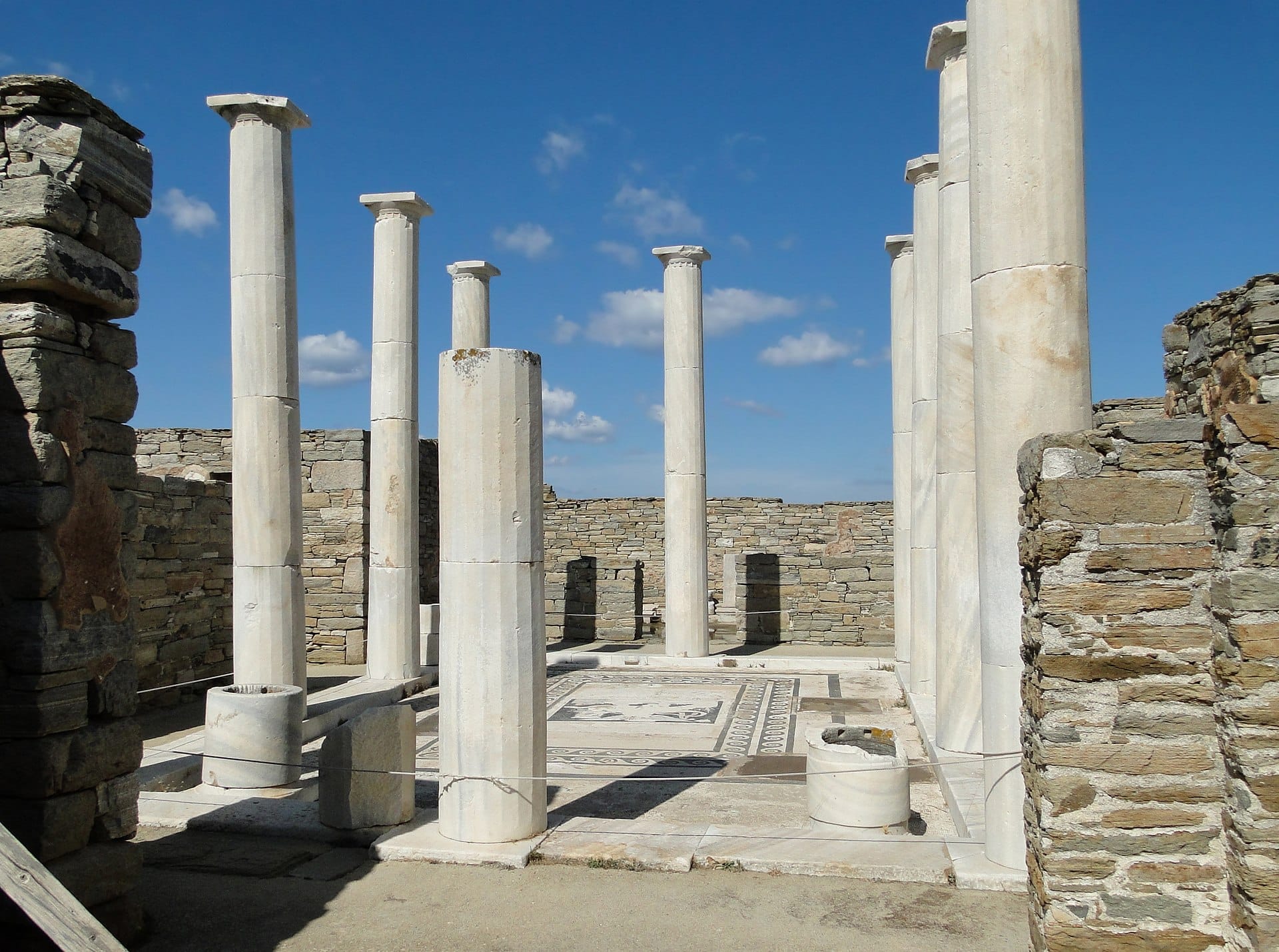
The House of Dionysus is a Hellenistic peristyle residence built in the 2nd century BC, situated in the Theatre Quarter of Delos, the sacred island that once served as the commercial and religious center of the Aegean world. The structure follows the classic wealthy-household plan of its era: rooms arranged around a central colonnaded courtyard, designed to channel Mediterranean light into a private interior world of considerable elegance.
The house takes its name from the mosaic that once covered the floor of its central courtyard, depicting the god Dionysus as a winged figure riding a big cat often identified as a tiger or panther. It is one of the finest examples of Hellenistic tesserae work ever found in the Greek world, precise enough in its detail and confident enough in its composition to suggest the work of a skilled specialist rather than a local craftsman. That mosaic is no longer on site: the original was removed for preservation and is now displayed inside the Archaeological Museum of Delos. A version remains visible at the location itself, but visitors seeking the full impact of the original should factor in a stop at the museum.
ℹ️ Good to know
The original Dionysus mosaic is housed in the Archaeological Museum on Delos, not at the house itself. Plan time for the museum to see it properly, as the on-site version gives context but the museum installation shows the full detail and color.
The Setting: Delos and the Theatre Quarter
Delos is a small, uninhabited island roughly 3.4 kilometers long, sitting near the center of the Cyclades. In antiquity it was considered one of the holiest sites in the Greek world, the mythological birthplace of Apollo and Artemis, and by the 2nd century BC it had grown into one of the Mediterranean's busiest commercial ports. Tens of thousands of people lived here: merchants, bankers, slaves, priests. The Theatre Quarter, where the House of Dionysus stands, was the residential district where the wealthiest inhabitants built their homes.
Walking from the Delos ferry pier toward the Theatre Quarter takes you through layers of ruins: sanctuaries, warehouses, market spaces. The transition into the residential zone is gradual but distinct. The houses here are bigger, the stonework more refined, and the atmosphere quieter than the main sanctuary area. For context on what you will encounter across the wider site, the Terrace of the Lions and the Sanctuary of Apollo are both worth seeing before or after the House of Dionysus.
The ground throughout the site is uneven: ancient paving stones, exposed foundations, and patches of rubble require careful footing. Footwear with grip is not optional here. The Theatre Quarter involves some uphill walking and stone steps, and there is no indication of step-free or wheelchair-adapted access into the House of Dionysus itself. Visitors with significant mobility limitations should assess their options carefully and contact the Ephorate of Antiquities of Cyclades in advance.
Tickets & tours
Live prices and dates from our booking partner. If you book, we may earn a commission at no extra cost to you.
Mykonos South Coast Cruise on a Traditional Caique
From 93 €Instant confirmationFree cancellationMykonos yacht cruise to Rhenia Island and guided tour of Delos
From 120 €Instant confirmationFree cancellationSunset sailing to Rhenia with Delos self-guided virtual tour
From 110 €Instant confirmationFree cancellationHalf-Day Mykonos, Delos and Rhenia Catamaran Cruise with Lunch
From 150 €Instant confirmationFree cancellation
The Architecture: Reading the House
Even without the original mosaic in place, the House of Dionysus communicates what elite Hellenistic domestic life looked like. The peristyle courtyard sits at the center of the plan, its column bases still visible and roughly spaced in the proportions that once framed the mosaic pavement. Around it, the outlines of individual rooms are legible: private quarters, reception spaces, storage areas.
The scale is instructive. This was not a modest home. The overall footprint and the quality of construction indicate serious wealth, consistent with what we know about the Delian merchant class of the 2nd century BC, many of them Italians and Greeks who had made fortunes in the island's trading economy. The house represents a moment when private display of luxury, including commissioned mosaic floors, had become a normal part of aristocratic self-presentation across the Hellenistic Mediterranean.
Taken alongside the nearby House of the Masks and the House of the Trident (other residences in the same quarter), the House of Dionysus forms part of a cluster that makes the Theatre Quarter the most architecturally legible domestic zone on the island. If you are specifically interested in ancient domestic architecture, this stretch of Delos offers more per square meter than almost anywhere else in Greece.
Time of Day and Crowd Patterns
Delos receives visitors only during defined daily windows, dictated by the ferry schedule from Mykonos. Boats typically begin arriving mid-morning, and the site sees its densest crowds between roughly 10am and noon, when multiple tours land simultaneously. The Theatre Quarter, being further from the main pier than the sanctuary area, tends to receive visitors in waves rather than a constant flow, and the House of Dionysus specifically is rarely overcrowded even when the broader site is busy.
If you take one of the earlier morning departures from Mykonos, you will reach the Theatre Quarter before the bulk of tour groups, which makes a real difference. The low-angle morning light also falls more directly into the courtyard space, which helps in understanding the original proportions and gives better photographic results. By early afternoon, the light is harsh overhead and the site feels more exposed.
💡 Local tip
Take the earliest available ferry from the Old Port of Mykonos. You will reach the Theatre Quarter before the main tour groups, giving you quieter access to the House of Dionysus and better light for photography.
Delos is fully exposed to the Aegean. There is almost no shade outside the museum building, and in July and August the midday heat is severe. Sun protection, water, and a hat are not suggestions. The site has very limited food and water infrastructure, so bring supplies from Mykonos. The last boats back to Mykonos depart in the early-to-mid afternoon, and missing them is not a theoretical concern: Delos is uninhabited, and there is nowhere to stay.
⚠️ What to skip
There are no hotels or overnight options on Delos. Check your return ferry time before you arrive and build in a buffer. Missing the last boat back to Mykonos is a genuine logistical problem.
The Mosaic: On-Site Versus the Museum
The Dionysus-and-panther mosaic is the reason most visitors seek out this particular house, and the question of where to look at it is worth addressing clearly. The original, with its wing-spread figure of Dionysus and the careful rendering of the panther's musculature, is in the Archaeological Museum of Delos. The on-site presence at the house conveys the spatial context: the mosaic sat at the center of a colonnaded courtyard, surrounded by the domestic life of an extremely wealthy household. But the detail, the color, and the craftsmanship read best in the museum setting.
The Archaeological Museum of Delos is located near the main sanctuary and is included in the site admission. It contains not just the Dionysus mosaic but also sculpture, pottery, and finds from across the island. It is one of the more underrated archaeological museum collections in Greece, and it is worth at least 45 minutes of separate attention.
Getting to Delos from Mykonos
Delos is accessible only by boat. Excursion boats and organized day trips depart from the Old Port of Mykonos (Mykonos Town), with the crossing taking roughly 30 minutes. Several operators run scheduled services during the main tourist season, approximately April through October, with frequency highest in summer. Outside this window, access is sharply reduced and weather-dependent.
Booking your Delos boat trip in advance is strongly recommended in peak season (July and August), when spaces fill quickly. Once on Delos, entry tickets to the site and museum are purchased at the gate. For a full orientation of how to structure your day on the island, the day trip to Delos from Mykonos guide covers ferry logistics, what to prioritize, and how to sequence the main attractions.
The site is managed by the Hellenic Ministry of Culture and Sports through the Ephorate of Antiquities of Cyclades. Admission pricing, opening hours, and any seasonal closures should always be confirmed with the official ticket office or the Ministry before travel, as these details change between seasons.
Who Will Get the Most From This Attraction
The House of Dionysus rewards visitors who come with some preparation. If you have read a little about Hellenistic domestic architecture, about what Delos was at its commercial peak, or about the iconography of Dionysus in ancient art, the site pays out considerably more. Walking the Theatre Quarter with that context turns a collection of stone foundations into a coherent picture of how the wealthiest people in the ancient Aegean actually lived.
Visitors who expect clearly labeled, fully preserved rooms, or the kind of interpretive infrastructure found at major mainland museums, may find the open ruins harder to read. The site has signage, but it is not designed as a hands-held experience. First-time visitors to archaeological sites in Greece, or those with limited time who want a single high-impact experience, might find the broader Delos sanctuary area, the Terrace of the Lions, or the museum itself more immediately accessible than the Theatre Quarter houses.
For those combining the trip with a broader Mykonos itinerary, the things to do in Mykonos guide provides a full overview of how a Delos day trip fits into a longer stay on the island.
Insider Tips
- Visit the Archaeological Museum of Delos before walking the Theatre Quarter, not after. Seeing the original mosaic first gives you a precise mental image to bring to the house itself, which makes standing in the courtyard significantly more evocative.
- The Theatre Quarter is uphill from the main sanctuary zone. Most visitors fatigue before reaching it and turn back early. This is one of the few places on Delos where arriving in good physical condition pays off in terms of quieter access.
- Bring significantly more water than you think you need. The site has almost no shade and no reliable on-site water supply. One liter per person is a minimum for a summer visit; two is more realistic for July or August.
- Photography at the on-site mosaic location works best in the first two hours after the site opens, when angled light falls into the courtyard. By midday, overhead light flattens everything and makes the stonework harder to read.
- If your schedule allows, combine the House of Dionysus with the nearby House of the Masks on the same Theatre Quarter walk. The cluster of elite residences together tells a more complete story than any single house in isolation.
Who Is House of Dionysus For?
- Ancient history and classical archaeology enthusiasts who want depth beyond the main sanctuary area
- Art and mosaic lovers interested in Hellenistic decorative traditions
- Photographers seeking well-preserved domestic ruins with strong architectural geometry
- Travelers on a Mykonos stay of three or more days who can dedicate a full day to Delos
- Students and academics of Greek and Roman history, urban planning, or ancient domestic life
Nearby Attractions
Other things to see while in Delos Island:
- Archaeological Museum of Delos
Built on the excavation site itself, the Archaeological Museum of Delos houses sculptures, mosaics, pottery, and artifacts uncovered from one of the ancient world's most sacred islands. It is reached only by boat from Mykonos, and admission covers both the museum and the wider archaeological site.
- Mount Kynthos
Rising 112 metres above the sacred island of Delos, Mount Kynthos is the highest point of this UNESCO World Heritage Site and one of the most historically charged viewpoints in the Aegean. The climb is short but rewarding, delivering panoramic island views alongside ancient sanctuary remains at the summit.
- Sanctuary of Apollo
The Sanctuary of Apollo on the island of Delos is one of the most important archaeological sites in Greece, a UNESCO World Heritage landmark accessible only by boat from Mykonos. Dating back at least to the 9th century BC, this open-air sanctuary sat at the religious and commercial center of the ancient Aegean world.
- Terrace of the Lions
The Terrace of the Lions is one of the most recognizable ancient monuments in the Aegean, a row of marble lion sculptures dedicated to Apollo by the Naxians around 600 BC. Located on the uninhabited island of Delos, accessible only by boat from Mykonos, the terrace anchors a UNESCO World Heritage site that rewards visitors willing to go beyond the postcard image.
Planning a trip? Discover personalized activities with the Nomado app.