Terrace of the Lions on Delos: What to Expect and Why It Matters
The Terrace of the Lions is one of the most recognizable ancient monuments in the Aegean, a row of marble lion sculptures dedicated to Apollo by the Naxians around 600 BC. Located on the uninhabited island of Delos, accessible only by boat from Mykonos, the terrace anchors a UNESCO World Heritage site that rewards visitors willing to go beyond the postcard image.
Quick Facts
- Location
- Island of Delos, Cyclades, Greece (day trip from Mykonos)
- Getting There
- Small ferries depart from Mykonos Old Port; journey takes roughly 30 minutes
- Time Needed
- 2–4 hours for the full Delos site; allow at least 30 minutes at the terrace itself
- Cost
- Included in the Archaeological Site of Delos ticket (verify current price with the Hellenic Ministry of Culture)
- Best for
- History enthusiasts, archaeology lovers, photographers, and curious day-trippers from Mykonos
What the Terrace of the Lions Actually Is
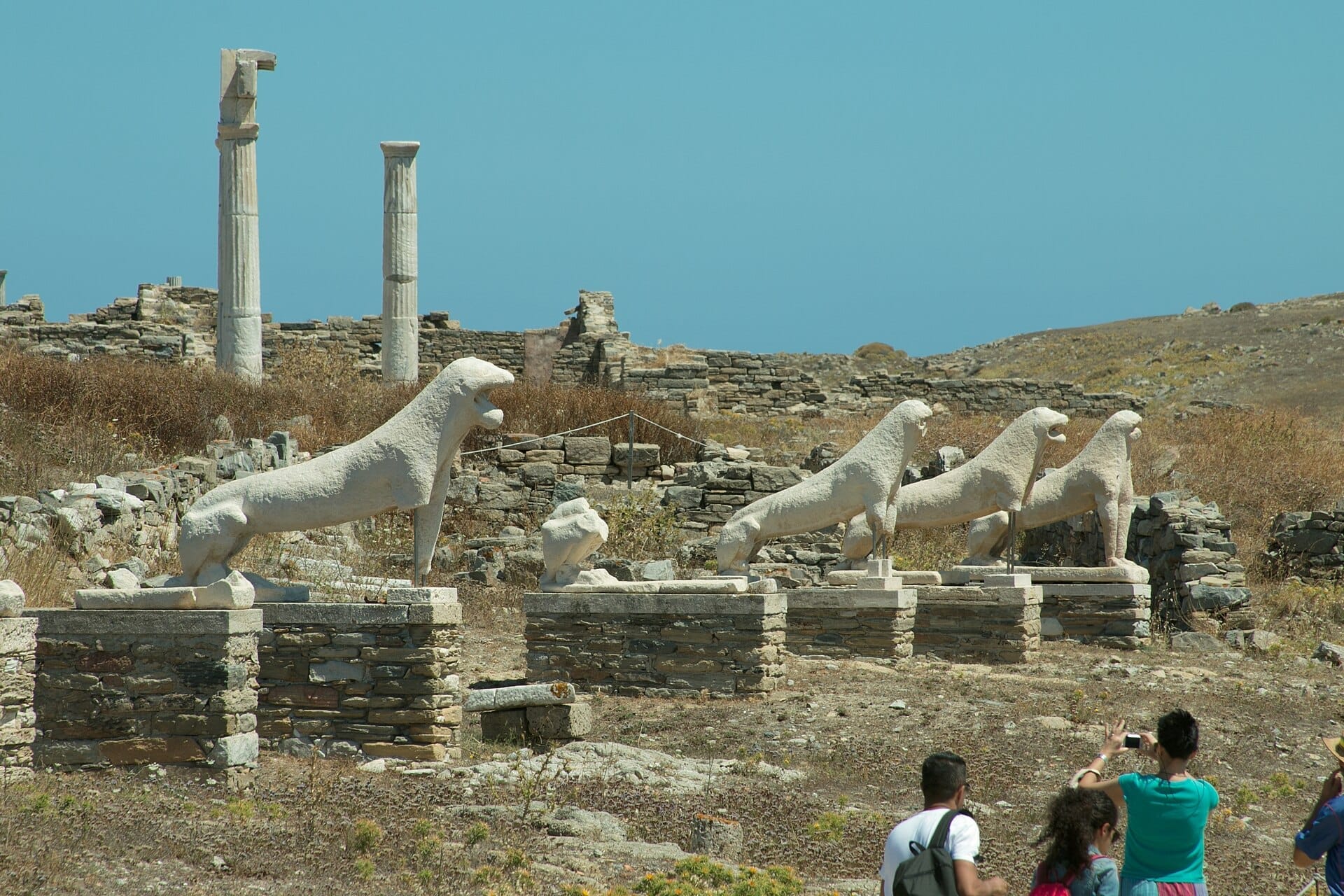
The Terrace of the Lions is a processional avenue of archaic marble lion sculptures on the sacred island of Delos, positioned along the northeastern edge of the now-dry Sacred Lake. The Naxians dedicated the original row of lions to Apollo shortly before 600 BC, making them among the oldest large-scale Greek marble sculptures still in situ anywhere in the Aegean. Ancient records and archaeological evidence suggest the original installation numbered somewhere between 9 and 19 lions, though the precise count remains a matter of scholarly debate. Five replicas now stand along the terrace in their approximate original positions.
A detail that surprises many visitors: what you see outdoors are not the originals. The authentic marble lions were moved into the Archaeological Museum of Delos to protect them from further weathering, and the outdoor row consists of high-quality replicas. If you visit the museum, you can stand a few meters from lions that have survived more than 2,600 years, which puts the outdoor experience in sharper focus rather than diminishing it.
ℹ️ Good to know
One original Delos lion left the island centuries ago. It now stands in Venice's Arsenal courtyard, where it has been since at least the late 17th century. Look closely at the replicas on the terrace and you begin to understand the scale of what was lost.
Getting to Delos from Mykonos
Delos is accessible only by boat. Small ferries and excursion vessels depart from the Mykonos Old Port on a seasonal schedule, with most departures in the morning hours and return boats in the early-to-mid afternoon. The crossing takes approximately 30 minutes across calm Aegean water when conditions are favorable, though the Cyclades can be windy, and rough crossings do occur, particularly in July and August when the meltemi wind is active.
Delos does not permit overnight stays. All visitors must return on the afternoon boats, which means the island empties out in a compressed window of time. If you arrive on the first morning ferry, you will have the earliest, quietest hours at the terrace before the mid-morning groups arrive. By noon, the site is at its most crowded and its hottest. Plan accordingly.
For a fuller orientation to planning this trip, including ferry timings and what else to see on Delos, read the day trip to Delos from Mykonos guide before you book your boat ticket.
⚠️ What to skip
Ferry services to Delos are seasonal and weather-dependent. Departures are cancelled in high winds. Check schedules the evening before and book your return ticket as soon as you arrive on the island, since afternoon boats can fill up during peak season.
Tickets & tours
Live prices and dates from our booking partner. If you book, we may earn a commission at no extra cost to you.
Mykonos South Coast Cruise on a Traditional Caique
From 93 €Instant confirmationFree cancellationMykonos yacht cruise to Rhenia Island and guided tour of Delos
From 120 €Instant confirmationFree cancellationSunset sailing to Rhenia with Delos self-guided virtual tour
From 110 €Instant confirmationFree cancellationHalf-Day Mykonos, Delos and Rhenia Catamaran Cruise with Lunch
From 150 €Instant confirmationFree cancellation
The Experience at the Terrace: What You Actually See
From the ferry landing, a marked path leads north through the main sanctuary area before reaching the terrace. The approach past the Sacred Lake enclosure gives the lions a proper theatrical entrance: they emerge along the low ridge line against a wide Aegean sky, mouths open, seated on their haunches in the stylized archaic posture that predates classical naturalism. The forms are rigid and confident rather than lifelike, their manes rendered in tight parallel ridges that catch the Cycladic light sharply in the morning and dissolve into flat shadow by midday.
The Sacred Lake itself is now a dry basin marked by a ring of low stone walls and a solitary palm tree at its center. The lake was drained in the early 20th century for mosquito control, so what you see is a symbolic outline rather than a living reflection. The original relationship between the lions and the water they once guarded requires some imagination, but the spatial logic is still legible: the lions faced the lake, screening the sacred precinct from the profane road beyond.
The replicas themselves are weathered convincingly and have acquired a pale ochre patina that reads as genuinely old from a few meters away. Up close, the texture differs from ancient marble, but the forms are accurate. The spacing between the lions feels generous enough that you can walk the full length of the terrace without feeling crowded, except during peak arrival periods.
Historical and Cultural Context
Delos occupies a singular place in ancient Greek religion. According to myth, the island was the birthplace of Apollo and Artemis, which made it one of the most sacred sites in the Greek world for nearly a millennium. The Sanctuary of Apollo drew pilgrims, merchants, and delegations from across the Aegean, and the island functioned as a major commercial and religious hub from the 7th century BC through the Roman period.
The Naxians' decision to line the Sacred Way with lions was a deliberate political and religious statement. Naxos was the dominant island power in the Cyclades at the time of the dedication, and the lions served as a permanent, monumental assertion of Naxian piety and influence. The choice of lions is significant: lions were not native to the Aegean and carried associations with divine power and protection borrowed partly from Near Eastern iconography, filtered through the archaic Greek sculptural vocabulary.
The broader Delos archaeological site is one of the most complete ancient urban landscapes in the Mediterranean, and the terrace is one component of a much larger story. The House of Dionysus with its famous mosaic floor, the theater quarter, and the summit of Mount Kynthos with its panoramic views all reward the visitor who treats Delos as more than a one-monument stop.
Photography and Lighting
The terrace faces roughly eastward, which means the lion sculptures receive direct morning light on their flanks and faces from the east. In the first two hours after the site opens, the low sun creates strong shadow definition across the carved mane ridges and open mouths, producing the most sculptural photographs of the day. By late morning, the light flattens significantly, and by midday the figures appear pale and washed out against the bright Aegean sky.
If your priority is photography, take the earliest available ferry. A wide-angle lens lets you capture the full row in context with the Sacred Lake basin behind. For detail shots of individual lion heads, a medium telephoto from the far end of the terrace compresses the row effectively. The surrounding site provides little shade, so a hat and sunscreen are more than polite suggestions during summer months.
💡 Local tip
After photographing the replicas outside, walk directly to the Archaeological Museum of Delos. The original marble lions are displayed inside and can be examined from very close range, including the fine surface detail that centuries of outdoor exposure have erased from the surviving fragments.
Practical Considerations Before You Go
Delos has no permanent population and almost no shade outside the museum building. There is a small café-snack facility near the ferry landing, but do not rely on it for a full meal or consistent availability. Bring water in larger quantities than you think you need, particularly between June and September when temperatures regularly exceed 30°C on the unshaded ruins.
The terrain across the Delos site includes uneven stone paving, loose gravel paths, and occasional raised thresholds between ruined structures. Closed-toe shoes with reasonable grip are strongly recommended. Parts of the site are accessible for visitors with limited mobility, but the terrace approach and much of the surrounding route involve uneven ground. The Archaeological Museum itself is more navigable.
Ticket prices for the Archaeological Site of Delos, including access to the Terrace of the Lions and the museum, are set by the Hellenic Ministry of Culture and Sports and are subject to change. Check current admission fees before traveling. For a broader look at how Delos fits into time spent in the region, the Mykonos things to do guide covers the island's main options and helps with prioritization if your time is limited.
Visitors who find open-air archaeological sites without reconstructed buildings or interpretive installations unsatisfying may find Delos harder work than expected. There are no roofed structures, no reconstructions, and relatively sparse on-site interpretation in languages other than Greek and English. The experience rewards those who arrive with some background knowledge. Those expecting a polished museum-style presentation will need to set different expectations.
Insider Tips
- Take the first morning ferry from Mykonos Old Port. You will have the terrace essentially to yourself for 30 to 45 minutes before the main tour groups arrive, which makes a measurable difference to the atmosphere.
- Go directly to the Archaeological Museum of Delos after seeing the outdoor terrace. The original marble lions are inside, and seeing them immediately after the replicas makes the comparison both striking and informative. Most visitors skip the museum or leave it for last when they are already tired.
- The dry Sacred Lake basin looks its best when viewed from the raised ground near the northern end of the terrace rather than from the main path. A brief scramble up the low ridge gives you the spatial relationship between the lions and the lake that the standard approach does not reveal.
- Bring more water than seems necessary, at least 1.5 liters per person in summer. The site has almost no shade and the ferry back is not immediate if you run out. The on-site café may be closed or under-stocked during shoulder season.
- If the meltemi wind is blowing strongly from the north, the crossing from Mykonos can be choppy enough to be unpleasant on the small excursion boats. Check conditions the evening before; if the wind has been consistent for several days, the sea will be rougher in the morning than in the afternoon on the return leg.
Who Is Terrace of the Lions For?
- Archaeology and ancient history enthusiasts who want one of the best-preserved sacred landscapes in the Greek world
- Photographers seeking early morning light on archaic marble sculpture with minimal crowds
- Day-trippers from Mykonos looking for a complete change of pace from the island's beach and nightlife scene
- Travelers combining a Cyclades itinerary who want a UNESCO World Heritage site between Mykonos and other islands
- Curious visitors who want to understand what made the Aegean world significant before the classical period
Nearby Attractions
Other things to see while in Delos Island:
- Archaeological Museum of Delos
Built on the excavation site itself, the Archaeological Museum of Delos houses sculptures, mosaics, pottery, and artifacts uncovered from one of the ancient world's most sacred islands. It is reached only by boat from Mykonos, and admission covers both the museum and the wider archaeological site.
- House of Dionysus
The House of Dionysus is one of the best-preserved Hellenistic residences in the Aegean, built in the 2nd century BC and named for its extraordinary courtyard mosaic depicting Dionysus riding a panther. Located in the Theatre Quarter of the Archaeological Site of Delos, it offers a rare glimpse into the private luxury of ancient Greek merchants and aristocrats. Access requires a boat crossing from Mykonos, making advance planning essential.
- Mount Kynthos
Rising 112 metres above the sacred island of Delos, Mount Kynthos is the highest point of this UNESCO World Heritage Site and one of the most historically charged viewpoints in the Aegean. The climb is short but rewarding, delivering panoramic island views alongside ancient sanctuary remains at the summit.
- Sanctuary of Apollo
The Sanctuary of Apollo on the island of Delos is one of the most important archaeological sites in Greece, a UNESCO World Heritage landmark accessible only by boat from Mykonos. Dating back at least to the 9th century BC, this open-air sanctuary sat at the religious and commercial center of the ancient Aegean world.
Planning a trip? Discover personalized activities with the Nomado app.