Mount Kynthos: The Sacred Summit of Delos
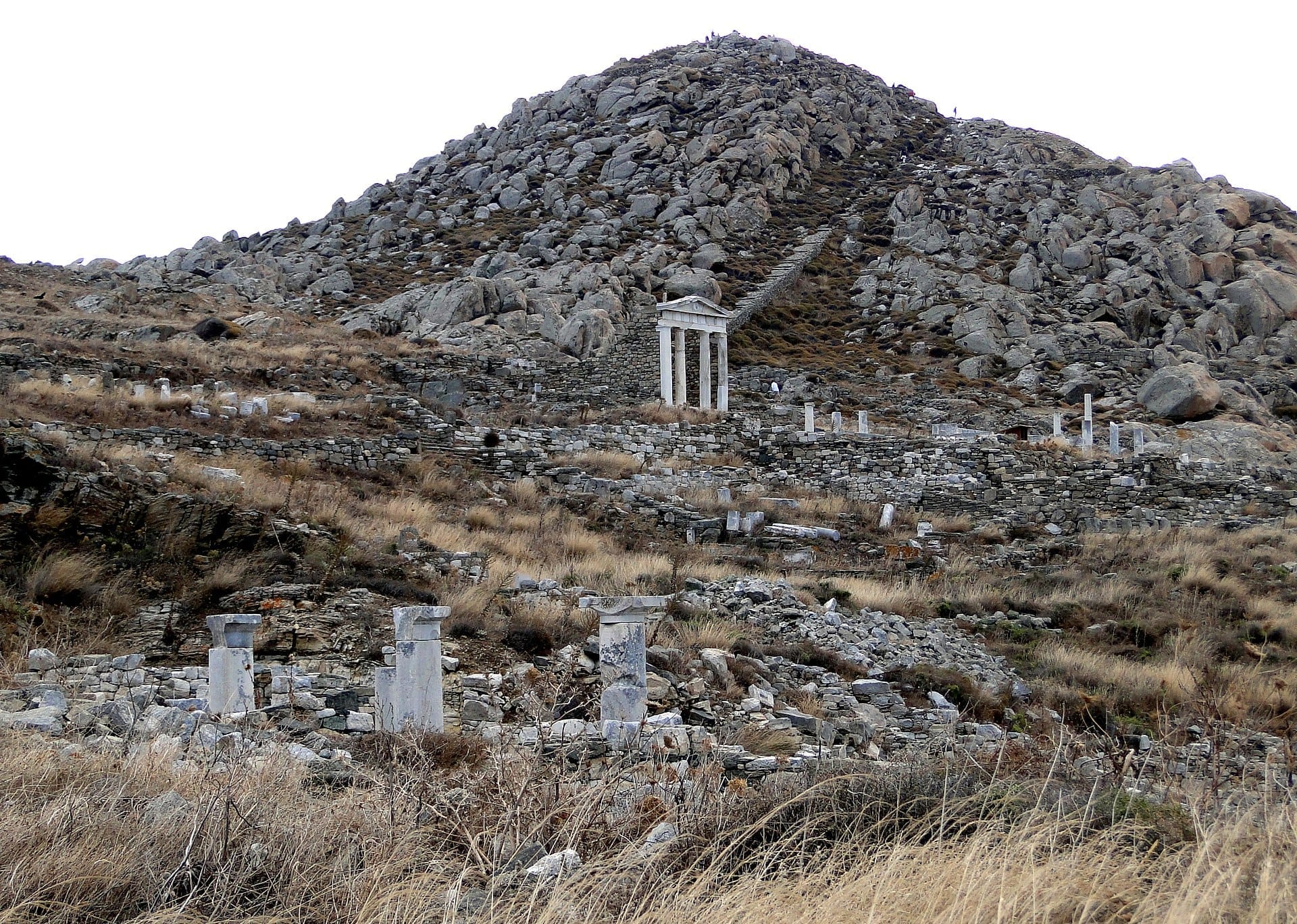
Rising 112 metres above the sacred island of Delos, Mount Kynthos is the highest point of this UNESCO World Heritage Site and one of the most historically charged viewpoints in the Aegean. The climb is short but rewarding, delivering panoramic island views alongside ancient sanctuary remains at the summit.
Quick Facts
- Location
- Island of Delos, Cyclades, Greece (reached by boat from Mykonos)
- Getting There
- Day-trip boats depart from Mykonos Old Port; no overnight stays permitted on Delos
- Time Needed
- 2–3 hours for the full Delos site including the Kynthos ascent; allow 4+ hours if exploring thoroughly
- Cost
- Included with Delos archaeological site admission (set in EUR by the Hellenic Ministry of Culture; verify current price before travel)
- Best for
- Archaeology enthusiasts, hikers seeking Aegean panoramas, mythology lovers
- Official website
- odysseus.culture.gr
What Is Mount Kynthos?
Mount Kynthos (Greek: Κύνθος, also spelled Cynthus) is the rocky summit crowning the island of Delos at approximately 112 metres above sea level. It is the island's highest point and, by almost any measure, its most dramatic viewpoint. From the top, on a clear day, you can trace the outline of Mykonos, Tinos, Naxos, Paros, and Syros spread across the Aegean in every direction.
The summit sits within the greater Delos archaeological site, a UNESCO World Heritage Site inscribed in 1990. That means every step up Kynthos is also a step deeper into one of the most significant ancient sanctuaries in the Greek world. You are not simply hiking a hill; you are walking through a landscape that the ancient Greeks considered the birthplace of the gods Apollo and Artemis.
ℹ️ Good to know
No separate ticket is required for Mount Kynthos. It is accessible to all visitors holding a valid Delos archaeological site admission ticket. Confirm current prices with the Hellenic Ministry of Culture before your trip, as fees are updated periodically.
The Ascent: What to Expect on the Path
The trail to the summit begins after you pass through the lower archaeological zone and is clearly signposted from the main site paths. The climb itself is not technically demanding. The path is well-worn, but it is steep in sections and the surface underfoot is uneven rock and compacted earth. Good footwear with grip is essential. Sandals or flip-flops are a poor choice regardless of what you see others wearing.
The ascent typically takes 15 to 25 minutes at a moderate pace. You will pass through remnants of ancient structures on the lower slopes before the terrain opens up as you approach the summit ridge. The wind picks up noticeably the higher you climb, which is welcome relief in summer heat but can be disorienting if you arrive without a layer in spring or autumn.
Visitors with limited mobility or joint problems should assess the terrain carefully before committing to the climb. There are no vehicles, no paved road, and no mechanical assistance. The path is entirely on foot over natural ground. Children can manage it, but they will need close supervision on the steeper sections.
⚠️ What to skip
In July and August, the exposed rock face radiates intense heat. Start your Delos visit as early as the first boat allows and attempt Kynthos before 10:30 AM. By midday, the summit can become genuinely exhausting. Bring at least one litre of water per person.
Tickets & tours
Live prices and dates from our booking partner. If you book, we may earn a commission at no extra cost to you.
Mykonos South Coast Cruise on a Traditional Caique
From 93 €Instant confirmationFree cancellationMykonos yacht cruise to Rhenia Island and guided tour of Delos
From 120 €Instant confirmationFree cancellationSunset sailing to Rhenia with Delos self-guided virtual tour
From 110 €Instant confirmationFree cancellationHalf-Day Mykonos, Delos and Rhenia Catamaran Cruise with Lunch
From 150 €Instant confirmationFree cancellation
At the Summit: The Ancient Sanctuary of Zeus
The summit of Mount Kynthos is not simply a viewpoint. The plateau at the top holds the remains of ancient cult structures, including a sanctuary dedicated to Zeus and Athena. Fragments of worked stone, altar bases, and foundation walls are visible, though much of the original structure has been lost to time and earlier excavations.
What makes the summit compelling for anyone with even passing interest in ancient religion is the layering of significance. This hilltop was considered sacred long before the great temples were built in the valley below. The mythology frames Apollo and Artemis as born here on Delos, and the elevation of Kynthos made it a natural focal point for divine observation and worship. Standing at the top, you can understand why the ancient Greeks chose this spot for ritual: the sightlines across the Aegean are extraordinary and the isolation is complete.
For deeper context on the island's broader religious history, the Sanctuary of Apollo in the lower site provides the architectural centrepiece of ancient Delos. The summit of Kynthos functions as its elevated counterpart, and visiting both in sequence gives a more complete picture of how the island functioned as a religious centre for the ancient Aegean world.
Views, Light, and Photography
The 360-degree panorama from the summit is the primary reason most visitors make the climb. The Aegean spreads out in every direction, dotted with the grey-white profiles of the Cycladic islands. On very clear days, the view extends impressively far. The islands are close enough to identify individually, yet the visual sense of open sea is total.
For photography, the morning hours produce the best light. Early in the day, the low sun comes from the east and casts directional light across the ruins below, giving depth to the stone and making the Terrace of the Lions particularly photogenic from above. By afternoon, the light flattens and the heat haze over the water can reduce visibility.
If you plan a full-day itinerary that includes the summit, the lower sanctuary area, and the museum, our guide to a day trip to Delos from Mykonos covers the boat schedules, timing strategy, and practical logistics in detail.
💡 Local tip
For photographs looking back toward Mykonos, stand near the northeast edge of the summit. The sea channel between Delos and Mykonos frames perfectly with a standard phone camera. No zoom needed.
Visiting Delos: Logistics and Context
Delos is an uninhabited island with no overnight accommodation. All visitors arrive and depart by day-trip boats, the majority of which leave from Mykonos. The island has seasonal opening hours governed by the Hellenic Ministry of Culture. The site generally opens during daylight hours, with extended hours in summer. Always check the current schedule before your visit, as the last boat back to Mykonos departs at a fixed time and missing it has no easy solution.
The Mykonos Old Port is where most excursion boats to Delos depart. There is a small ticket office at the port. For orientation on the Old Port area and how to navigate it efficiently on the morning of your Delos trip, it helps to arrive at least 20 minutes before the scheduled departure.
Within the Delos site, there are no restaurants or cafes. A small kiosk near the entrance may sell water and minimal snacks, but supply is unreliable. Treat Delos as a self-sufficient half-day: pack water, sunscreen, and a hat regardless of what the weather looks like when you board the boat in Mykonos.
The island's archaeological museum at the site entrance is worth 30 to 45 minutes before or after the Kynthos climb. The Archaeological Museum of Delos holds statuary, mosaics, and finds from excavations across the island, including material from the summit sanctuary.
How Kynthos Fits Into the Delos Visit
Many visitors to Delos spend most of their time in the lower archaeological zone near the harbour, walking through the residential and commercial quarter, the sanctuaries, and the museum. The Kynthos climb is frequently skipped, either because of heat, time pressure, or because people do not realise the summit is accessible. This is a miscalculation. The view from above fundamentally changes how you understand the site: you can see the entire island from one point, trace the ancient town plan below you, and appreciate the geographic logic of why Delos mattered as a hub in the ancient Aegean world.
That said, if your interest in Delos is primarily archaeological rather than physical, and if the heat is significant, a reasonable approach is to complete the lower site first, then decide whether you have the energy and time for the ascent. If you have the energy and want the best light and fewer people on the trail, tackle Kynthos early in your visit, as the insider tips above suggest. Otherwise, complete the lower site first and climb only if time and heat allow.
For those planning a broader exploration of Mykonos and the surrounding Cyclades, the Terrace of the Lions on the lower site is one of the most iconic ancient monuments in Greece and should not be missed before making your way up to the summit.
Who Should Skip the Climb
Mount Kynthos is not the right activity for every visitor. Anyone with significant knee, hip, or balance issues should consider their options carefully. The path is not paved, and the descent on loose stone requires more effort than the ascent. There is no shade on the upper portion of the trail, which makes midday summer visits genuinely uncomfortable. If you are travelling with very young children or elderly companions who cannot manage uneven steep terrain, the lower site offers more than enough archaeological content without the climb.
If your visit to Delos is already compressed into a short window due to boat schedules, it is also worth asking whether a rushed summit adds more than it costs in energy and time. The view is exceptional, but the lower sanctuary area is where the density of ancient material is highest.
Insider Tips
- Take the first boat of the day from Mykonos Old Port to Delos, then head directly to Mount Kynthos before the crowds and the heat build up. By 11 AM, the exposed trail becomes significantly more punishing.
- The summit wind can be strong enough to make a phone difficult to hold steady. Bring a small portable tripod or use burst mode if you want sharp photographs from the top.
- The descent from Kynthos gives different sightlines than the ascent. Pause on the way down to look back toward the lower sanctuary zone: the layout of the ancient town reads remarkably clearly from the mid-slope.
- Water runs out fast in summer heat on an exposed rocky summit with no shade. One litre per person is a minimum; on hot days, carry more. The site kiosk is not a reliable fallback.
- If mythology is part of your interest, read about Apollo and Artemis and their connection to Delos before you arrive. Standing on Kynthos with that context changes the experience substantially compared to simply admiring the view.
Who Is Mount Kynthos For?
- History and archaeology enthusiasts who want physical engagement with the landscape, not just monument-level sightseeing
- Photographers seeking elevated Aegean panoramas without a cable car or organised tour
- Travellers combining Delos with Mykonos who want to make their day trip genuinely memorable rather than a checkbox visit
- Hikers looking for a short but historically significant ascent that requires no specialist equipment
- Anyone fascinated by ancient Greek religion and the mythological geography of the Cyclades
Nearby Attractions
Other things to see while in Delos Island:
- Archaeological Museum of Delos
Built on the excavation site itself, the Archaeological Museum of Delos houses sculptures, mosaics, pottery, and artifacts uncovered from one of the ancient world's most sacred islands. It is reached only by boat from Mykonos, and admission covers both the museum and the wider archaeological site.
- House of Dionysus
The House of Dionysus is one of the best-preserved Hellenistic residences in the Aegean, built in the 2nd century BC and named for its extraordinary courtyard mosaic depicting Dionysus riding a panther. Located in the Theatre Quarter of the Archaeological Site of Delos, it offers a rare glimpse into the private luxury of ancient Greek merchants and aristocrats. Access requires a boat crossing from Mykonos, making advance planning essential.
- Sanctuary of Apollo
The Sanctuary of Apollo on the island of Delos is one of the most important archaeological sites in Greece, a UNESCO World Heritage landmark accessible only by boat from Mykonos. Dating back at least to the 9th century BC, this open-air sanctuary sat at the religious and commercial center of the ancient Aegean world.
- Terrace of the Lions
The Terrace of the Lions is one of the most recognizable ancient monuments in the Aegean, a row of marble lion sculptures dedicated to Apollo by the Naxians around 600 BC. Located on the uninhabited island of Delos, accessible only by boat from Mykonos, the terrace anchors a UNESCO World Heritage site that rewards visitors willing to go beyond the postcard image.
Planning a trip? Discover personalized activities with the Nomado app.