Manto Mavrogenous Square: Mykonos Town's Historic Civic Heart
Manto Mavrogenous Square sits at the center of Mykonos Town, honoring the island's most celebrated heroine of the Greek War of Independence. Effectively always accessible as a public space, it serves as both a landmark orientation point and a quiet pause within the frenetic energy of Chora.
Quick Facts
- Location
- Serakonta, Mykonos Town (Chora) 846 00, Greece
- Getting There
- On foot from the Old Port or central Chora; taxis drop at the pedestrian zone edge
- Time Needed
- 10–20 minutes to visit; longer if you linger at surrounding cafés
- Cost
- Free public access at all times
- Best for
- History seekers, first-time visitors, photographers, and anyone needing a central meeting point
What Manto Mavrogenous Square Actually Is
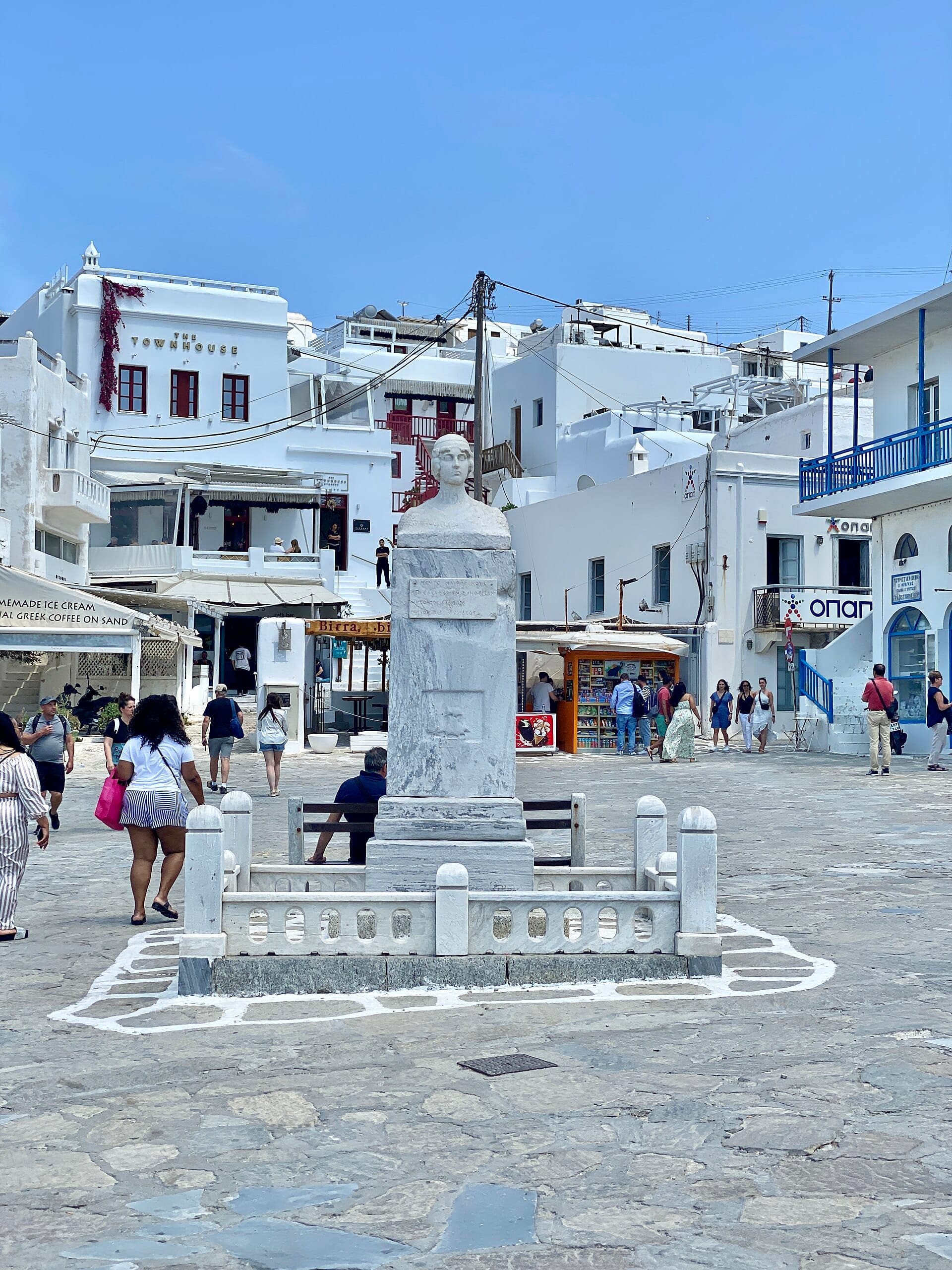
Manto Mavrogenous Square (Πλατεία Μαντώς Μαυρογένους) is the main civic square of Mykonos Town, situated in the heart of Chora near the Old Port waterfront. It is an open-air public space centered on a statue of Manto Mavrogenous, the Mykonian aristocrat who became one of the most consequential female figures of the Greek War of Independence in the 1820s. The square functions simultaneously as a navigational landmark, a social gathering point, and a small moment of historical reflection in a town otherwise dominated by shopping lanes and nightlife.
Unlike the grand plateia of larger Greek cities, this square is compact. Its scale is proportional to Chora itself: intimate, whitewashed, and framed by traditional Cycladic architecture. The bust of Mavrogenous stands as the clear focal point, with surrounding benches, café tables, and the ever-present hum of foot traffic through the adjacent streets.
💡 Local tip
The square is one of the easiest orientation points in Mykonos Town. If you get lost in Chora's labyrinthine alleys, asking for 'Plateia Manto' will get you back to a recognizable starting point quickly.
The Woman Behind the Name
Manto Mavrogenous was born in 1796 into a wealthy Phanariot Greek family with roots in Mykonos and Trieste. When the Greek War of Independence broke out in 1821, she used her personal fortune to equip warships and armed fighters against Ottoman forces. She personally led troops in naval and land engagements, and her financial contributions to the revolution were substantial enough to draw recognition from the Greek provisional government of the era.
Her story did not end triumphantly. Despite her sacrifices, she died in poverty and relative obscurity, in July 1848. The square and bust in Mykonos Town represent a belated civic acknowledgment of her legacy, one that resonates strongly in Greek national memory. For visitors with even a passing interest in modern Greek history, the few moments spent reading about her life add genuine weight to what might otherwise seem like just another pleasant Aegean piazza.
To understand her place in the broader story of Greek independence, it helps to have context about the island itself. Mykonos has always been a place defined as much by its maritime culture as by its landscape, and Mavrogenous embodied that seafaring confidence. If you are planning a trip and want deeper context on the island's heritage, the Mykonos Archaeological Museum nearby contains artifacts that flesh out centuries of Aegean history.
Tickets & tours
Live prices and dates from our booking partner. If you book, we may earn a commission at no extra cost to you.
Mykonos South Coast Cruise on a Traditional Caique
From 93 €Instant confirmationFree cancellationMykonos yacht cruise to Rhenia Island and guided tour of Delos
From 120 €Instant confirmationFree cancellationSunset sailing to Rhenia with Delos self-guided virtual tour
From 110 €Instant confirmationFree cancellationHalf-Day Mykonos, Delos and Rhenia Catamaran Cruise with Lunch
From 150 €Instant confirmationFree cancellation
How the Square Changes Throughout the Day
Early morning, roughly between 7 and 9 a.m., the square has a calm that is rare in peak-season Mykonos. Locals pick up coffee from nearby spots, delivery workers navigate the lanes on small motorbikes before vehicle access closes, and the light from the east catches the whitewash of surrounding buildings at a warm, low angle. This is the cleanest and quietest you will find it.
By mid-morning, the first wave of day-trippers and hotel guests begins filtering through on their way toward the waterfront or Matoyianni Street. The square becomes a natural crossroads: some pause to photograph the bust, others use it as a reference point before heading deeper into the alleys. Café tables fill up and the ambient noise of the town takes over.
In the evenings, especially in July and August, the square takes on a different atmosphere entirely. It sits within earshot of bars and restaurants, and foot traffic through it remains heavy well past midnight. The statue of Mavrogenous is lit at night, which makes for a striking photograph against the dark Aegean sky. Expect noise and crowds after 10 p.m. in high season.
ℹ️ Good to know
The square is exposed to the Meltemi wind, the strong northerly that blows across the Aegean in summer, particularly July and August. On gusty days, napkins fly off café tables and the wind can be strong enough to make outdoor seating uncomfortable.
Navigating the Square and Surrounding Area
The square sits within the pedestrianized core of Mykonos Town, so there is no vehicle access. From the Old Port waterfront, it is a short walk inland through Chora's characteristic narrow lanes. Taxis can bring you to the edge of the pedestrian zone, after which it is a few minutes on foot. There are no steep inclines to the square itself, though some of the surrounding lanes have uneven stone paving.
The square is a natural starting point for exploring central Mykonos Town. From here, Matoyianni Street, Chora's main commercial artery, is within easy walking distance. The iconic Panagia Paraportiani church is also reachable in under ten minutes on foot, as are the Mykonos windmills and the Little Venice waterfront district.
For those arriving by ferry to the Old Port, the square makes a logical first stop before deciding where to go. For accessibility, the square itself is flat and open, though the surrounding lanes are narrow and cobbled, which can be challenging for wheelchairs or pushchairs.
Photography Notes
The bust of Manto Mavrogenous makes for a straightforward portrait-style photograph, especially in the soft morning or late-afternoon light. In peak season, getting a clean shot without other tourists in the frame requires patience or an early start, ideally before 9 a.m.
The surrounding architecture, low whitewashed buildings with wooden doors and colorful accents, provides a classic Cycladic backdrop. Wide-angle shots from across the square work well in the morning when the light falls from the east. Evening shots with the illuminated bust and the glow of café lights can also be effective, though the busy background will be harder to control.
⚠️ What to skip
In July and August, the square can be genuinely packed from mid-morning onward. If clean photographs of the square and bust are important to you, aim for before 8:30 a.m. or consider visiting in the shoulder season (May, June, or September).
Honest Assessment: Is It Worth Your Time?
Manto Mavrogenous Square is not a destination in the conventional sense. You will not spend an hour here the way you might at the Archaeological Museum or on a boat to Delos. It is a five-to-fifteen-minute stop, and its value depends entirely on what you bring to it.
For travelers who read a little about Mavrogenous before arriving, the square carries genuine weight as a tribute to a remarkable and underappreciated historical figure. For travelers with no prior interest, it may register simply as a pleasant, photogenic piazza in a photogenic town.
It is worth noting that the square works best as part of a broader walk through Mykonos Town rather than an isolated visit. Pair it with the Aegean Maritime Museum and the nearby church of Paraportiani for a half-morning of cultural sightseeing that covers multiple layers of the island's history. If you are planning your time carefully, the things to do in Mykonos guide offers a fuller picture of how to structure a visit to the island.
Those who should skip the square entirely: travelers on a tight day-trip schedule who are prioritizing beaches, and those who find civic monuments generally uninteresting. It requires no special effort to include on any Chora walk, but it is not a reason to extend your time in the town on its own merits.
Insider Tips
- Come before 9 a.m. in peak season for the only version of this square that feels calm. The light is also better for photography at that hour, and cafés opening early will serve you a Greek coffee as the town slowly wakes up.
- Read about Manto Mavrogenous before you arrive, even briefly. The square is noticeably more affecting when you understand who she was and what she gave up. A five-minute Wikipedia read before you fly will change how you see the bust.
- The square is one of the few flat, open spaces in central Chora, making it a useful meeting point if you are traveling in a group and expect to split up during the day. Agree on a time to reconvene at 'the Manto square' rather than trying to coordinate via phone in areas with poor signal.
- On windy summer afternoons when the Meltemi is blowing hard, the square becomes noticeably gusty. If you are sitting at a café table, secure loose items. The wind is strongest from the north and channels through the surrounding lanes.
- The square is lit at night and the illuminated bust makes a more dramatic photograph than the daytime version. In shoulder season, when crowds thin out after dinner, you can often get the square nearly to yourself after 10 p.m.
Who Is Manto Mavrogenous Square For?
- First-time visitors to Mykonos Town using it as an orientation anchor
- History and culture travelers with an interest in the Greek War of Independence
- Photographers looking for an iconic Cycladic square composition
- Slow travelers who enjoy sitting at a café in a meaningful public space
- Anyone combining a walking tour of Chora's landmarks in a single morning
Nearby Attractions
Other things to see while in Mykonos Town (Chora):
- Aegean Maritime Museum
Tucked inside a 19th-century Cycladic building in the Tria Pigadia quarter of Mykonos Town, the Aegean Maritime Museum offers a focused, well-curated look at centuries of Aegean maritime history. It is small enough to do in under an hour, and genuinely informative for anyone curious about the sea culture that shaped these islands.
- Agios Stefanos Beach
Agios Stefanos Beach sits just 3.5 km north of Mykonos Town, relatively sheltered from the island's notorious winds and backed by a whitewashed chapel with a red roof. It draws families, couples on a quieter budget, and anyone who finds the party beaches on the south coast too much. Sandy underfoot, shallow at the waterline, and served by a regular bus from Chora.
- Armenistis Lighthouse
Perched on the rocky northwest tip of Mykonos at roughly 180–184 metres above sea level, Armenistis Lighthouse is a 19th-century navigation beacon with one of the island's most panoramic viewpoints. Built in 1891 after a fatal shipwreck, it rewards visitors willing to venture beyond the town with open Aegean horizons and a quieter side of the island.
- Matoyianni Street
Matoyianni Street is the beating commercial heart of Mykonos Town, a short but dense pedestrian lane lined with boutiques, jewelry shops, cafes, and bars tucked into the whitewashed Cycladic old town. Free to walk, open day and night, and best experienced at the quieter hours when the crowds thin and the lane reveals its actual character.
Planning a trip? Discover personalized activities with the Nomado app.