Mykonos Windmills (Kato Mili): What to Expect Before You Visit
The Mykonos Windmills, known locally as Kato Mili, stand on a low hill just south of Mykonos Town, framing the skyline with seven cylindrical, whitewashed towers that have defined the island's silhouette since the Venetian era. Free to visit at all hours as an unfenced public outdoor site, they reward early risers and sunset-chasers in equal measure, though the experience is more photogenic than immersive.
Quick Facts
- Location
- Alefkadras, Mykonos Town (Chora), 846 00, Greece — above the Little Venice waterfront
- Getting There
- 10-15 min walk from Mykonos Old Port along the waterfront; no vehicle access to the hill itself
- Time Needed
- 20–40 minutes to walk up, photograph, and take in the views; longer if visiting the Boni’s Windmill Agricultural Museum
- Cost
- Free for the outdoor site; interior museum visits (Bonis/Geronymos mills) may charge a small fee — verify on-site
- Best for
- Sunset photography, architectural history, orienting yourself on arrival to Mykonos
What the Mykonos Windmills Actually Are
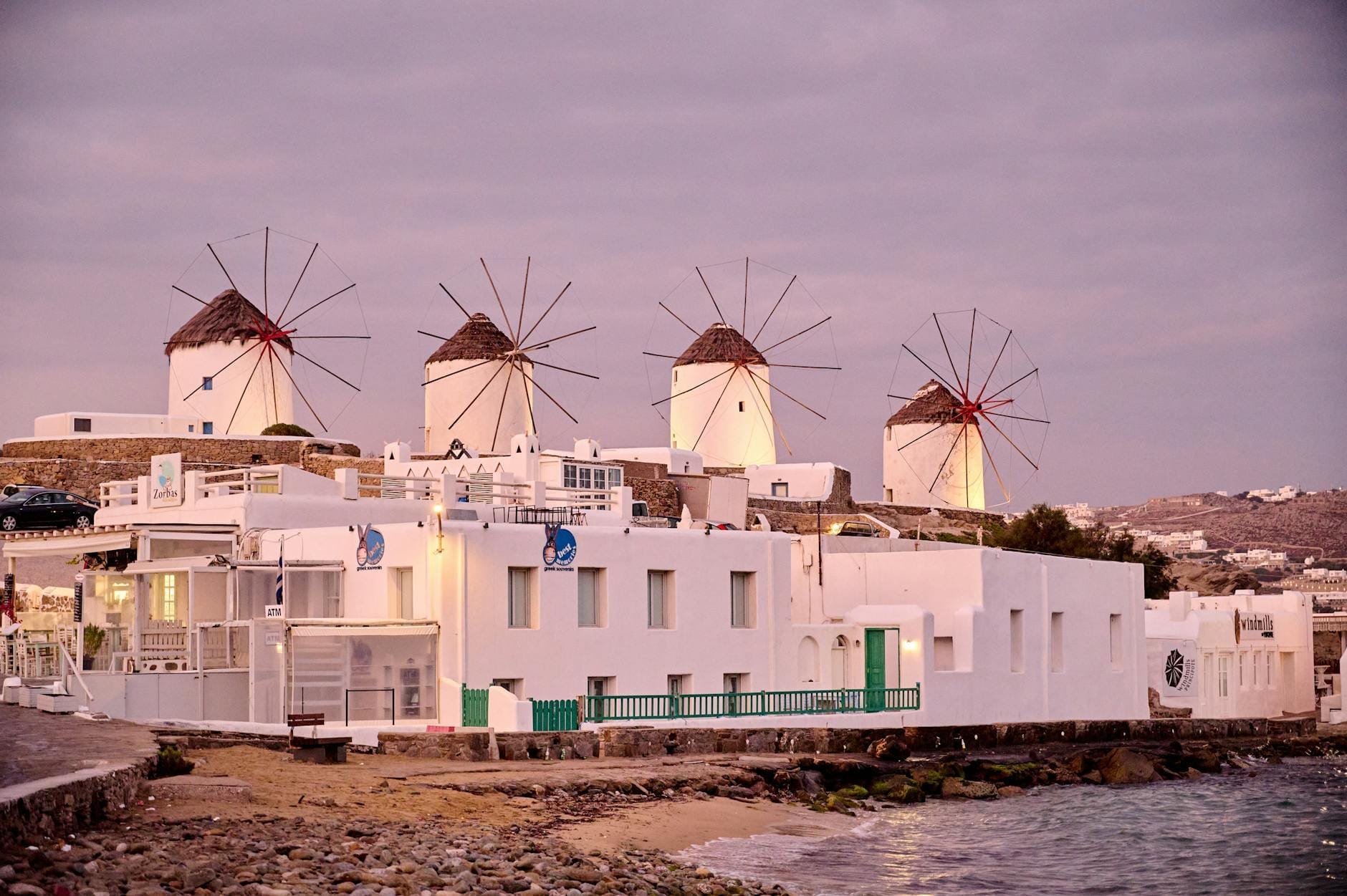
The Mykonos Windmills, officially called Kato Mili (Greek: Κάτω Μύλοι, meaning 'Lower Mills'), are a row of seven cylindrical stone towers on a rounded hilltop at the southern edge of Mykonos Town. They are part of a larger group of 16 windmills scattered across the island, but these seven are the ones most prominently visible from the water, from Little Venice, and in almost every aerial photograph of Chora. That visibility is the point: they were built to catch the strong Aegean winds that funnel across this exposed ridge, and they still dominate the skyline the same way they have for centuries.
Most of the Mykonos windmills were constructed by Venetians in the 16th century, with some additions from the late 18th through the early 20th century. Their function was straightforward: milling grain, primarily wheat, at a time when the island was a significant trading stop in the Aegean. The sails would spin in the same meltemi winds that still buffet visitors in summer, and the grain would be ground for local consumption and export. Milling operations continued until the mid-20th century, when industrial alternatives made the windmills redundant. Today they are protected historic structures, maintained as part of the island's architectural identity.
The architecture is immediately recognizable as Cycladic: each mill is a thick-walled, whitewashed stone cylinder topped with a conical thatched roof, punctuated by very small windows that kept the interior cool and the structure aerodynamically stable. Up close, the whitewash is rough and chalky to the touch, and the walls curve slightly inward as they rise. The wooden sail frames — bare of canvas on most mills — still project outward in a spoke pattern, giving the structures their characteristic silhouette against the sky.
How the Experience Changes Through the Day
Early morning is when the Kato Mili are at their quietest and most photogenic. Before 9 a.m. in high season, the hilltop is largely empty, the light is low and golden from the east, and the whitewash glows against a deep blue sky without a crowd of smartphones in frame. The only sounds are wind across the ridge, distant boat engines from the Old Port below, and the occasional clatter of delivery vehicles navigating the lanes of Chora. If you want a considered photograph rather than a souvenir snap, this is the window.
💡 Local tip
Arrive before 9 a.m. in July and August for near-empty conditions. By 10 a.m. on most summer days, the hilltop fills steadily with day-trippers and cruise passengers, and it stays busy until late afternoon.
Midday in summer is the least rewarding time to visit. The meltemi wind, which blows consistently across the Cyclades from June through August, can be genuinely strong on this exposed hilltop — at times gusting hard enough to make holding a camera steady difficult. The light is harsh and flat, the hill is at its most crowded, and there is no shade. If you visit between noon and 4 p.m., lower your expectations for photography and bring water.
Sunset draws the largest crowds by far. The mills face west over the sea, which means the hour before sunset turns the sky behind them shades of amber and coral, and the whitewashed walls catch the warm light cleanly. The terrace below the mills, near the Little Venice waterfront bars, fills with people waiting for the moment. It is genuinely beautiful, but it is also genuinely packed. Expect shoulder-to-shoulder conditions on the hill itself during peak season in the final thirty minutes before sundown.
Tickets & tours
Live prices and dates from our booking partner. If you book, we may earn a commission at no extra cost to you.
Mykonos South Coast Cruise on a Traditional Caique
From 93 €Instant confirmationFree cancellationMykonos yacht cruise to Rhenia Island and guided tour of Delos
From 120 €Instant confirmationFree cancellationHalf-Day Mykonos, Delos and Rhenia Catamaran Cruise with Lunch
From 150 €Instant confirmationFree cancellationMykonos Old Town Historic and Cultural Walking Tour
From 60 €Instant confirmationFree cancellation
Getting There: On Foot from Mykonos Town
The windmills are walkable from almost anywhere in Mykonos Town within 15 minutes. The most natural approach is along the waterfront from the Old Port, heading south through the Alefkandra neighborhood until the path rises slightly toward the hill. You will pass the iconic waterfront buildings of Little Venice along the way, where balconies overhang the water and the smell of salt and coffee mingles in the lanes. From here, the windmills are visible above you and it is a short, moderately steep walk up to the base of the mills.
There is no vehicle access directly to the windmill hill. The paths leading up are cobbled and uneven, which makes the approach difficult for anyone with significant mobility limitations. The ground around the mills themselves is also irregular, with loose stones and sloped terrain. Visitors who use wheelchairs or have difficulty with inclines should be aware that no step-free route has been documented to the hilltop; it is worth checking locally for current conditions before planning the visit around accessibility.
If you are arriving from the New Port (Tourlos), where large ferries and cruise ships dock, a taxi or bus to Mykonos Town is the practical option before walking to the mills. The KTEL bus network connects the new port area (Tourlos) with the town center regularly in high season, though exact schedules change year to year and should be confirmed locally.
Inside the Mills: The Agricultural Museum Option
Two of the windmills are occasionally open to visitors for interior access: Geronymos Mill and Boni’s Windmill, the latter functioning as a small agricultural museum. The Bonis Windmill museum contains tools and equipment related to traditional grain milling and island agriculture, giving some context to what these structures actually did for three centuries. It is a compact, single-room experience rather than an extensive collection, but for visitors interested in the working history of the mills rather than just their appearance, it adds genuine value.
Interior opening hours and any admission fees for these two mills are not consistently published and can vary by season and year. The safest approach is to check locally on arrival or ask at your accommodation. Do not plan a visit specifically around interior access without confirming it is available during your travel dates.
⚠️ What to skip
The majority of the Kato Mili windmills are closed structures — you are viewing them from outside, not entering them. If interior access is important to your visit, confirm the Bonis Mill museum schedule before making the walk up.
Photography: Making the Most of the Location
The most reproduced view of the windmills is taken from below, along the Little Venice waterfront, with the mills framed against the sky above the pastel-painted buildings. This angle works best in the late afternoon when the buildings and mills are both in warm light. For close-up architectural shots of the mills themselves, the best positions are slightly to the north or south of the row, shooting along the line of cylinders to get depth and scale.
Wind is a constant factor in your photography here. Flags, hair, and loose clothing will all be animated — sometimes usefully for motion shots, sometimes frustratingly for portraits. A lens hood is useful to prevent flare in the direct afternoon light reflecting off the white walls. The thatched roofs photograph well in overcast light, when the texture is more visible than under harsh direct sun.
For visitors combining the windmills with a broader Mykonos Town photography walk, Panagia Paraportiani church is a five-minute walk away and offers similarly striking Cycladic whitewash architecture. Matoyianni Street is close by for a different kind of visual interest.
Historical Context: Why These Windmills Mattered
Mykonos occupies a strategically positioned point in the central Aegean, roughly 150 km southeast of Athens and within easy sailing distance of Tinos, Syros, Paros, and Naxos. For centuries it served as a waypoint for Aegean trade, and grain processing was central to that economy. The Venetians who built the first Kato Mili in the 16th century understood that this ridge caught reliable wind from the north and northwest, the same direction the summer meltemi blows today.
The mills continued operating through Ottoman rule and into the modern Greek period, remaining economically relevant until motorized milling made them obsolete in the mid-20th century. Their survival is partly a result of Mykonos's relatively late development as a mass tourism destination: by the time serious infrastructure investment arrived, the windmills had already become the island's most recognized symbol, and preservation was more commercially valuable than demolition.
Visitors with a deeper interest in Aegean history often pair the windmills with a day trip to Delos, the uninhabited sacred island a short boat ride from Mykonos, where the archaeological remains span millennia of Aegean civilization. The Aegean Maritime Museum in Mykonos Town also provides broader context for the island's role in Aegean seafaring and trade.
Is It Worth Your Time? An Honest Assessment
The Kato Mili windmills are worth visiting, but it is worth being clear about what the visit involves. This is not a curated attraction with exhibits, guides, or structured interpretation. You walk up a hill, you look at seven old stone cylinders, you take photographs, and you walk back down. The experience is short, free, and almost impossible to do wrong. For most visitors, it will be a 20-minute stop on the way to or from somewhere else in Chora, not a destination in its own right.
The windmills are overhyped specifically as a sunset experience. The location is genuinely good for sunsets, but it is one of the most crowded spots on the island at that hour, and the views from the Little Venice waterfront bars below are equally good and accompanied by a drink. If your priority is watching the sunset comfortably rather than photographing the mills in sunset light, sitting at one of the waterfront cafes is a more relaxed alternative.
Visitors who are primarily interested in history, interiors, or hands-on experiences may find the windmills underwhelming without prior research into the Bonis Mill museum. Visitors who simply want to orient themselves, understand the island's topography, and get the classic Mykonos image will find the short walk entirely worthwhile.
ℹ️ Good to know
The windmills are always accessible as a public outdoor site — no ticket, no booking, no closing time. The hill is well-lit at night, when the mills are illuminated and the crowds have thinned considerably.
Insider Tips
- The windmills look their best photographed from below, from the Little Venice waterfront, in the 30 minutes before sunset — you get the warm light on the white walls and the sea in the background without fighting for space on the crowded hilltop.
- Night visits are underrated. After 10 p.m. in summer, the illuminated mills attract far fewer visitors than the sunset rush, the wind has usually eased slightly, and the contrast between the lit white towers and the dark sky is genuinely striking.
- The meltemi wind can be strong enough on this ridge to make standing photographs difficult in July and August, especially in the afternoon. Brace yourself or use a wall for stability when shooting with a longer lens.
- If you want to visit the Bonis Mill Agricultural Museum for interior context on how the mills actually worked, check availability the morning of your visit at your accommodation or a local tourism point — it does not keep consistent published hours.
- Combine the windmills with the walk through Little Venice and up to Panagia Paraportiani for a single loop that covers the three most architecturally significant spots in Mykonos Town within about an hour.
Who Is Mykonos Windmills (Kato Mili) For?
- First-time visitors to Mykonos wanting to see the island's defining landmark
- Photographers looking for the classic Cycladic architecture shot at golden hour
- Travelers interested in the Venetian and Aegean trading history of the Cyclades
- Anyone combining a broader Mykonos Town walk with a stop for views over Little Venice and the sea
- Visitors arriving by ferry who want to orient themselves in Chora on foot
Planning a trip? Discover personalized activities with the Nomado app.