Aegean Maritime Museum: Mykonos Town's Window into Aegean Seafaring
Tucked inside a 19th-century Cycladic building in the Tria Pigadia quarter of Mykonos Town, the Aegean Maritime Museum offers a focused, well-curated look at centuries of Aegean maritime history. It is small enough to do in under an hour, and genuinely informative for anyone curious about the sea culture that shaped these islands.
Quick Facts
- Location
- Enóplon Dynámeon 10, Tria Pigadia, Mykonos Town (Chora)
- Getting There
- On foot from anywhere in Mykonos Town center; no vehicles needed
- Time Needed
- 45 minutes to 1 hour
- Cost
- Approx. €4 adults, €2 students (verify locally before visiting)
- Best for
- History lovers, sailors, families seeking a midday break from the heat
- Official website
- www.aegean-maritime-museum.com/en
What the Aegean Maritime Museum Actually Is
The Aegean Maritime Museum (Greek: Ναυτικό Μουσείο Αιγαίου) is a small, privately organized museum founded in 1983 as a private non-profit institution and opened to the public in 1985. It sits inside a whitewashed 19th-century Cycladic building in the Tria Pigadia neighborhood of Mykonos Town, a quiet residential pocket just a few minutes' walk from the church of Panagia Paraportiani and the Old Port waterfront.
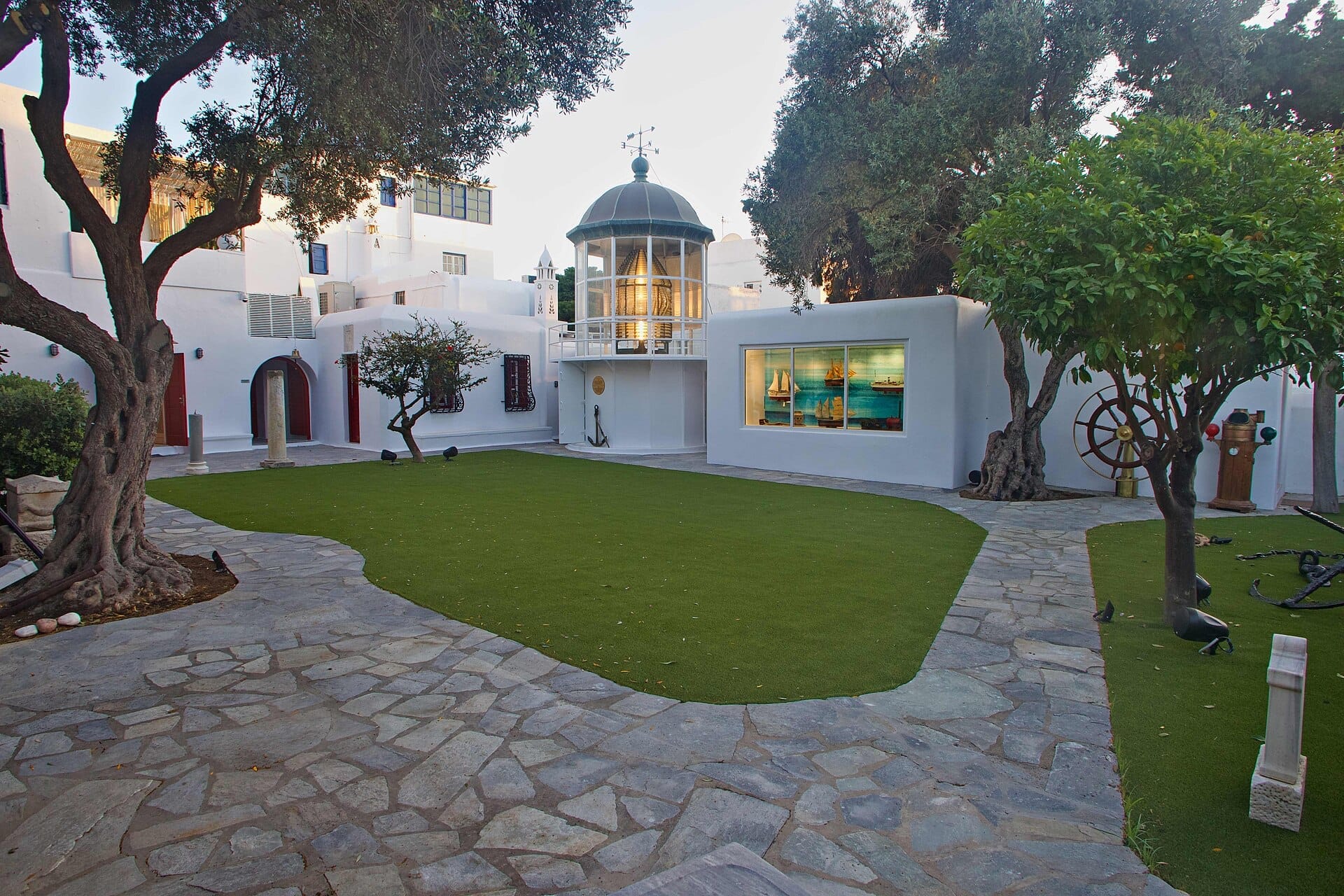
The collection documents the maritime history of the Aegean from antiquity through the early 20th century. Exhibits include scale models of ancient and Byzantine vessels, original navigational instruments, maps, figureheads, coins, and documents related to Aegean trade and seafaring. A restored traditional lighthouse lantern installed in the museum garden adds genuine outdoor character to the visit.
ℹ️ Good to know
The museum is seasonal: open daily from April to October only. Hours vary by source (one listing shows 10:30–13:00 and 18:30–21:00; another shows 10:00–15:00 and 18:00–21:00). Confirm current hours directly with the museum or via their official website before visiting.
The Collection: What You Will Actually See
The heart of the museum is its ship models, which range from ancient Greek triremes to 19th-century Aegean cargo vessels. These are not generic reproductions. Several have been crafted with a level of detail that rewards close inspection: rigging, deck hardware, and hull construction are rendered with care. For anyone interested in how Aegean islanders built, crewed, and traded by sea across two millennia, this room alone justifies the admission.
Navigational instruments occupy another section: sextants, compasses, chronometers, and charts. Many date from the 18th and 19th centuries, when Greek merchant vessels were active across the eastern Mediterranean. The labels are generally in both Greek and English, though the English translations are occasionally terse.
The outdoor garden holds one of the museum's most distinctive exhibits: the restored Evangelistria, an actual traditional Aegean vessel built in 1940, displayed alongside a replica of the Armenistis lighthouse lantern. The Armenistis lighthouse itself, built in 1891, still stands on the northwestern tip of Mykonos island. The museum also displays the Thalis o Milesios, a vessel dating to 1909. Standing next to these restored hulls on a warm afternoon, with the stone walls of the garden blocking the noise from the surrounding lanes, gives the visit a texture that the interior rooms alone cannot.
💡 Local tip
Spend time in the garden before going inside, especially in the morning when the light is clean and the courtyard is cool. The restored vessels are easier to photograph then, and the garden rarely gets crowded.
Tickets & tours
Live prices and dates from our booking partner. If you book, we may earn a commission at no extra cost to you.
Mykonos South Coast Cruise on a Traditional Caique
From 93 €Instant confirmationFree cancellationMykonos yacht cruise to Rhenia Island and guided tour of Delos
From 120 €Instant confirmationFree cancellationSunset sailing to Rhenia with Delos self-guided virtual tour
From 110 €Instant confirmationFree cancellationHalf-Day Mykonos, Delos and Rhenia Catamaran Cruise with Lunch
From 150 €Instant confirmationFree cancellation
Historical Context: Why This Museum Exists on Mykonos
Mykonos is not a large island. At about 85.5 square kilometers with a permanent population of roughly 10,000–11,000, it has always depended on the sea for survival. From the Classical period onward, the Aegean served as a highway connecting the Cyclades to Athens, the Levant, and the wider Mediterranean world. Mykonos itself was historically significant not because of its land resources, which are minimal in this semi-arid environment, but because of its position along Aegean trade routes.
The island sits close to Delos, which for centuries functioned as the Aegean's most important religious and commercial hub. For context on how significant that proximity was, see the Sanctuary of Apollo on Delos, which drew pilgrims and traders from across the Greek world. The maritime museum's collection reflects this layered history: sea trade, naval conflict, merchant enterprise, and the specific shipbuilding traditions that evolved in the Cyclades.
Founding the museum in 1983 was a deliberate act of cultural preservation at a moment when Mykonos was transforming rapidly into a tourism economy. The island's permanent population was small, but its maritime heritage was genuine and deep-rooted. The museum's relatively modest scale is appropriate: it covers what it covers well, rather than sprawling into territory it cannot support.
How the Experience Changes by Time of Day
The museum typically opens in the morning and again in the early evening, with a midday closure during its April–October season. This pattern is typical for Mykonos in July and August, when temperatures in the interior of Chora can push above 30°C and foot traffic in the lanes slows to a crawl by early afternoon.
Morning visits, roughly 10:00 to noon, are the most comfortable. The Tria Pigadia neighborhood is quieter than the area around Matoyianni Street or the port, and the museum rarely draws crowds. You can move through the rooms at your own pace and linger in the garden without competition for space.
The evening session, from approximately 18:30 onward, is worth considering if your day is already packed with beaches or boat trips. The heat has dropped, the light in the garden is golden and photogenic, and you can connect the visit to an evening walk through Matoyianni Street or down to Little Venice afterward.
Getting There and Practical Logistics
The museum is in the center of Mykonos Town, in the Tria Pigadia area, and is reached entirely on foot. There is no practical way to drive to it, nor any reason to try: the lanes of Chora are too narrow for vehicles, and the walk from any part of the town center takes at most ten minutes.
If you are arriving from the Old Port or the ferry terminal at Tourlos, head into Chora and navigate by the well-known landmarks. The Panagia Paraportiani church is nearby and serves as a useful orientation point. The lanes around Tria Pigadia are less heavily trafficked than the main shopping streets, so the walk itself is pleasant.
Admission is reported at approximately €4 for adults and €2 for students, though these figures come from travel listing sites rather than the museum's own current pricing. Treat them as a general indication only and verify before visiting. Payment options on-site are not confirmed in available sources; carry cash as a precaution, since small Mykonos museums do not always accept cards.
⚠️ What to skip
The museum is housed in a traditional 19th-century Cycladic building. No official accessibility statement is published. Visitors with mobility limitations should contact the museum in advance, as the building's historic construction may present access challenges.
Honest Assessment: Is It Worth Your Time?
The Aegean Maritime Museum is a focused, well-maintained small museum. It is not a major international collection, and it does not claim to be. The exhibits are informative without being overwhelming, and the restored vessels in the garden give it a tactile dimension that lifts it above a straightforward display case experience.
For visitors whose Mykonos itinerary is primarily beaches and nightlife, this will feel like a detour. But for anyone spending more than two days on the island, or anyone doing a day trip to Delos and wanting to understand the broader Aegean maritime world before or after, the museum provides genuine context. It is also one of the cheaper indoor activities in a destination where prices for almost everything run high.
Visitors who tend to find small specialist museums slow or poorly lit may not get much from it. The labeling, while bilingual, is not always detailed enough for deep engagement without prior background knowledge. Children old enough to appreciate model ships will likely enjoy it; younger children will probably exhaust the experience in twenty minutes.
Insider Tips
- The garden's restored vessels are the most distinctive part of the collection. Do not rush through the indoor rooms and skip them: budget time for the courtyard specifically.
- The museum closes for several hours midday during its April–October operating season. If you arrive between roughly 13:00 and 18:00, you will find it shut. Plan accordingly, especially if you are fitting this into a tight itinerary.
- Photography is generally permitted in the garden area. The Evangelistria vessel photographs well in morning or evening light when shadows are long. Midday sun flattens the hull detail.
- Combine the visit with the nearby Panagia Paraportiani church and a walk down to the Old Port waterfront. The three sites form a natural loop through the quieter, more historically textured part of Mykonos Town.
- If you are traveling on a budget, the museum is one of the most affordable paid attractions in Mykonos Town. The €4 entry is a reasonable exchange for an hour in an air-conditioned space during the height of summer.
Who Is Aegean Maritime Museum For?
- History and archaeology enthusiasts who want context before or after visiting Delos
- Sailors and anyone with a professional or personal interest in traditional seafaring craft
- Travelers looking for a calm, cool indoor activity during the midday heat
- Couples or solo visitors who prefer cultural depth over another beach afternoon
- Families with older children (roughly 8 and up) who can engage with ship models and historical objects
Nearby Attractions
Other things to see while in Mykonos Town (Chora):
- Agios Stefanos Beach
Agios Stefanos Beach sits just 3.5 km north of Mykonos Town, relatively sheltered from the island's notorious winds and backed by a whitewashed chapel with a red roof. It draws families, couples on a quieter budget, and anyone who finds the party beaches on the south coast too much. Sandy underfoot, shallow at the waterline, and served by a regular bus from Chora.
- Armenistis Lighthouse
Perched on the rocky northwest tip of Mykonos at roughly 180–184 metres above sea level, Armenistis Lighthouse is a 19th-century navigation beacon with one of the island's most panoramic viewpoints. Built in 1891 after a fatal shipwreck, it rewards visitors willing to venture beyond the town with open Aegean horizons and a quieter side of the island.
- Manto Mavrogenous Square
Manto Mavrogenous Square sits at the center of Mykonos Town, honoring the island's most celebrated heroine of the Greek War of Independence. Effectively always accessible as a public space, it serves as both a landmark orientation point and a quiet pause within the frenetic energy of Chora.
- Matoyianni Street
Matoyianni Street is the beating commercial heart of Mykonos Town, a short but dense pedestrian lane lined with boutiques, jewelry shops, cafes, and bars tucked into the whitewashed Cycladic old town. Free to walk, open day and night, and best experienced at the quieter hours when the crowds thin and the lane reveals its actual character.
Planning a trip? Discover personalized activities with the Nomado app.