Armenistis Lighthouse: Mykonos's Windswept Edge with a Maritime Story
Perched on the rocky northwest tip of Mykonos at roughly 180–184 metres above sea level, Armenistis Lighthouse is a 19th-century navigation beacon with one of the island's most panoramic viewpoints. Built in 1891 after a fatal shipwreck, it rewards visitors willing to venture beyond the town with open Aegean horizons and a quieter side of the island.
Quick Facts
- Location
- Fanari area, northwest Mykonos, approx. 6.5 km from Mykonos Town (Chora)
- Getting There
- Rental scooter, ATV, or car (15–20 min from Chora); taxis available; no direct bus to the entrance
- Time Needed
- 30–60 minutes on site; allow extra for sunset visits
- Cost
- Free — no ticket and no gate; as an active lighthouse there are no formal visiting hours, but access is typically possible at all times of day
- Best for
- Sunset photography, panoramic views, maritime history, escaping the crowds
What Armenistis Lighthouse Actually Is
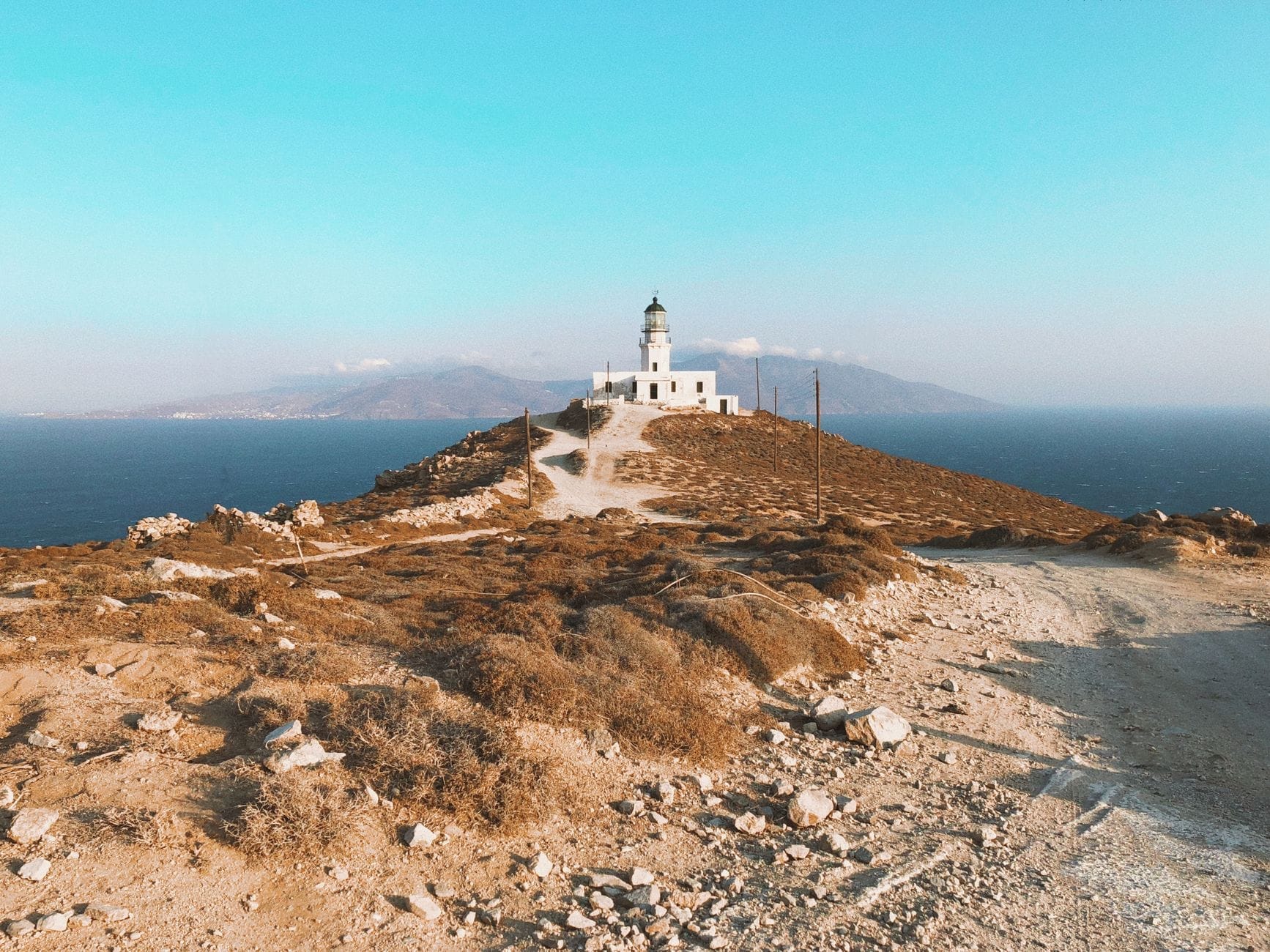
Armenistis Lighthouse, known in Greek as Fáros Armenistís (Φάρος Αρμενιστής), sits on the far northwestern headland of Mykonos at roughly 180–184 metres above sea level. It is a functioning navigation beacon, not a museum or visitor attraction in the formal sense. There is no ticket window, no café, no interpretive signage. What it offers instead is something harder to find on this island in high season: space, silence, and an unobstructed sweep of the Aegean stretching toward the horizon.
The tower itself stands about 19 metres tall, finished in the whitewashed Cycladic style that blends naturally into the rocky landscape. The interior is not open to the public. But the headland around it is unfenced and free to explore, and on a clear day the views extend across multiple Aegean islands.
ℹ️ Good to know
The lighthouse is accessible around the clock with no formal operating hours, but the walk from the small parking area involves uneven, rocky terrain. Wear closed-toe shoes, especially if you plan to explore beyond the main viewing area.
The History Behind the Tower
The lighthouse was built in 1891, and its origin is tied to a specific disaster. In 1887, the British steamship Volta sank in these waters, killing 11 people. The wreck exposed how dangerous this stretch of the Aegean was for vessels navigating the rocky northwest coast of Mykonos without any guiding light. Construction followed four years later.
The original mechanism was a French Sauter Lemonier Fresnel lens, which won recognition at the Paris International Exhibition. It was a precision optical instrument, and it operated for nearly a century before being replaced when the lighthouse was electrified around 1982–1983. The original lens did not disappear: it was preserved and is now on display at the Aegean Maritime Museum in Mykonos Town, making a visit to that museum a fitting companion to a trip out here.
Visitors with an interest in maritime history will find the Aegean Maritime Museum particularly rewarding as a follow-up. The museum holds the original Fresnel lens from Armenistis, along with ship models, navigational charts, and Aegean seafaring artifacts that provide context for what you see from the headland.
Tickets & tours
Live prices and dates from our booking partner. If you book, we may earn a commission at no extra cost to you.
Mykonos South Coast Cruise on a Traditional Caique
From 93 €Instant confirmationFree cancellationMykonos yacht cruise to Rhenia Island and guided tour of Delos
From 120 €Instant confirmationFree cancellationSunset sailing to Rhenia with Delos self-guided virtual tour
From 110 €Instant confirmationFree cancellationHalf-Day Mykonos, Delos and Rhenia Catamaran Cruise with Lunch
From 150 €Instant confirmationFree cancellation
The Experience at Different Times of Day
Midday visits are the most common and the least rewarding. The light is harsh, shadows flatten the landscape, and summer temperatures on this exposed headland can be brutal. The meltemi wind, which blows strongly across the Cyclades from roughly July through August, hits this cape with particular force. In strong meltemi conditions, standing on the outer edges of the headland requires real effort, and gusts can make photography frustrating.
The site transforms in the late afternoon. From around two hours before sunset, the angle of light picks up the texture of the tower's whitewash, the surrounding dry-grass hillside shifts from bleached yellow to amber, and the Aegean takes on a deep blue that photographs don't quite capture. This is when most photographers arrive, and even in peak July and August, the crowd here is nothing compared to what's happening at the beaches or in Chora. A dozen people, maybe two dozen on the most popular evenings, spread across a wide headland.
Early morning is perhaps the most underappreciated window. Before 8am in summer, you are almost certainly alone. The air is cooler, the sea often calmer, and the quality of the light is softer. If you have a rental vehicle and don't mind an early start, this is genuinely the best time to come.
💡 Local tip
Sunset timings vary across the season. In late June, sunset falls around 8:45pm local time. Arrive at least 45 minutes earlier to catch the best light on the tower and have time to find your footing on the rocky ground.
Getting There and Navigating the Site
The lighthouse sits about 6.5 kilometres from Mykonos Town, following the road northwest toward the Fanari area. By scooter or ATV, which are the most popular rental options on the island, the drive takes 15 to 20 minutes. By taxi from Chora, the fare is short but worth confirming with the driver before departure as rates can vary. There is a small parking area near the approach to the lighthouse.
Public bus routes do not run directly to the lighthouse entrance. If you rely on buses, you would need to walk the final stretch, which is uphill and on uneven ground. This is manageable for fit walkers but not suitable for anyone with mobility difficulties. The terrain around the headland itself is rocky and steep in places, with no paved paths, no railings near the cliffs, and no onsite facilities: no toilets, no food or drink, no shelter. Bring water, especially in summer.
Planning your transport around the island? The guide to getting around Mykonos covers rental options, bus routes, and taxi logistics in detail.
⚠️ What to skip
The cliffs around the headland have no safety barriers. Keep children close and step carefully near the edges, particularly if the ground is wet or the wind is strong. The meltemi can arrive with little warning and reach considerable force at this exposed point.
Photography and What You Can Actually See
The most photographed angle puts the lighthouse tower against the Aegean sky, usually from slightly below and to the southwest where the white tower contrasts against blue water and horizon. A wide-angle lens captures both the tower and the surrounding rocky terrain. For portraits, the late afternoon light falls favorably on the seaward face of the structure.
On clear days the view from the headland reaches across to Tinos to the northwest, and you can often see the silhouettes of more distant Cycladic islands on the horizon. Looking south, the coastline of Mykonos curves away with no development in sight from this vantage point, which makes it feel far more remote than it is. In the foreground, the dry Aegean scrubland, low granite outcroppings, and the occasional burst of wild thyme provide the kind of spare, photogenic landscape that defines the Cyclades.
Who This Attraction Suits, and Who It Doesn't
Armenistis Lighthouse is not for everyone, and there's no point pretending otherwise. If you are expecting a polished visitor experience with facilities, exhibits, or easy access, you will be disappointed. There is nothing to see inside, nothing to read, nowhere to sit comfortably, and no shade. It is a lighthouse on a windswept cape.
What it delivers is something specific: open air, a genuine sense of the island's geography, and a view that most visitors to Mykonos never see because they never leave the southern beaches or the town. For photographers, for anyone craving a moment of actual quiet on what can be a very loud island in summer, and for travelers interested in the maritime history of the Aegean, it is worth the short drive.
Travelers building a full day in the area might pair this with a visit to Panagia Paraportiani back in Mykonos Town, or consider a day trip to the ancient ruins at Delos Island, just a short ferry ride from the Old Port.
If you are working out how to allocate limited time on the island, the guide to things to do in Mykonos provides a broader framework for prioritizing attractions across different traveler types.
Insider Tips
- Go early in the morning rather than at sunset if you want the site to yourself. Most visitors only think of it as a sunset destination, so before 8am in summer you may have the entire headland alone.
- The original Fresnel lens from the lighthouse is displayed at the Aegean Maritime Museum in Mykonos Town. Seeing it in person gives scale to how sophisticated the 1891 lighting mechanism actually was.
- In July and August, the meltemi wind can make the headland genuinely difficult to stand on. If you arrive on a calm day, consider yourself lucky. If the wind picks up during your visit, step back from the cliff edges.
- There is no shade anywhere on the site. In high summer, a midday visit without a hat and water bottle is uncomfortable enough to ruin the experience. Pack accordingly or time your visit for the cooler hours.
- The small parking area fills quickly around sunset in peak season. Arriving 90 minutes before sunset instead of 45 minutes guarantees a spot and gives you better light anyway.
Who Is Armenistis Lighthouse For?
- Photographers seeking dramatic Aegean light and a clean architectural subject
- Travelers who want a quiet contrast to the crowds of southern beaches and Mykonos Town
- History enthusiasts interested in 19th-century Aegean maritime infrastructure
- Couples looking for a scenic, uncrowded sunset viewpoint
- Day visitors with a rental vehicle wanting to explore the lesser-seen northwest coast
Nearby Attractions
Other things to see while in Mykonos Town (Chora):
- Aegean Maritime Museum
Tucked inside a 19th-century Cycladic building in the Tria Pigadia quarter of Mykonos Town, the Aegean Maritime Museum offers a focused, well-curated look at centuries of Aegean maritime history. It is small enough to do in under an hour, and genuinely informative for anyone curious about the sea culture that shaped these islands.
- Agios Stefanos Beach
Agios Stefanos Beach sits just 3.5 km north of Mykonos Town, relatively sheltered from the island's notorious winds and backed by a whitewashed chapel with a red roof. It draws families, couples on a quieter budget, and anyone who finds the party beaches on the south coast too much. Sandy underfoot, shallow at the waterline, and served by a regular bus from Chora.
- Manto Mavrogenous Square
Manto Mavrogenous Square sits at the center of Mykonos Town, honoring the island's most celebrated heroine of the Greek War of Independence. Effectively always accessible as a public space, it serves as both a landmark orientation point and a quiet pause within the frenetic energy of Chora.
- Matoyianni Street
Matoyianni Street is the beating commercial heart of Mykonos Town, a short but dense pedestrian lane lined with boutiques, jewelry shops, cafes, and bars tucked into the whitewashed Cycladic old town. Free to walk, open day and night, and best experienced at the quieter hours when the crowds thin and the lane reveals its actual character.
Planning a trip? Discover personalized activities with the Nomado app.