Matoyianni Street: Mykonos Town's Famous Pedestrian Strip
Matoyianni Street is the beating commercial heart of Mykonos Town, a short but dense pedestrian lane lined with boutiques, jewelry shops, cafes, and bars tucked into the whitewashed Cycladic old town. Free to walk, open day and night, and best experienced at the quieter hours when the crowds thin and the lane reveals its actual character.
Quick Facts
- Location
- Mykonos Town (Chora), between Kalogera Street and Enoplon Dinameon Street, Mykonos, Greece
- Getting There
- Short walk from the Old Port; local buses from beaches and villages stop in Mykonos Town, from where the street is a 5-10 minute walk into the old town core
- Time Needed
- 30 minutes to browse end-to-end; 2-3 hours if you stop at shops, cafes, or bars
- Cost
- Free to walk; individual shops, bars, and restaurants set their own prices in EUR
- Best for
- Shopping, evening strolls, people-watching, and getting oriented in Mykonos Town
What Matoyianni Street Actually Is
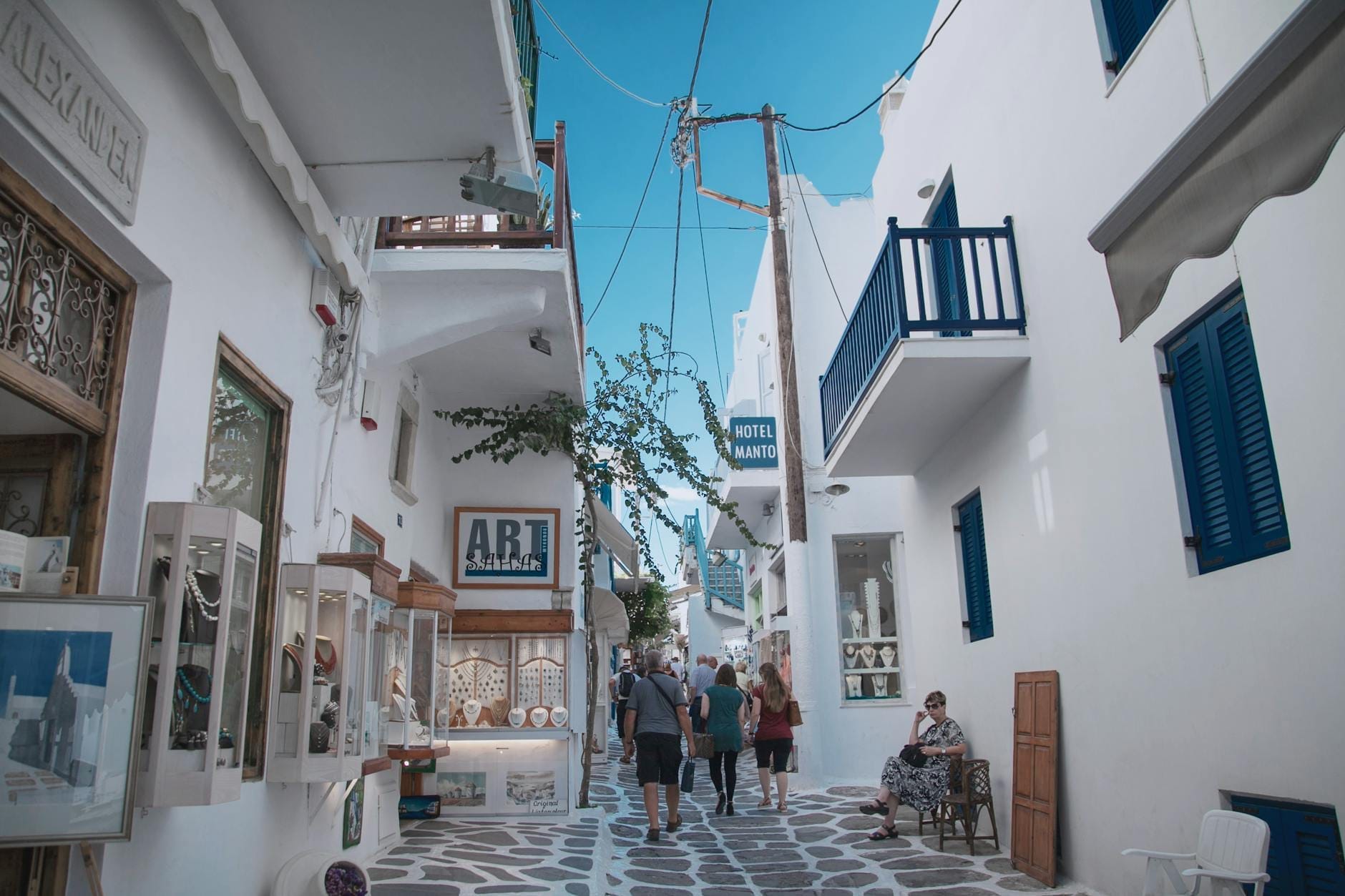
Matoyianni Street (Greek: Οδός Ματογιάννη, also spelled Matogianni) is the main pedestrian commercial lane running through the historic core of Mykonos Town, known locally as Chora. It is short and winding, connecting Kalogera Street at one end to Enoplon Dinameon Street at the other, threading through the dense whitewashed labyrinth that defines Cycladic old-town architecture. The lane is flanked on both sides by boutiques, gold and jewelry shops, cafe terraces, bars, and restaurants, with buildings so close together that their whitewashed walls and painted doorframes form an almost continuous facade.
The street is named after Matoyannis Anastassiou, a figure associated with the Greek War of Independence, though today that historical connection is invisible to the casual visitor. What you notice instead is how efficiently the lane concentrates Mykonos Town's commercial and social life into a very small space. It is not a grand boulevard. It is a narrow, cobblestoned passage where two groups of people walking in opposite directions have to negotiate their way past each other at busy hours.
ℹ️ Good to know
Matoyianni Street is a public thoroughfare with no admission fee and no gate. The street itself is accessible 24 hours a day. Individual shops generally open mid-morning and, in high season, many stay open until around midnight.
How the Street Changes Through the Day
Early morning, roughly 8am to 10am, Matoyianni Street is one of the more pleasant corners of Mykonos Town. The cobblestones are still cool underfoot, the shop shutters are mostly closed, and the only people around are hotel guests heading out for coffee and the occasional delivery worker navigating a small scooter through the lane. The whitewashed walls catch the flat morning light cleanly, and you can actually look at the architectural details: the deep blue and terracotta painted woodwork on doors and window frames, the hanging bougainvillea, the uneven texture of the hand-plastered walls.
By midday in peak summer, the street is dense with foot traffic. The Aegean sun is direct and strong, the lane provides little shade, and the combination of heat, slow-moving crowds, and persistent shop music makes this one of the less comfortable times to be here. Prices in nearby cafes and bars are uniformly high during peak hours, and the experience of browsing shifts from leisurely to effortful.
Late evening is when the street earns its reputation. From around 9pm onward, the temperature drops to something comfortable, the light turns golden and then purple, and the lane fills with people who are dressed for a night out rather than a beach day. Shops stay open, bar stools fill up, and the narrow passage takes on a genuinely atmospheric quality. This is also when the photographic conditions are best, with warm artificial light mixing with the last of the natural light against white walls.
💡 Local tip
Visit before 10am for photos without crowds, or after 9pm for atmosphere. Midday in July and August is the least rewarding time to be on this street, both for comfort and for shopping.
Tickets & tours
Live prices and dates from our booking partner. If you book, we may earn a commission at no extra cost to you.
Mykonos South Coast Cruise on a Traditional Caique
From 93 €Instant confirmationFree cancellationMykonos yacht cruise to Rhenia Island and guided tour of Delos
From 120 €Instant confirmationFree cancellationSunset sailing to Rhenia with Delos self-guided virtual tour
From 110 €Instant confirmationFree cancellationHalf-Day Mykonos, Delos and Rhenia Catamaran Cruise with Lunch
From 150 €Instant confirmationFree cancellation
The Physical Experience: Walking the Lane
The cobblestones on Matoyianni Street are uneven and polished smooth by decades of foot traffic. They are slippery when wet and genuinely uncomfortable in thin-soled sandals over any distance. Wear shoes with some grip and a flat sole. The lane is narrow enough that shop displays often spill onto the walkway, and bar seating extends into the street, reducing the passable width further during busy periods.
The smells shift as you walk: espresso and fresh pastry near cafe entrances, sunscreen and perfume from passing tourists in summer, the faint salt-and-diesel edge that drifts in from the direction of the old port when the wind is right. In the evening, grilled food from nearby tavernas adds a layer to the air. The sounds are layered too: music from competing bars, conversation in a half-dozen languages, the distant rumble of a motorbike somewhere in the lanes behind the main strip.
Matoyianni Street sits within the larger maze of Mykonos Town, and it is genuinely easy to lose your bearings once you step off the main lane into the surrounding alleys. This is not entirely a bad thing. Some of the more interesting small cafes and local shops are one or two turns off Matoyianni, where foot traffic drops sharply and prices sometimes follow.
Shopping and Spending on Matoyianni Street
The commercial mix on Matoyianni Street skews toward fashion, jewelry, accessories, and souvenirs, with a concentration of international designer names alongside Greek jewelers and local clothing boutiques. Prices reflect the island's positioning as a premium destination: expect to pay significantly more here than in Athens or other Greek islands for comparable items. If you are looking for inexpensive souvenirs, you will find them, but they sit alongside genuinely high-end goods, and the street does not pretend to be a budget shopping destination.
Greek gold and silver jewelry is one of the stronger categories along the street, with several established jewelers offering both traditional and contemporary designs. This is worth time if you are interested in handcrafted pieces. For context on how Matoyianni Street fits into the broader Mykonos spending landscape, the Mykonos luxury guide covers the island's high-end offerings in more detail.
If your budget is tight, Matoyianni Street is still worth a walk for the atmosphere and people-watching, but the eating and drinking options here are among the most expensive in Mykonos Town. The Mykonos on a budget guide identifies where to find more reasonable food and drink options within walking distance.
Historical and Architectural Context
Mykonos Town developed its characteristic labyrinthine street pattern over centuries, partly as a defensive measure against pirate raids that plagued the Aegean islands well into the early modern period. The narrow, winding alleys made it difficult for outsiders to navigate quickly, and the dense, connected buildings created a continuous defensive wall facing the sea. Matoyianni Street is a product of this organic urban growth rather than planned town design, which explains why it bends and narrows unpredictably and why no two sections of it look quite the same.
The whitewashing of buildings in the Cyclades is not purely aesthetic. Lime plaster has natural antiseptic properties and was historically applied to walls and even paved surfaces partly for hygiene reasons. The Greek government has also, over time, established regulations requiring that buildings in historic Cycladic settlements maintain the traditional white-and-blue color scheme. On Matoyianni Street, this means that even the commercial facades maintain a degree of visual coherence, regardless of which global brand occupies the ground floor.
The street sits close to some of Mykonos Town's most photographed landmarks. Panagia Paraportiani church is a short walk away, as are the iconic windmills that overlook the town from the Kato Myli hill. Both are worth including in any walk that starts or ends on Matoyianni Street.
Practical Notes: Getting There, Getting Around, Accessibility
Matoyianni Street is most easily reached on foot from the Old Port area of Mykonos Town, a walk of roughly five to ten minutes through the old town alleys. From the New Port (Tourlos), where larger ferries and many cruise ship tenders connect, you will need a taxi or bus into town first, then proceed on foot. Local buses from the island's beaches and villages terminate in Mykonos Town, from where the old town is walkable.
There is no dedicated parking on or near Matoyianni Street itself; if you are arriving by rental car or scooter, park at the edge of Mykonos Town and walk in. For a fuller picture of getting around the island, see the guide to getting around Mykonos.
Accessibility is limited. The cobblestone surface is uneven and has no formal adaptations for wheelchair users or visitors with significant mobility constraints. The narrowness of the lane, combined with crowds at peak times, makes navigation with a pushchair or wheelchair practically difficult. If mobility is a concern, early morning visits offer the best chance of navigating without the added obstacle of dense foot traffic.
⚠️ What to skip
Matoyianni Street is genuinely crowded during July and August, particularly from late morning to early evening. If crowds are a dealbreaker for you, this street in peak summer may not reward the visit. The shoulder months of May, June, and September offer a noticeably more relaxed experience.
Who Should Think Twice
Travelers who are primarily interested in authentic local life or a quiet Greek island experience may find Matoyianni Street disappointing. At peak season, the commercial density and tourist concentration here is high, and the street functions more as an upscale resort strip than a slice of traditional Greek island culture. For a contrast, the village of Ano Mera in the island's interior offers a noticeably different, less tourist-saturated atmosphere.
Those with serious mobility limitations will find the cobblestones and crowds a genuine obstacle rather than a minor inconvenience. And visitors on a tight budget should know upfront that the bars and restaurants along and immediately adjacent to Matoyianni Street are priced at the premium end of an already expensive island.
Insider Tips
- The alleys immediately parallel to Matoyianni Street, one block back from the main lane, hold smaller independent shops and cafes that see a fraction of the foot traffic. Prices for food and coffee are often lower and the atmosphere is considerably calmer.
- In high season, many shops on Matoyianni Street stay open until midnight or later. If you want to browse without crowds and without the midday heat, an evening shopping session from 9pm onward is genuinely practical, not just atmospheric.
- The street is most photogenic in the 30 minutes after sunset, when the sky is still pale blue but the shop and bar lights have come on. The contrast against white walls at this hour is difficult to replicate at any other time of day.
- If you are navigating with a phone map, be aware that GPS accuracy in the dense old-town alleys around Matoyianni Street is unreliable. Satellite signal bounces off the close-set whitewashed walls. Learn two or three physical landmarks before you head in, rather than relying on turn-by-turn navigation.
- Street-level shop prices are fixed in most boutiques; bargaining is not a norm here the way it might be in some other Mediterranean markets. However, in smaller independent jewelry and craft shops, a polite conversation sometimes leads to flexibility, particularly outside of peak hours.
Who Is Matoyianni Street For?
- First-time visitors to Mykonos wanting a quick orientation of the old town's commercial core
- Shoppers looking for Greek jewelry, fashion boutiques, and designer goods in a concentrated area
- Evening strollers and people-watchers who want atmosphere without committing to a specific bar or restaurant
- Travelers who want to connect the dots between the Old Port, the windmills, and Paraportiani church on a single walk through Mykonos Town
- Couples and groups who want a scenic, walkable stretch as a starting point for a night out
Nearby Attractions
Other things to see while in Mykonos Town (Chora):
- Aegean Maritime Museum
Tucked inside a 19th-century Cycladic building in the Tria Pigadia quarter of Mykonos Town, the Aegean Maritime Museum offers a focused, well-curated look at centuries of Aegean maritime history. It is small enough to do in under an hour, and genuinely informative for anyone curious about the sea culture that shaped these islands.
- Agios Stefanos Beach
Agios Stefanos Beach sits just 3.5 km north of Mykonos Town, relatively sheltered from the island's notorious winds and backed by a whitewashed chapel with a red roof. It draws families, couples on a quieter budget, and anyone who finds the party beaches on the south coast too much. Sandy underfoot, shallow at the waterline, and served by a regular bus from Chora.
- Armenistis Lighthouse
Perched on the rocky northwest tip of Mykonos at roughly 180–184 metres above sea level, Armenistis Lighthouse is a 19th-century navigation beacon with one of the island's most panoramic viewpoints. Built in 1891 after a fatal shipwreck, it rewards visitors willing to venture beyond the town with open Aegean horizons and a quieter side of the island.
- Manto Mavrogenous Square
Manto Mavrogenous Square sits at the center of Mykonos Town, honoring the island's most celebrated heroine of the Greek War of Independence. Effectively always accessible as a public space, it serves as both a landmark orientation point and a quiet pause within the frenetic energy of Chora.
Planning a trip? Discover personalized activities with the Nomado app.