Psarou and Platis Gialos sit side by side on Mykonos's south coast, roughly 4 to 6 kilometres from Mykonos Town. Together they offer two distinct beach experiences: Psarou draws a high-spending, celebrity-spotting crowd, while Platis Gialos is the island's most practical and accessible family beach, complete with water taxis to Paradise and beyond.
Two adjacent bays, one coastal road, and a sharp divide in atmosphere: Psarou is Mykonos at its most glamorous, while Platis Gialos is the south coast's most practical, genuinely swimmable beach. Together they cover a lot of ground, and the 10-minute walk between them is one of the more interesting contrasts the island has to offer.
Orientation: Where Psarou and Platis Gialos Sit on the Island
Both beaches occupy Mykonos's sheltered south coast, roughly 4 to 6 kilometres south of Mykonos Town (Chora). The two bays are separated by a low rocky headland, and the coastal path connecting them takes about 10 minutes on foot. Coming from Chora by road, you reach Psarou first, then continue slightly further east to Platis Gialos, which is the terminal point of one of the main southern bus routes.
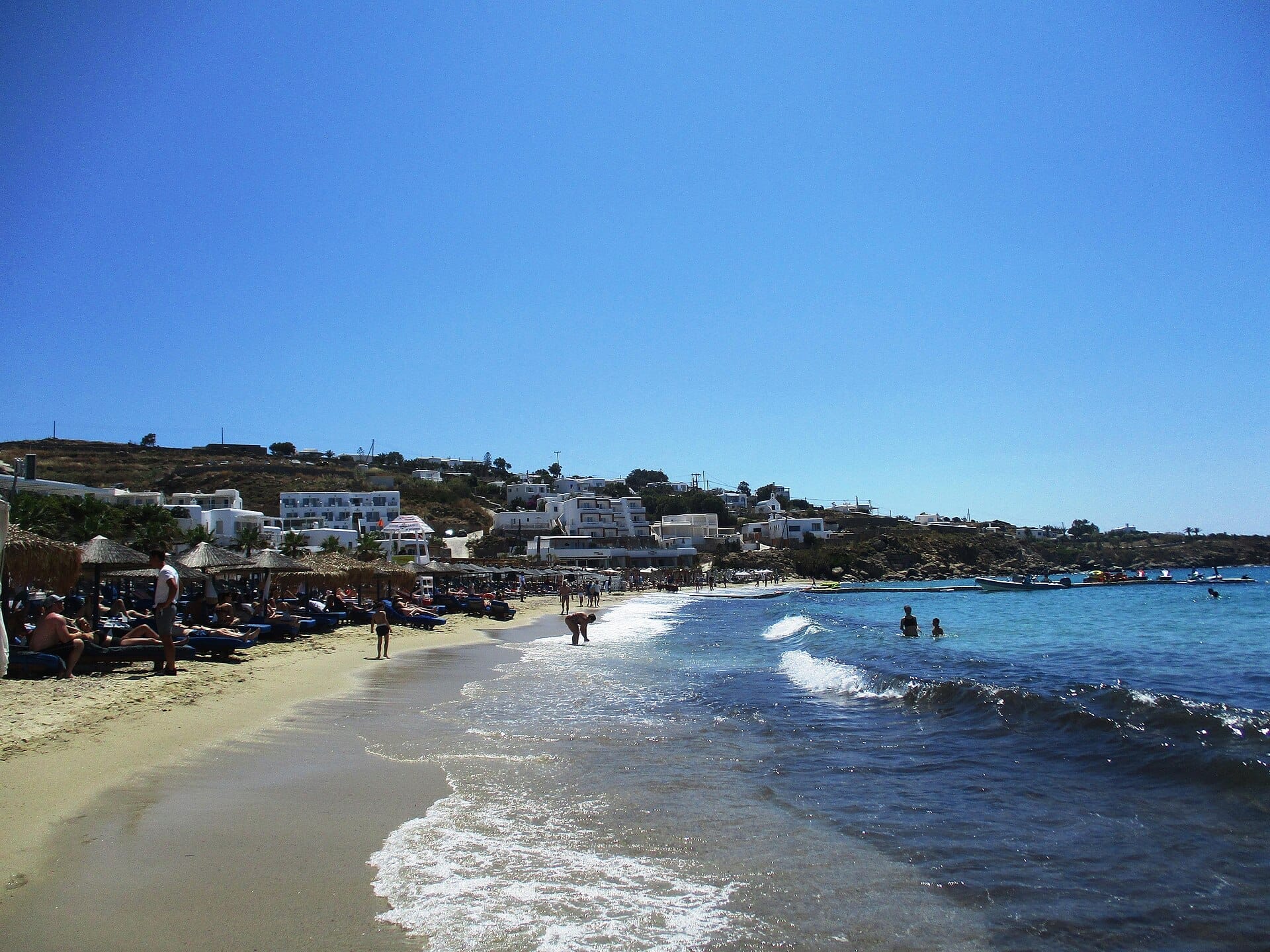
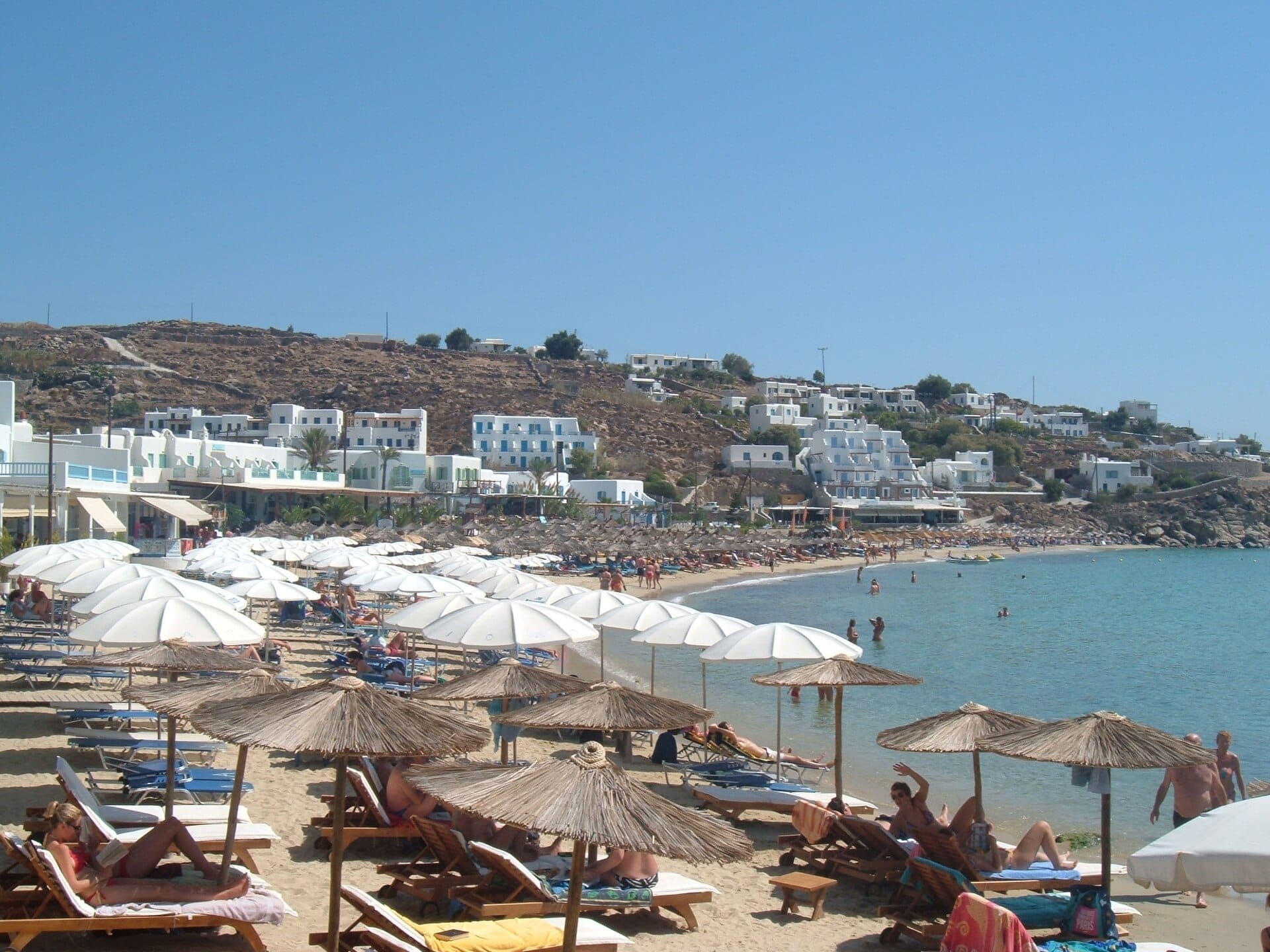
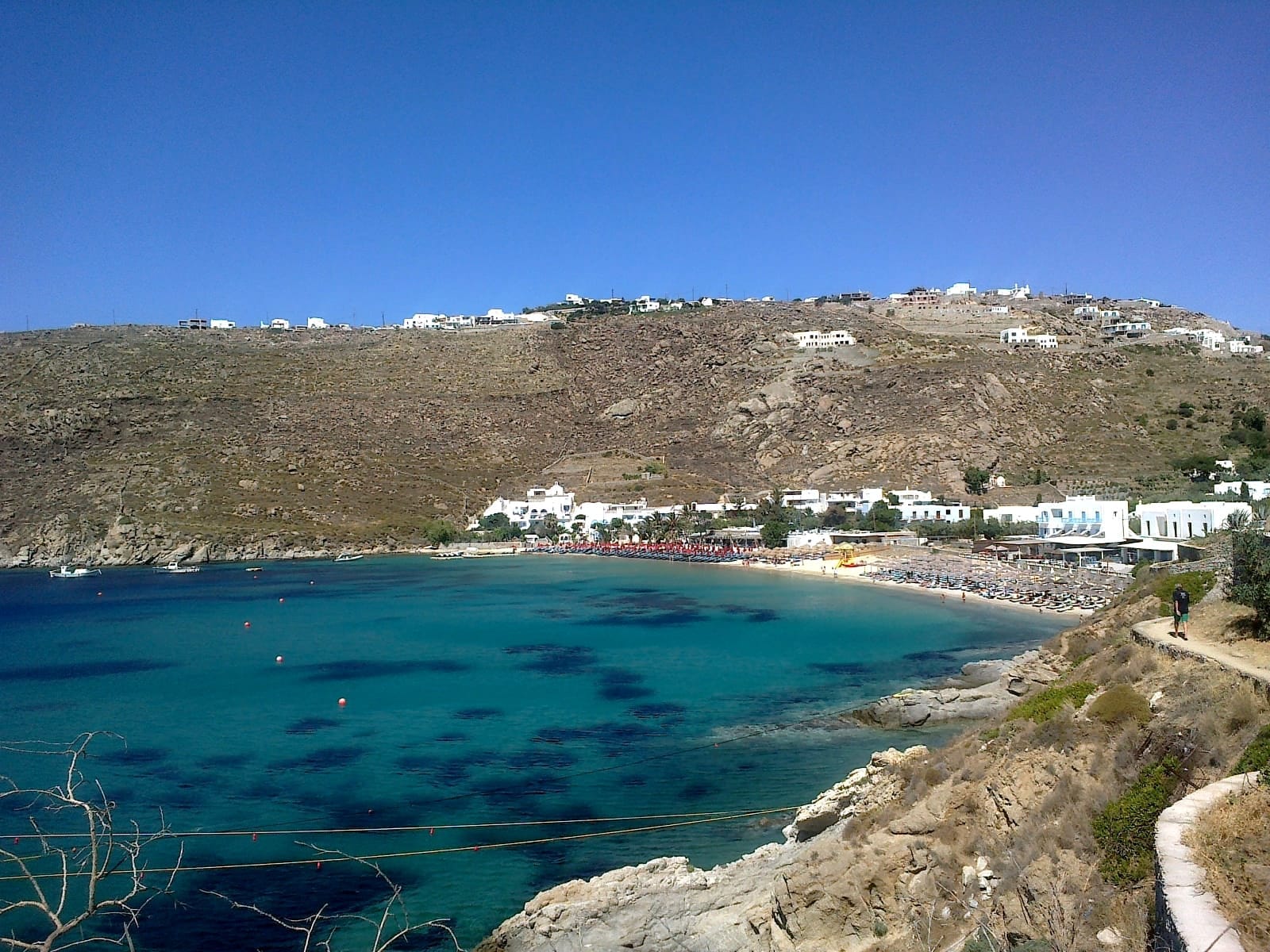
Platis Gialos is the larger and more developed of the two settlements. Its horseshoe bay holds a long curve of golden sand with hotels, tavernas, and water-sports operators packed tightly between the road and the shoreline. The seafront is essentially one continuous strip of accommodation and eating, with almost no undeveloped land between the buildings and the water. Psarou, immediately to the northwest, is more compact and dramatically more exclusive: a smaller cove framed by low hills, with a handful of high-end restaurants and beach clubs controlling most of the sand.
To the east of Platis Gialos, a short walk or quick taxi ride brings you to Paraga Beach and then Agia Anna, and further on to Paradise Beach. The entire south coast can be navigated without returning to Chora, either on foot for short hops or by the water taxis that depart from the Platis Gialos jetty. To the west, the coast turns rocky before reaching Ornos Bay. Understanding this linear layout matters: Platis Gialos functions as the logistical hub of the south coast.
Character and Atmosphere: Two Beaches, Two Worlds
Early in the morning, before 9am, both beaches have a genuine stillness to them. The light comes in low and flat from the east, turning the water the kind of pale green that gets photographed and disbelieved. The sunbed attendants are just setting out the chairs, and the taverna staff are stacking chairs the opposite way, getting ready to open. This is the hour when the two bays feel most similar: quiet, salt-aired, a little windswept.
By midday the contrast is sharp. Platis Gialos fills with families, couples, and groups who have come for an honest day at the beach. The bay's south-coast position and curved shape help shelter it from the meltemi wind that hammers exposed north-facing coasts in July and August, which makes it genuinely comfortable for swimming even on gusty days. The water is shallow enough near the shore for children, and the beach is long enough that it absorbs crowds without feeling claustrophobic. You can rent a sunbed, order a Greek salad and a cold beer, and stay all afternoon without anyone pressuring you to spend more. Water-skis and jet skis operate from the eastern end.
Psarou, by comparison, operates on a different register. The beach is smaller and the logistics are tighter: a significant portion of the sand is controlled by beach clubs, and securing a prime sunbed in peak season means either booking ahead or spending at the level those venues expect. The crowd skews toward people for whom Mykonos is specifically about being seen. Superyachts anchor in the bay. The restaurant prices are high even by Mykonos standards. None of this is a criticism, but it is worth knowing before you arrive expecting a casual afternoon.
After dark, neither area has significant nightlife of its own. The tavernas at Platis Gialos stay open for dinner and are lively without being loud. Psarou quiets down considerably once the beach club crowd moves on. Visitors looking for the kind of late-night energy Mykonos is known for will need to head back to Chora or continue to Paradise Beach.
💡 Local tip
If you are visiting Psarou without a reservation at one of the beach clubs, arrive early (before 10am in peak season). The small amount of public sand at the edges of the cove fills quickly, and by noon your options are limited to either paying beach-club prices or moving on.
What to See and Do
The main activity at both beaches is, straightforwardly, the beach itself. Platis Gialos BeachPlatis Gialos is one of the longer stretches of sand on Mykonos and one of the most consistently swimmable, with calm, clear, shallow water and full facilities. Water sports are available from operators at the eastern end of the bay, including jet skis, water skis, and paddleboards.
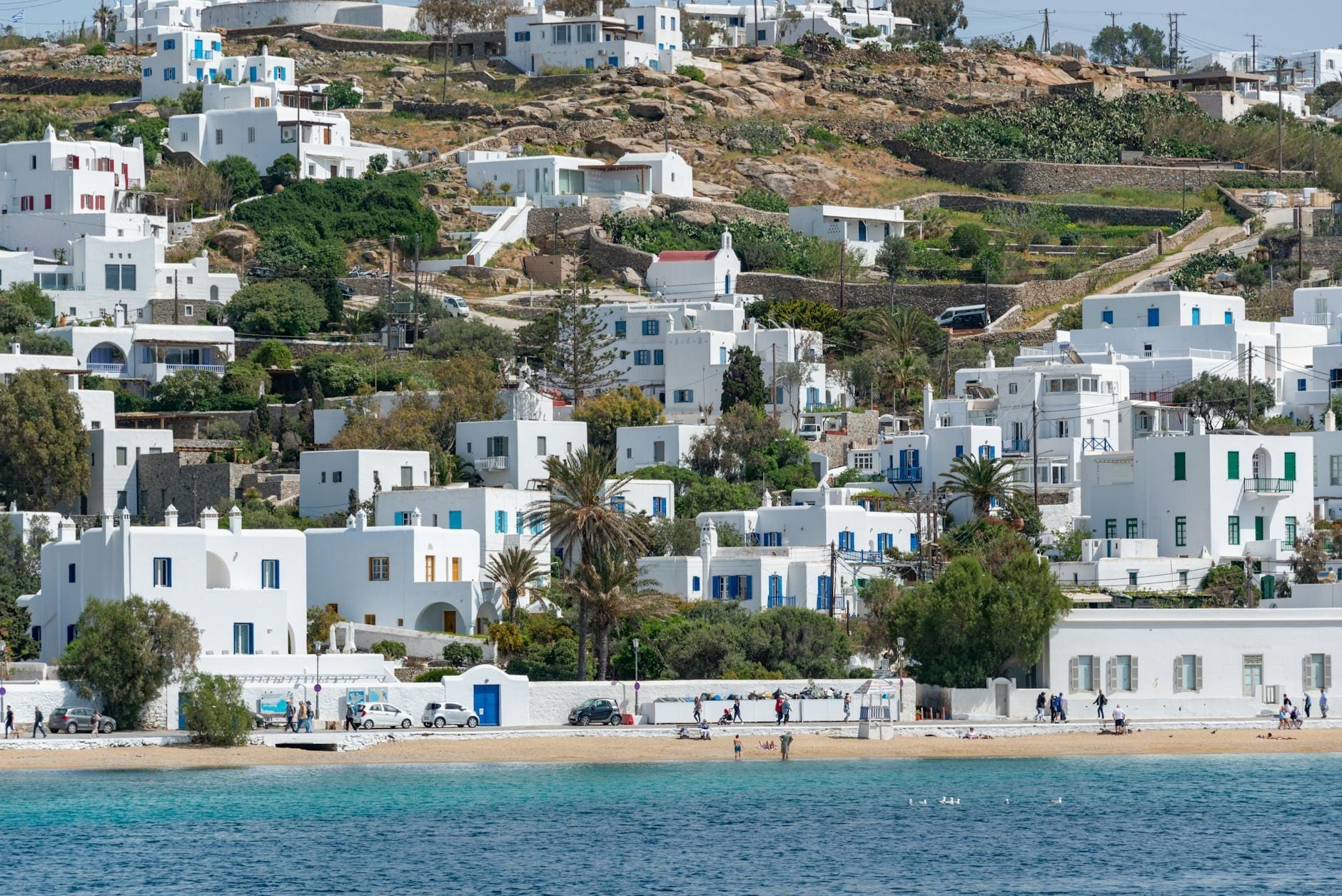
Psarou BeachPsarou is a shorter cove, but the quality of the water is exceptional: that characteristic deep turquoise of the sheltered Aegean. Even if you are not spending at the beach club level, it is worth the walk over from Platis Gialos purely to look at it. The atmosphere of the cove, surrounded by low white-washed buildings and a handful of mature tamarisks, gives it a slightly more intimate scale than the wider bay next door.
Platis Gialos serves as the main water-taxi departure point for the south coast. Small open boats run roughly every hour to Paradise Beach, Super Paradise, Agrari, and Elia, making it a sensible base if you want to beach-hop without renting a vehicle. The service is informal: boats depart when they are reasonably full, and the schedule tightens or loosens depending on demand and weather.
Swimming and sunbathing at Platis Gialos, one of the island's most protected bays
Water sports rentals at the eastern end of Platis Gialos (jet skis, water skis, paddleboards)
Beach club experience at Psarou (book ahead in July and August)
Water-taxi connections from Platis Gialos jetty to Paradise, Super Paradise, Agrari, and Elia beaches
Coastal walk linking Psarou, Platis Gialos, Paraga, and Agia Anna
Snorkelling around the rocky headland separating the two bays
If you are building a wider itinerary around the south coast, the best beaches in Mykonos guide provides a useful overview of how Platis Gialos and Psarou compare to options further east like Elia Beach, which is longer, quieter, and a 15-minute boat ride away.
Eating and Drinking
The food scene at Platis Gialos is practical and reliable without being extraordinary. The seafront strip has a concentration of tavernas serving standard Greek beach fare: grilled fish, calamari, Greek salad, moussaka, and mezze platters. Quality varies, but prices are broadly consistent and more reasonable than in Mykonos Town. Portions tend to be generous, and most kitchens are used to feeding a mixed international crowd across a very long lunch sitting.
Breakfast and coffee are available at several spots opening from around 8am, with hotel terraces usually offering sea views alongside the standard Greek breakfast of bread, cheese, honey, and yoghurt. By late afternoon, the tavernas transition smoothly into dinner service and stay open until around 11pm. There is no meaningful bar scene here in the way there is in Chora, but a cold beer with a view of the bay at dusk is an entirely reasonable end to a beach day.
Psarou's dining is dominated by the high-end restaurant attached to the Nammos beach club complex, which has become one of the most recognizable (and most expensive) dining addresses on Mykonos. The menu runs to fresh seafood and Mediterranean dishes, and the wine list is priced accordingly. A full lunch for two with wine can reach into genuinely surprising figures. The food is by most accounts excellent, but if the bill is a concern, knowing this in advance helps you plan.
ℹ️ Good to know
For a more affordable meal with a similar sea view, the tavernas at the western end of Platis Gialos (closest to Psarou) offer good grilled fish at roughly a third of the price of the upmarket Psarou venues. A 10-minute walk changes the bill significantly.
For a broader sense of what to eat and drink on the island, the guide to what to eat in Mykonos covers local specialties worth seeking out, including kopanisti cheese and loukoumades, which are more reliably found in Mykonos Town than at the south-coast beach tavernas.
Getting There and Around
The most straightforward option from Mykonos Town is the public bus from the Fabrika terminal, located at the southern edge of Chora. Buses run to Platis Gialos throughout the day during the tourist season, with the journey taking about 15 minutes. The stop at Platis Gialos is just a few steps from the beach, outside the Petasos Beach Resort. Psarou is one stop earlier on the same line. In peak summer the buses run frequently but can be crowded; arriving at Fabrika early avoids the worst of the queues.
Taxis from Mykonos Town are quick (under 10 minutes to either beach) but availability in high season is unreliable, especially during the afternoon rush when everyone is leaving the beach simultaneously. Booking ahead via the taxi stand or a hotel concierge is more reliable than flagging one down. There is no ride-hailing infrastructure of significance on the island.
Renting an ATV or scooter from one of the agencies near Fabrika gives you the most flexibility, particularly if you want to visit multiple beaches in a single day. The road south from Chora is well-paved and straightforward, though it narrows toward the coast. Parking at Platis Gialos can be tight in August. Rental cars are also available and make sense for groups of three or more splitting the cost.
Once at Platis Gialos, the water-taxi jetty is the most efficient way to reach other south-coast beaches. Boats run to Super Paradise Beach, Paradise, Agrari, and Elia roughly hourly in peak season. The short hop to Paradise takes about 10 minutes and costs a few euros each way. For more detail on navigating the island, see the getting around Mykonos guide.
⚠️ What to skip
The south-coast road between Chora and Platis Gialos has no pavement for pedestrians on most sections. Walking is not recommended and takes the better part of an hour. Use the bus, a taxi, or a rental vehicle.
Where to Stay
Platis Gialos has the widest range of accommodation on this stretch of coast, from comfortable mid-range hotels directly on the sand to larger resort properties set slightly back from the shore. Staying here gives you immediate beach access, an easy bus connection to Chora, and the water-taxi link to other south-coast beaches. It is well-suited to families, couples who prioritize beach time over nightlife, and anyone who wants a quieter base than Mykonos Town without sacrificing convenience.
Psarou is almost entirely luxury-tier. The hotels and villas in this cove are among the most expensive on the island, and the area essentially caters to a single market segment. If budget is not a constraint and you want to wake up directly in that bay, Psarou delivers it in a way few places on Mykonos can match. For everyone else, staying at Platis Gialos and walking to Psarou for the day is the practical solution.
For a full breakdown of where to stay across the island, including how Platis Gialos compares to Mykonos Town and Ornos, the where to stay in Mykonos guide covers each area in detail. Honeymooners specifically may want to consult the Mykonos honeymoon guide, which gives more weight to the smaller, high-design properties in the Psarou area.
Honest Assessment: Who This Area Is and Isn't For
Platis Gialos is one of the most straightforwardly enjoyable beaches on Mykonos, and its combination of calm water, reliable bus connections, and full facilities makes it a sensible base for a wide range of travellers. It is not the most photogenic bay on the island, and the strip of hotels directly on the sand can feel dense and commercial. But it works, day in and day out, in a way that some of the more fashionable beaches do not.
Psarou rewards visitors who understand what it is: a small, beautiful, luxury cove where the price of entry is either a significant spend or an early arrival on the public sand. It is not a place to stumble into expecting a relaxed and affordable beach day. The water and setting are genuinely exceptional, but the atmosphere is shaped by the clientele and the beach clubs that dominate it.
Neither beach suits visitors primarily interested in Mykonos's nightlife or its architectural character. For that, time in Mykonos Town is essential. The south coast is also not the place to come if you want to escape the crowds entirely: for quieter swimming, Agios Sostis Beach on the north coast offers a dramatically different atmosphere, with no sunbeds and no facilities.
TL;DR
Platis Gialos is the south coast's most practical family beach: calm water, full facilities, and regular bus connections from Mykonos Town make it one of the island's most accessible options.
Psarou is a compact luxury cove best known for high-end beach clubs. Arrive early if you want free sand, or book and budget accordingly for the full beach-club experience.
The Platis Gialos jetty is the main water-taxi hub for the south coast, with regular boats to Paradise, Super Paradise, Agrari, and Elia — making it a useful base for beach-hopping.
Neither area has meaningful nightlife; after dinner, the action moves to Mykonos Town or Paradise Beach.
Best suited to: families wanting calm water and convenience (Platis Gialos); luxury travellers and beach-club enthusiasts (Psarou). Less suited to: budget travellers, nightlife seekers, or those wanting unspoiled, crowd-free swimming.
Three days is exactly enough time to cover Mykonos properly — the labyrinthine alleys of Chora, the UNESCO ruins of Delos, the south-coast beach scene, and a genuine taste of the island's nightlife. This day-by-day itinerary gives you the structure, the practical details, and the honest advice to make it work.
Mykonos has a beach for every type of traveler. This guide covers the 12 best beaches on the island, from the legendary party scene at Paradise to the car-free calm of Agios Sostis, so you can find exactly the day you're looking for.
Mykonos rewards travelers who time their visit carefully. This guide breaks down every season by weather, crowd levels, prices, and what's actually open, so you can decide when the island works best for your trip.
Delos is one of Greece's most extraordinary archaeological sites, and it sits just 30 minutes by boat from Mykonos. This guide covers ferry schedules, entry fees, the best ruins to prioritize, and whether a guided tour is worth the extra cost.
Mykonos is a small island with a surprisingly complex transport puzzle. From the KTEL bus network and south-coast caiques to the island's notoriously scarce taxis and rental vehicles, this guide breaks down every way to get around — with real prices, practical tips, and honest warnings about what doesn't work as well as you'd hope.
Mykonos has a reputation that precedes it: luxury prices, wall-to-wall tourists, and beach clubs that run until dawn. But the island is more layered than that. This guide cuts through the hype to tell you exactly who Mykonos is worth visiting for — and who should skip it.
Mykonos has some of the world's most famous beach clubs, from full-day party venues at Paradise Beach to bohemian sunset gatherings at Scorpios. This guide breaks down where to go, what to expect, what things actually cost, and how to book before peak season fills up.
Mykonos is far more than a party island. For couples, it offers sunset cocktails at Little Venice, private-pool suites above the Aegean, quiet beaches with turquoise water, and a day trip to the ancient ruins of Delos. This guide covers the best romantic experiences, when to go, where to stay, and how to avoid the crowds.
Mykonos is Greece's most polished luxury destination, combining world-class hotels, private beach clubs, superyacht culture, and some of the Aegean's best dining. This guide cuts through the hype with specific advice on when to go, where to stay, how to get around, and what actually justifies the price tag.
Mykonos has one of Europe's most legendary party scenes, from clifftop superclubs to sun-soaked beach raves and intimate cocktail bars in Chora's whitewashed alleys. This guide covers the best venues, realistic prices, seasonal timing, and the honest trade-offs so you can plan a night out that actually matches your expectations.
Mykonos has a reputation as one of Greece's most expensive islands, and that reputation is mostly earned. But visiting without hemorrhaging money is entirely possible if you understand how pricing works, when to go, and where to spend versus save. This guide breaks it all down honestly.
Everything you need to plan the trip from Mykonos to Santorini: which ferry operators run the route, how long the crossing takes, what fares to expect by season, whether flying makes sense, and how to fit in stops at Paros or Naxos along the way.
Both islands dominate Cyclades itineraries, but they deliver completely different experiences. This guide breaks down the real differences between Mykonos and Santorini across scenery, beaches, nightlife, budget, and logistics so you can choose the right one — or plan both smartly.
Mykonos delivers more than beach clubs and late nights. This guide covers the top things to do in Mykonos, Greece — from ancient ruins on Delos and windswept Cycladic lanes to family beaches and genuine local culture — with practical logistics for every type of traveler.
Mykonos has a distinct culinary identity that goes far beyond generic Greek salads and souvlaki. This guide covers the island's signature foods, honest price expectations, where to eat well on any budget, and the restaurants worth planning your day around.
Choosing where to stay in Mykonos shapes your entire trip. This guide breaks down every key area, from the lively lanes of Chora to the family-friendly shores of Ornos, with honest advice on prices, logistics, and who each neighborhood actually suits.