Wangfujing Street: Beijing's Grand Commercial Avenue
Wangfujing Street (王府井大街) is Beijing's most recognizable commercial thoroughfare, stretching nearly 1,818 meters through Dongcheng District. Free to enter and open around the clock, it layers imperial-era history onto a modern pedestrian spine of department stores, snack alleys, bookshops, and street food. Whether you visit for an hour or an evening, understanding what the street actually offers helps you decide how much time it deserves.
Quick Facts
- Location
- Dongcheng District, Beijing; runs north–south from East Chang'an Avenue toward Wusi Street
- Getting There
- Beijing Subway Line 1, Wangfujing Station (Exit A)
- Time Needed
- 1–3 hours for a casual walk; longer if you browse malls or eat
- Cost
- Free to enter the street; individual shops and restaurants charge separately
- Best for
- First-time visitors, evening strolls, shopping, street food sampling
What Wangfujing Actually Is
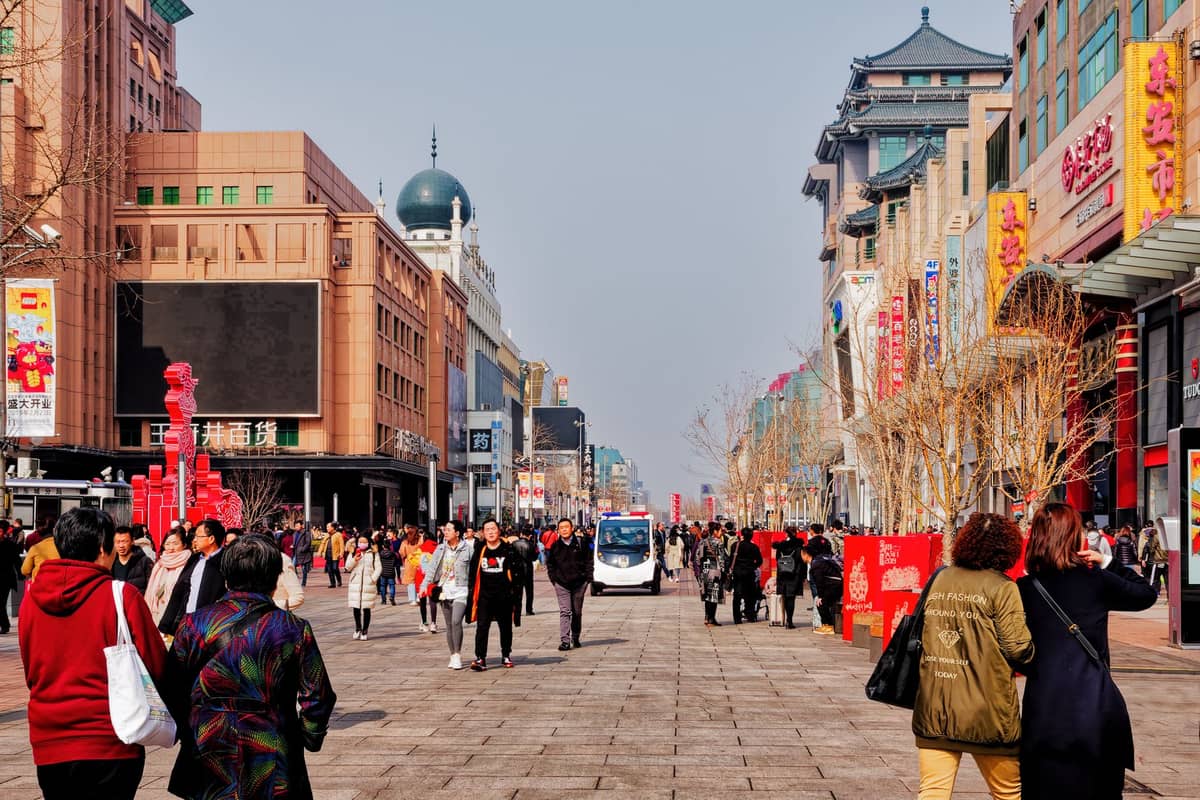
Wangfujing Street is not a museum, park, or ticketed site. It is a pedestrian commercial corridor, approximately 810 meters from south to north, flanked by department stores, international brand flagships, snack food stalls, and a handful of surviving older shopfronts. The full street, including its northern and southern approaches, extends to about 1,818 meters. Entry is free at all times.
Its official Chinese name, 王府井大街 (Wángfǔjǐng Dàjiē), translates roughly to 'Prince's Mansion Well Avenue.' The area was associated with princely residences in the Ming dynasty, while the present name was formally established in 1905 during the Qing dynasty because of a sweet freshwater well on the street. That well, or a reconstruction of it, still sits in a small plaza near the southern end of the pedestrian zone, a quiet anchor to more than 700 years of commercial history.
💡 Local tip
Getting there is simple: take Beijing Subway Line 1 to Wangfujing Station and use Exit A. The main pedestrian zone begins within a two-minute walk of the exit. Bus routes 41, 52, 103, 104, 120, and 140 also serve the area if you are coming from a direction not covered by Line 1.
Morning, Afternoon, Evening: How the Street Changes
Wangfujing before 10:00 is nearly calm. Shop shutters are rolling up, delivery workers move boxes across the paving, and the air carries a faint smell of steam from breakfast carts along the side alleys. This is genuinely the best window for photography: the wide paving tiles reflect soft morning light, the large-character signage reads clearly without being lost in crowd movement, and you can walk the full length without stopping every few meters.
By mid-afternoon, especially on weekends and public holidays, the pedestrian zone fills substantially. School groups, domestic tourists from other provinces, and families with young children are the dominant crowds. The noise level rises considerably; the main strip between the Sun Dong'an Plaza and the Foreign Language Bookstore can feel congested. If you are sensitive to crowds, plan around this window or cut through the quieter side lanes.
Evening, roughly from 18:00 onward, brings a different register. Shop lighting intensifies, the neon and LED signage becomes more prominent, and the snack alley off the main street draws long queues. The air picks up the char and spice of grilling skewers. For visitors who have spent the day at the Forbidden City or Temple of Heaven, Wangfujing at dusk makes a logical final stop: convenient by metro, well-lit, and easy to navigate.
Tickets & tours
Hand-picked options from our booking partner. Prices are indicative; availability and final rates are confirmed when you complete your booking.
Small group tour of Tian'anmen Square and the Forbidden City
From 43 €Instant confirmationFree cancellationBeijing Summer Palace Entrance Ticket
From 7 €Instant confirmationFree cancellationMutianyu Great Wall and Summer Palace small-group tour from Beijing
From 171 €Instant confirmationFree cancellationPrivate Guided Tour to Temple of Heaven, Panda House and Summer Palace
From 67 €Instant confirmationFree cancellation
The Snack Alley: Reality vs. Reputation
No honest account of Wangfujing can skip the snack alley (小吃街, Xiǎochī Jiē), the short covered lane branching east off the main pedestrian zone. It is heavily photographed and widely referenced in travel content for its skewers of scorpions, starfish, and silk worm pupae. These items exist and are for sale. They are also priced as tourist novelties, not as local staple food.
The snack alley is worth a look for the spectacle and the energy, but the food choices most worth trying are the more ordinary ones: lamb skewers (羊肉串), fried dough sticks with sesame, stinky tofu if you are curious, and various fruit-on-a-stick preparations. The insect skewers photograph well and cost accordingly. Treat them as a sideshow rather than a culinary destination.
⚠️ What to skip
Prices in the snack alley are not fixed. Ask the price before taking food handed to you, and confirm it again before paying. Overcharging is a known issue with unprepared tourists. The same caution applies to photo opportunities offered by vendors holding live animals.
Shopping: What Is Actually Here
The commercial offer on Wangfujing spans a wide range. At the upper end, the Oriental Plaza at the southern end of the street is a substantial luxury and mid-market mall with international brands, a food court, and a cinema. Sun Dong'an Plaza (新东安广场) anchors the middle of the pedestrian zone with several floors of fashion retail and restaurants. The Beijing Department Store (北京市百货大楼), a state-owned institution that has occupied this street since 1955, is worth a brief look as a relic of a different commercial era.
For visitors interested in Chinese-language books, maps, or reference materials, the Foreign Language Bookstore (外文书店) on the west side of the street stocks a curated selection of Chinese classics in translation, language-learning materials, and some English-language titles. It is quieter than the surrounding malls and a useful stop if you want to sit down and browse without commercial pressure.
Wangfujing is not, despite its reputation, Beijing's best destination for traditional crafts, antiques, or culturally distinctive souvenirs. For those, Liulichang Cultural Street in Xicheng District offers a more concentrated and specialist selection. Wangfujing skews toward mainstream Chinese retail, sportswear, cosmetics, and international food chains.
Historical Context: 700 Years on the Same Ground
The street's commercial importance pre-dates the Ming dynasty (1368–1644), but it was during that period that the area consolidated its identity around aristocratic residences and the well that gave it the second part of its name. Under the Qing dynasty, the area served merchants, craftsmen, and the administrative class associated with the nearby imperial court.
In the early 20th century, foreign businesses and trading houses established a presence on the street, giving it an international character unusual for Beijing at the time. The 1949 founding of the People's Republic brought state-owned department stores, most visibly the Beijing Department Store, which became a symbol of socialist retail organization. The 1990s and 2000s saw substantial reconstruction and the arrival of large malls, which is why much of what you see today looks modern rather than historic.
If imperial-era Beijing is what you are after, Wangfujing works best as a complement rather than a primary destination. Pair it with the Forbidden City or Tiananmen Square, both less than two kilometers to the west, to give the commercial street meaningful historical context.
The Wider Area: What Sits Around Wangfujing
Wangfujing sits at the eastern edge of Beijing's historic central core in Dongcheng District. A short walk south leads toward the Qianmen area and the old commercial lanes of Dashilar. A walk north along quieter parallel streets brings you into the surviving hutong neighborhoods east of the palace complex, where the scale and texture change dramatically from the commercial strip.
The Nanluoguxiang hutong corridor is a 20-minute walk or short subway ride from Wangfujing and offers a very different atmosphere: narrower lanes, independent food and craft vendors, and a younger domestic crowd rather than the mixed tourist wave on the main commercial street.
For those following an extended Dongcheng itinerary, the Beijing hutong guide explains how to navigate the traditional alley neighborhoods efficiently from this part of the city.
Practical Notes: What to Know Before You Go
The pedestrian zone is fully flat and paved, making it accessible for pushchairs and wheelchairs on its main surface. Step-free access within individual malls varies; the larger venues generally have lifts, but verify at the specific building if this is a priority. Most major shops and malls accept WeChat Pay and Alipay; international credit cards are accepted in larger department stores and international brand outlets, but cash in Chinese yuan (CNY/RMB) remains useful for street food and smaller vendors.
There is no dedicated locker storage on the street itself, but several of the larger malls have cloakroom facilities. If you are arriving from a morning at a major museum or historical site and carrying bags, check cloakroom availability at Oriental Plaza or Sun Dong'an Plaza rather than lugging everything through a crowded snack alley.
Photography on the open street is unrestricted. Inside shops and malls, individual policies apply; signage is usually present but not always in English. The snack alley vendors generally welcome photography of their goods, though some will ask for a purchase before a posed photo with their products.
ℹ️ Good to know
Beijing's weather affects the experience on Wangfujing more than most visitors expect. Winter visits (December to February) can involve temperatures below freezing, and the open pedestrian zone offers limited wind shelter. Summer (June to August) brings heat and higher humidity. The most comfortable walking conditions are in April to May and September to October.
For a broader sense of how Wangfujing fits into a first trip to the city, the Beijing first-timer guide positions it within a logical sequence of central Beijing attractions.
Insider Tips
- The small plaza at the southern end of the pedestrian zone, where the replica Ming-dynasty well sits, is a low-traffic spot even on busy days. It is the calmest place on the street to stop, sit, and get your bearings before heading into the mall sections.
- If you want to eat well rather than just sample novelties, look for the restaurants on the upper floors of Sun Dong'an Plaza rather than the ground-level street food. Queue times are shorter, prices are posted clearly, and the food quality is more consistent.
- The Foreign Language Bookstore keeps longer hours than most bookshops in the area and has free seating on upper floors. It makes a practical rest stop mid-afternoon when the street is at its most crowded.
- Evening lighting on Wangfujing is designed for commercial effect, not photography, but if you frame shots from the northern end looking south toward the illuminated signs, you get a graphic urban image without needing a wide lens. Arrive around 18:30 when ambient and artificial light are balanced.
- Line 1 trains toward Sihui (eastbound) run frequently and are usually less crowded leaving Wangfujing in the evening than the Line 1 trains heading west toward the city center. If you need to transfer to another line, Dongdan Station, one stop east, often has shorter platform crowds.
Who Is Wangfujing For?
- First-time Beijing visitors who want to see the city's main commercial artery as part of an orientation day
- Travelers combining a Forbidden City or Tiananmen visit with an evening walk and dinner
- Shoppers looking for major Chinese brands, department stores, and international retailers in a single walkable corridor
- Visitors curious about Beijing's street food scene who want an accessible, well-lit, and easy-to-navigate introduction
- Families with young children who need a flat, car-free, and well-serviced area for an afternoon stretch
Nearby Attractions
Other things to see while in Dongcheng District:
- Ancient Observatory (Guguanxiangtai)
Built in 1442 during the Ming dynasty, it holds a remarkable collection of Qing-era bronze instruments and offers a rare window into imperial Chinese astronomy in central Beijing.
- Bell Tower and Drum Tower
Standing at the northern end of Beijing's ancient central axis, the Bell Tower and Drum Tower have marked time for the city since the Ming dynasty. This guide covers what to see, when to go, how to get there, and whether the climb is worth your while.
- Confucius Temple and Guozijian
The Confucius Temple and Guozijian Museum preserves two of Beijing's most historically significant sites: a Yuan dynasty Confucian temple and the Imperial College that trained China's governing elite for six centuries. Quieter than most major attractions, it rewards visitors who want genuine historical depth alongside calm, tree-shaded courtyards.
- Forbidden City (Palace Museum)
The Forbidden City, officially the Palace Museum, is the world's largest surviving imperial palace complex and Beijing's most significant cultural landmark. Built between 1406 and 1420 under Ming emperor Zhu Di, it served as the ceremonial and political heart of China for nearly five centuries. This guide covers everything you need to visit confidently.