Trenino Verde: Sardinia's Little Green Train Through the Island's Heart
The Trenino Verde della Sardegna is a seasonal narrow-gauge tourist railway that threads through Sardinia's rugged interior, connecting mountain villages, river gorges, and cork oak forests that no road trip can replicate. Running on tracks built over 130 years ago, it is less a transport option and more a slow-travel experience in its own right.
Quick Facts
- Location
- Network of 438 km across Sardinia; key hubs at Mandas, Arbatax, Macomer, Bosa, Palau, and Tempio Pausania
- Getting There
- From Cagliari, take the regional/metro service to Monserrato and connect to ARST trains toward Mandas. Each route has its own access point — check the official site per journey.
- Time Needed
- Half-day to full day depending on route; Palau–Tempio Pausania alone takes roughly 3.5 hours one way
- Cost
- From around €15 one way for basic journeys; package excursions with lunch or guided visits from approx. €59 per person. Verify current fares at treninoverdedellasardegna.it
- Best for
- Slow-travel enthusiasts, photographers, families, and anyone wanting to see Sardinia's interior without a car
- Official website
- www.treninoverdedellasardegna.it/en/homepage
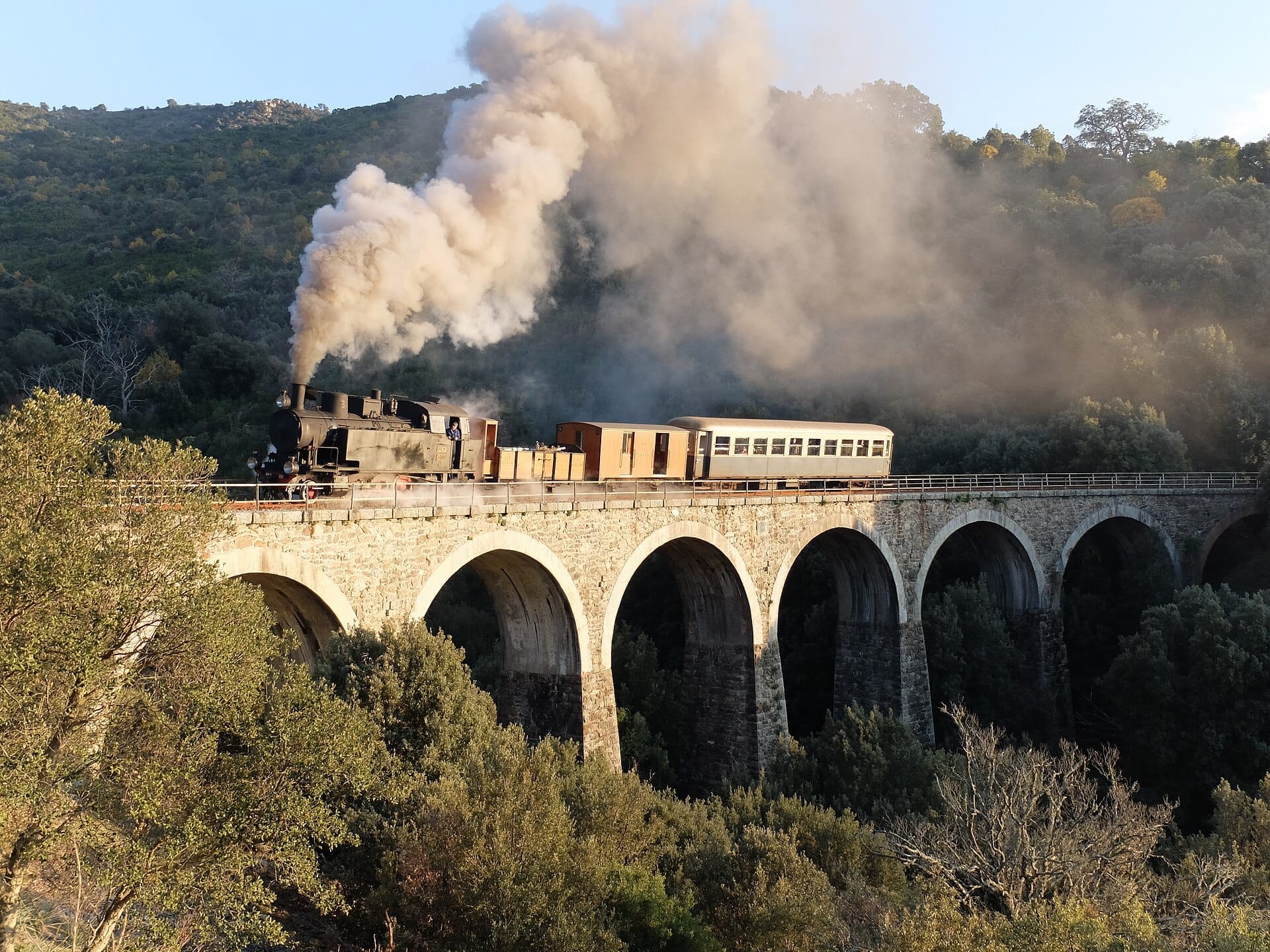
What Exactly Is the Trenino Verde?
The Trenino Verde della Sardegna, officially the Ferrovia Complementare della Sardegna, is a network of narrow-gauge tourist railway lines that covers approximately 438 km across Sardinia. That makes it one of the longest tourist railway networks in Europe. The tracks themselves are well over 130 years old, originally built to link the island's isolated mountain communities with its coastal towns, hauling minerals, timber, and passengers through terrain that resisted road-building for decades.
Today, operated seasonally by ARST (Azienda Regionale Sarda Trasporti), the network runs excursion services rather than regular commuter trains. The schedule changes year to year, with departures published in advance for each specific line, typically from spring through autumn. There is no single daily train you can catch on a whim — you plan ahead, choose your route, and book your seat.
⚠️ What to skip
The Trenino Verde does NOT run year-round and does NOT run every day. Timetables and active routes vary by season. Always check the official site (treninoverdedellasardegna.it) before planning your trip around it.
The Routes: Choosing the Right Journey
The network is divided into several distinct lines, each with its own character. The most talked-about options are the Mandas–Laconi route through the central highlands, the Arbatax–Gairo line along the Ogliastra coast and into the mountains, the Macomer–Bosa route descending toward the Planargia coast, and the Palau–Tempio Pausania line in the Gallura granite landscape of the north.
The Palau–Tempio Pausania route is perhaps the most immediately dramatic. The train covers under 60 km but takes roughly 3.5 hours, averaging around 20 km/h as it climbs through cork oak forest and granite outcrops. This is slow travel in the most literal sense: you watch shepherds' paths thread between boulders, hear the wheels grinding on tight curves, and feel the carriage sway as it crosses small iron bridges over dry summer riverbeds. The Gallura region that surrounds this route is also home to some of Sardinia's most extraordinary rock formations — not far away, you can find the Valle della Luna near Capo Testa, whose lunar granite shapes echo what you glimpse from the train window.
The Macomer–Bosa line descends from the basalt plateau of the Marghine into the valley of the Temo river, ending in the painted medieval town of Bosa. This route is shorter and often recommended for travelers who want a single compelling destination at the end of the ride rather than pure wilderness immersion. The combination of train journey and a few hours in Bosa's riverside historic centre makes a satisfying full-day excursion from Macomer or Nuoro.
Tickets & tours
Hand-picked options from our booking partner. Prices are indicative; availability and final rates are confirmed when you complete your booking.
Vineyard Guided Tour and 7 Wine Tasting in Palau
From 84 €Instant confirmationFree cancellationFull-Day Sailboat Tour in La Maddalena Archipelago from Cannigione
From 112 €Instant confirmationFree cancellationHiking excursion to the Devil's Saddle
From 35 €Instant confirmationFree cancellationExcursion to the Archaeological site of Nora
From 70 €Instant confirmationFree cancellation
What the Journey Feels Like
The rolling stock is historic. The carriages are compact, with wooden interiors, wide windows designed for viewing, and a slight diesel smell that mixes with the dry herb and resin scent drifting in from outside. Ventilation is modest. On warm June or September days, the windows stay open and you smell myrtle and wild fennel as the train pushes through scrubland. In the hotter weeks of July and August, those open windows are both a blessing and, when the train enters a tunnel, briefly unpleasant.
The sound profile is distinctive: a rhythmic clatter over rail joints, the occasional long horn blast before a level crossing, and a hush between stations where the engine note drops and you hear birdsong through the window. The pace encourages passengers to talk to each other. On organized excursion departures, you will often find a mix of Italian families, foreign rail enthusiasts, and older Sardinian travelers revisiting a form of transport they remember from childhood.
Stops at intermediate stations are short and sometimes feel almost theatrical: a platform that consists of a single bench, a water fountain, and a painted sign in faded green and white. Nobody boards, nobody alights, but there is a pause long enough to lean out and photograph the empty village lane. On the longer routes, scheduled stops at towns like Laconi or Gairo allow 30 to 60 minutes to explore on foot before the train continues.
💡 Local tip
Book a window seat on the correct side for your chosen route — check the route map in advance so you know which side faces the most dramatic landscape. On mountain descents, the valley-facing side gives the better views.
Historical and Cultural Context
Sardinia's narrow-gauge secondary railways were built starting in the 1880s and 1890s to open up the island's interior, which had resisted road construction due to its mountainous terrain and sparse population. The 950 mm gauge (narrower than standard European track) was chosen to reduce construction costs through steep valleys and across gorges. At their peak, these lines carried ore from Sardinia's mining districts, grain from the Campidano plain, and timber from the Gennargentu highlands.
As road infrastructure improved through the twentieth century, the practical transport function of these lines diminished. Regular passenger services on most routes ended progressively from the 1970s onward. Rather than abandoning the infrastructure, ARST converted surviving lines to seasonal tourist use under the Trenino Verde brand. The move preserved something rare: functional railway infrastructure crossing landscapes that remain as isolated today as they were when the tracks were laid. The Barbagia and Nuoro region that the central routes cross is one of the least densely populated zones in Italy, a landscape associated with traditional Sardinian pastoralism and the cultural identity of villages that appear in the novels of Grazia Deledda, Sardinia's Nobel Prize-winning author. You can explore this world further on foot through the hiking routes of Sardinia's interior.
Practical Walkthrough: How to Actually Book and Board
Start at the official Trenino Verde della Sardegna website (treninoverdedellasardegna.it), which publishes the year's active routes and departure dates well in advance of each season. Routes are typically announced in late winter or early spring. Some excursions sell out on popular summer dates, particularly the Palau–Tempio Pausania route in July and August, so booking early in the season is advisable.
Commercial partner Sardinia Green Train (sardiniagreentrain.com) handles packaged excursions that bundle the rail journey with guided village visits and lunch at a local agriturismo. These packages start around €59 per person and are worth considering if you want the logistical side handled for you. Simple point-to-point tickets start from around €15 one way, though fares vary by route and are adjusted seasonally, so treat those figures as a planning baseline rather than a fixed price.
Getting to the departure stations requires planning. Mandas, the hub for the central Sardinian routes, is reachable from Cagliari via the regional metro service to Monserrato, then ARST trains eastward. Macomer is on the main Cagliari–Sassari rail corridor served by Trenitalia. Palau, departure point for the northern Gallura route, sits near the ferry terminal for La Maddalena and is accessible by ARST bus from Olbia. Once you understand the island's public transport network, the connections become logical. For orientation, the broader guide to getting around Sardinia is a useful reference before you start piecing together the journey.
ℹ️ Good to know
Trenino Verde uses historic narrow-gauge rolling stock. Step-free boarding is not guaranteed and varies by route and trainset. Travelers with limited mobility should contact the operator directly when booking to clarify accessibility arrangements.
Photography, Weather, and the Best Time to Travel
The light in Sardinia's interior is harshest between 11:00 and 15:00 in summer, which is unfortunately when many trains are en route through open landscape. Morning departures produce softer, more photogenic light for the first hour or two. On the Macomer–Bosa route, the descent into the Temo valley in the late morning catches the river in a way that photographs particularly well. A wide-angle lens captures the cramped but characterful carriage interiors; a telephoto or a phone with a good zoom is more useful for distant landscape shots through the window.
September and early October are widely considered the best months for this type of journey. The summer heat has eased, the scrubland takes on warm amber and ochre tones, harvest activity is visible around villages, and the tourist volume on the trains drops compared to August. May and early June work well too: the hills are still green, wildflowers are present along the trackside, and the light is clear. Avoid peak summer if you are heat-sensitive; carriages can become warm. For a broader look at seasonal conditions across the island, the guide to Sardinia in September covers conditions well.
Who Should Think Twice
The Trenino Verde asks for patience. If your travel style prioritizes covering ground efficiently, the train's 20 km/h average and multi-hour journeys will frustrate rather than delight. The onboard facilities are basic: a toilet is usually present but not always comfortable by modern standards, and food and drink options on the train itself are limited. On packaged excursion days, catering is handled at stops, but on basic ticket journeys you are responsible for your own provisions.
Travelers with significant mobility limitations should contact the operator before booking, as the narrow-gauge carriages and station infrastructure vary considerably in accessibility. Children generally respond well to the novelty of the train, but very young children on full-day routes may find the long stretches between stops difficult. The trains are not air-conditioned in the traditional sense, so summer travel with infants requires careful planning around hydration and shade.
Insider Tips
- Print or download your ticket confirmation before travel — rural station staff do not always have reliable internet access to scan mobile tickets, and starting the journey with confusion at the gate is avoidable.
- Pack a small picnic for any route without a bundled lunch stop. The intermediate village stops on the Mandas–Laconi route are short, and the only food options at small stations may be nothing at all. Sardinian flatbread (pane carasau), local cheese, and cured meats travel well without refrigeration.
- The Macomer–Bosa route pairs naturally with an overnight stay in Bosa rather than a same-day return. The return ARST bus service covers the coastal road and adds a completely different perspective on the same landscape.
- Ask at the station about the specific trainset assigned to your departure. On some routes, older open-sided carriages (carrozze aperte) run alongside or instead of enclosed ones on scenic sections — the open carriages give a completely different sensory experience but offer no shelter if weather turns.
- Route availability changes year to year as ARST adjusts the operational calendar. If a specific route you have read about elsewhere is not appearing on the current season's timetable, it may be temporarily suspended rather than permanently cancelled — worth emailing the operator directly to confirm.
Who Is Trenino Verde (Green Train) For?
- Rail and slow-travel enthusiasts who prioritize the journey over the destination
- Photographers looking for Sardinia's interior landscapes without a rental car
- Families with children aged 6 and above who enjoy the novelty of vintage trains
- Travelers extending a trip through Barbagia and Nuoro province who want context for the landscape
- Anyone combining the train with a specific destination: Bosa via Macomer, or Tempio Pausania via Palau
Nearby Attractions
Other things to see while in Barbagia & Nuoro:
- Giara di Gesturi
Rising to around 550 metres above central Sardinia, the Giara di Gesturi is a 45-square-kilometre basalt plateau formed by Oligocene volcanic activity. Cork oak forests, seasonal wetlands, and an extraordinary population of small wild horses make it one of the most ecologically singular landscapes on the island.
- Gola di Su Gorropu
Gola di Su Gorropu is a karst canyon in Sardinia's Supramonte massif with walls rising over 500 metres and passages as narrow as 4 metres across. It's a serious hiking destination that rewards physical effort with one of the most dramatic landscapes in the Mediterranean.
- Monte Ortobene
Reaching a maximum elevation of 955 metres above sea level near the inland city of Nuoro, Monte Ortobene is a forested mountain with panoramic views across central Sardinia, a landmark bronze statue of Cristo Redentore, and walking paths through fragrant Mediterranean scrubland. Access is free, the road reaches the summit, and the atmosphere is unlike anything on the coast.
- Murales di Orgosolo
Orgosolo, a small hill town in the Barbagia region of central Sardinia, has covered its streets in around 150 murals since the late 1960s. Free to visit at any hour, the Murales di Orgosolo form one of the most politically charged and visually striking open-air art experiences in Italy.