Valle della Luna (Capo Testa): Sardinia's Surreal Granite Valley
On the far northern tip of Sardinia, the Valle della Luna is a roughly 500-metre granite valley that drops to a sheltered cove called Cala Grande. No ticket, no services, no crowds in shoulder season — just sculpted rock, clear water, and one of the island's most atmospheric short walks.
Quick Facts
- Location
- Capo Testa promontory, Santa Teresa Gallura, Gallura — approx. 4 km from Santa Teresa town centre
- Getting There
- Drive or cycle to Capo Testa, then a roughly 700 m footpath from the small clearing near the bungalows. No direct public bus to the trailhead.
- Time Needed
- 2 to 3 hours including the walk in, time at the cove, and the return
- Cost
- Free — no admission fee, no ticket office
- Best for
- Nature lovers, geology enthusiasts, wild swimmers, photographers, couples
- Official website
- www.sardegnaturismo.it/en/explore/cala-grande-valle-della-luna
What Is Valle della Luna?
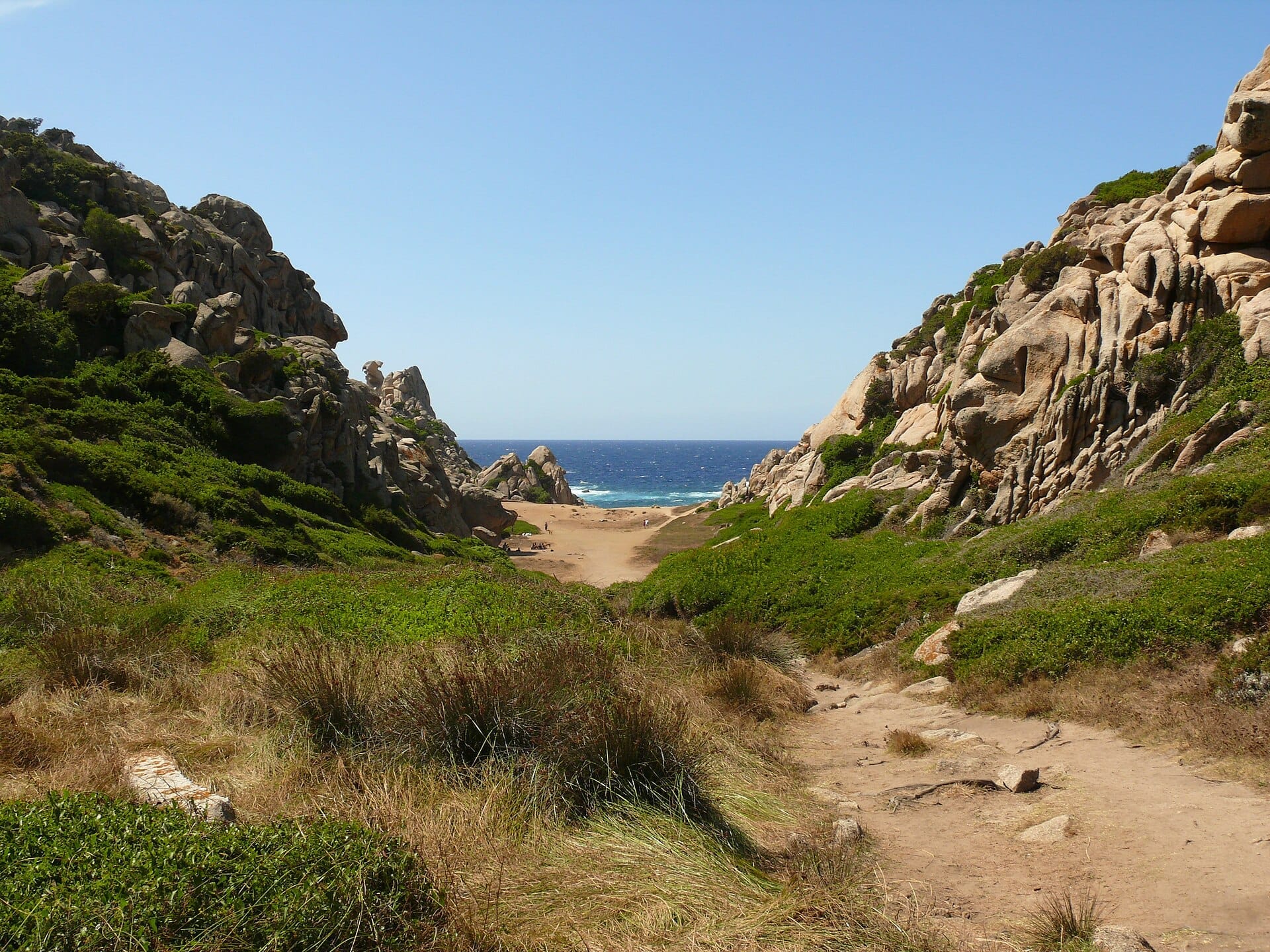
Valle della Luna — officially known as Cala Grande or Valle della Luna — is a compact natural valley on the western flank of the Capo Testa promontory, in the municipality of Santa Teresa Gallura. The valley runs roughly 500 metres through weathered granite, eventually opening onto Cala Grande, a small, sheltered cove with water that shifts between turquoise and deep blue depending on the light and time of day.
The geology here is the main event. The granite formations are enormous — some blocks the size of small houses, rounded by millennia of wind and sea salt into organic, almost molten-looking shapes. Walking through the valley feels less like a nature trail and more like moving through a sculpture garden that nobody designed. The rock is warm to the touch in summer, almost luminous at dusk when the low sun catches the pale grey surface.
Capo Testa itself has a perimeter of about 10 km and has been worked since Roman times — historical sources note it as an important granite quarry area linked to Roman-era construction. Evidence of that extraction is still visible in the rock faces if you know what to look for. For more on the broader area, the Gallura region page gives useful orientation on the surrounding landscape and nearby towns.
💡 Local tip
There are no facilities in the valley or at the cove — no toilets, no snack bar, no shade structures. Bring at least 1.5 litres of water per person, sunscreen, and something to eat. In peak summer this is non-negotiable.
The Walk In: What the Path Is Actually Like
From Santa Teresa Gallura, follow signs toward Capo Testa. After crossing the narrow isthmus connecting the promontory to the mainland, turn left and continue for about one kilometre until you reach a cluster of bungalows. Bear right from there toward a small clearing — this is where the footpath begins. There is limited informal parking in the clearing, though in August it fills by 9am.
The path itself is roughly 700 metres long and involves navigating over uneven granite slabs, squeezing between large boulders, and the occasional short scramble where you will use your hands for balance. It is rated easy to moderate — fit adults and older children will manage without difficulty, but it is not suitable for pushchairs, wheelchairs, or anyone with significant mobility limitations. Sturdy sandals work, but closed shoes with grip are more comfortable.
The descent is gradual rather than steep, and the path is clearly used enough that route-finding is not a problem. What changes with each visit is the quality of light filtering through the rock formations. In the morning, the granite is cool and the light is sharp and directional, making the boulders look almost architectural. By midday it becomes harsh and flat. The late afternoon light, particularly in September, turns the stone a warm amber that is worth the timing effort.
Tickets & tours
Hand-picked options from our booking partner. Prices are indicative; availability and final rates are confirmed when you complete your booking.
Santa Teresa di Gallura hiking tour of Valle della Luna
From 30 €Instant confirmationFree cancellationCala Goloritze and Cala Luna dinghy tour from Orosei
From 149 €Instant confirmationFree cancellationDolphin watching RIB tour to Capo Figari from Olbia
From 72 €Instant confirmationFree cancellationTrekking to Cala Luna from Cala Gonone
From 54 €Instant confirmationFree cancellation
Cala Grande: The Cove at the Bottom
Cala Grande is the reward at the end of the path. It is not a classic Sardinian beach in the white-sand sense — the shore is rocky and the entry into the water requires some care over submerged boulders. But the water clarity here is exceptional, and the cove is small enough that it never feels overrun except during the final weeks of July and first half of August.
Snorkelling is worthwhile. The underwater granite formations continue beneath the surface, creating ledges and crevices that shelter small fish. Bring a mask; the visibility can extend 10 to 15 metres on calm days. Swimming conditions depend on wind direction — the cove faces roughly west-northwest and picks up chop when the Mistral blows, which is common in this part of Sardinia. On still days the surface is flat and the water temperature in July and August is comfortable.
If you want to compare this kind of granite-coast swimming experience with other wild coves in northern Sardinia, Capo Testa itself has several additional coves accessible by foot, and the rocky coast near Costa Paradiso to the southwest offers similarly sculptural landscapes.
⚠️ What to skip
When the Mistral wind is blowing, conditions at Cala Grande can change quickly — the sea becomes choppy and entry over the rocks becomes more hazardous. Check the local forecast before committing to the walk on windy days.
The Hippie History and Cultural Layer
Valle della Luna carries a distinctive cultural undercurrent. From the late 1960s onward, a loose community of European counterculture travellers frequented and in some cases settled in the valley, drawn by its isolation, its otherworldly atmosphere, and the fact that nobody seemed to own it in any conventional sense. The name itself — Valley of the Moon — dates from that era, and some visitors still come with that history in mind.
Evidence of that era has mostly faded, though you may find the occasional remnant of informal shelter tucked against the rock faces. The atmosphere of the place — remote, slightly untamed, with acoustic qualities shaped by the curved granite walls — still reads as something apart from standard tourist infrastructure. It attracts a noticeably mixed crowd: families from nearby campsites, free divers, couples, and photographers alongside the occasional visitor who seems to be here for reasons that predate Instagram.
The broader Gallura region has several other layers of history worth exploring alongside this one. Sardinia's nuragic past is well represented nearby, and the nuragic sites guide is useful if you want to build a day around more than one type of attraction in the north.
When to Go: Time of Day and Season
The best window is either early morning before 9am or after 5pm in July and August. Midday visits in peak summer mean full sun with no shade in the valley, warm rock surfaces, and the greatest concentration of people at the cove. The path does not have tree cover and the granite radiates heat.
September is arguably the most rewarding month. The water is still warm from summer, the crowds thin considerably after the Italian school holiday ends in the first week of September, and the light at the golden hour is long and striking across the rock formations. May and June offer cooler conditions and near-empty paths, though the sea is cooler for swimming.
For a broader picture of how to time a trip to this part of Sardinia, the guide to Sardinia in September covers the shoulder season advantages in detail, including reduced prices and more available accommodation across the north.
ℹ️ Good to know
Valle della Luna has no formal gates controlling access and no formal opening hours. It is accessible at any hour, though visiting after dark without a torch is not advisable given the uneven terrain.
Photography: What Works and What Doesn't
The granite formations photograph well in almost any condition, but the images that stand out come from two specific windows. The first is the soft light of early morning, when long shadows emphasise the texture of the rock and the sky still holds some blue depth. The second is the hour before sunset, when the stone takes on a warm tone and the sea behind the cove becomes a deep, saturated blue-green.
Midday shots tend to look washed out — the pale granite and bright sky create a high-contrast scene that is difficult to expose well without graduated filters. If you are shooting on a phone, the late afternoon is your best option. Wide-angle lenses capture the scale of the boulders better than telephoto. For the cove, position yourself on the rocks above the waterline for the clearest view of the turquoise shallows against the granite.
Drone operators should be aware that Capo Testa falls within a coastal area where local flying restrictions may apply. Check current regulations with ENAC (Italy's civil aviation authority) before flying.
Is It Worth the Trip?
For most visitors to northern Sardinia, yes. The combination of the geological spectacle, free access, and a swimmable cove at the end makes it a strong half-day option. It is not a polished attraction — there are no signs explaining the geology, no visitor centre, and no services — but that is precisely what makes it function as a counterpoint to the more developed beaches nearby.
Who might not get much from it: travellers who are primarily beach-focused and want a long stretch of sand, anyone with mobility limitations that make rocky terrain difficult, and visitors who dislike being in the sun without shade options. Families with very young children should factor in the scrambling sections of the path.
If you are based in Santa Teresa Gallura for a few days, this pairs naturally with the lighthouse walk on the opposite side of the promontory and an evening back in town. The day trips guide covers longer planning options if you are approaching from the south, though the drive from Cagliari to Capo Testa is around four to four and a half hours each way.
Insider Tips
- Park at the clearing early — by 10am in August the informal parking area is full and cars line the road back toward the bungalows, adding 10 to 15 minutes to the walk each way.
- The valley has natural acoustic chambers formed by the curved boulder walls. On quiet mornings, the sounds of the sea below reach you before the cove comes into view — follow the sound to stay on the correct path when the route briefly becomes ambiguous.
- The best snorkelling is to the right side of Cala Grande as you face the sea, where the submerged granite ledges are deeper and more varied. The left side is shallower and more exposed to surge on windy days.
- If you arrive to find the cove crowded, the rocks immediately above and to the west of the cove offer flat ledges for sunbathing and swimming entry points that most day visitors overlook.
- Bring cash for parking or lunch in Santa Teresa Gallura afterward — card acceptance at small beach bars in the area is inconsistent outside peak season.
Who Is Valle della Luna (Capo Testa) For?
- Wild swimmers who prefer rocky coves to crowded sandy beaches
- Photographers, particularly those working in natural light and landscape
- Couples looking for a scenic half-day that avoids the main tourist beaches
- Nature-focused travellers interested in geology or counterculture history
- Families with children old enough to handle a short rocky scramble
Nearby Attractions
Other things to see while in Gallura:
- Basilica di San Simplicio (Olbia)
The Basilica di San Simplicio is the oldest surviving building in Olbia and one of the finest Romanesque churches in Sardinia. Built between the late 11th and mid-12th centuries on a site with origins in a Roman necropolis and a Palaeo-Christian church, it offers a rare, unhurried encounter with pre-medieval Gallura — around ten minutes' walk from the ferry port crowds.
- Capo Testa
Capo Testa is a rugged granite promontory jutting into the Strait of Bonifacio near Santa Teresa Gallura, in Sardinia's far north. The headland is free to visit and rewards exploration with wind-sculpted rock formations, secluded sea pools, and the eerily beautiful Valle della Luna. It is one of northern Sardinia's most distinctive natural landscapes.
- Coddu Vecchiu Giants' Tomb (Arzachena)
The Giants' Tomb of Coddu Vecchiu is one of Sardinia's best-preserved Nuragic funerary monuments, featuring a roughly 4-metre granite entrance stele that has stood in the Gallura countryside for roughly 4,000 years. Located about 10 km from the Gulf of Arzachena, it offers a absorbing encounter with the island's prehistoric past in under an hour.
- Costa Paradiso
Costa Paradiso is a striking stretch of northern Sardinian coastline where ancient red and orange granite cliffs drop into transparent turquoise water. Largely a seasonal holiday settlement with under 200 year-round residents, it offers raw scenery, natural rock pools, and sheltered coves without the infrastructure of larger resorts.