Costa Paradiso: Sardinia's Red Rock Coastline in Gallura
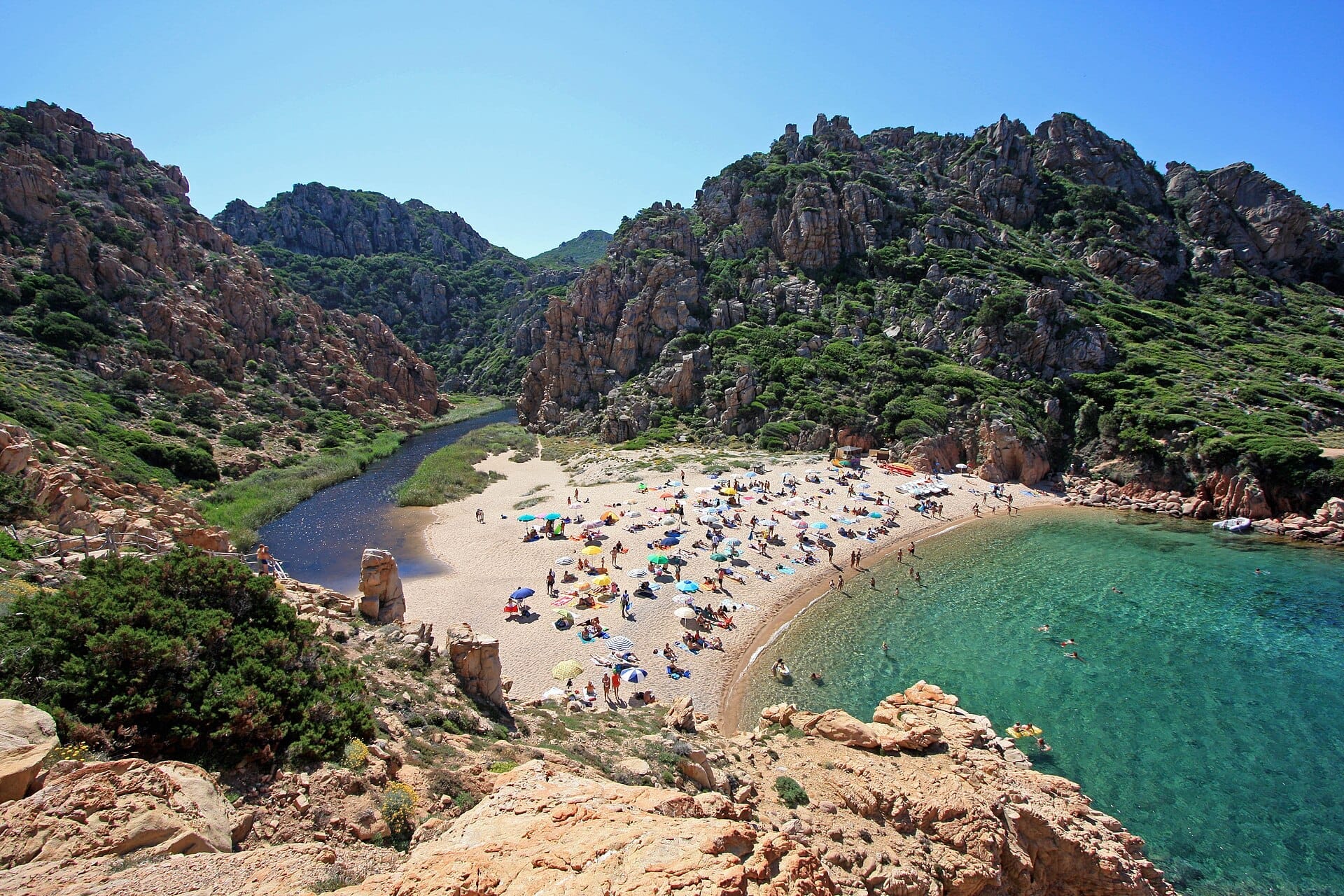
Costa Paradiso is a striking stretch of northern Sardinian coastline where ancient red and orange granite cliffs drop into transparent turquoise water. Largely a seasonal holiday settlement with under 200 year-round residents, it offers raw scenery, natural rock pools, and sheltered coves without the infrastructure of larger resorts.
Quick Facts
- Location
- Trinità d'Agultu e Vignola, Province of Sassari, northern Sardinia — between Santa Teresa Gallura and Castelsardo
- Getting There
- Car essential — no reliable public transport serves the locality. Nearest airports: Olbia Costa Smeralda (OLB, ~90 km) or Alghero-Fertilia (AHO, ~100 km)
- Time Needed
- Half day to explore a few coves; a full day if you plan to swim, picnic, and walk the coastal paths
- Cost
- Free to access the coastline. Private parking, beach facilities, and boat hire are charged separately by individual operators
- Best for
- Geology lovers, photographers, swimmers seeking uncrowded water, and travellers who want dramatic scenery without resort crowds
- Official website
- www.italia.it/en/sardinia/sassari/costa-paradiso
What Costa Paradiso Actually Is
Costa Paradiso is not a town in any conventional sense. It is a coastal locality in the municipality of Trinità d'Agultu e Vignola, in the Gallura region of northern Sardinia, with roughly 200 year-round residents. The settlement consists of roughly 3,500 villas and holiday homes spread across a rocky promontory, built from the late 1960s onward as a planned tourist development. Around 2,500 owners use those homes seasonally. Almost nothing here operates year-round: shops, restaurants, and rental services open in June and close by late September or early October.
What draws visitors is not the settlement itself but the geology surrounding it. The coastline is formed from ancient granite that has oxidized into shades of deep red, burnt orange, and rust. Waves have sculpted the rock into jagged fjord-like inlets, natural swimming pools, and small sandy coves tucked between boulders. The colour contrast between the reddish cliffs and the pale green-blue water is striking, and it makes Costa Paradiso one of the most photogenic stretches of Sardinian coastline north of the Gallura interior.
ℹ️ Good to know
Costa Paradiso sits just outside the most famous stretches of the Costa Smeralda circuit. It offers comparable water clarity and more dramatic rock scenery, but with far fewer organized facilities. Come prepared with your own food, water, and sun protection.
The Landscape: Red Granite, Coves, and Natural Pools
The defining feature of Costa Paradiso is its granite. The exposed rock here belongs to the same geological formation that shaped much of the Gallura region, but oxidation and erosion have given it an unusually warm colour palette. In morning light, the cliffs read as deep terracotta. By midday, they bleach slightly in the direct sun. In the hour before sunset, the rock glows almost copper-red against the darkening water, which is when photographers tend to gather on the higher outcrops.
The coastline is rocky and irregular. There are no long sandy beaches in the style of, say, the beaches further south along the Costa Rei. Instead, visitors move between small inlets: some floored with pale sand, others with smooth pebbles or flat granite shelves that serve as natural sunbathing platforms. Natural rock pools form in lower-lying areas where the sea cuts into horizontal shelves of stone — these are sheltered from swell and safe for children to splash in on calm days, though the terrain getting to them requires care.
The wider northern coast of Sardinia has several comparable wild rocky stretches. If Costa Paradiso's terrain appeals to you, it's worth also considering Capo Testa near Santa Teresa Gallura, where granite formations reach even more dramatic sculptural extremes, or exploring the broader Gallura region coastline for similar geology with different orientations.
Tickets & tours
Hand-picked options from our booking partner. Prices are indicative; availability and final rates are confirmed when you complete your booking.
Sightseeing tour of Costa Smeralda
From 130 €Instant confirmationDolphin-watching experience from Pittulongu with a marine biologist
From 35 €Instant confirmationFree cancellationDolphin watching and snorkeling near Figarolo Island
From 79 €Instant confirmationFree cancellationVineyard Guided Tour and 7 Wine Tasting in Palau
From 84 €Instant confirmationFree cancellation
How the Experience Changes by Time of Day
Early morning at Costa Paradiso is the closest thing the place has to genuine quiet. Before 9am in high summer, the coves near the village are essentially empty. The water is glassy in sheltered spots, and the low angle of sunlight intensifies the red tones in the granite. This is the best time for swimming — the sea is cool and clean, visibility underwater is excellent, and you have the flat granite shelves largely to yourself.
By mid-morning in July and August, the main accessible coves fill up quickly. Families with children, villa renters from the surrounding development, and day-trippers from Santa Teresa Gallura and Castelsardo all converge. The rocky terrain means there is limited flat space, and popular spots feel crowded despite the area's low profile compared to larger resorts. Parking in the village fills up. The heat on exposed granite by noon is intense — the rock absorbs and radiates heat in a way that beach sand does not, and shade is limited.
Late afternoon is productive again. The crowds thin from around 5pm as families leave. The light turns golden. The water, having absorbed a full day of sun, is at its warmest. This late window — roughly 5pm to 7pm in summer — is when the coastline shows itself at its best: warm rock, warm sea, low crowds, and exceptional light quality for photography.
💡 Local tip
Arrive before 9am or after 5pm in July and August. Midday on the granite cliffs without shade is uncomfortable, and parking near the main coves becomes difficult from late morning.
Getting to Costa Paradiso and Getting Around
A car is not optional here — it is the only realistic way to reach Costa Paradiso. The locality has no train connection and sits off the main public transport routes along the northern Sardinian coast. The closest airports are Olbia Costa Smeralda (IATA: OLB), approximately 90 kilometres to the southeast, and Alghero-Fertilia (IATA: AHO), roughly 100 kilometres to the southwest. Both are served by seasonal European routes, with the highest frequency in summer.
The coastal road between Santa Teresa Gallura and Castelsardo passes near Costa Paradiso. From Santa Teresa Gallura the drive takes around 25 to 30 minutes on winding roads with occasional sharp bends. Internal roads within the Costa Paradiso development are narrow and designed for low-speed movement between villas. There is no central car park for the coastline as a whole; visitors park where they can near whichever cove they intend to visit.
If you're planning a longer loop through northern Sardinia, Costa Paradiso fits naturally into a route that also takes in the medieval village of Castelsardo to the east and Santa Teresa Gallura to the west. A Sardinia road trip is by far the most practical way to combine these northern coastal sites.
Swimming, Snorkelling, and What the Water is Like
The water quality around Costa Paradiso is consistently good. The rocky and relatively undeveloped coastline means minimal runoff, and the coves benefit from strong tidal circulation. Visibility underwater is often excellent — typically several metres on calm days — making it productive for snorkelling even without a boat. The combination of granite boulders, rock shelves, and patches of posidonia seagrass below the surface supports a reasonable variety of fish, including sea bream, wrasse, and occasional octopus in the shallower rocky areas.
Entry to the water is the main challenge. Few of the natural coves have gently shelving sandy beaches. Most require stepping off rocks or granite ledges, which can be slippery when wet and awkward with young children or anyone with mobility limitations. Wearing water shoes is strongly advisable — both for entry and for exploring the natural pools. If you're planning to snorkel around the outer rocks, even a short surface swim from an entry ledge, be aware that swell can make re-entry onto rocks uncomfortable or dangerous in anything other than calm conditions.
The swimming season at Costa Paradiso runs broadly from late May through early October, matching the wider Sardinian pattern. For more on timing your visit to get the sea at its best, see the best time to visit Sardinia guide, which covers water temperatures and shoulder-season conditions across the island.
Practical Realities: What to Know Before You Go
Costa Paradiso is seasonal in an unusually complete way. Outside June to September, most of the 3,500 villas are locked, the handful of local restaurants and bars are closed, and even basic supplies are difficult to find. If you visit in May or October — shoulder months when the light is often excellent and the sea still swimmable — bring everything you need: food, water, sunscreen, and a fully charged phone, since mobile signal can be patchy on the more remote coastal paths.
The terrain is not wheelchair accessible in any meaningful sense. Rocky paths, uneven granite surfaces, steps cut into cliff faces, and the absence of formal infrastructure all make this a challenging environment for visitors with reduced mobility. This is not a beach in the resort sense of the word, and it should not be treated as one.
Photography here rewards patience and preparation. The red granite photographs best in the first and last hours of daylight, when the warm light source-matches the warm rock tones. A polarising filter makes a significant difference in cutting reflection off the water surface. The highest outcrops above the main coves give the best compositional angle, placing the coloured cliffs in the foreground against the water beyond.
⚠️ What to skip
Do not attempt to access unfamiliar coves alone when swell is running. The rock shelves can be slippery and re-entry from the water onto steep granite is hazardous in rough conditions. Check sea conditions before arriving.
Honest Assessment: Is It Worth the Detour?
Costa Paradiso is not the most convenient stop in northern Sardinia. It requires a car, offers limited services, and in peak summer the better-known coves can feel crowded relative to the space available. But the geology is distinctive. The red granite coastline looks unlike anything else on this part of the island, and the natural swimming conditions — clear water, rock pools, good snorkelling — are excellent when the sea is calm.
Travellers who want a sun-bed, a beach bar, and easy sand-to-sea access will be disappointed. Travellers who are happy to pick their way across granite, bring a packed lunch, and spend a morning in the water without infrastructure will likely find it one of the more memorable stops on a northern Sardinian itinerary.
If you are weighing up where to focus your time in northern Sardinia, the Sardinia hidden gems guide covers several comparable wild coastal spots that require a similar approach — car, self-sufficiency, and a tolerance for rugged access — but reward with solitude and scenery that the larger resorts cannot match.
Insider Tips
- The highest accessible outcrops above the main coves give a dramatically different perspective to the water below — worth the short scramble for the view and for photography, particularly in the late afternoon.
- In July and August, parking near the coastal access points fills by 10am. Drive through the villa development the evening before to identify where you'll park, or plan to arrive at dawn.
- Water shoes are not optional — they are the difference between comfortable exploration and cut feet. Bring them even if you only plan to sit on the rocks.
- The shoulder months of May and late September offer the same geology and comparable water clarity with a fraction of the visitors. Many villa owners are absent, local services are reduced, but the coastline itself is fully accessible.
- If you have access to a kayak or inflatable boat, launching from one of the accessible coves and paddling along the base of the cliffs gives a completely different view of the red granite formations — the rock faces photographed from water level are even more dramatic than from above.
Who Is Costa Paradiso For?
- Photographers and travellers focused on landscape and geology
- Swimmers and snorkellers who prefer clear rocky coves to organized beaches
- Road-trippers building a northern Sardinia coastal route
- Couples or independent travellers who want striking scenery without resort infrastructure
- Visitors in shoulder season (May or late September) looking for wild coastline without summer crowds
Nearby Attractions
Other things to see while in Gallura:
- Basilica di San Simplicio (Olbia)
The Basilica di San Simplicio is the oldest surviving building in Olbia and one of the finest Romanesque churches in Sardinia. Built between the late 11th and mid-12th centuries on a site with origins in a Roman necropolis and a Palaeo-Christian church, it offers a rare, unhurried encounter with pre-medieval Gallura — around ten minutes' walk from the ferry port crowds.
- Capo Testa
Capo Testa is a rugged granite promontory jutting into the Strait of Bonifacio near Santa Teresa Gallura, in Sardinia's far north. The headland is free to visit and rewards exploration with wind-sculpted rock formations, secluded sea pools, and the eerily beautiful Valle della Luna. It is one of northern Sardinia's most distinctive natural landscapes.
- Coddu Vecchiu Giants' Tomb (Arzachena)
The Giants' Tomb of Coddu Vecchiu is one of Sardinia's best-preserved Nuragic funerary monuments, featuring a roughly 4-metre granite entrance stele that has stood in the Gallura countryside for roughly 4,000 years. Located about 10 km from the Gulf of Arzachena, it offers a absorbing encounter with the island's prehistoric past in under an hour.
- La Cinta Beach (San Teodoro)
La Cinta is one of the longest beaches in northeast Sardinia, a 3.2 km arc of fine white sand backed by a brackish lagoon where flamingos wade year-round. Shallow, calm water and flat access from San Teodoro town make it one of Gallura's most approachable stretches of coast, though its reputation means peak-summer crowds are real and worth planning around.