Coddu Vecchiu Giants' Tomb: Sardinia's Most Impressive Bronze Age Burial
The Giants' Tomb of Coddu Vecchiu is one of Sardinia's best-preserved Nuragic funerary monuments, featuring a roughly 4-metre granite entrance stele that has stood in the Gallura countryside for roughly 4,000 years. Located about 10 km from the Gulf of Arzachena, it offers a absorbing encounter with the island's prehistoric past in under an hour.
Quick Facts
- Location
- SP 14, località Coddu Ecchju, 07021 Arzachena (SS), Sardinia
- Getting There
- Car required via provincial road SP 14; signposted archaeological area approx. 10 km from Arzachena town centre
- Time Needed
- 45–90 minutes
- Cost
- Paid entry; combined ticket options available. Check current prices at gesecoarzachena.it
- Best for
- History enthusiasts, archaeology fans, curious travellers staying near Costa Smeralda
- Official website
- www.gesecoarzachena.it
What Is Coddu Vecchiu, and Why Does It Matter?
The Giants' Tomb of Coddu Vecchiu (Italian: Tomba dei Giganti di Coddu Ecchju) is a Nuragic-era collective burial monument located in the Gallura region of northern Sardinia, a short distance from Arzachena. It is one of the most structurally complete examples of this tomb type on the island, and the sheer scale of its entrance stele makes it immediately striking even to visitors with no prior knowledge of Sardinian prehistory.
Giants' tombs are among the most distinctive monuments of the Nuragic civilisation, which flourished across Sardinia through much of the Bronze Age. The name is folkloric rather than literal: medieval Sardinians encountering these enormous stone structures assumed they must have been built by giants. In reality, they were communal burial galleries used by Nuragic communities, likely holding the remains of dozens of individuals over several generations.
Coddu Vecchiu sits within a broader archaeological landscape that rewards curious travellers. The Gallura hinterland contains several Nuragic sites within a compact area, making it possible to combine this visit with other monuments on the same afternoon. For broader context on Sardinia's prehistoric heritage, see the Sardinia Nuragic sites guide.
The Archaeology: 4,000 Years in Stone
Construction at Coddu Vecchiu unfolded in two distinct phases. The first belongs to the Bonnanaro culture of the Early Bronze Age, roughly 2100 to 1800 BC, when an earlier gallery tomb (allée couverte) was built here. A renovation followed in the early Middle Bronze Age, approximately 1800 to 1600 BC, when Nuragic builders enlarged and dramatically transformed the structure into the form visible today.
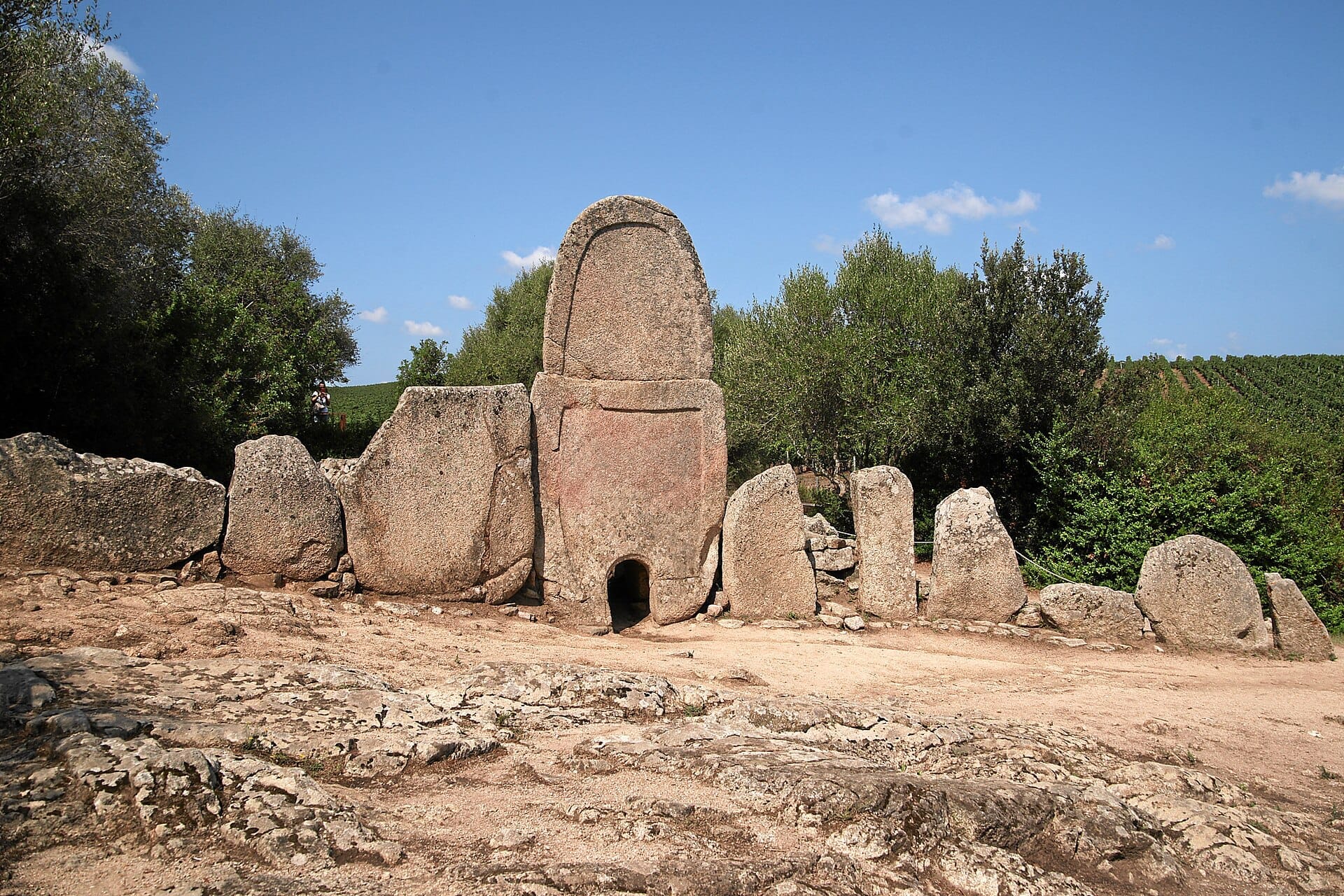
The defining feature is the entrance stele: a single upright granite slab rising to approximately 4 metres, positioned at the centre of a curved exedra, a semicircular forecourt of standing stones that frames the burial corridor entrance. This exedra arrangement is characteristic of the more developed giants' tombs and would have functioned as a ritual gathering space, a place where the living could perform ceremonies connected to ancestor veneration.
The funerary corridor itself runs about 8.4 metres in length and is about one metre wide, contained within a broader burial structure approximately 10 metres long. The corridor is formed by upright slabs with covering capstones, several of which remain in place. You can peer directly into the chamber from the entrance, giving a genuine sense of the enclosed, cave-like space that would have received the dead.
ℹ️ Good to know
The stele at the entrance has a low rectangular doorway carved near its base. Scholars believe this opening allowed ritual access to the tomb interior during ceremonies — not for regular entry. The proportions feel deliberate and precise even after four millennia.
Tickets & tours
Hand-picked options from our booking partner. Prices are indicative; availability and final rates are confirmed when you complete your booking.
Vineyard Guided Tour and 7 Wine Tasting in Palau
From 84 €Instant confirmationFree cancellationFull-Day Sailboat Tour in La Maddalena Archipelago from Cannigione
From 112 €Instant confirmationFree cancellationHiking excursion to the Devil's Saddle
From 35 €Instant confirmationFree cancellationExcursion to the Archaeological site of Nora
From 70 €Instant confirmationFree cancellation
What the Visit Actually Looks and Feels Like
The approach from the small car park is brief, through low scrubby macchia. The monument comes into view suddenly as you crest a gentle rise: a grey granite stele standing alone in an open field of pale grass and rock, with the Gallura hills rolling away behind it. There is no grand entrance building. The simplicity is effective.
Up close, the granite has the rough, lichen-stained texture of very old exposed stone. The exedra stones, some upright and some tilted by centuries of soil movement, curve outward from the stele in a loose arc. In morning light, the stones cast long shadows across the forecourt and the carved doorway on the stele is easy to examine closely. By midday in summer, the site offers almost no shade, and the pale stone reflects heat intensely. Visiting early or in the late afternoon is not just preferable, it is more comfortable.
The surrounding land is quiet. On weekday mornings in spring and autumn, you may have the site almost entirely to yourself, with only the sound of wind and occasional birdsong. At peak summer, particularly July and August, small groups pass through regularly, but the monument never feels overcrowded in the way that coastal sites do during high season.
💡 Local tip
Photography tip: the entrance stele photographs best in the golden hour before sunset, when low-angle light picks out the texture of the granite and the carved doorway catches shadow. Morning light works well too if you want the Gallura hills in the background without harsh midday glare.
Opening Hours, Tickets, and Getting There
Coddu Vecchiu is managed by Geseco Arzachena and operates seasonal hours. From May through September, the site is open daily from 10:00 to 19:30. Between October and April, it opens Tuesday to Sunday from 10:00 to 16:00, with Mondays closed. These hours are subject to adjustment, so checking the official website or contacting the site directly before your visit is worth the two minutes it takes.
Admission is charged. Combined ticket options exist that bundle Coddu Vecchiu with other Arzachena archaeological sites, which can represent good value if you plan to visit more than one monument. Current prices are listed at gesecoarzachena.it. Guided tours and audio guides are available on-site and can be arranged through the ticket office. The on-site bookshop stocks materials on Nuragic archaeology. Wi-Fi is available at the site.
The site lies along provincial road SP 14 in the locality of Coddu Ecchju, about 10 kilometres from the Gulf of Arzachena. It is clearly signposted as an archaeological area. A car is essentially required: there is no practical public transport connection. Taxis from Arzachena town or from nearby coastal resorts are possible but should be arranged in advance, as a return pickup at a rural site is not something you can assume will be available on demand. Parking at the site is free and straightforward.
⚠️ What to skip
If you are staying on the Costa Smeralda without a rental car, this site is difficult to reach. Plan for a rental or a pre-arranged taxi with a confirmed return time.
Practical Considerations: What to Wear and Bring
The site is outdoors and the ground around the monument is uneven in places, with loose stones and low vegetation. Flat, closed-toe shoes are strongly preferable to sandals. In summer, sun protection is not optional: there is no shade of consequence within the monument area, temperatures regularly reach the high 20s and 30s Celsius, and the walk from the car park offers no cover.
Coddu Vecchiu has facilitated physical accessibility for visitors with reduced mobility, with some site adaptations in place. The terrain around the monument itself is not paved, however, so visitors with significant mobility constraints should contact the managing body in advance to understand the current arrangements. The email contact is archeologia@gesecoarzachena.it and the site phone is +39 345 5760643.
If you are visiting Sardinia in the shoulder months of May or September, the combination of mild weather, good light quality, and thinner crowds makes the experience considerably more enjoyable than in the peak summer rush. For a broader picture of what the island offers in those months, the guides on visiting Sardinia in May and Sardinia in September are worth reading before you book.
Placing Coddu Vecchiu in Context: the Gallura Archaeological Circuit
The Gallura region is not typically what travellers associate with archaeological depth: most visitors come for the Costa Smeralda's beaches and the spectacle of La Maddalena. But the inland territory around Arzachena holds a cluster of Nuragic monuments that are among the most accessible in northern Sardinia, and Coddu Vecchiu is the centrepiece.
Within a short drive, you can also visit the nuraghe of Albucciu and the Li Muri necropolis, another Arzachena site that predates giants' tombs and belongs to the island's Copper Age. The Gallura region page covers the wider area, including how to structure a day that takes in both prehistoric monuments and the coast.
For travellers who want to go deeper into Nuragic culture across the island, the major benchmarks are Su Nuraxi di Barumini in the south, a UNESCO World Heritage Site, and Nuraghe Santu Antine in the Meilogu. Coddu Vecchiu does not compete on scale with those complexes, but it offers something they cannot always provide: a relatively uncrowded, intimate encounter with a single monument where you have the space to look carefully and think.
Who Should Consider Skipping This
Visitors with no interest in archaeology or prehistory are unlikely to find the visit rewarding. The monument is a field with ancient stones: there is no reconstruction, no immersive exhibition, no dramatic landscape setting comparable to a coastal cliff or mountain summit. If your time in Sardinia is limited and concentrated around beaches and food, this is not the highest-priority use of a half-day.
Similarly, travellers relying solely on public transport or those with very young children who need structured activities may find the logistics awkward and the monument itself less engaging than interactive family sites. For a broader assessment of what the island offers different types of traveller, the guide to things to do in Sardinia provides a useful comparative framework.
Insider Tips
- Buy the combined ticket that includes multiple Arzachena archaeological sites before arriving: it costs only marginally more than a single-site ticket and covers the nuraghe of Albucciu and the Li Muri necropolis, both within a short drive.
- Visit on a weekday in late spring or early autumn if your schedule allows. Peak summer weekends bring tour groups from the Costa Smeralda resorts, and while the site never becomes truly congested, weekday mornings in May, June, or September offer noticeably more solitude.
- Bring a torch or use your phone light even in daytime: the funerary corridor interior is dim and the construction details of the capstones and side slabs are easier to examine with supplementary light.
- The stele carving at the base, the low rectangular access doorway, is easy to miss if you only photograph the monument from a distance. Crouch down and examine it directly — the proportions and finish are more precise than the surrounding stonework.
- Mobile signal in the area can be patchy. Download offline maps and the site information before you leave your accommodation, particularly if you are navigating from a coastal resort.
Who Is Coddu Vecchiu Giants' Tomb (Arzachena) For?
- Archaeology and prehistory enthusiasts who want to move beyond the Su Nuraxi benchmark and see well-preserved monuments with fewer crowds
- Travellers staying on the Costa Smeralda or in Arzachena looking for a culturally substantive half-morning away from the beach
- Photographers interested in ancient stone architecture and landscape light in the Gallura interior
- Families with older children (roughly 10 and above) who are curious about ancient history and can engage with an outdoor site
- Anyone building an archaeological day-trip itinerary across Arzachena's cluster of Nuragic monuments
Nearby Attractions
Other things to see while in Gallura:
- Basilica di San Simplicio (Olbia)
The Basilica di San Simplicio is the oldest surviving building in Olbia and one of the finest Romanesque churches in Sardinia. Built between the late 11th and mid-12th centuries on a site with origins in a Roman necropolis and a Palaeo-Christian church, it offers a rare, unhurried encounter with pre-medieval Gallura — around ten minutes' walk from the ferry port crowds.
- Capo Testa
Capo Testa is a rugged granite promontory jutting into the Strait of Bonifacio near Santa Teresa Gallura, in Sardinia's far north. The headland is free to visit and rewards exploration with wind-sculpted rock formations, secluded sea pools, and the eerily beautiful Valle della Luna. It is one of northern Sardinia's most distinctive natural landscapes.
- Costa Paradiso
Costa Paradiso is a striking stretch of northern Sardinian coastline where ancient red and orange granite cliffs drop into transparent turquoise water. Largely a seasonal holiday settlement with under 200 year-round residents, it offers raw scenery, natural rock pools, and sheltered coves without the infrastructure of larger resorts.
- La Cinta Beach (San Teodoro)
La Cinta is one of the longest beaches in northeast Sardinia, a 3.2 km arc of fine white sand backed by a brackish lagoon where flamingos wade year-round. Shallow, calm water and flat access from San Teodoro town make it one of Gallura's most approachable stretches of coast, though its reputation means peak-summer crowds are real and worth planning around.