Bosa: Sardinia's Riverside Town of Painted Houses and Medieval Castles
Bosa sits on the north bank of the Temo River in western Sardinia, its medieval quarter tumbling down a hillside in layers of terracotta, ochre, and faded pink. It is the only town in Sardinia built along a navigable river, and that distinction shapes everything about it: the old tanneries along the water, the boat-lined banks, the slow pace that has little to do with the island's summer beach circus.
Quick Facts
- Location
- Province of Oristano, west coast of Sardinia, ~45 km south of Alghero and ~35 km north of Oristano
- Getting There
- By car via regional roads from Alghero or Oristano; ARST regional buses serve the west coast corridor. Nearest airport: Alghero–Fertilia (AHO), roughly 45–55 km north.
- Time Needed
- Half a day for the town centre and riverside; a full day if you add Bosa Marina and the castle interior
- Cost
- Free to enter the town; specific sites such as Malaspina Castle charge separate admission (verify current prices before visiting)
- Best for
- Slow-travel explorers, photographers, history enthusiasts, and anyone wanting authentic Sardinian town life away from beach crowds
- Official website
- www.comune.bosa.or.it
What Makes Bosa Worth the Drive
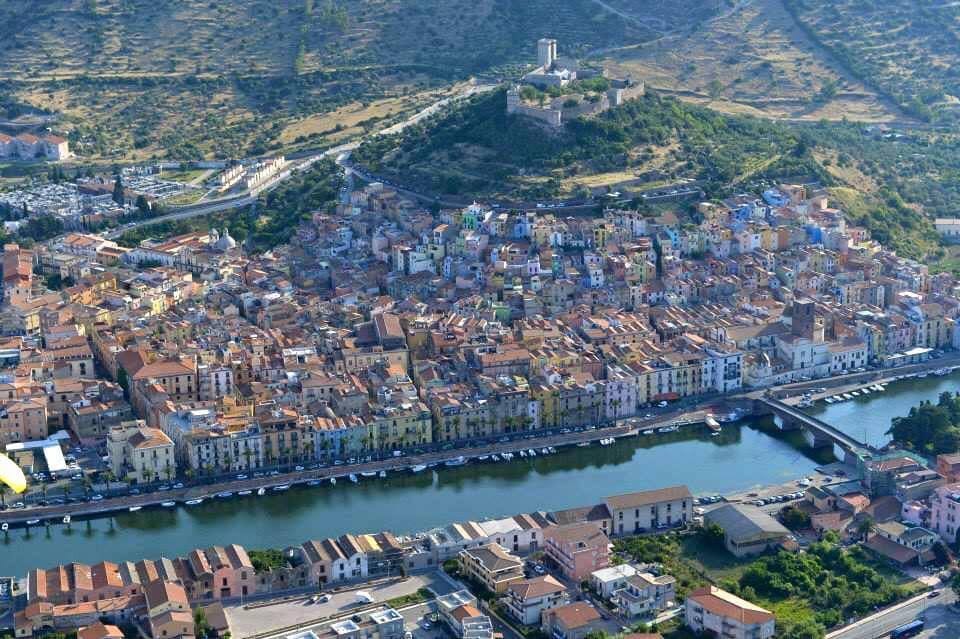
Bosa is the only town in Sardinia built on the banks of the island’s only navigable river, the Temo, and that single geographical fact sets the tone for the entire visit. Where most Sardinian towns orient themselves toward the sea or the mountains, Bosa turns inward toward its river, with a string of medieval tanneries along the water and coloured houses reflected in the slow current below. The effect is less Mediterranean postcard, more northern Italian borgo that somehow drifted southwest. Visit Malaspina Castle and you understand immediately why the Malaspina lords chose this hill: you can see the river mouth, the coastal plain, and the terraced hillside all at once.
The town sits about 3 km inland from the sea, connected to Bosa Marina by a flat riverside road that makes for a pleasant walk or cycle. The coast here is calm and largely undeveloped by Sardinian resort standards, which means the marina beach gets local families rather than package tourists. That combination of medieval hilltop, painted riverfront, and low-key coast in a single half-day radius makes Bosa unusual.
💡 Local tip
Bosa is administratively in the Province of Oristano, but it sits much closer to Alghero and is most naturally visited as a day trip from there. The road south from Alghero along the coast (SP49) is scenic but narrow and winding — budget extra time and drive slowly.
The Medieval Quarter: Sa Costa
The historic hilltop quarter of Bosa is called Sa Costa, and it rises steeply above the river in a tangle of narrow lanes, stone staircases, and arched passages. The houses are painted in the faded earth tones typical of western Sardinia — terracotta, dusty rose, burnt sienna, pale yellow — but unlike in heavily restored Italian hill towns, the colours here feel weathered and lived-in rather than curated. Laundry hangs between windows. Cats occupy doorsteps. The small churches are often locked outside of service times.
In the morning, before 9 am, the lanes are mostly quiet, with the sound of shutters opening and the smell of coffee drifting from ground-floor windows. This is the best hour to photograph the quarter, when the light catches the house fronts and there are almost no other visitors. By late morning in summer, small groups begin working their way up toward the castle, and by midday the steeper sections near the top can feel warm. Bring water and wear shoes with grip: the cobblestones are old and uneven.
Visitors with limited mobility should be aware that Sa Costa is not wheelchair accessible. The lower riverside area and the flat road to Bosa Marina are considerably more manageable and still offer the best views of the painted house facades reflected in the Temo.
Tickets & tours
Hand-picked options from our booking partner. Prices are indicative; availability and final rates are confirmed when you complete your booking.
Vineyard Guided Tour and 7 Wine Tasting in Palau
From 84 €Instant confirmationFree cancellationFull-Day Sailboat Tour in La Maddalena Archipelago from Cannigione
From 112 €Instant confirmationFree cancellationHiking excursion to the Devil's Saddle
From 35 €Instant confirmationFree cancellationExcursion to the Archaeological site of Nora
From 70 €Instant confirmationFree cancellation
Malaspina Castle: The View from the Top
Castello di Serravalle, known locally as Malaspina Castle, was built by the Malaspina family in the 12th and 13th centuries on the hill above Bosa. The Malaspina Castle is one of the better-preserved examples of medieval Sardinian fortification, and the small chapel inside, the Chiesa di Nostra Signora de Sos Regnos Altos, contains a rare cycle of 14th-century frescoes that are considered among the most significant medieval paintings on the island. The frescoes are in fragile condition, and access to the interior has occasionally been restricted depending on conservation works; verify current access before building your itinerary around them.
The walk up from the river takes around 20 minutes at a leisurely pace. The reward at the top is a panoramic view over the Temo valley, the terracotta rooftops of Sa Costa below, and on clear days the coastline to the west. Early evening, roughly an hour before sunset, is when the light turns the whole hillside a deep amber and the view becomes memorable. The castle itself charges a separate admission fee; check current prices and opening hours directly with the site or the local tourist office before visiting, as hours shift by season.
The Temo Riverfront: Tanneries, Boats, and Colour
Walking along the Temo below Sa Costa is the other core experience of a visit to Bosa. The row of old tanneries on the south bank — their facades in shades of coral, lime green, and sky blue — is the image most associated with the town. In the 19th century, this stretch of river was an active industrial zone producing leather, and the buildings, now mostly converted to small bars, studios, or storage, retain the wide arched openings at river level where hides were worked and rinsed.
Small wooden boats are moored along the bank, and in the late afternoon a handful of locals fish from the low walls. The light here is softer than on the coast, filtered by the surrounding hills, and the reflections of the coloured buildings in the still water make this one of the most photogenic spots in the western Sardinia interior. Wide-angle lenses or a phone camera in portrait mode both work well from the north bank looking south.
Bosa is in the province of Oristano, not far from other remarkable stretches of the Sardinian interior and coast. If you're building a wider route, the Sardinia road trip guide covers the best way to connect Bosa with Alghero to the north and the Sinis Peninsula to the south, both within comfortable driving range.
Bosa Marina: The Beach Annex
About 3 km downstream, where the Temo meets the sea, is Bosa Marina, a small coastal settlement with a dark-sand beach, a handful of trattorias, and a 16th-century watchtower. The beach is not the finest on Sardinia's west coast by any objective measure, but it is uncrowded and family-oriented in a way that feels local rather than managed. In July and August it fills up with Italian families; in May, June, and September it is almost empty.
The road between Bosa and Bosa Marina follows the river and is flat enough for a leisurely bicycle ride, with a few rental options in the town. For a broader sense of what the west coast beaches look like, the best beaches in Sardinia guide puts the area in regional context — this stretch is quieter and more characterful than the Costa Smeralda, though the water quality and sand colour at the more famous northern beaches are objectively superior.
History, Identity, and Why Bosa Feels Different
Bosa's historical trajectory separates it from most Sardinian coastal towns. During the Middle Ages it belonged to the Giudicato of Arborea, one of four autonomous Sardinian kingdoms, before passing through Malaspina and eventually Aragonese-Spanish control. In 1499 the town received the title of royal city under the Aragonese crown, a designation that carried administrative privileges and contributed to its relative prosperity through the early modern period.
That mercantile and administrative identity — rather than purely agricultural or fishing — gave Bosa its particular built character. The tannery industry along the Temo River continued well into the 19th century, and the town retains the density and layering of somewhere that was economically active for a long time. It is not a town that was preserved by poverty and neglect, like some interior Sardinian villages; it is one that had enough going on to build properly and enough subsequent decline to avoid being modernised into blandness.
For travellers interested in the deeper pre-medieval layer of Sardinian history, the wider Sassari and Oristano provinces hold some of the island's most significant Nuragic sites. The guide to Sardinia's Nuragic sites explains the civilisation that preceded the medieval Giudicati and left thousands of stone towers across the island.
When to Visit and What to Expect by Season
Bosa works well outside the main summer rush in a way that many Sardinian coastal destinations do not. In May and June, the hills above the town are still green, temperatures are in the low-to-mid 20s Celsius, and the riverfront is quiet enough that you can sit at a table by the water without booking ahead. September is similarly pleasant, with the added warmth of late summer lingering without July's heat — daytime temperatures around 25-27°C and long golden evenings.
July and August bring warmer weather — coastal Sardinia regularly sees 30°C or above — and more visitors, though Bosa remains quieter than the resort towns further north. The town does have a summer festival calendar worth checking; the Sardinia festivals and events guide covers regional celebrations that sometimes extend to smaller towns like Bosa. Winter visits are quiet and atmospheric, but some smaller restaurants and shops reduce hours or close entirely from November through March.
⚠️ What to skip
The coastal road south from Alghero to Bosa (SP49) is narrow, with blind bends and occasional livestock crossings. It is beautiful but not suitable for large campervans or inexperienced drivers. Leave extra time and avoid driving it in poor visibility.
Who Should and Should Not Visit
Bosa rewards visitors who are comfortable with an unscripted day: wandering without a fixed itinerary, finding a table at a bar and watching the river, pausing in front of a doorway because the colour is right. There are no queues, no audio guides, no rooftop bars with curated views. The atmosphere is that of a Sardinian town getting on with its life, with the historic elements simply there as part of the fabric.
Travellers expecting a polish similar to Alghero's old town, or the same range of restaurants and nightlife, will find Bosa understated. It is not overrated, but it is also not a conventional 'top attraction' in the sense of having a defined highlight you queue to see. The value is cumulative and atmospheric. If your travel style prioritises efficiency and a clear list of sights to check off, you might prefer Alghero as a base and visit Bosa only as an afternoon detour rather than a primary destination.
Insider Tips
- The best vantage point for photographing the tannery facades reflected in the Temo is from the north bank, roughly opposite the old Sa Piatta district, in the late afternoon when the sun angles across the coloured walls. This shot is easier in September when the sun is lower and warmer.
- The ARST bus from Alghero to Bosa runs along the coast road and takes roughly 1 hour 45 minutes. It is a scenic journey in its own right, but schedules are limited and change seasonally — check the ARST website (arst.sardegna.it) before relying on it for a day trip.
- Parking is available in a flat area near the river in the lower town, which is a much better starting point than attempting to drive into the historic centre. From the riverside parking area the tanneries are a two-minute walk and the start of the Sa Costa ascent is clearly signposted.
- Bosa produces its own Malvasia wine, a sweet amber-coloured dessert wine that is quite different from the more common Sardinian reds. Look for it in local bars and enotecas near the river; it pairs well with the local biscuits (papassinos) that appear in shop windows throughout the year.
- If the castle chapel with the medieval frescoes is a priority, contact the local tourist office or the municipality before your visit to confirm it is currently open — conservation restrictions have periodically limited access to the interior.
Who Is Bosa For?
- Slow travellers who want authentic Sardinian town life rather than resort infrastructure
- Photographers drawn to colour, reflection, and medieval architectural texture
- History enthusiasts interested in medieval Sardinia and Malaspina-era fortification
- Day-trippers based in Alghero looking for something substantially different from beach and sea
- Couples and independent travellers in shoulder season (May, June, September) who want quiet and atmosphere
Nearby Attractions
Other things to see while in Sassari:
- Basilica di San Gavino (Porto Torres)
Standing on Monte Agellu in Porto Torres, the Basilica dei Santi Gavino, Proto e Gianuario is the largest Romanesque church in Sardinia and one of the most architecturally singular in Italy. Built in the first half of the 11th century, it is the only Romanesque monument in the country originally designed with two opposing apses. For anyone tracing the island's medieval history, this is as significant as it gets.
- Castello dei Doria (Castelsardo)
Perched on a volcanic promontory above the Gulf of Asinara, Castello dei Doria is a 12th-century Ligurian fortress that has shaped northern Sardinia for nearly a thousand years. Today it houses the Museo dell'Intreccio Mediterraneo, dedicated to Mediterranean basketry, while its ramparts offer some of the most commanding coastal views on the island.
- Castello Malaspina (Bosa)
Perched 81 metres above the Temo river on Serravalle hill, Castello Malaspina is the medieval landmark that defines Bosa's skyline. Inside its walls stands the Romanesque Church of Nostra Signora de Sos Regnos Altos, sheltering rare 14th-century frescoes. The climb is steep, but the views over terracotta rooftops, vineyards, and coastline are exceptional.
- Castelsardo
Perched on a basalt promontory above the Gulf of Asinara, Castelsardo is one of the most visually striking towns in Sardinia. Its labyrinthine medieval streets, Doria family fortress, and panoramic coastal views make it a compelling half-day stop in the northwest of the island.