Castello Malaspina, Bosa: Medieval Castle Above a Pastel-Coloured Town
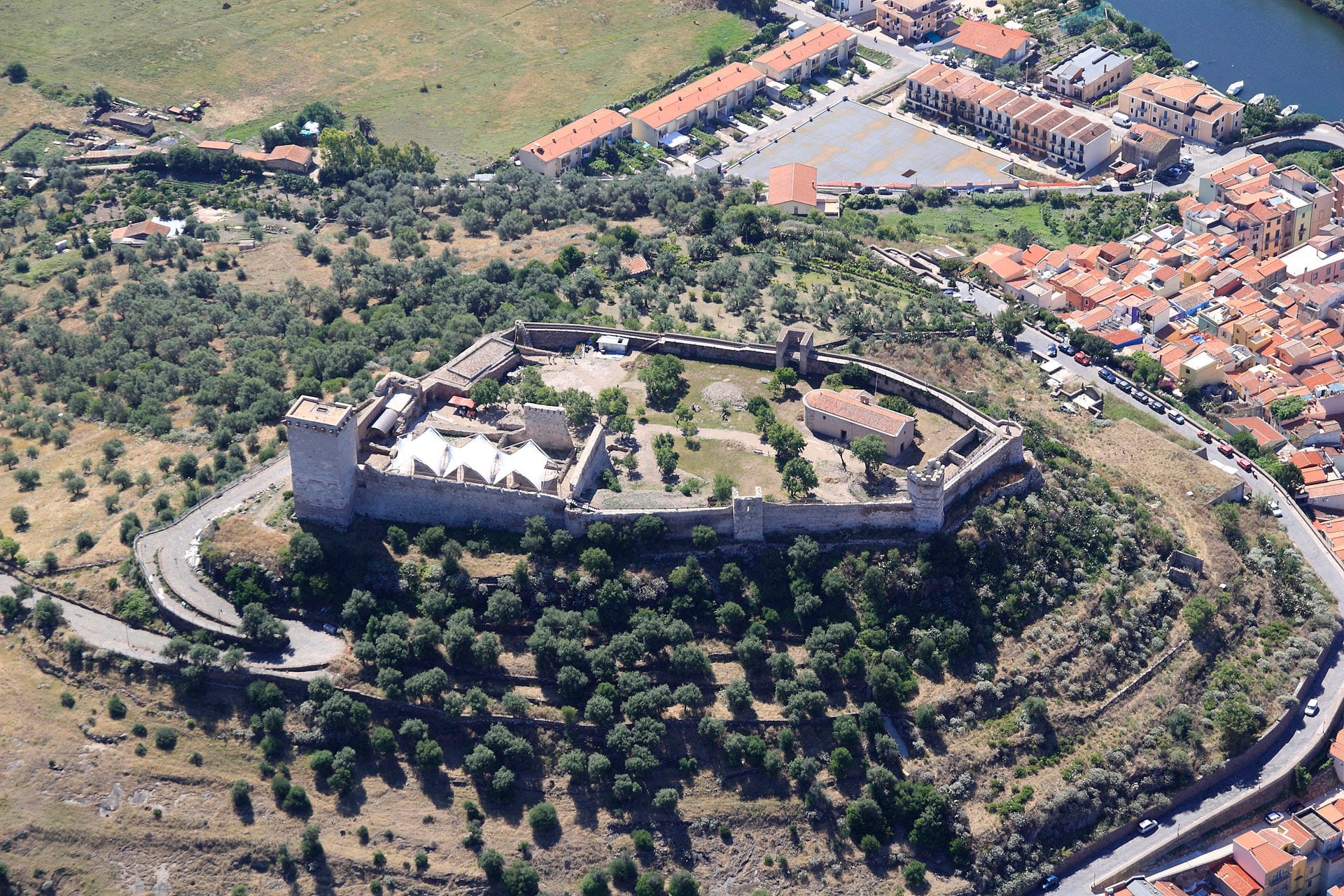
Perched 81 metres above the Temo river on Serravalle hill, Castello Malaspina is the medieval landmark that defines Bosa's skyline. Inside its walls stands the Romanesque Church of Nostra Signora de Sos Regnos Altos, sheltering rare 14th-century frescoes. The climb is steep, but the views over terracotta rooftops, vineyards, and coastline are exceptional.
Quick Facts
- Location
- Via Canonico Gavino Nino, s.n.c., 08013 Bosa, Oristano province, Sardinia
- Getting There
- On foot from Bosa town centre via a long, steep staircase up Serravalle hill. No public transport directly to the castle gate. Car access is limited; park in town and walk.
- Time Needed
- 1.5 to 2.5 hours including the climb, castle grounds, and church frescoes
- Cost
- Approx. €6.50 adults / €5.50 children (verify locally before visiting, as prices and hours vary by season)
- Best for
- History lovers, photographers, travellers combining a stop in Bosa with the western Sardinia coast
- Official website
- http://www.castellodibosa.com
What Is Castello Malaspina?
Castello Malaspina, formally known as the Castello di Serravalle (Castle of Serravalle), is a medieval fortification that crowns the rocky hill above Bosa, one of the most photogenic towns on Sardinia's western coast. The castle complex occupies roughly one hectare and sits 81 metres above sea level, with the fortified area itself covering approximately 2,000 square metres. It takes its popular name from the Malaspina family, the Genoese nobility who controlled the region from the 13th century onward and left the most visible architectural legacy.
Historical accounts differ on the precise founding date. Some sources point to 1112, while others date the main construction phase to the 13th century. What is consistent is that the site evolved over several centuries, moving from early Norman-era fortifications to a fully articulated castle under Malaspina control. Today the complex is both an archaeological site and a working cultural venue, maintained and interpreted through the official site at castellodibosa.com.
ℹ️ Good to know
The castle's full official Italian name is Castello di Serravalle. 'Castello Malaspina' is the commonly used name in tourism contexts and refers to the same site.
The Climb Up Serravalle Hill
There is no polite way to say this: the approach is a genuine physical effort. A long, steep staircase winds up through the upper quarter of Bosa's old town, passing weathered stone walls, fig trees growing from cracked masonry, and occasional cats occupying the sunniest ledges. The path is not difficult for anyone reasonably fit, but in July and August, midday heat makes the ascent uncomfortable. The stone underfoot can also be slippery after rain.
The recommended strategy is to begin the climb in the morning, ideally before 10am in summer, when the air is still cool and the light is warm and low across the valley. The walk up takes roughly 15 to 20 minutes at a steady pace. Wear shoes with grip, carry water, and pack a sun hat if you are visiting between May and September.
⚠️ What to skip
The steep staircase approach makes Castello Malaspina inaccessible for visitors using wheelchairs or those with significant mobility impairments. No accessible alternative route is documented. If this is a concern, verify with the site directly before planning your visit.
Bosa itself is worth treating as a half-day or full-day destination rather than a quick stop. The town sits along the Temo river, Sardinia's only navigable river, and the riverfront street lined with former tanneries (Sa Costa) gives excellent photographic angles back toward Serravalle hill. If you are building an itinerary around this area, see our guide to Oristano and the Sinis Peninsula for context on the broader western Sardinia region.
Tickets & tours
Hand-picked options from our booking partner. Prices are indicative; availability and final rates are confirmed when you complete your booking.
Castello walking tour
From 28 €Instant confirmationFree cancellationVineyard Guided Tour and 7 Wine Tasting in Palau
From 84 €Instant confirmationFree cancellationFull-Day Sailboat Tour in La Maddalena Archipelago from Cannigione
From 112 €Instant confirmationFree cancellationHiking excursion to the Devil's Saddle
From 35 €Instant confirmationFree cancellation
Inside the Walls: The Fresco Church of Nostra Signora de Sos Regnos Altos
The most significant reason to pay admission rather than simply admiring the exterior from below is the Church of Nostra Signora de Sos Regnos Altos, a small Romanesque church within the castle precinct that contains a remarkable cycle of 14th-century frescoes. These works have survived in unusually good condition relative to comparable Sardinian examples, and they represent one of the most complete examples of late medieval sacred painting on the island.
The frescoes depict biblical scenes and figures of saints in a style that blends Catalan-Gothic influence with local iconographic traditions. Inside the church, the light is low and the space is intimate. Give your eyes a moment to adjust when you enter. The smell is cool stone and faint damp, the kind that accumulates in thick-walled medieval buildings regardless of season. Standing inside while mid-morning light filters in from the doorway gives the paintings a depth that photographs rarely capture.
If medieval religious architecture interests you, Sardinia has several comparable sites worth comparing. The Basilica di San Gavino in Porto Torres is one of the most complete Romanesque structures on the island, and the Basilica di San Simplicio in Olbia offers another early Christian benchmark for context.
The Panoramic View: What You Actually See from the Top
The view from the castle walls is the payoff for the climb. Looking south, Bosa spreads below in layered rows of ochre, pink, and faded yellow buildings, with the Temo winding toward the sea. To the west, on clear days, the view extends to the coast and the open waters of the Mediterranean. The surrounding landscape is agricultural patchwork interrupted by low scrub and the vineyards that produce Malvasia di Bosa, one of Sardinia's most distinctive white wines.
The quality of the view changes dramatically by time of day. Morning light from the east throws long shadows across the town below, giving the rooftops texture. By late afternoon the light turns golden and the stone walls of the castle glow. Photographers willing to time a second visit for the late afternoon, roughly 5pm to 7pm in summer, will find conditions substantially better for wide landscape shots. Midday in high summer produces harsh, flat light and considerable glare.
There is no charge to walk up and photograph the exterior walls from the hillside path below the entrance, which is worth knowing if you arrive when the castle is closed or prefer to skip the interior.
Historical and Cultural Context
The Malaspina family, originally from Tuscany, were a powerful marchioness dynasty who extended influence across coastal trading routes in the medieval Mediterranean. Their presence in Bosa reflects broader patterns of mainland Italian noble families acquiring control of Sardinian coastal towns during the 12th and 13th centuries, before Aragonese expansion gradually displaced them in the 14th and 15th centuries.
Bosa itself was already an ancient settlement with Phoenician and Roman antecedents. The hill above the current town was the site of Bosa Vetus, the original elevated settlement, before the population gradually shifted toward the river valley. The castle's position was therefore both defensive and symbolic: control of Serravalle hill meant visual command over river access, coastal approaches, and the entire surrounding agricultural basin.
For visitors with a serious interest in Sardinia's archaeological and historical depth, the island offers a remarkable spread of sites spanning Nuragic, Phoenician, Roman, and medieval eras. Our guide to Sardinia's Nuragic sites provides a broader framework for understanding the island's pre-medieval layers.
Practical Visitor Information
Opening hours for Castello Malaspina vary by season and are not fixed across all sources. The official site at castellodibosa.com is the most reliable reference. Admission is approximately €5.00–€6.50 for adults and €5.50 for children, though prices should be confirmed before your visit. The castle is located at Via Canonico Gavino Nino, s.n.c., in central Bosa, within the Oristano province.
Bosa is approximately 60 kilometres south of Alghero by the coastal SS292 road, a stretch that is itself one of the more scenic drives in western Sardinia. The ARST regional bus service connects Bosa to Alghero and Sassari, though schedules are infrequent and should be checked directly with ARST before planning a public transport trip. Most visitors arrive by car, and parking is available in the town centre a short walk from the castle staircase.
If you are moving through western Sardinia by road, Bosa pairs logically with a visit to Grotte di Nettuno near Alghero or the historic centre of Alghero's old town. See our Sardinia road trip guide for suggested routes.
💡 Local tip
Combine the castle visit with a walk along Bosa's riverfront (Sa Costa) and a glass of local Malvasia di Bosa at one of the bars near the river. The combination makes for a full, satisfying half-day.
Who Should Think Twice Before Visiting
Visitors with limited mobility should be aware that the steep staircase approach has no documented accessible alternative. This is not a site you can experience meaningfully from a vehicle. Similarly, travellers visiting Sardinia primarily for beaches and with no particular interest in medieval history may find the effort-to-reward ratio lower than for dedicated history enthusiasts. The panoramic view is excellent, but Sardinia offers several other vantage points that require less physical effort.
In peak summer (July to August), the climb in midday heat and the sometimes limited shade within the castle grounds can make the visit uncomfortable for those sensitive to heat. Early morning timing essentially solves this problem, but visitors on tight itineraries who cannot control when they arrive should factor this in.
Insider Tips
- Visit on a weekday morning in May, June, or September. Bosa sees far fewer tourists than northern beach resorts, but weekend afternoons in summer still bring tour groups up the hill. Arriving at opening time means you may have the church frescoes almost to yourself.
- The staircase from the Sa Costa riverfront district is the most atmospheric approach. Walking up through the older residential streets rather than the main tourist path adds about five minutes but passes beautiful crumbling architecture.
- Bring a small torch or use your phone light inside the fresco church. The interior is dim, and having your own light source lets you examine details in the lower sections of the paintings that the fixed interior lighting does not reach.
- The hillside immediately outside the castle walls has a natural terrace with an unobstructed westward view toward the coast. This spot is freely accessible without buying a ticket and is the best place for wide-angle shots of the coastline at sunset.
- Check castellodibosa.com before you travel. The castle sometimes hosts evening events and temporary exhibitions during summer, and hours can shift significantly between winter and peak season.
Who Is Castello Malaspina (Bosa) For?
- Travellers with a genuine interest in medieval Sardinian history and architecture
- Photographers seeking panoramic views over Bosa's colourful rooftops and the Temo valley
- Visitors exploring western Sardinia by car who want cultural depth alongside coastal scenery
- Those interested in rare medieval fresco cycles outside the major museum circuit
- Couples or solo travellers looking for a quiet, non-beach half-day with real historical substance
Nearby Attractions
Other things to see while in Sassari:
- Basilica di San Gavino (Porto Torres)
Standing on Monte Agellu in Porto Torres, the Basilica dei Santi Gavino, Proto e Gianuario is the largest Romanesque church in Sardinia and one of the most architecturally singular in Italy. Built in the first half of the 11th century, it is the only Romanesque monument in the country originally designed with two opposing apses. For anyone tracing the island's medieval history, this is as significant as it gets.
- Bosa
Bosa sits on the north bank of the Temo River in western Sardinia, its medieval quarter tumbling down a hillside in layers of terracotta, ochre, and faded pink. It is the only town in Sardinia built along a navigable river, and that distinction shapes everything about it: the old tanneries along the water, the boat-lined banks, the slow pace that has little to do with the island's summer beach circus.
- Castello dei Doria (Castelsardo)
Perched on a volcanic promontory above the Gulf of Asinara, Castello dei Doria is a 12th-century Ligurian fortress that has shaped northern Sardinia for nearly a thousand years. Today it houses the Museo dell'Intreccio Mediterraneo, dedicated to Mediterranean basketry, while its ramparts offer some of the most commanding coastal views on the island.
- Castelsardo
Perched on a basalt promontory above the Gulf of Asinara, Castelsardo is one of the most visually striking towns in Sardinia. Its labyrinthine medieval streets, Doria family fortress, and panoramic coastal views make it a compelling half-day stop in the northwest of the island.