Grotte di Nettuno (Neptune's Grotto): Alghero's Spectacular Sea Cave
Cut into the limestone cliffs of Capo Caccia, the Grotte di Nettuno is one of Sardinia's most dramatic natural attractions. Reach it by descending 654 steps carved into a sheer cliff face, or arrive by boat from Alghero's port. Inside, a guided tour reveals a vast karst cave system built around a saltwater lake and draped in extraordinary stalactite and stalagmite formations.
Quick Facts
- Location
- Capo Caccia promontory, approx. 24–25 km from Alghero, northwest Sardinia
- Getting There
- By car or shuttle bus to Capo Caccia, then 654 steps down (Escala del Cabirol); or by boat from Porto di Alghero
- Time Needed
- 2–4 hours total, including travel and the 30-minute guided tour
- Cost
- Cave admission: €18 full price / €10 reduced (ages 6–17, Alghero residents, students up to age 26) / Free for children under 6 and certified disabled visitors plus one companion. Boat tickets sold separately.
- Best for
- Geology enthusiasts, families with older children, scenic boat trips, photography
- Official website
- grottadinettuno.it
What You're Actually Visiting
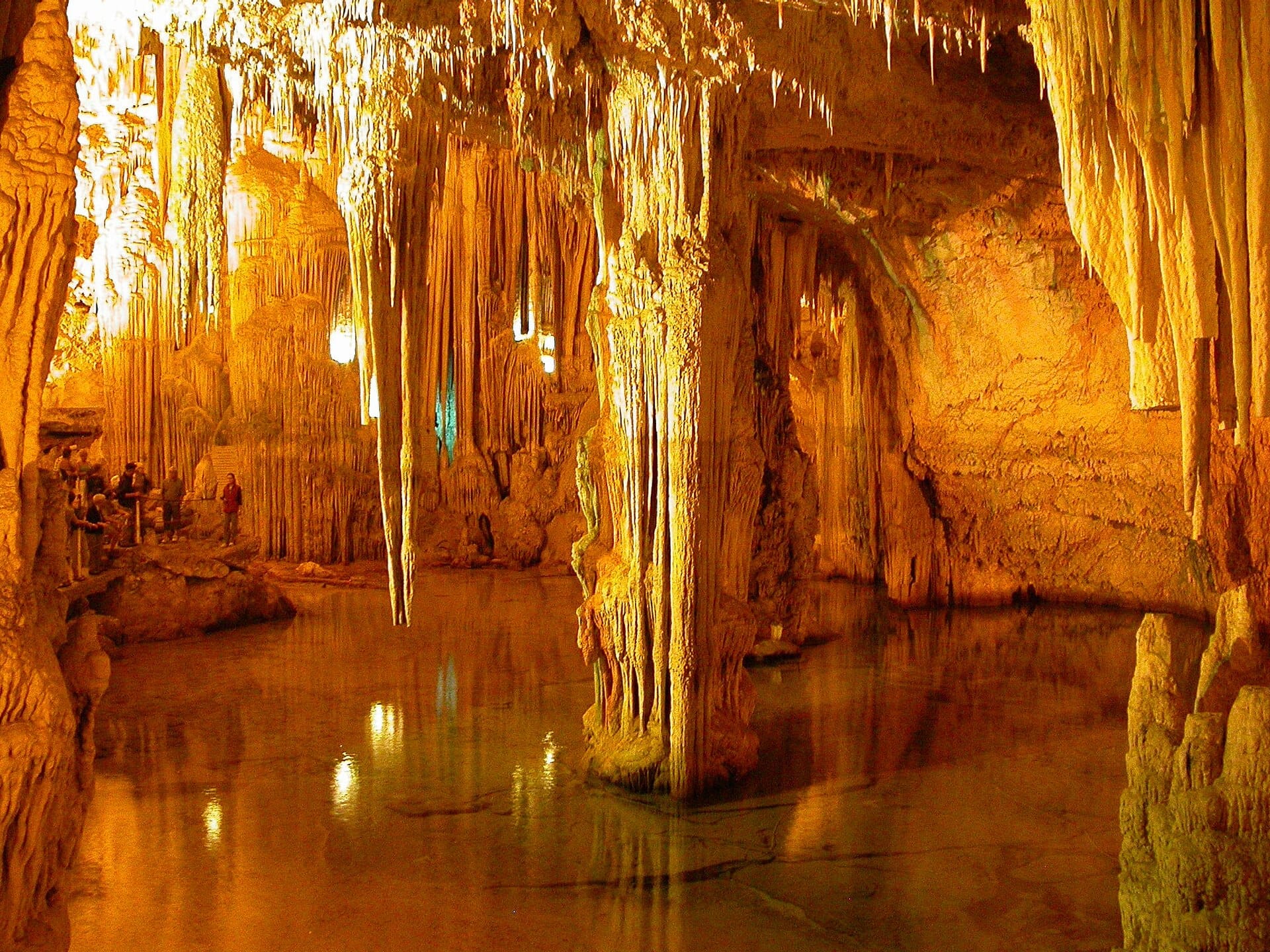
The Grotte di Nettuno (Neptune's Grotto) is a karst limestone cave complex carved into the base of the Capo Caccia cliffs on Sardinia's northwest coast, about 24 kilometres from Alghero. Discovered by local fishermen in the 18th century, it sits partially below sea level, which is why one of its most striking features is a large saltwater lake that extends into the darkness beyond the lit tourist path. The cave is managed by the municipality of Alghero and is one of the most visited natural sites on the island.
The interior spans a complex of galleries filled with stalactites and stalagmites, pillars, and curtain formations built over hundreds of thousands of years by calcium carbonate-rich water seeping through the limestone. Some formations reach several metres in height. The largest chamber opens into a cathedral-like space where the combined effect of the formations, the still saltwater pool, and the cool underground air creates an atmosphere that earns the dramatic name.
ℹ️ Good to know
Guided visits run every hour from 10:00 to 15:00 (last entry in the current schedule), last approximately 30 minutes, and are the only way to enter the cave. There is no self-guided access. The cave is closed on 25 December and whenever sea or weather conditions make safe access impossible — always verify same-day opening via the official website or phone before making the journey.
Two Ways In: The Steps vs. The Boat
Choosing how to arrive is the first real decision, and it shapes the whole experience. The land route brings you to the top of the Capo Caccia headland, where you then descend the Escala del Cabirol — 654 steps cut directly into the cliff face, dropping roughly 120 metres to the cave entrance at sea level. The steps are well-maintained, with handrails along most of the route, but the path is steep and exposed. In summer, the descent is hot and the rock radiates heat; going down takes around 15–20 minutes for most people, and coming back up is considerably harder. Allow time and bring water.
The views from the staircase, however, are extraordinary. The cliff drops sheer into deep turquoise water, and on clear days you can see across to the island of Foradada and along the protected coastline of the Parco Naturale Porto Conte. The sight alone justifies the approach even if you were not visiting the cave.
The sea route departs from Porto di Alghero and from Cala Dragunara at Porto Conte. Boat services (marketed as "Linea Grotte") run seasonally and are operated by private companies. The crossing from Alghero takes approximately 30–40 minutes and gives you a dramatic arrival at the cave from the water — the entrance is a low arch at the base of the cliff that opens into the darkness. Note that boat tickets do not include cave admission; you pay the entrance fee separately on arrival. For full context on the surrounding coastal landscape, see the Parco Naturale Porto Conte attraction page.
⚠️ What to skip
Access by sea can be suspended without notice when sea conditions are rough, even on days that look clear from town. If you have booked a specific tour date and conditions look unsettled, contact the operator directly. The climb back up the Escala del Cabirol is non-negotiable if you arrive by land — there is no other exit.
Tickets & tours
Hand-picked options from our booking partner. Prices are indicative; availability and final rates are confirmed when you complete your booking.
Cala Goloritze, Mariolu, Gabbiani, Biriala, Grotta del Fico boat tour
From 69 €Instant confirmationFree cancellationVineyard Guided Tour and 7 Wine Tasting in Palau
From 84 €Instant confirmationFree cancellationFull-Day Sailboat Tour in La Maddalena Archipelago from Cannigione
From 112 €Instant confirmationFree cancellationHiking excursion to the Devil's Saddle
From 35 €Instant confirmationFree cancellation
Inside the Cave: What the Tour Covers
The guided tour follows a single path through a sequence of interconnected chambers, lit by fixed artificial lighting that picks out the main formation clusters without overwhelming the natural atmosphere of the space. Guides typically speak Italian and English; groups enter together on the hour and move at a steady pace with stops at key formations.
The temperature inside remains stable year-round at around 16–17°C, which feels cold if you have been outside in July heat. Bring a light layer even in midsummer. The air is damp and the surfaces are wet in places; the path is paved and lit, but footwear with grip is advisable. Flip-flops are not recommended.
The highlight of the interior is the saltwater lake known as Lago Lamarmora — a quiet, perfectly still body of water extending beyond the reach of the lights. The acoustic quality of the cave amplifies every footstep and whispered conversation, giving the space an unexpected intimacy. Photography is permitted, but flash tends to flatten the formations; slow shutter speeds and the ambient lighting produce better results. A small tripod or surface to rest your camera on helps significantly.
Getting There from Alghero
If driving, take the SP55 toward Capo Caccia. Free parking is available at roadside lay-bys near Capo Caccia; at present there is no officially advertised dedicated La Stalla car park with a regular shuttle bus to the cape. Tickets are purchased on board. Without a car, the boat from Alghero port is the most practical option for most visitors, as public bus services to the cape are limited and schedules should be verified in advance with ARST.
Alghero itself is a compact, well-preserved historic city that warrants at least half a day before or after visiting the cave. The old town's Catalan heritage, medieval walls, and seafront setting make it one of northwest Sardinia's most rewarding urban stops. For orientation, see the guide to Alghero's historic centre and the Alghero city walls.
Best Time to Visit
May, June, and September offer the most comfortable conditions. The weather is warm enough to enjoy the boat crossing and the cliff views, the sea is generally calmer than in winter, and the queues at the cave entrance are shorter than in July and August. In peak summer, the hourly tours fill quickly, especially mid-morning. Arriving for the 10:00 first entry or securing tickets online in advance is strongly advisable in July and August.
Winter visits (November through March) are possible in theory, but the combination of reduced hours, frequent weather-related closures, and the boat service operating on a very limited schedule makes reliability a real concern. If Sardinia's shoulder season interests you more broadly, the Sardinia in May guide and the Sardinia in September guide give useful seasonal context.
Morning light on the boat approach, roughly between 10:00 and 11:30, catches the cliff face at its most photogenic angle. The water in the cove below the Escala del Cabirol shifts from green to deep blue as the sun moves overhead. On the return trip by boat in the early afternoon, the light flattens but the view back toward Alghero, with the old town visible on its promontory, is worth having your camera ready.
Practical Notes: Limitations to Know
The cave is impressive, but the 30-minute tour duration means you see a curated portion of the system rather than an extended underground exploration. Visitors hoping for a caving adventure will find this feels more like a museum walk through a natural space than a physical challenge. The lighting and fixed path are thoughtfully done, but the format is structured and guided throughout — there is no wandering or self-pacing.
The Escala del Cabirol is not suitable for visitors with significant mobility limitations, and the cave itself, while accessible once inside, requires descending and re-ascending those 654 steps. This is a meaningful physical commitment, particularly in heat. Anyone with heart or joint conditions, or travelling with very young children or elderly companions with reduced mobility, should consider the sea route carefully and note that even arriving by boat involves some uneven terrain at the entrance platform.
If your main interest is coastal scenery rather than the cave itself, you could argue that the Escala del Cabirol's views justify the trip independently. The headland of Capo Caccia is one of the most dramatic coastal formations in northwest Sardinia, and the surrounding protected area is worth time even without the cave ticket.
Insider Tips
- Buy tickets online through the official Alghero Experience portal or the Grotta di Nettuno website before you travel. Walk-up availability is not guaranteed in summer, and there is no option to wait inside the cave while a tour is in progress.
- If you come by boat, sit on the right side of the vessel on the outward journey from Alghero for the best views of the Capo Caccia cliffs as you approach.
- The cave temperature is a constant 16–17°C year-round. In July and August, this feels cold against sun-warmed skin. A light jacket stuffed into a daypack is easy to carry and useful inside.
- If driving, aim to arrive at the roadside parking areas near Capo Caccia by 09:00–09:30 in summer, as spaces fill early, especially on days with calm seas and good visibility.
- Combine the visit with the Capo Caccia headland itself: once you have climbed back up the steps, the viewpoint at the top looking back down the cliff and out to sea requires no extra effort and no extra ticket.
Who Is Grotte di Nettuno For?
- Geology and cave enthusiasts who want to see a world-class karst formation in a coastal Mediterranean setting
- Families with children aged 8 and above who can manage the staircase and will find the formations memorable
- Photographers looking for dramatic cliff approach shots and atmospheric interior subjects in consistent natural light
- Day-trippers based in Alghero who want a half-day excursion combining a scenic boat ride with an underground experience
- Travellers on a broader Sardinian itinerary who want to see northwest Sardinia's most celebrated natural landmark
Nearby Attractions
Other things to see while in Alghero:
- Bastioni di Alghero
The Bastioni di Alghero are a continuous promenade along the medieval and 16th-century fortifications that frame the old city on its seaward side. Free to walk at any hour, they offer some of the most compelling views in northwest Sardinia, from the coral-blue water below the walls to the distant outline of Capo Caccia across the gulf.
- Capo Caccia
Capo Caccia is a towering limestone promontory on Sardinia's northwestern coast, forming the western boundary of the Capo Caccia – Isola Piana Marine Protected Area. The clifftop belvederes are free and open to all, while the famous Grotte di Nettuno lie below, reached by a vertiginous staircase or seasonal boat.
- Centro Storico di Alghero
The historic centre of Alghero is one of the Mediterranean's most atmospheric old towns, where Catalan Gothic architecture, honey-coloured ramparts, and a language that isn't quite Italian create a quarter that feels unlike the rest of Sardinia. Entry is free, the streets run to the sea, and it rewards slow exploration at almost any hour.
- Domus de Janas di Anghelu Ruju
Cut into sandstone on a flat plain 6 km from Alghero, the Necropoli di Anghelu Ruju contains 38 prehistoric tombs dating back to around 3200 BC. It is the most extensive hypogean burial site in northern Sardinia and one of the most significant Neolithic monuments in the entire Mediterranean.