Capo Caccia: Sardinia's Most Dramatic Promontory
Capo Caccia is a towering limestone promontory on Sardinia's northwestern coast, forming the western boundary of the Capo Caccia – Isola Piana Marine Protected Area. The clifftop belvederes are free and open to all, while the famous Grotte di Nettuno lie below, reached by a vertiginous staircase or seasonal boat.
Quick Facts
- Location
- Municipality of Alghero, Province of Sassari, northwest Sardinia
- Getting There
- Drive SP55 from Alghero (approx. 25 km); seasonal ARST buses from Alghero run to Capo Caccia in summer
- Time Needed
- 1–2 hours for clifftop views; half-day if combining with Neptune's Grotto or a boat excursion
- Cost
- Free access to clifftops and viewpoints; separate tickets required for Grotte di Nettuno and boat tours
- Best for
- Coastal scenery, photography, snorkelling, geology enthusiasts, day-trippers from Alghero
- Official website
- www.algheroparks.it/en/nature-and-local-area/promontories
What Is Capo Caccia?
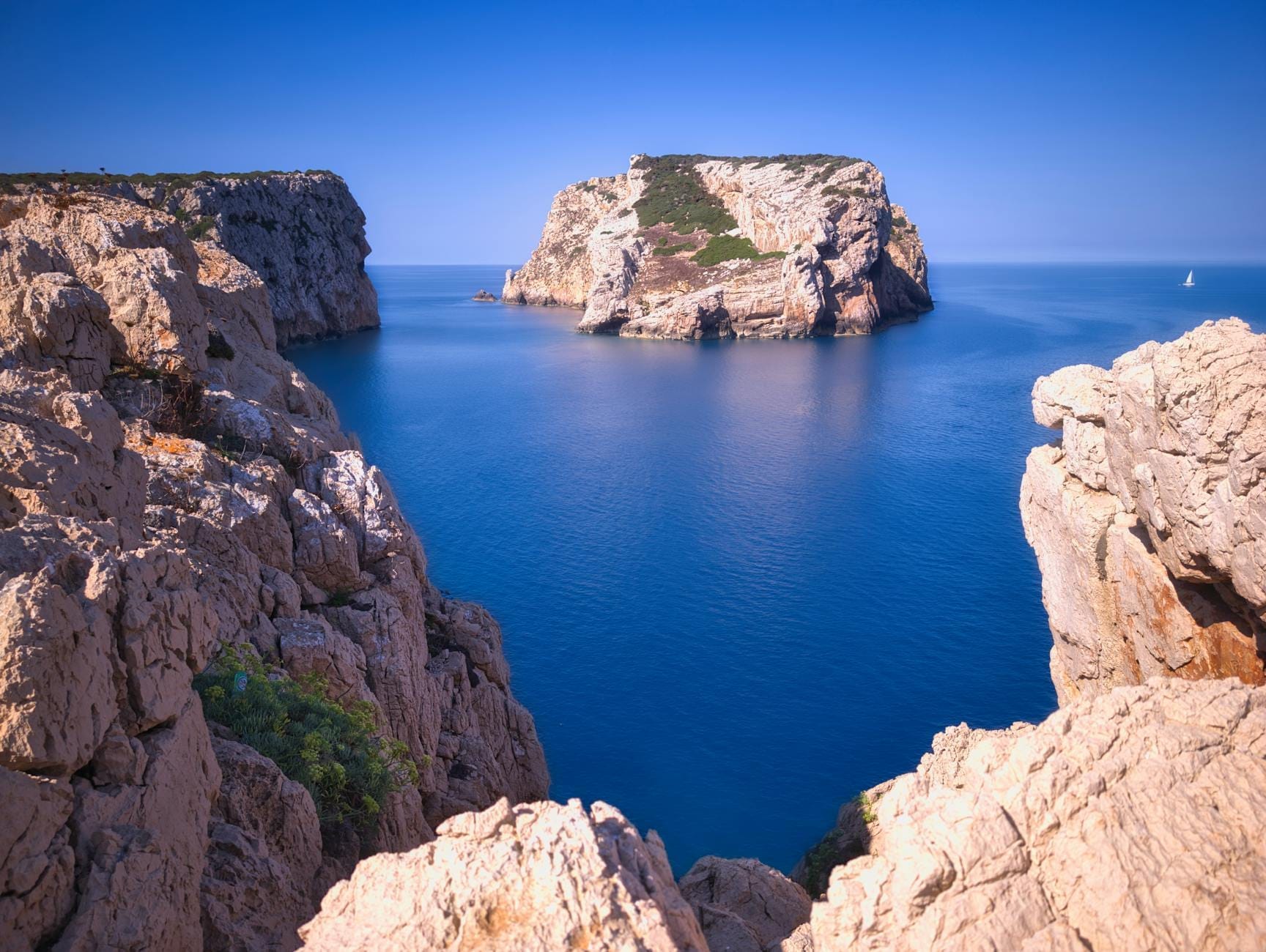
The Capo Caccia promontory is the kind of place that stops you mid-sentence. A sheer wall of Cretaceous limestone rising about 180 metres above the Tyrrhenian Sea, it forms the dramatic western edge of the Porto Conte natural park ecosystem and defines the boundary of the officially protected Capo Caccia – Isola Piana Marine Protected Area, established within the Porto Conte Park system since 2002. Nearby, the cliffs of Punta Cristallo reach around 326 metres above sea level, making this one of the most vertiginous stretches of coastline in the entire Mediterranean.
The promontory sits about 25 kilometres from Alghero along the provincial road SP55, which dead-ends at the clifftop car park and belvedere. There are no entry fees for the viewpoints themselves: you simply drive or take the bus, step out, and walk to the edge. What you find there is hard to describe without sounding hyperbolic. The sea below shifts from deep indigo to electric turquoise depending on depth and time of day, and the silence at the cliff edge — broken only by wind and the occasional call of a Griffon vulture — is something that lingers.
💡 Local tip
Arrive before 10am or after 4pm in July and August. The car park at the promontory is small, and in peak summer the road up to Capo Caccia can see queues. Morning visits also give calmer sea conditions for boat tours.
The Cliffs Up Close: What You Actually See
Standing at the belvedere, the first thing you register is scale. The cliff face drops almost vertically below the railing, pale grey and streaked with orange lichen. Across the water, the flat profile of Isola Piana sits low on the horizon, while to the south the coastline curves back toward Alghero. On a clear day — which is most days between May and October — the visibility extends far enough to see the silhouette of Monte Doglia rising behind the bay.
The limestone here is ancient: the Cretaceous rock was laid down roughly 70 to 100 million years ago, and millennia of wave erosion have carved the base of the cliffs into arches, sea caves, and submerged passages. The most famous of these is the Grotte di Nettuno (Neptune's Grotto), which burrows more than 4 kilometres into the cliff. From the viewpoint, you can spot the entrance to the caves at sea level — a dark slot in the pale rock that looks impossibly small from above.
The cliffs also shelter a significant breeding colony of Griffon vultures (Gyps fulvus), one of the largest in Sardinia. You are likely to see several circling on the thermals, especially in the late morning. The marine protected area below supports posidonia seagrass meadows, moray eels, sea bream, and occasional sightings of dolphins. For the full underwater picture, see our guide to snorkelling and diving around Sardinia.
Tickets & tours
Hand-picked options from our booking partner. Prices are indicative; availability and final rates are confirmed when you complete your booking.
Cagliari Sunset Boat Tour With Prosecco, Focaccia and Swimming
From 75 €Instant confirmationFree cancellationDolphin watching RIB tour to Capo Figari from Olbia
From 72 €Instant confirmationFree cancellationVineyard Guided Tour and 7 Wine Tasting in Palau
From 84 €Instant confirmationFree cancellationFull-Day Sailboat Tour in La Maddalena Archipelago from Cannigione
From 112 €Instant confirmationFree cancellation
Neptune's Grotto: Getting Down (and Back Up)
The main draw below the clifftop is the Grotte di Nettuno, and accessing them requires a decision. You can descend on foot via the Escala del Cabirol — a staircase of around 654 steps cut directly into the cliff face — or arrive by seasonal boat from Alghero's port. Both options have their logic, and both have their costs beyond the cave entry ticket itself.
The Escala del Cabirol (the name means 'chamois staircase' in Catalan, a nod to Alghero's historic Catalan heritage) descends at an angle steep enough to make your thighs aware of it on the way back up. The views from the staircase itself are extraordinary at every turn: the cliff drops away to your left, the sea expands below, and if you pause mid-descent you get perspectives of the rock face that no photograph from the top provides. Allow at least 20 to 30 minutes each way. The steps are generally in good condition but narrow in places, with some sections exposed to the drop.
⚠️ What to skip
The Escala del Cabirol is NOT suitable for wheelchair users, visitors with significant mobility impairments, or anyone uncomfortable with heights and exposed stairways. The boat from Alghero port is the only alternative access, but it operates seasonally and cannot dock in rough sea conditions — so cave access is not always guaranteed from either route.
The boat approach from Alghero is worth considering if you're visiting in summer. The journey along the coastline from Alghero to the cave entrance gives you a completely different reading of the cliffs: you see their full height from below, pass through narrower inlets, and arrive at the cave mouth from the water, which is dramatic. Boat tours are run by independent operators from Alghero harbour and should be booked in advance during July and August.
How the Place Changes by Time of Day
In the early morning, before 9am, the car park at the promontory is almost empty. The light at this hour hits the cliff face from a low eastern angle, turning the limestone a warm amber and casting sharp shadows into every fissure. The sea surface is typically flat and glassy before the afternoon breeze builds, and the colour of the water is at its most concentrated, a deep lapis at depth shading to transparent turquoise over the shallower rock platforms.
By midday in summer, the terrace is at its most crowded and the light is flat and harsh for photography. The car park fills quickly after the first boat tour groups arrive. If you have a car, the morning or late-afternoon window is significantly more comfortable. From about 5pm onward, the light comes from the west and falls directly onto the cliff face, making it glow. At sunset, the cliffs turn rust-orange and the water darkens to deep violet. This is technically the best light of the day, but it also coincides with the road back to Alghero being busy with returning visitors.
Getting There and Around
The SP55 from Alghero is the only road to Capo Caccia. The drive takes around 25 to 30 minutes from Alghero's old town and passes through the Porto Conte lagoon and nature reserve, which is scenic in its own right. The road ends at the promontory car park. In summer, ARST operates seasonal bus services from Alghero that stop at Capo Caccia, making it accessible without a car — check current timetables with ARST directly before visiting, as schedules change annually.
There is no petrol station on the SP55, so fill up in Alghero before heading out. The road itself is well-maintained but narrow in places, with some hairpin sections as it climbs toward the promontory. Driving confidently at moderate speed is more important than speed.
Alghero is served by Alghero-Fertilia Airport (IATA: AHO), approximately 8 kilometres northwest of the city centre. ARST buses connect the airport to Alghero. For accommodation options in the area, the Sardinia accommodation guide covers Alghero options across different budgets.
Photography, Practicalities, and What to Bring
For photography, a wide-angle lens captures the scale of the cliff against the sea, while a telephoto is useful for isolating the vultures in flight or compressing the Isola Piana flat profile against the horizon. A polarising filter dramatically improves the colour contrast between the water and the pale rock in the middle of the day. The wind at the promontory can be significant even in summer: secure your camera bag and stand away from the railing edge in gusty conditions.
There is a small bar and souvenir shop near the car park, but no restaurant at the promontory itself. Bring water, sunscreen, and a hat, particularly if you plan to descend the Escala del Cabirol. The limestone terrace around the belvedere offers no shade. Sturdy footwear is recommended for the staircase descent, not flip-flops.
The clifftop belvederes are accessible from the car park by a short, mostly flat walk. The surface is not formally described as barrier-free in official documentation, so visitors with mobility considerations should confirm accessibility details directly with the park management via the official portal before visiting.
Capo Caccia in Context: The Wider Area
Capo Caccia does not exist in isolation. The drive along SP55 passes through the Porto Conte lagoon, a brackish coastal wetland that shelters flamingos and other wading birds in spring and autumn. The Porto Conte Park encompasses Capo Caccia itself, the lagoon, and the Isola Piana island across the bay. Paired with a morning at the cliffs, the lagoon stop adds very little time but a completely different register of landscape. For visitors exploring northwest Sardinia further, Alghero's own medieval walled centre — particularly the bastions that overhang the sea — is a logical complement. See the guide to Alghero's sea bastions for what to expect.
If you're building a longer itinerary around the northwest, Capo Caccia combines naturally with the Nuraghe Palmavera complex inland and the coastal road north toward Stintino. The region's Catalan linguistic heritage, still alive in Alghero where Catalan is recognised alongside Italian, makes the area culturally distinctive even by Sardinian standards. For a structured plan, the Sardinia road trip guide covers northwest routes in detail.
Insider Tips
- The belvedere car park fills fast in peak summer. If it's full, do not try to park on the narrow SP55 approach road. Turn around, drive a kilometre back, and wait 20 minutes — turnover is quick as most people stay less than an hour at the viewpoint.
- Griffon vultures are most active on the thermals between 10am and 1pm. If you want to photograph them in flight, arrive early enough to be in position before they start soaring.
- The boat from Alghero to Neptune's Grotto passes the full face of Capo Caccia at water level. Even if you have no interest in the cave itself, the coastal boat trip gives you the most complete understanding of the cliff's scale — something the clifftop view alone cannot provide.
- In September and October, the crowds thin dramatically but the weather remains excellent. Sea conditions are typically calmer than August, boat tours run reliably, and the light has a golden quality that summer visitors rarely see.
- If the Escala del Cabirol feels daunting on the descent, it is far harder psychologically on the way back up. Budget more time for the ascent than the descent, especially in summer heat, and take water.
Who Is Capo Caccia For?
- Photographers looking for dramatic coastal light, especially at golden hour
- Nature enthusiasts interested in Griffon vultures, marine ecosystems, and Mediterranean geology
- Day-trippers from Alghero seeking a half-day excursion with minimal planning
- Snorkellers and divers using the marine protected area as a base
- Travellers combining landscape scenery with a cave visit to Neptune's Grotto
Nearby Attractions
Other things to see while in Alghero:
- Bastioni di Alghero
The Bastioni di Alghero are a continuous promenade along the medieval and 16th-century fortifications that frame the old city on its seaward side. Free to walk at any hour, they offer some of the most compelling views in northwest Sardinia, from the coral-blue water below the walls to the distant outline of Capo Caccia across the gulf.
- Centro Storico di Alghero
The historic centre of Alghero is one of the Mediterranean's most atmospheric old towns, where Catalan Gothic architecture, honey-coloured ramparts, and a language that isn't quite Italian create a quarter that feels unlike the rest of Sardinia. Entry is free, the streets run to the sea, and it rewards slow exploration at almost any hour.
- Domus de Janas di Anghelu Ruju
Cut into sandstone on a flat plain 6 km from Alghero, the Necropoli di Anghelu Ruju contains 38 prehistoric tombs dating back to around 3200 BC. It is the most extensive hypogean burial site in northern Sardinia and one of the most significant Neolithic monuments in the entire Mediterranean.
- Grotte di Nettuno
Cut into the limestone cliffs of Capo Caccia, the Grotte di Nettuno is one of Sardinia's most dramatic natural attractions. Reach it by descending 654 steps carved into a sheer cliff face, or arrive by boat from Alghero's port. Inside, a guided tour reveals a vast karst cave system built around a saltwater lake and draped in extraordinary stalactite and stalagmite formations.