Domus de Janas di Anghelu Ruju: Sardinia's Largest Prehistoric Necropolis
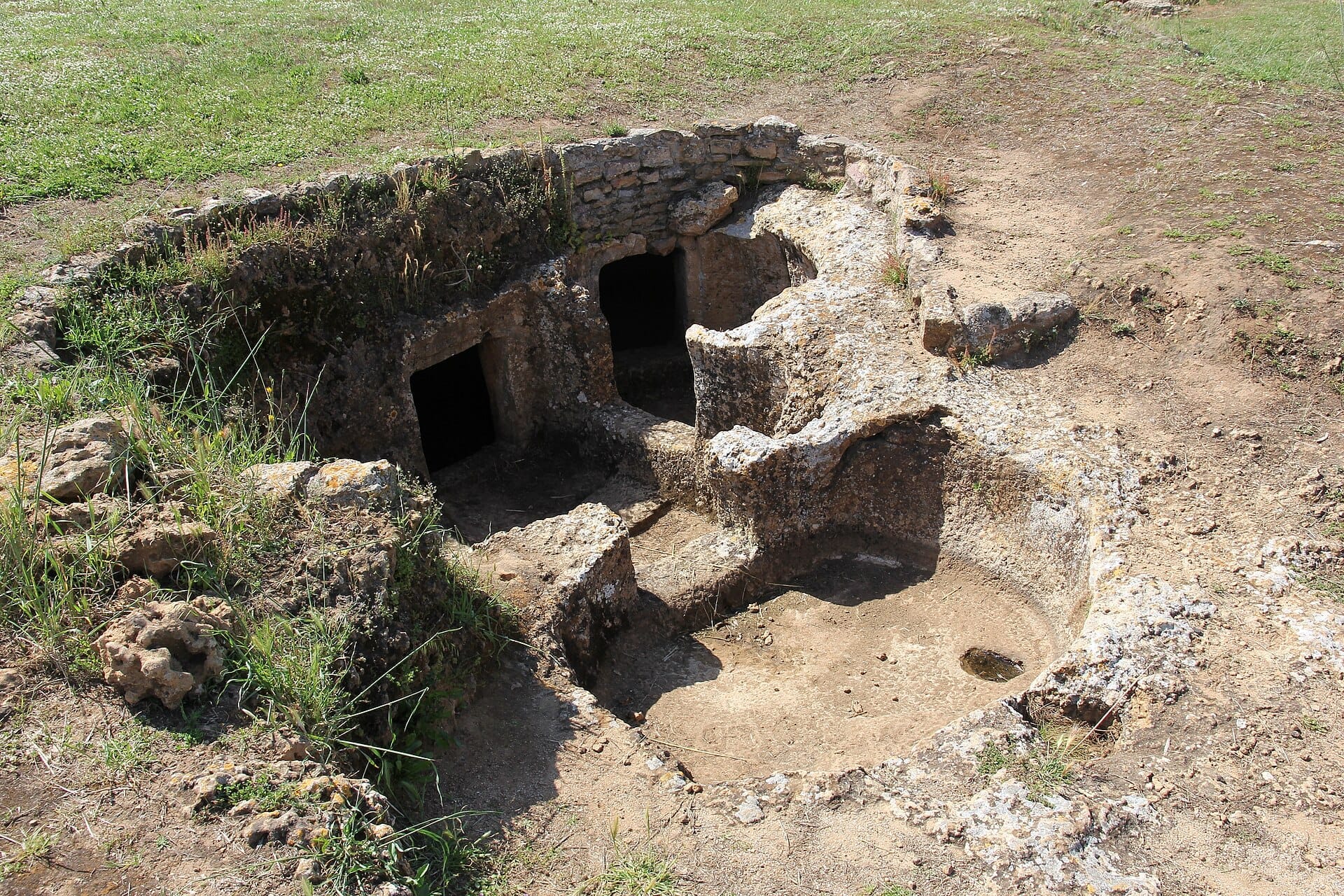
Cut into sandstone on a flat plain 6 km from Alghero, the Necropoli di Anghelu Ruju contains 38 prehistoric tombs dating back to around 3200 BC. It is the most extensive hypogean burial site in northern Sardinia and one of the most significant Neolithic monuments in the entire Mediterranean.
Quick Facts
- Location
- SP 42, strada dei Due Mari, Alghero (SS), Sardegna
- Getting There
- Car from Alghero city centre: approx. 10–15 min via SP 42 toward Sassari/Porto Torres. No reliable public bus service to the site.
- Time Needed
- 1 to 2 hours
- Cost
- Tickets sold on-site by Coop. SILT. Prices not published online — verify at necropoliangheluruju.it or by calling ahead.
- Best for
- Archaeology enthusiasts, prehistory travellers, visitors combining with Sella & Mosca winery nearby
- Official website
- necropoliangheluruju.it
What Is Anghelu Ruju?
The Domus de Janas di Anghelu Ruju is the largest hypogean necropolis in northern Sardinia: a complex of 38 prehistoric rock-cut tombs, 37 of which are classic domus de janas and one pit grave, carved into the soft sandstone plateau known as I Piani near the Rio Filibertu stream. The site sits roughly 6 kilometres from Alghero along the SP 42, on land that today borders the celebrated Sella & Mosca wine estate — a juxtaposition of ancient death and modern viticulture that is quietly strange and worth noticing.
The necropolis was in use from approximately 3200 BC through to around 1600 BC, spanning the late Neolithic into the Early Bronze Age. That is a period of active burial spanning some 1,700 years — longer than the entire span of the Roman Empire. The people who carved these chambers belonged to the Ozieri culture and its successors, pre-Nuragic Sardinian communities who buried their dead in artificial grottos rather than megalithic structures.
For context on how this site fits into the broader arc of Sardinian prehistory, the Sardinia Nuragic sites guide covers the full chronological picture, from Neolithic hypogea through to the Iron Age Nuragic towers.
ℹ️ Good to know
Opening hours vary by season: November–March 10:00–14:00; April–May and October 10:00–18:00; June–September 10:00–19:00. The site is open daily and closed on 25 December. Always confirm current hours at necropoliangheluruju.it before visiting, as schedules can shift.
The Discovery and the Excavations
The necropolis was accidentally uncovered in 1903 during quarrying operations to source stone for the construction of the Sella & Mosca winery. Workers cutting into the hillside broke through the roofs of several tomb chambers, revealing carved interiors and human remains that had lain undisturbed for millennia. Systematic excavation began the following year under archaeologist Antonio Taramelli and continued at intervals through the twentieth century, with subsequent campaigns led by Doro Levi, Ercole Contu, and Giovanni Maria Demartis.
That ninety-year excavation history means the tombs have been progressively understood rather than revealed all at once. Earlier digs focused on cataloguing human remains and grave goods; later ones examined the carved iconography in detail. The result is one of the most thoroughly documented prehistoric sites in Sardinia, though active research continues and interpretations of some carved symbols remain open to debate.
Tickets & tours
Hand-picked options from our booking partner. Prices are indicative; availability and final rates are confirmed when you complete your booking.
Vineyard Guided Tour and 7 Wine Tasting in Palau
From 84 €Instant confirmationFree cancellationFull-Day Sailboat Tour in La Maddalena Archipelago from Cannigione
From 112 €Instant confirmationFree cancellationHiking excursion to the Devil's Saddle
From 35 €Instant confirmationFree cancellationExcursion to the Archaeological site of Nora
From 70 €Instant confirmationFree cancellation
Inside the Tombs: What You Actually See
The tombs are carved directly into the sandstone, typically consisting of a small antechamber cut at ground level or slightly below, followed by one or more inner cells. You descend through low, narrow doorways — most adults need to crouch — into chambers roughly the size of a large bathroom, with smooth curved ceilings that retain the marks of the stone tools used to cut them. The smell inside is cool and faintly mineral, like old stone held out of sunlight for a long time.
Several tombs feature carved reliefs on their interior walls and doorframe lintels. The most significant are bull horns in relief (often called 'bucranium' motifs), which appear on at least a dozen of the chambers. These stylised bull-head carvings are thought to represent a deity or ritual symbol associated with fertility and death across ancient Mediterranean cultures, though their precise meaning in the Ozieri context remains a matter of archaeological discussion. A few tombs also preserve carved spiral and geometric patterns that are rare in Sardinian prehistory.
Not all 38 tombs are accessible or equally legible. Some have partially collapsed ceilings or are fenced for conservation. The most visually intact and most heavily carved examples are signposted, and a numbered path guides visitors through the complex in a logical sequence. Allow your eyes to adjust each time you enter a tomb — the carved details that seem invisible at first become apparent once the light settles.
💡 Local tip
Bring a small flashlight or use your phone torch. The interior lighting in the tombs is minimal and some of the most interesting carved details are on side walls that natural light does not reach. A torch also helps you read the surface texture of the stone.
How the Experience Changes by Time of Day
Morning visits, particularly in the first hour after opening, are noticeably quieter. The low angle of early light rakes across the sandstone surface of the hillside, making the exterior cuts and mound shapes easier to read. By late morning in summer, tour groups from Alghero begin arriving and the path between tombs becomes more congested.
Midday in July and August brings real heat to the open plateau. There is very little shade between the tomb entrances, and the pale sandstone reflects the sunlight strongly. Wearing a hat is not optional at this time of year — it is a practical necessity. The tomb interiors themselves remain cool and offer brief relief, but the passages between them are fully exposed.
Late afternoon visits in spring and autumn offer the most pleasant conditions. The light softens, the crowds thin, and you have more time to linger at individual tombs without feeling pressure to move along. In November and December, the winter opening hours close at 14:00, so check the schedule carefully if you are visiting outside the summer season.
⚠️ What to skip
In summer (June–September), aim to arrive at opening time (10:00) or after 16:00 to avoid both the worst heat and the mid-morning group tour rush. Flat sandstone terrain offers no wind protection.
Getting There and Practical Logistics
The most straightforward way to reach Anghelu Ruju is by car. From Alghero city centre, take the SP 42 (Strada Provinciale 42 dei Due Mari) in the direction of Sassari and Porto Torres. After approximately 6 kilometres, the entrance and parking area appear on the left side of the road, marked with signs. The drive takes around 10 to 15 minutes from the old town.
There is no reliable public bus service that stops at the necropolis. Visitors without a car should consider a taxi from Alghero or, if staying locally, arranging a day trip that combines the necropolis with the nearby Parco Naturale di Porto Conte. The site is not walkable or cyclable from Alghero for most visitors given the road conditions and distances.
Combining this visit with the Parco Naturale di Porto Conte makes geographic sense — the park's entrance is in the same general area northwest of Alghero. Read more in the Porto Conte Natural Park guide if you are planning a half-day or full-day itinerary in this part of northwestern Sardinia.
Tickets are sold on-site by the managing cooperative Coop. SILT. Prices are published online and should be confirmed directly via the official site necropoliangheluruju.it or by phone before visiting, particularly if you are travelling as a group or with concession requirements. Payment options on-site should also be confirmed in advance, as rural archaeological sites in Sardinia do not always accept cards.
Accessibility inside the tomb chambers is limited. The doorways are low and narrow, floors are uneven carved sandstone, and most chambers require descending steps or crouching passages. Visitors with significant mobility impairments will be largely limited to the exterior areas. The external plateau and tomb mounds are relatively flat and may be viewable without entering the interiors, but the carved details that make the site remarkable are primarily inside.
Cultural Significance and Why It Matters
Anghelu Ruju is not an isolated monument. Domus de janas tombs are found throughout Sardinia — there are many of them across the island — but few sites match this necropolis for scale, variety, and the quality of surviving iconography. Understanding the site properly benefits from some wider context about Sardinian prehistory; the Museo Archeologico Nazionale di Cagliari holds grave goods and artefacts excavated from sites across the island, including material culture comparable to what was found here.
The bucranium carvings at Anghelu Ruju are among the finest examples of Neolithic sacred art in the western Mediterranean. They place the people who carved these tombs within a broader world of Neolithic belief systems that stretched from the Iberian Peninsula to Anatolia, in which cattle symbolism played a central ritual role. The fact that these symbols were carved into burial chambers rather than settlement structures tells us something specific: the dead were placed under the protection of a powerful sacred symbol, in chambers designed to resemble houses — a deliberate architectural metaphor for continuity between the living and the dead.
Visitors who want to deepen their understanding of the pre-Nuragic and Nuragic world before or after a visit here should also consider the Monte d'Accoddi near Sassari — an altar-platform monument with no direct parallel in prehistoric Europe — and Su Nuraxi di Barumini, the UNESCO-listed Nuragic complex in the island's south.
Is It Worth the Visit?
For anyone with a genuine interest in prehistoric archaeology or ancient Mediterranean cultures, Anghelu Ruju is one of the most rewarding sites in Sardinia — and consequently one of the most undervisited, given that it sits just minutes from Alghero but lacks the photogenic beach scenery that drives most visitor decisions in northwest Sardinia. The experience rewards attention and patience. It is not a theme park version of prehistory: the tombs are small, the lighting is dim, and interpretation panels, while present, are basic.
Visitors expecting a wide paved path with multilingual audio guides and café facilities will be disappointed. The site is managed modestly. What it offers instead is genuine proximity to something 5,000 years old, with no reconstruction and no dramatisation. Some of the carved bull horns you touch with your eyes are in the same condition they were in when the last burial took place here around 1800 BC.
Children who are too young to engage with archaeological context may find the site dull after the first two or three tombs. Adults who are mainly visiting Alghero for the coast and food will likely find it an interesting hour but not a revelatory one. For travellers who approach Sardinia as a place with one of the richest and least widely known prehistoric cultures in Europe, it is close to essential.
Insider Tips
- The numbered tomb sequence on the site map is not strictly chronological or thematic. Tomb VI and Tomb XVIII are among the most visually impressive for carved iconography — prioritise these if your time is limited or group fatigue sets in.
- The Sella & Mosca winery is immediately adjacent. Its estate shop and tasting room welcome drop-in visitors and makes for a natural pairing: prehistoric burial in the morning, Vermentino in the afternoon. No booking is required for the shop, though cellar tours may need advance reservation.
- If you visit in winter (November–March), the 10:00–14:00 closing time applies in winter. Do not rely on arriving at 13:00 expecting a full visit — the ticket office closes and
- The sandstone surface of the exterior mounds and cut faces shows best detail in early morning or late afternoon raking light. If you are photographing the site, the midday overhead sun flattens the relief carvings almost completely. Side-lit conditions reveal the carved bucranium horns with much greater depth.
- Ask the site staff (or check with the cooperative in advance) whether a guided tour is available on the day of your visit. Small guided groups occasionally form at the entrance, and even a 30-minute guided walkthrough with basic explanation significantly increases what you take away from the carved details.
Who Is Domus de Janas di Anghelu Ruju For?
- Archaeology and prehistory travellers who want to encounter the pre-Nuragic world at scale
- Visitors combining Alghero's old town with a morning or afternoon excursion into the inland plateau
- Photographers interested in ancient stone and texture, particularly in early morning or autumn light
- Wine travellers who can pair the site with a visit to the adjacent Sella & Mosca estate
- Curious generalists who enjoy sites that feel unmediated and off the heavily touristed circuit
Nearby Attractions
Other things to see while in Alghero:
- Bastioni di Alghero
The Bastioni di Alghero are a continuous promenade along the medieval and 16th-century fortifications that frame the old city on its seaward side. Free to walk at any hour, they offer some of the most compelling views in northwest Sardinia, from the coral-blue water below the walls to the distant outline of Capo Caccia across the gulf.
- Capo Caccia
Capo Caccia is a towering limestone promontory on Sardinia's northwestern coast, forming the western boundary of the Capo Caccia – Isola Piana Marine Protected Area. The clifftop belvederes are free and open to all, while the famous Grotte di Nettuno lie below, reached by a vertiginous staircase or seasonal boat.
- Centro Storico di Alghero
The historic centre of Alghero is one of the Mediterranean's most atmospheric old towns, where Catalan Gothic architecture, honey-coloured ramparts, and a language that isn't quite Italian create a quarter that feels unlike the rest of Sardinia. Entry is free, the streets run to the sea, and it rewards slow exploration at almost any hour.
- Grotte di Nettuno
Cut into the limestone cliffs of Capo Caccia, the Grotte di Nettuno is one of Sardinia's most dramatic natural attractions. Reach it by descending 654 steps carved into a sheer cliff face, or arrive by boat from Alghero's port. Inside, a guided tour reveals a vast karst cave system built around a saltwater lake and draped in extraordinary stalactite and stalagmite formations.