Monte d'Accoddi: Sardinia's Unique Neolithic Altar
A massive stone platform with a ceremonial ramp, Monte d'Accoddi predates the Nuragic civilization by over a thousand years and stands alone in the western Mediterranean as a monument of its kind. Located along the old SS131 between Sassari and Porto Torres, it rewards visitors with genuine archaeological strangeness and deep prehistory.
Quick Facts
- Location
- Ex SS131 km 222.2, Nurra area, Municipality of Sassari, Sardinia
- Getting There
- Best reached by car from Sassari (approx. 11 km); follow signs for Porto Torres and then the brown tourist signs at the Bancali junction. No reliable public bus connection to the site itself.
- Time Needed
- 1 to 1.5 hours is sufficient for most visitors; allow extra time if you read the on-site panels carefully
- Cost
- Paid entry; exact ticket prices vary by season — verify current rates at musei.sardegna.beniculturali.it before visiting
- Best for
- Archaeology enthusiasts, prehistory travellers, day-trippers from Sassari or Alghero
What Is Monte d'Accoddi?
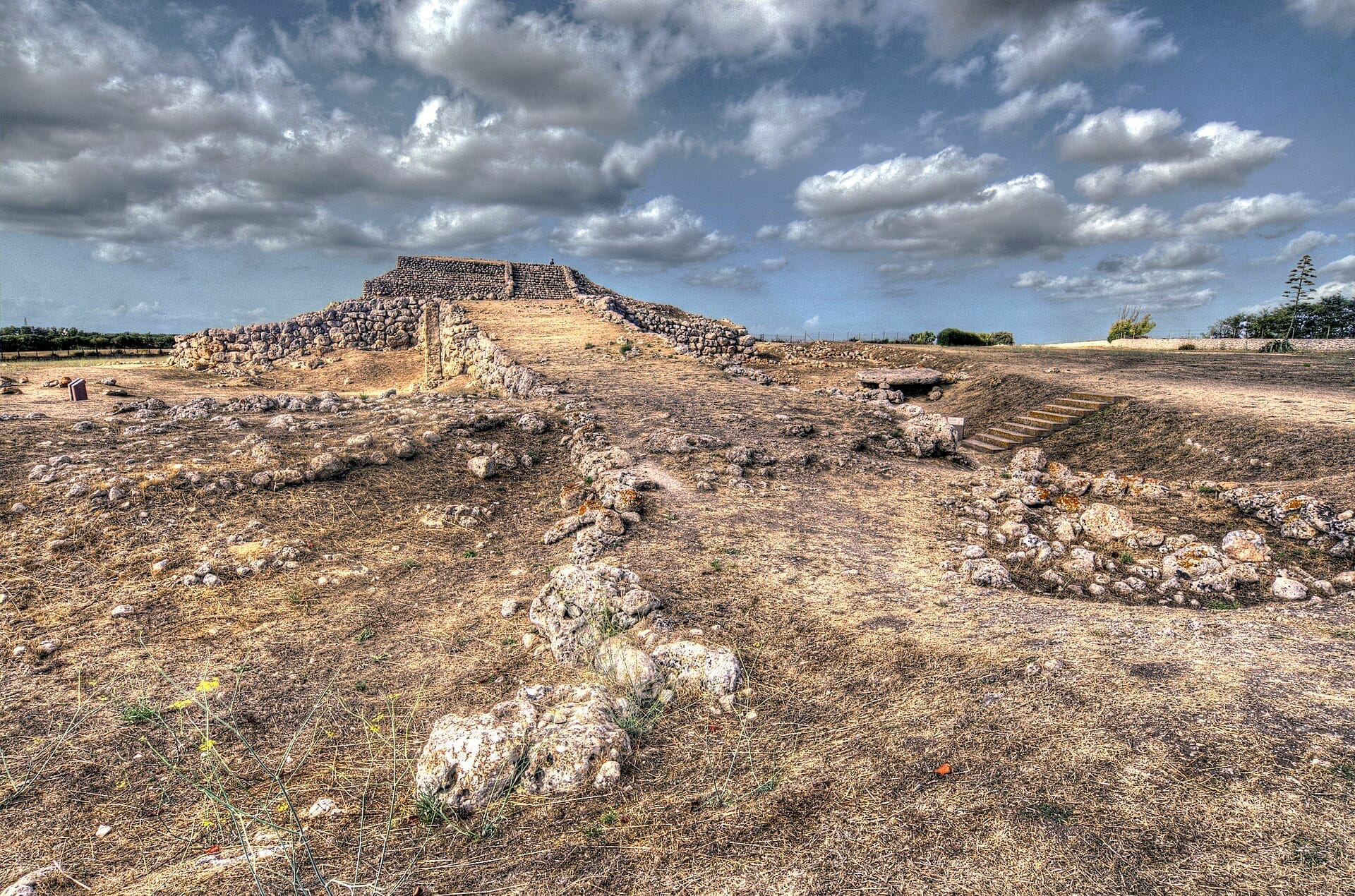
Monte d'Accoddi is a pre-Nuragic megalithic sanctuary unlike anything else in Sardinia or, indeed, the wider western Mediterranean. It consists of a large, roughly truncated stone platform — a raised altar — accessed by a long stone ramp, surrounded by the eroded remains of a prehistoric settlement. The whole structure rises from the flat agricultural plain of the Nurra, a quiet farming area northwest of Sassari, with no dramatic landscape to compete with it. That isolation makes it feel stranger and more imposing than its modest dimensions might otherwise suggest.
The monument's official designation is Altare prenuragico di Monte d'Accoddi, or the pre-Nuragic altar of Monte d'Accoddi, and that word 'pre-Nuragic' is significant. Most visitors to Sardinia come to see the island's famous Bronze Age nuraghi towers, but Monte d'Accoddi is centuries older. It belongs to a different world entirely: the Neolithic and early Eneolithic, a period when the people of Sardinia were building something that looks, to modern eyes, faintly like the ziggurats of ancient Mesopotamia or the stepped platforms of the Aegean.
ℹ️ Good to know
Opening hours are seasonal. Generally open seasonally with reduced hours in winter and longer hours in summer; the site is usually closed on Mondays. Always verify the current timetable on the official Sardinian museums portal or the Monte d’Accoddi site before visiting, as opening days and hours change frequently. Last entry is one hour before closing. Always verify hours before travel via the official Sardinian museums portal.
The History Layered Into This Platform
The story of Monte d'Accoddi is one of accumulation. The earliest traces of human activity here belong to the San Ciriaco culture, dating to around 3400 BC, when a settlement occupied the site. The first altar platform was raised slightly later, during an evolved phase of the Ozieri culture, roughly between 3200 and 2800 BC. The Ozieri culture produced some of the most refined Neolithic pottery in the Mediterranean, and the builders of this first altar were clearly capable of large-scale organised labour.
What makes the structural history especially compelling is that the monument was rebuilt rather than abandoned. Around 2700 BC, in the Eneolithic period, a second, larger platform was constructed directly over the first — encasing it, in a sense — creating the stepped 'temple a gradini' form that visitors see today. The result is a monument containing its own earlier self, like a series of nested layers of time.
Occupation and use of the site did not end with the Eneolithic. Archaeological evidence shows activity continuing through the Monte Claro, Bell Beaker, and Bonnanaro cultures, into the Bronze Age and Nuragic period, and even into Phoenician-Punic, Roman, and medieval times. The platform itself seems to have retained some form of significance long after the civilisation that built it had disappeared. Scattered finds from these periods surround the base of the mound, and standing near the ramp, you are standing in a place that has drawn human attention for roughly 5,400 years.
For visitors who want to situate Monte d'Accoddi within the broader arc of Sardinian prehistory, the Museo Nazionale Sanna in Sassari holds key finds from the Ozieri culture and provides essential context for understanding what daily life looked like for the altar's builders. Combining both sites in a single day is very manageable from Sassari.
Tickets & tours
Hand-picked options from our booking partner. Prices are indicative; availability and final rates are confirmed when you complete your booking.
Supramonte Full-Day Jeep Off-Roading and Hiking Tour in Dorgali
From 95 €Instant confirmationFree cancellationVineyard Guided Tour and 7 Wine Tasting in Palau
From 84 €Instant confirmationFree cancellationFull-Day Sailboat Tour in La Maddalena Archipelago from Cannigione
From 112 €Instant confirmationFree cancellationHiking excursion to the Devil's Saddle
From 35 €Instant confirmationFree cancellation
What You Actually See On Site
Approaching from the car park, the platform comes into view across an open field. It is not tall — the top sits perhaps around 10 metres above the surrounding plain — but it is wide and solid, with the stone ramp projecting forward at a gentle angle. The ramp is one of the defining details: it gives the structure an almost architectural purposefulness, a sense that it was built not just to be seen but to be approached in a specific way, perhaps in procession.
Near the base of the ramp, you will notice two large standing stones: a roughly spherical stone that some researchers have interpreted as a betyl (a sacred stone), and a flat slab nearby. These objects are originals, left in situ, and they give the site a texture that photographs rarely convey. The ground around the base of the platform holds the fragmentary remains of the prehistoric settlement: low stone outlines, eroded surfaces, interpretive panels in Italian and English that map out what has been excavated.
The top of the platform is not accessible to visitors — you observe it from the base and from the surrounding path. This is a reasonable conservation decision, but it does mean you cannot stand on the summit and look outward. The views from ground level are correspondingly modest: flat farmland in most directions, the faint outline of hills to the south. The site is not scenic in a conventional sense. Its power is conceptual rather than visual, and visitors who approach it purely as a landscape attraction are likely to be underwhelmed.
⚠️ What to skip
Monte d'Accoddi is an outdoor archaeological site on open farmland. In summer the site has virtually no shade, and midday temperatures in the Sassari province regularly exceed 30°C. Bring water, wear sun protection, and consider visiting in the morning. In winter and early spring, the ground can be muddy after rain; flat, closed-toe shoes are recommended over sandals year-round.
Time of Day and Seasonal Experience
Morning visits, particularly in spring and autumn, offer the most rewarding conditions. The low-angle light catches the texture of the stonework and the earthen platform more clearly than the flat light of midday, and the temperatures remain comfortable. In April and May the surrounding fields are green, with wildflowers in the verges, which softens the otherwise austere landscape around the monument.
In July and August, the plain around Monte d'Accoddi bakes under the Sardinian sun. There is a small area of shade near the ticket office, but the monument itself sits in full exposure. The experience is still worthwhile, but the absence of shade makes an early start (opening time, 09:00) essentially non-negotiable in high summer. By 11:00 on an August day, the site can feel punishing.
Crowd levels at Monte d'Accoddi are low by the standards of Sardinian tourism. Even in August it rarely feels overwhelmed. This is not a site that draws large tour groups or casual beach tourists; the visitors here tend to be interested in prehistory, which makes for a quieter, more contemplative atmosphere than you find at more famous Sardinian landmarks. On weekday mornings in shoulder season, you may have the site almost entirely to yourself.
Getting There and Practical Logistics
The site sits along the former SS131 state road, approximately 11 kilometres from the centre of Sassari in the direction of Porto Torres. By car, the journey takes around 15 minutes. From Sassari, follow signs for Porto Torres; near km 222 on the former SS131, look for brown tourist signage for Monte d’Accoddi at the Bancali junction, then turn off following signs onto the local access road (Strada Vicinale Monte d'Accoddi) to reach the car park. The ticket office and car park, including reserved parking spaces, are at the end of the paved avenue.
There is no reliable direct public transport to the site. Visitors without a car face a difficult journey. Taxis from Sassari are an option but add cost; cycling is theoretically possible along the flat road but not recommended in summer heat. The practical advice is: if you are based in Sassari or Alghero and have access to a car or scooter, Monte d'Accoddi is an easy half-day excursion. If you are car-free and based elsewhere, the logistics do not justify the effort unless prehistory is a specific priority.
Monte d'Accoddi fits naturally into a wider circuit of Sardinian Neolithic and early Bronze Age sites. The Domus de Janas necropolis of Anghelu Ruju near Alghero, and the extraordinary Su Nuraxi di Barumini further south, together trace the full arc of prehistoric Sardinian civilisation across different periods and regions. Monte d'Accoddi is the earliest chapter in that story.
Photography Notes and Accessibility
The platform photographs best from the front, framed along the line of the ramp, which gives a sense of its stepped form and scale. Morning light from the east catches the ramp surface well. The two standing stones near the base make for a compelling foreground element when shooting wide. A mid-range zoom lens is more useful here than a wide-angle: the surrounding landscape is largely featureless, and a tighter composition keeps the focus on the monument itself.
On accessibility: the site has reserved parking near the ticket office. The ground around the monument is compacted earth and gravel, reasonably level in dry conditions. The path around the platform base is walkable without significant obstacles, though some areas may be uneven. The ramp is not open to visitors. For visitors with reduced mobility, the most important advice is to contact the site directly before visiting via the official channel listed on the Monte d’Accoddi website to confirm current conditions.
Who Will Value This — and Who Will Not
Monte d'Accoddi is one of the most archaeologically significant sites in Sardinia and unusual in the context of European prehistory. For travellers with an interest in ancient history, the Neolithic Mediterranean, or simply in monuments that challenge easy categorisation, it is worth a deliberate detour. The comparison to Mesopotamian ziggurats is not just a tourist board flourish: archaeologists have debated what cultural connections, if any, might explain a ramp-accessed platform altar appearing in Bronze Age Sardinia.
However, visitors expecting a visually dramatic site on the scale of Stonehenge or even the nuraghi near Barumini should recalibrate. The monument is modest in height, the setting is a flat agricultural plain, and there is limited on-site interpretation beyond the informational panels. Without prior reading about the site's significance, the experience can feel underwhelming. The site rewards preparation. Read about the Ozieri culture and the Eneolithic before you arrive, and what you see will be fascinating. Arrive cold, and it may look like a large mound of earth.
Visitors travelling through the Sassari area with broader interests in prehistoric Sardinia should also consider the Sardinia nuragic and pre-nuragic sites guide for a fuller picture of what the island's ancient landscape contains.
Insider Tips
- Download or print the entry from sardegnacultura.it before visiting — the English-language site description provides historical detail that goes well beyond what the on-site panels cover, and reading it en route changes the experience.
- The site is closed on Mondays, which catches many visitors off guard. If you are planning a day trip from Sassari or Alghero, double-check the day of the week. A wasted drive to a closed gate is a common frustration here.
- Combine the visit with the Museo Nazionale Sanna in Sassari on the same day. The museum's Ozieri culture ceramics and archaeological finds from the Sassari province make Monte d'Accoddi's platform feel inhabited and human rather than abstract. The two together take under half a day.
- The large spherical stone near the ramp base (the so-called betyl) is easy to walk past without noticing if you are focused on the main platform. Slow down near the ramp foot and look around at ground level — several original prehistoric objects are placed in situ.
- For the clearest photographs of the stepped profile, position yourself at a slight angle to the ramp, about 30–40 metres back. Dead-on shots from directly in front tend to flatten the structure and lose the sense of the stepped form.
Who Is Monte d'Accoddi For?
- Travellers with a specific interest in Neolithic and Eneolithic prehistory who want to see something rare in the European context
- Day-trippers based in Sassari looking for a short, unusual cultural excursion that takes under two hours including travel
- Visitors combining the site with Alghero and the Anghelu Ruju necropolis for a dedicated prehistoric northwest Sardinia itinerary
- Photographers interested in ancient monuments and the interplay of stone structure and open agricultural landscape
- Families with older children (10+) who are curious about civilisations before the Romans and Greeks — the site's age (over 5,000 years) is arresting when explained in context
Nearby Attractions
Other things to see while in Sassari:
- Basilica di San Gavino (Porto Torres)
Standing on Monte Agellu in Porto Torres, the Basilica dei Santi Gavino, Proto e Gianuario is the largest Romanesque church in Sardinia and one of the most architecturally singular in Italy. Built in the first half of the 11th century, it is the only Romanesque monument in the country originally designed with two opposing apses. For anyone tracing the island's medieval history, this is as significant as it gets.
- Bosa
Bosa sits on the north bank of the Temo River in western Sardinia, its medieval quarter tumbling down a hillside in layers of terracotta, ochre, and faded pink. It is the only town in Sardinia built along a navigable river, and that distinction shapes everything about it: the old tanneries along the water, the boat-lined banks, the slow pace that has little to do with the island's summer beach circus.
- Castello dei Doria (Castelsardo)
Perched on a volcanic promontory above the Gulf of Asinara, Castello dei Doria is a 12th-century Ligurian fortress that has shaped northern Sardinia for nearly a thousand years. Today it houses the Museo dell'Intreccio Mediterraneo, dedicated to Mediterranean basketry, while its ramparts offer some of the most commanding coastal views on the island.
- Castello Malaspina (Bosa)
Perched 81 metres above the Temo river on Serravalle hill, Castello Malaspina is the medieval landmark that defines Bosa's skyline. Inside its walls stands the Romanesque Church of Nostra Signora de Sos Regnos Altos, sheltering rare 14th-century frescoes. The climb is steep, but the views over terracotta rooftops, vineyards, and coastline are exceptional.