Centro Storico di Alghero: Sardinia's Most Distinctly Catalan Quarter
The historic centre of Alghero is one of the Mediterranean's most atmospheric old towns, where Catalan Gothic architecture, honey-coloured ramparts, and a language that isn't quite Italian create a quarter that feels unlike the rest of Sardinia. Entry is free, the streets run to the sea, and it rewards slow exploration at almost any hour.
Quick Facts
- Location
- 07041 Alghero SS, northwest Sardinia
- Getting There
- ARST bus from Alghero-Fertilia Airport (AHO, ~8 km); city buses stop on the main boulevard adjacent to the historic walls
- Time Needed
- 2–4 hours for the quarter itself; a full day if you add the ramparts, cathedral, and seafront aperitivo
- Cost
- Free to enter public streets and ramparts; individual museums and the cathedral bell tower charge separately
- Best for
- History lovers, slow walkers, architecture enthusiasts, and anyone arriving by ferry or from the airport who wants a gentle introduction to Sardinia
- Official website
- www.algheroturismo.eu/en
What Makes the Centro Storico Worth Your Time
The Centro Storico di Alghero is the kind of place that makes you check your map twice, not because you are lost but because the street signs are in Catalan. This compact medieval quarter on the northwest coast of Sardinia has been shaped by a singular historical accident: in 1353, Peter IV of Aragon seized the city, expelled much of the existing population, and repopulated it with Catalan settlers. Seven centuries later, Catalan Gothic doorways still frame the alleys, church plaques run in two languages, and elderly residents greet each other in a dialect called Alguerès, one of the few surviving forms of Catalan spoken outside the Iberian Peninsula.
That cultural oddity is not a tourist performance. It is a lived reality embedded in the stone, the street names, and the food. Walking the Centro Storico feels less like touring a heritage site and more like landing in a place that took a different historical turn from everywhere around it.
ℹ️ Good to know
The historic centre is an open urban quarter accessible at all hours with no admission charge. Individual attractions inside, including the cathedral bell tower and civic museums, operate on their own seasonal schedules and may require tickets.
The Walls and Ramparts: Where the City Meets the Sea
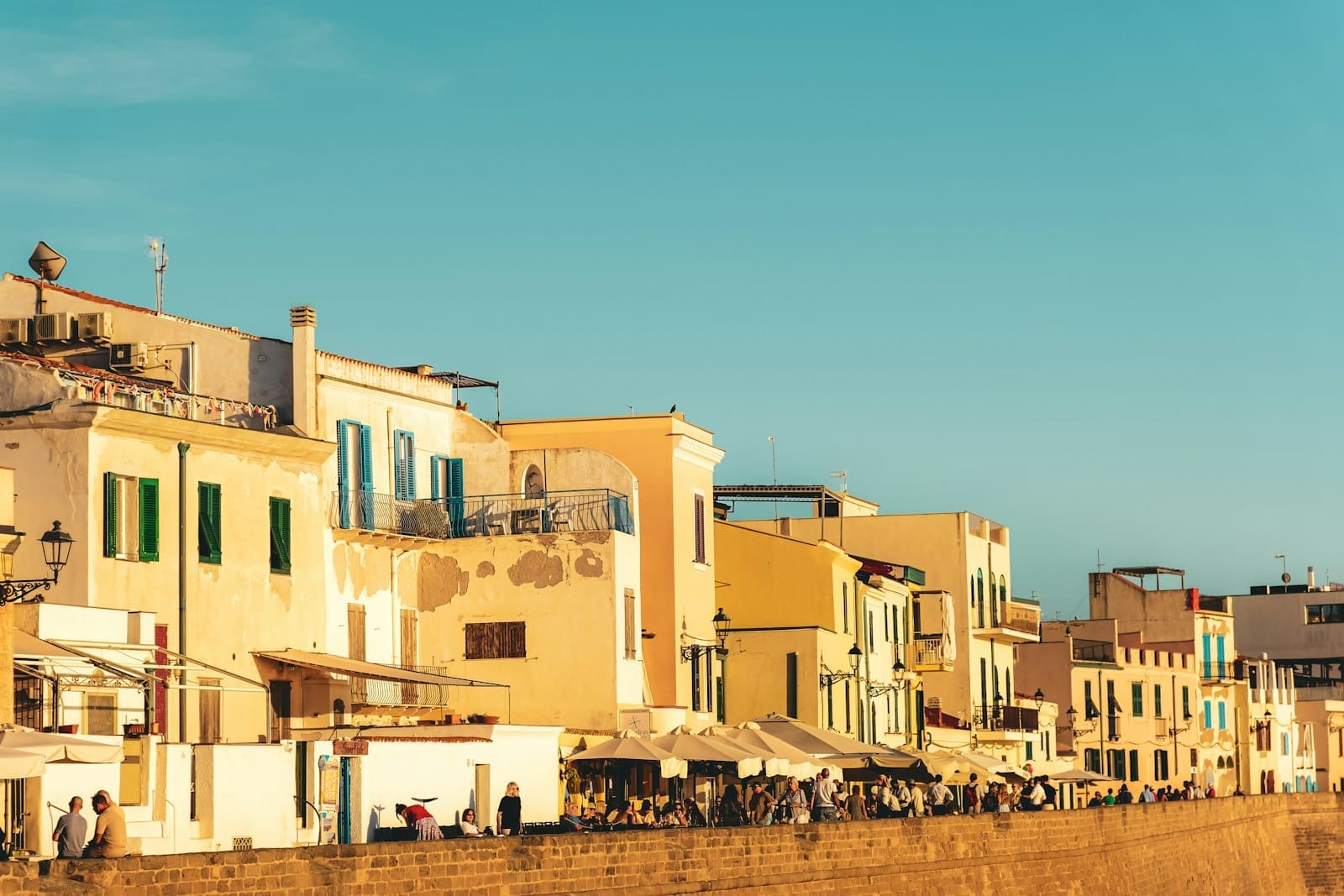
The most immediately striking feature of the Centro Storico is its ring of medieval sea walls. Built in limestone that turns a warm amber in afternoon light, these fortifications run along the western and northern edges of the old town, dropping almost directly into the water. The walkable section, known as the Bastioni, stretches for several hundred metres and functions as the social spine of the city in the early evening.
Between roughly 6 pm and sunset, the ramparts fill with a particular kind of crowd: locals with dogs, couples sharing a bottle of Vermentino in paper cups from the kiosks below, grandparents watching children chase pigeons near the towers. It is a genuine passeggiata rather than a tourist procession. The view west across the Gulf of Alghero is unobstructed, and when the light drops low, the sea shifts between deep blue and copper.
In the morning, especially before 9 am, the ramparts are nearly empty. The stone is cool, the fishing boats are already out in the bay, and you can hear the water against the walls below. This is the best hour to photograph the fortifications without other visitors framing your shots. Bring a light layer as the sea breeze can be sharp even in summer.
💡 Local tip
Walk the ramparts in both directions. The northern section near the Torre di San Giovanni offers the clearest view back over the old town roofscape. The southern end near the harbour gives you the fishing port and, on clear days, a distant view toward the Capo Caccia headland.
Tickets & tours
Hand-picked options from our booking partner. Prices are indicative; availability and final rates are confirmed when you complete your booking.
Alghero historic center walking tour
From 30 €Instant confirmationFree cancellationBoat excursion and snorkeling in Porto Conte marine area in Alghero
From 90 €Instant confirmationFree cancellationAlghero Porto Conte Park Eco-Museum Tickets
From 15 €Instant confirmationFree cancellationCooking class of traditional recipes with a full meal in Alghero
From 107 €Instant confirmationFree cancellation
Inside the Quarter: Lanes, Churches, and Catalan Gothic Details
The interior of the Centro Storico is small enough to cross in fifteen minutes, but that pace will cause you to miss most of what matters. The layout is a dense grid of narrow caruggi, some barely wide enough for two people to pass, paved in stone and largely closed to traffic. At street level, the ground floors alternate between restored medieval portals, local alimentari, coral jewellery workshops, and outdoor tables that appear mid-morning and stay until well past midnight in summer.
The cathedral, the Cattedrale di Santa Maria, anchors the southern end of the quarter near the port. Construction began in the 16th century in late Gothic-Catalan style with later Renaissance and Baroque additions, with the characteristic octagonal bell tower being one of the most photographed elements. The interior is cooler and quieter than the streets outside and worth a brief visit even if religious architecture is not usually your focus. Appropriate dress is required: shoulders and knees covered.
Several smaller churches dot the quarter. San Francesco, with its courtyard cloister, is the most architecturally significant after the cathedral and is sometimes used for summer concerts. Chiesa di San Michele, distinguished by its majolica-tiled dome, is visible from several approach angles. For the full architectural context of Alghero's urban form, the Alghero destination guide provides useful orientation.
Coral has been harvested from the waters around Alghero since the medieval period, and the centro storico is still the main place to buy it. The quality and origin of coral sold in tourist shops varies considerably. Pieces labelled 'corallo di Alghero' or certified by local workshops are more likely to be local than mass-produced imports. Prices reflect this distinction.
How the Quarter Changes Through the Day
Early morning, before the shops open and the tour groups arrive, the Centro Storico is primarily a residential neighbourhood. Bars put out their first espressos by 7:30 am. Deliveries clatter over the cobblestones. The smell in the alleys is bread from the nearby panifici and, close to the port, salt air and diesel. If you are staying in the old town, this hour is worth setting an alarm for.
By mid-morning, the tourist layer settles over the residential one. Shop shutters go up, the main pedestrian axis along Via Carlo Alberto fills with foot traffic, and the outdoor tables claim the wider intersections. From June through August, the quarter becomes crowded between 11 am and 7 pm, with the narrowest alleys feeling congested around lunchtime. This is not a reason to avoid summer visits but it does reshape how you move through the space.
Evenings from late May through September are the social peak. Restaurants fill by 8 pm, the ramparts hold their aperitivo crowd until dark, and the main square near the port occasionally hosts live music. In shoulder months, October and April especially, this energy is softer: fewer visitors but the restaurants are still open, the light is excellent, and the city feels more like itself.
⚠️ What to skip
In July and August, the combination of summer crowds and narrow stone streets means daytime heat is amplified. Wear breathable clothing, carry water, and plan any extended exploration for early morning or after 5 pm.
Historical and Cultural Context
Alghero's founding is traditionally dated to the early 12th century, when the Doria family of Genoa established a fortified settlement on this promontory. The Genoese phase shaped the basic urban structure, but it was the Aragonese conquest of 1354 that gave the city its defining character. The Catalan repopulation was systematic and thorough enough that Alguerès, the local dialect, survived through the subsequent Spanish, Piedmontese, and Italian periods without disappearing.
Today Alghero holds a recognised status as a Catalan-speaking city and maintains cultural ties with Catalonia itself. This is one of the more unusual linguistic situations in Italy and worth understanding before you arrive. The cultural identity of Sardinia more broadly involves several minority languages and traditions, and Alghero's Catalan heritage represents one of the most distinct of these.
Architecturally, the Catalan Gothic style visible in the cathedral, certain palazzo doorways, and a few surviving arched portals is characterised by wider, lower arches than northern Gothic, thick walls, and an emphasis on structural stability over vertical drama. It reads as solid and sober rather than soaring, which suits the maritime character of the town. Some of the most rewarding examples are not on the main tourist route but tucked into residential side streets where nobody has put a sign.
Practical Walkthrough: Moving Through the Quarter
The Centro Storico is compact. A useful approach is to begin at the port end, near the ferry terminal, where the old town opens onto the modern harbour. From there, walk north through the quarter along Via Carlo Alberto or its parallel alleys, working toward the ramparts. Once on the bastioni, follow the walls north and west for the sea views, then loop back through the interior lanes at a different angle. This loose circuit takes 90 minutes without stops and three hours with them.
Footwear matters here. The cobblestones are uneven in places, and some alley surfaces are polished smooth by centuries of foot traffic, making them slippery after rain or even morning dew. Flat-soled shoes with grip are better than sandals or heels. The terrain is largely flat within the quarter itself, but the rampart walk involves some low steps and uneven surfaces that can challenge wheelchair users. Step-free access exists along portions of the seafront promenade below the walls, which provides an alternative route with similar views.
Getting to Alghero from elsewhere in Sardinia is straightforward by car, but the historic centre itself is largely pedestrian-only and parking near the walls is limited and often paid. If you are arriving from the airport, ARST buses connect Alghero-Fertilia Airport to the city centre, from where the Centro Storico is a short walk downhill to the seafront. For broader regional context on movement around the island, see the guide to getting around Sardinia.
Alghero makes an excellent base for exploring the surrounding northwest. The dramatic sea caves of Neptune's Grotto at Capo Caccia are around 25 km from the centre and reachable by boat from the port or by road with a steep staircase descent. The Porto Conte Natural Park begins just outside the city.
Photography and Sensory Notes
The light in the Centro Storico follows the logic of the limestone. The walls and pavements absorb heat through the day and reflect warm tones in late afternoon. The golden hour before sunset, when the western ramparts are fully lit and the sea is behind them, is the most dramatic window. The cathedral's octagonal tower photographs best from the small square directly in front of it in the morning, when the sun is to the east.
For street photography within the alleys, overcast days are actually better than full sun: the narrow lanes create extreme contrast in direct light, with deep shade in the alleys and blown-out highlights at the ends. A cloudy morning produces even, soft light that works for architecture and detail shots. The coloured fishing boats in the old harbour are at their best in the first two hours after sunrise before the day's boats leave.
If the old town whets your appetite for Sardinian culture more broadly, the island has a remarkable depth of archaeological and historical sites ranging from Bronze Age nuraghi to Phoenician coastal towns.
Insider Tips
- The best coffee in the historic centre is typically found at the older, less-decorated bars frequented by locals rather than those with English-language menus on the ramparts. Look for the ones with standing room only at the bar counter in the morning.
- If you want to hear Alguerès spoken naturally, visit on a weekday morning rather than a summer weekend. Sit near the market or a residential square rather than the main tourist strip, and you will catch it in ordinary conversation.
- The boat excursion to Neptune's Grotto departs from the old harbour at the base of the ramparts. Booking in advance is advisable in July and August, but in May, June, or September you can often secure a spot by showing up 30 minutes before departure.
- Coral jewellery made from locally harvested coral is subject to international trade regulations. If you are buying a significant piece, ask the seller for documentation of origin and legal harvest certification to avoid customs complications when returning home.
- The streets inside the quarter are quieter north of the cathedral than south of it. The northern residential section near the old towers sees fewer visitors and retains a more everyday neighbourhood character, with residents' laundry overhead and cats on doorsteps.
Who Is Centro Storico di Alghero For?
- Travellers interested in European history and architecture who want something more layered than a standard Italian town
- Slow travellers who prefer lingering in a single area over covering maximum ground
- Photographers looking for Mediterranean light, textured stone, and authentic street scenes rather than staged scenery
- Families with older children who can manage cobblestone terrain and will benefit from the manageable scale of the quarter
- Visitors using Alghero as a base for northwest Sardinia who want an evening destination that rewards return visits
Nearby Attractions
Other things to see while in Alghero:
- Bastioni di Alghero
The Bastioni di Alghero are a continuous promenade along the medieval and 16th-century fortifications that frame the old city on its seaward side. Free to walk at any hour, they offer some of the most compelling views in northwest Sardinia, from the coral-blue water below the walls to the distant outline of Capo Caccia across the gulf.
- Capo Caccia
Capo Caccia is a towering limestone promontory on Sardinia's northwestern coast, forming the western boundary of the Capo Caccia – Isola Piana Marine Protected Area. The clifftop belvederes are free and open to all, while the famous Grotte di Nettuno lie below, reached by a vertiginous staircase or seasonal boat.
- Domus de Janas di Anghelu Ruju
Cut into sandstone on a flat plain 6 km from Alghero, the Necropoli di Anghelu Ruju contains 38 prehistoric tombs dating back to around 3200 BC. It is the most extensive hypogean burial site in northern Sardinia and one of the most significant Neolithic monuments in the entire Mediterranean.
- Grotte di Nettuno
Cut into the limestone cliffs of Capo Caccia, the Grotte di Nettuno is one of Sardinia's most dramatic natural attractions. Reach it by descending 654 steps carved into a sheer cliff face, or arrive by boat from Alghero's port. Inside, a guided tour reveals a vast karst cave system built around a saltwater lake and draped in extraordinary stalactite and stalagmite formations.