Giara di Gesturi: The Ancient Plateau Where Wild Horses Still Roam
Rising to around 550 metres above central Sardinia, the Giara di Gesturi is a 45-square-kilometre basalt plateau formed by Oligocene volcanic activity. Cork oak forests, seasonal wetlands, and an extraordinary population of small wild horses make it one of the most ecologically singular landscapes on the island.
Quick Facts
- Location
- Municipalities of Gesturi, Tuili, Setzu (South Sardinia) and Genoni (Oristano), approx. 60 km north of Cagliari
- Getting There
- Car essential. From Cagliari: SS131 north, then SS197 via Furtei and Villamar, approx. 1 hr 20 min. Parking available at Gesturi, Tuili, and Genoni access points
- Time Needed
- Half day minimum; full day recommended for wider exploration on foot or by bike
- Cost
- Free to access as a natural area. Guided tours via Parco della Giara have fees — contact the park for current rates
- Best for
- Nature lovers, wildlife watchers, hikers, photographers, and travellers combining with a visit to nearby Su Nuraxi di Barumini
- Official website
- museocavallinodellagiara.it/parco-della-giara
What the Giara di Gesturi Actually Is
The Giara di Gesturi — known in Sardinian as Sa Jara Manna — is a flat-topped basalt mesa covering roughly 44 to 45 square kilometres in the centre-south of Sardinia. It measures approximately 12 kilometres long and 4 kilometres wide, with an average elevation around 500 to 550 metres. Its two highest points are Zepparedda at 609 metres and Zeppara Manna at 580 metres. The plateau was formed by volcanic activity during the Oligocene epoch, and the hardened basalt cap has resisted erosion far more effectively than the softer limestone and clay of the surrounding lowlands — which is why it stands so visibly above the Campidano plain like a raised table.
What you find on top bears little resemblance to most of Sardinia's more famous landscapes. There are no sea views and no beaches. Instead, the plateau holds a dense canopy of cork oak and holm oak, open grassland clearings, and shallow seasonal ponds called paulis, which fill from autumn rains and persist through spring before drying out in summer heat. This cycle drives everything: the ponds are the reason the wild horses stay, the reason migratory birds pass through, and the reason the plateau feels alive in a way that is difficult to replicate at more polished nature sites.
💡 Local tip
The best time to see the wild horses near the paulis is between late autumn and early spring, when the seasonal ponds hold water and the horses concentrate around them. In July and August the ponds are dry, horses are harder to spot, and the heat on the open plateau is intense.
The Wild Horses: What You Need to Know
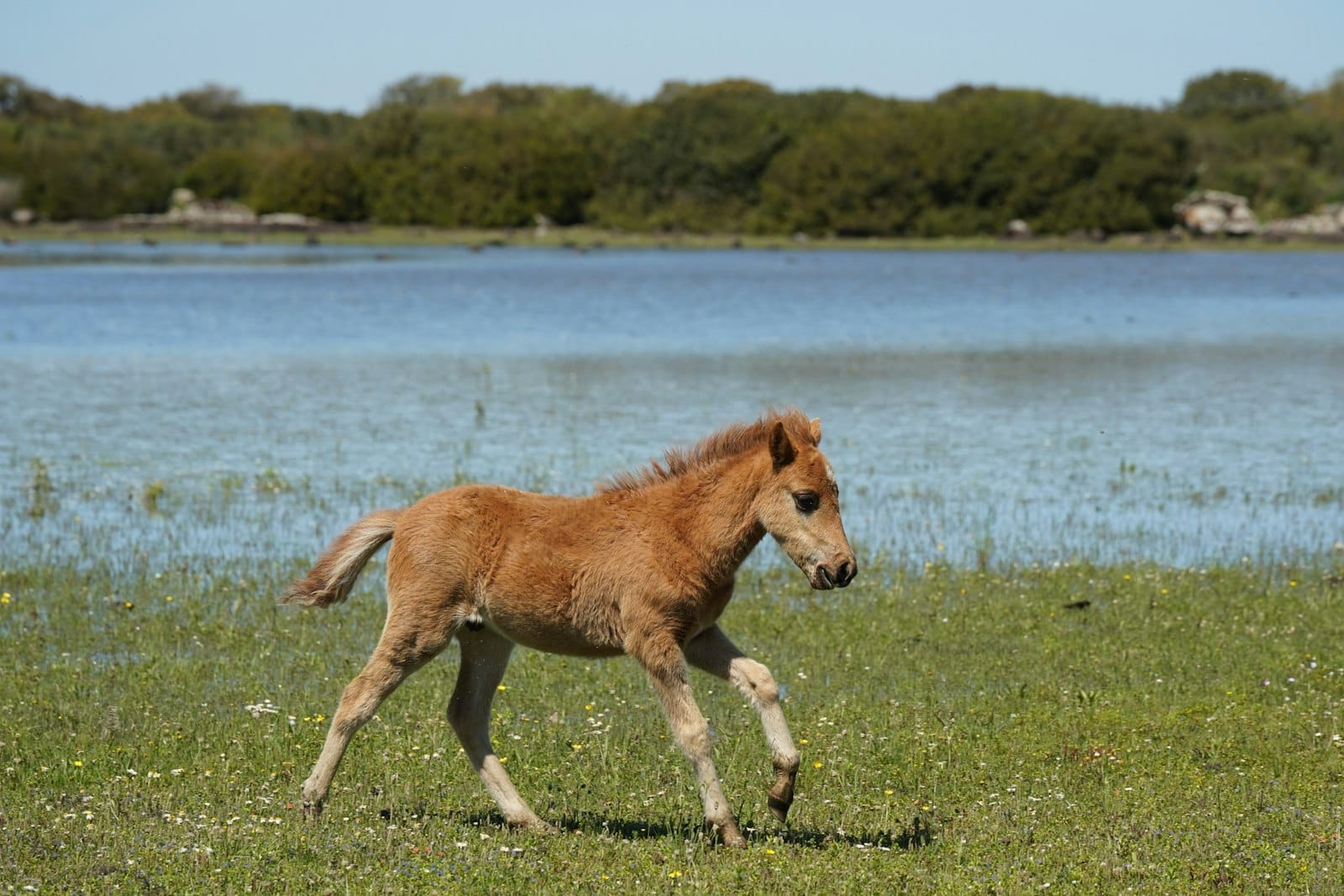
The cavallini della Giara are one of the most remarkable populations of semi-wild horses in Europe. Small and stocky — typically standing around 130 centimetres at the shoulder — they live in family groups across the plateau, moving freely and relying on the paulis for water through the cooler months. Their origins are debated, but they have been present on the Giara for centuries, and their isolation on the plateau has contributed to a genetically distinct population.
Encountering them requires patience and a degree of luck. They are not tame, and they will move away if you approach directly or make sudden noise. The most reliable strategy is to walk quietly along the trails nearest the paulis in the early morning, before the plateau receives visitors on organised tours. Groups of mares with foals in spring are the most reliably visible; stallions tend to range more widely. The light in the hour after sunrise, when mist still sits in the tree hollows, produces the kind of photographs that justify the early drive from wherever you are staying.
Photographers should bring a telephoto lens — 200mm or longer — and manage expectations around guarantees. You may walk for two hours and spot a large group near the first pond, or cover most of the plateau and see distant silhouettes in the treeline. The plateau is not a zoo. That unpredictability is, for many visitors, precisely the point. If spotting the horses is the primary goal of your trip to this part of Sardinia, consider pairing the Giara with a guided visit from Su Nuraxi di Barumini, which sits only about 25 minutes away — if the horses prove elusive, you will still have had a deeply worthwhile day.
Tickets & tours
Hand-picked options from our booking partner. Prices are indicative; availability and final rates are confirmed when you complete your booking.
Tour of Barumini UNESCO site and Giara di Gesturi plateau
From 105 €Instant confirmationFree cancellationDaytrip to Barumini and the Giara of Gesturi
From 80 €Instant confirmationFree cancellationVineyard Guided Tour and 7 Wine Tasting in Palau
From 84 €Instant confirmationFree cancellationFull-Day Sailboat Tour in La Maddalena Archipelago from Cannigione
From 112 €Instant confirmationFree cancellation
How the Experience Changes Through the Day
Arriving by 8 or 9 in the morning gives you the plateau largely to yourself. The air at this elevation is noticeably cooler than the plain below, even in summer, and the cork oaks hold a particular stillness in the early light. Birdsong is layered and constant: black woodpeckers, hoopoes, and — near the paulis in season — wading birds and waterfowl that stop here during migration. The smell of the vegetation at this hour is fresh and slightly resinous, a mix of wild herbs, damp soil, and the faintly waxy scent of the oak canopy.
By mid-morning, especially in summer, the quality of the experience begins to shift. Organised tour groups arrive from nearby villages, the light becomes harsher and less photogenic, and the heat on the open grassland sections builds quickly. If you are visiting in July or August and cannot arrive early, the shaded woodland trails remain tolerable, but the open clearing areas near the central ponds can be uncomfortably exposed by midday.
Late afternoon visits in spring and autumn have their own quality: the low angled light through the cork oaks turns the plateau golden, and the horse groups often move toward the water as temperatures drop. The plateau does not have facilities such as cafes or drinking water points, so whatever you need, you bring with you.
⚠️ What to skip
There are no drinking water sources on the plateau itself. Bring at least 1.5 litres per person. In summer, double that. Shade is available in the woodland sections but the open pauli areas are fully exposed.
Getting There and Navigating the Access Points
A car is effectively essential. Public transport does not serve the plateau access points. From Cagliari, the drive takes approximately 1 hour 20 minutes via the SS131 motorway north to the Villasanta exit, then the SS197 through Furtei and Villamar, and onward toward Tuili or Gesturi. The road up to the plateau from Gesturi is the most commonly used approach; there is a parking area at the top of the ascent from the village.
The Genoni access on the northern (Oristano province) side of the plateau is less frequented and involves a 6-kilometre road from the village to the plateau parking. This approach is worth considering if you want fewer people around: visitor density tends to be lower on the Genoni side, particularly on weekday mornings. From Barumini — the natural pairing town given the nearby nuraghe — the drive to the plateau takes around 25 minutes via the SS197 and the SP 5.22.
Once on the plateau, movement is on foot, by mountain bike, or on horseback along unpaved tracks. The terrain is basalt-based and uneven in places; sturdy walking shoes with ankle support are advisable. Trails are not formally signposted to a high standard throughout, so downloading an offline map before you arrive (or picking up route information from local visitor centres in Gesturi or Tuili) is useful. The Giara makes an excellent addition to a broader itinerary through this part of Sardinia — see the Sardinia nuragic sites guide for a sense of how the surrounding area fits together.
Guided Visits and the Parco della Giara
The Parco della Giara, managed from the Genoni side, offers guided tours at set departure times that vary by season. Between October and March, departures run at 10:00 and 14:30. In April and September, departures are at 10:00 and 15:00. From May through August, tours run at 10:00 and 17:00. Fees apply for guided tours; exact current pricing is not published online and should be requested directly from the park.
Guided visits are worth considering if you are visiting for the first time and want to understand the ecology rather than simply walk the trails independently. Local guides know which pauli areas currently hold horses, which avoids spending an hour in the wrong section. Horse-trekking options are also available through private operators based in the villages below — this is a slower and more immersive way to cover the plateau, and the horses seem to accept other horses more readily than approaching humans on foot.
ℹ️ Good to know
The plateau is officially open every day of the year. Outside guided tour hours, independent access is free of charge. The Parco della Giara website (museocavallinodellagiara.it) is the most reliable source for current tour schedules.
Ecology, History, and Why This Place Matters
The Giara's basalt cap, which resisted the erosion that shaped the valleys below, has also functioned as an ecological refuge. The plateau's isolation meant that land use practices here evolved differently from the surrounding farmland: the cork oak forest was harvested for bark rather than cleared, the paulis were not drained, and large-scale agriculture never took hold on the rocky surface. The result is a landscape that retains a character increasingly rare in Mediterranean Europe.
The paulis are particularly significant. These seasonal ponds support amphibians, including the Sardinian brook salamander, and serve as refuelling stops for migratory birds moving between Africa and Europe. The plateau sits within a protected area, and this status constrains what can be built or altered — which is why the Giara looks today much as it has for generations. Visitors interested in Sardinia's biodiversity may also want to explore other protected landscapes on the island, such as Parco Nazionale del Gennargentu, though the Giara's flat, open character makes it far more approachable for a half-day visit.
Archaeologically, the plateau and its surrounding villages are embedded in Sardinia's nuragic past. The landscape around the Giara is dense with nuragic structures, and the small town of Gesturi below the plateau sits near some of the richest archaeological terrain in the island's centre. The proximity to Barumini means that a combined day covering both the Giara and the Su Nuraxi complex is geographically logical and culturally coherent.
Honest Assessment: Is It Worth the Detour?
The Giara di Gesturi rewards people who go for the right reasons. If you arrive expecting a curated wildlife experience with guaranteed horse sightings from a comfortable viewpoint, you will likely be underwhelmed. The plateau requires walking on uneven ground, tolerating uncertainty about what you will see, and accepting that nature operates on its own schedule.
If, on the other hand, you want somewhere in Sardinia that feels off the beach-and-resort circuit, the Giara delivers that clearly. It is not overrun in the way that coastal sites can be in peak season. The combination of ecological interest, the strange flatness of the plateau above the Campidano plain, and the presence of truly wild horses creates an experience with no real equivalent on the island. Travellers spending a week or more in Sardinia — particularly those using the interior — should seriously consider it. For context on how to build this into a wider trip, the one-week Sardinia itinerary and the Sardinia road trip guide both cover routes through the centre of the island that pass near the Giara.
People who should not prioritise the Giara: travellers with very limited time (one or two days) who are focused on beaches and coastal towns. The drive from the coast adds significant time, and the plateau experience requires the right mindset and season to pay off. Visitors with mobility limitations should note that the terrain is rough, unpaved, and has no accessible facilities; this is not an attraction that can be experienced meaningfully from a car.
Insider Tips
- Visit on a weekday in April or October for the best combination of full paulis, mild temperatures, active horses, and thin crowds. Weekends in spring draw local visitors from Cagliari and Oristano, and the trails near the main paulis become noticeably busier.
- The Genoni access on the north side of the plateau is consistently less crowded than the Gesturi and Tuili approaches. If you are driving from Oristano or arriving via the SS131 from the north, use the Genoni road — it adds no meaningful distance and puts you in a quieter section of the plateau.
- Cork oak bark is harvested on the Giara in cycles, and recently stripped trees display vivid red-orange trunks that are striking in contrast to the grey-green canopy. If you see these, look closely at the ground beneath them — beetles and small reptiles concentrate around the disturbed soil.
- Do not walk directly toward a horse group. Stop, crouch slightly, and wait. Horses that initially move away often circle back out of curiosity if you stay still and quiet for five to ten minutes. Standing at the edge of a pauli at dawn and letting the animals approach on their terms produces far better encounters than pursuing them.
- The villages of Gesturi and Tuili both have small cafes and bars open in the morning. Have breakfast in one of them before ascending; there is nothing to eat or drink on the plateau itself.
Who Is Giara di Gesturi For?
- Wildlife and nature photographers wanting unpredictable, authentic subjects in natural habitat
- Hikers and cyclists looking for flat to gently rolling terrain away from coastal crowds
- Travellers combining archaeology and nature, pairing the plateau with Su Nuraxi di Barumini on the same day
- Families with older children comfortable with walking on uneven ground for two or more hours
- Off-season visitors (October to April) seeking active outdoor experiences when beaches are closed
Nearby Attractions
Other things to see while in Barbagia & Nuoro:
- Gola di Su Gorropu
Gola di Su Gorropu is a karst canyon in Sardinia's Supramonte massif with walls rising over 500 metres and passages as narrow as 4 metres across. It's a serious hiking destination that rewards physical effort with one of the most dramatic landscapes in the Mediterranean.
- Monte Ortobene
Reaching a maximum elevation of 955 metres above sea level near the inland city of Nuoro, Monte Ortobene is a forested mountain with panoramic views across central Sardinia, a landmark bronze statue of Cristo Redentore, and walking paths through fragrant Mediterranean scrubland. Access is free, the road reaches the summit, and the atmosphere is unlike anything on the coast.
- Murales di Orgosolo
Orgosolo, a small hill town in the Barbagia region of central Sardinia, has covered its streets in around 150 murals since the late 1960s. Free to visit at any hour, the Murales di Orgosolo form one of the most politically charged and visually striking open-air art experiences in Italy.
- Museo del Costume e della Tradizione Sarda (Nuoro)
Perched on the Sant'Onofrio hill above Nuoro, the Museo della Vita e delle Tradizioni Popolari Sarde holds one of the most significant ethnographic collections in Italy. With around 8,000 objects spanning ceremonial dress, silverwork, masks, and weaving tools, it offers a serious, rewarding portrait of the culture that shaped inland Sardinia.