Gola di Su Gorropu: Inside Italy's Deepest Canyon
Gola di Su Gorropu is a karst canyon in Sardinia's Supramonte massif with walls rising over 500 metres and passages as narrow as 4 metres across. It's a serious hiking destination that rewards physical effort with one of the most dramatic landscapes in the Mediterranean.
Quick Facts
- Location
- Supramonte massif, on the border of Orgosolo and Urzulei, central-eastern Sardinia
- Getting There
- By car only — trailhead at Passo Genna Silana on SS125, between Dorgali and Baunei
- Time Needed
- 4–6 hours for the round trip from Passo Genna Silana; visits must be completed by 15:30
- Cost
- €6 adults, €4 children (6–17); tickets sold only at the canyon entrance info point
- Best for
- Experienced hikers, geology enthusiasts, and anyone willing to work for a extraordinary landscape
- Official website
- gorropu.info
What Gola di Su Gorropu Actually Is
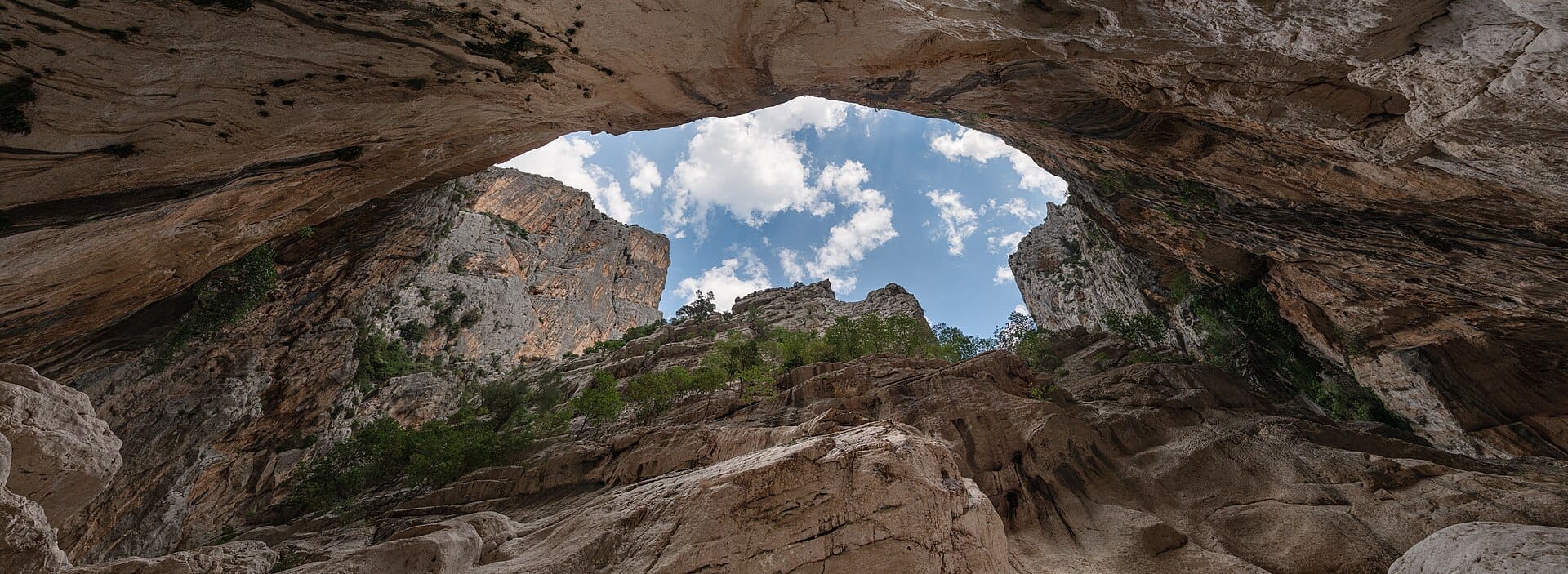
Gola di Su Gorropu is a karst canyon carved over millions of years by the Rio Flumineddu river along a fault line in the Supramonte limestone. The walls climb over 500 metres from the canyon floor, and at its narrowest points the gorge is only around 4 metres wide. Roughly 1.5 kilometres long, it is classified as Italy's deepest canyon and ranks among the deepest in all of Europe.
The limestone here is not geologically young. The rock faces contain fossilised marine shells and sea urchins dating from between 190 and 60 million years ago, deposited when this part of the Mediterranean was submerged under a shallow sea. Standing at the canyon floor and pressing your hand against the pale grey wall, you're touching a record of an ocean that no longer exists.
The gorge sits on the territorial boundary between Orgosolo and Urzulei in the Barbagia and Nuoro region, one of Sardinia's most rugged and culturally distinct areas. There are no roads into the canyon and no development inside it. Access is entirely on foot.
⚠️ What to skip
The canyon is open daily from 10:00, but all visits must be completed by 15:30. The official site at gorropu.info publishes real-time closure notices when rockfall risk, wind, or heavy rain makes entry unsafe. Check before you drive out there.
The Hike In: What to Expect on the Trail
The most commonly used approach starts at Passo Genna Silana, a signed trailhead with parking directly on the SS125 Orientale Sarda state road at approximately kilometre 183, between Dorgali and Urzulei. From here, the trail descends into the Flumineddu valley over roughly 5 kilometres, dropping several hundred metres in elevation. The path is well-worn but uneven, crossing dry riverbeds, passing through macchia scrubland, and occasionally scrambling over exposed limestone.
The descent takes around 1.5 to 2 hours at a steady pace, longer if the ground is wet or if you stop to look around. By the time you reach the canyon entrance, your legs will know they've been used. The first thing most people notice is a drop in temperature. The gorge runs predominantly north-south, and direct sunlight only reaches the floor during a narrow window at midday in summer. Arrive in the morning and the interior feels cool, even on a day when the SS125 is baking.
Inside the gorge, the walking surface changes completely. Large limestone boulders, smoothed and sometimes slippery, fill the floor. Progress is slow and requires concentration. Some sections require using your hands for balance. This is not a stroll, and the terrain punishes casual footwear. Sturdy hiking boots with ankle support are not optional.
💡 Local tip
A 4x4 shuttle transfer back to the Passo Genna Silana parking area can be booked at the canyon entrance info point during opening hours, which helps significantly if your group includes people who struggled on the descent or if afternoon heat is a concern.
Tickets & tours
Hand-picked options from our booking partner. Prices are indicative; availability and final rates are confirmed when you complete your booking.
Canyon of Gorropu Guided Hike from Genna Silana
From 84 €Instant confirmationFree cancellationVineyard Guided Tour and 7 Wine Tasting in Palau
From 84 €Instant confirmationFree cancellationFull-Day Sailboat Tour in La Maddalena Archipelago from Cannigione
From 112 €Instant confirmationFree cancellationHiking excursion to the Devil's Saddle
From 35 €Instant confirmationFree cancellation
Inside the Canyon: Light, Sound, and Scale
The sensory experience at the floor of Gola di Su Gorropu is unlike anything else in Sardinia. Sound behaves differently: distant water movement echoes off the walls and arrives from unexpected directions. The air smells of wet stone and river sediment even in dry months, because moisture persists in the lower sections year-round. The scale of the walls overhead compresses your sense of what's large and what's small.
At the narrowest passages, the walls are close enough to touch simultaneously with both arms outstretched. Looking directly up, you see a strip of sky that changes from blue-white at noon to a pale amber in late afternoon. In the hours before the 15:30 closing time, the sun angles into the western faces of the rock and illuminates the fossil textures in the stone with unexpected clarity. This is also the best photography window if you're shooting the walls themselves.
The vegetation inside the gorge is sparse but persistent: holm oak and lentisk grow from cracks in the rock, their roots prying deeper into the limestone every season. In spring, small ferns colonise the shadowed base of the walls where moisture lingers longest. Peregrine falcons nest on the upper cliff faces and are occasionally visible circling above the canyon rim.
Best Time to Visit and Seasonal Conditions
Late spring (May to early June) and early autumn (September to October) offer the most balanced conditions. Temperatures are moderate, the trail is generally dry, and the Rio Flumineddu is at a manageable level. In these windows, the hike in is pleasant rather than a test of heat endurance.
Summer visits are possible but demand an early start. The SS125 approach and the open trail sections before the canyon entrance are fully exposed to the sun, and summer temperatures across the Supramonte can exceed 35°C. Arriving at the trailhead by 10:00 when it opens means you're in the cooler canyon interior before the worst afternoon heat builds. Carry at least 2 litres of water per person.
Winter and periods of heavy rainfall are a different matter. The gorge floor can partially fill with water after significant rain, making passage dangerous or impossible. The official site is the authoritative source for closure notices. Do not attempt entry after rainfall without checking the status first.
For broader seasonal planning across the region, the best time to visit Sardinia guide covers how weather patterns affect different parts of the island, including the Supramonte interior.
Getting There: The Practical Reality
There is no direct public transport to Gola di Su Gorropu. A car is necessary. The primary access point is the signed trailhead at Passo Genna Silana on the SS125, at approximately kilometre 183. The SS125 is a mountain state road: scenic, sometimes narrow, and requiring focused driving, particularly on the hairpin sections between Baunei and Dorgali. A standard hire car handles it without difficulty, but it is not a motorway.
From Nuoro, the drive takes approximately 45 to 60 minutes. From Cagliari (roughly 200 kilometres away), allow at least 3 hours. From the Golfo di Orosei area around Cala Gonone, the trailhead is about 30 to 40 minutes. The gorge makes logical sense as part of a wider Supramonte itinerary combining the canyon with the coastal sections of the Golfo di Orosei.
Because driving is essential for this part of Sardinia, a planned route helps enormously. The Sardinia road trip guide covers the SS125 corridor and how to combine it with other Supramonte and Ogliastra highlights.
Guided Excursions and the Full Canyon Route
The standard visit enters the canyon from the Flumineddu valley side and covers the first accessible section of the gorge floor before the terrain becomes impassable without technical equipment. This is what the entrance ticket covers and what most visitors experience.
A longer technical traverse of the full gorge length is a separate undertaking requiring specialist canyoning skills, ropes, and ideally a licensed guide. This is not an improvised adventure. The canyon walls offer no escape routes once you're committed to certain sections, and water levels can rise quickly in wet conditions.
Licensed hiking and canyoning guides operating in the Supramonte area can be sourced through local tourism offices in Dorgali, Urzulei, and Orgosolo. The hiking in Sardinia guide covers the broader network of trails in this part of the island, including routes connecting the Supramonte with the Golfo di Orosei coastline.
Is Gola di Su Gorropu Worth the Effort?
The approach hike from Passo Genna Silana is approximately 8–12 kilometres round trip with significant elevation change and no shade on the open sections. The canyon floor requires physical confidence on uneven boulders. This is not an attraction you stumble across; it demands planning, appropriate fitness, and the right footwear. Anyone expecting a gentle walk-and-look will find it uncomfortable.
For those who meet those conditions, the canyon delivers. The scale of the walls, the quiet of the interior, and the geological strangeness of the place justify the effort in a way that photographs don't fully convey. It is not overhyped in the way that some Sardinian coastal attractions are. The difficulty acts as a natural filter, meaning the experience inside is rarely crowded even in peak summer.
People who should consider skipping it: anyone with significant mobility limitations, those travelling with young children who cannot handle 5-plus hours of demanding terrain, and anyone unwilling or unable to carry adequate water and sun protection. The canyon's 15:30 hard close also means late risers will be rushed or turned away.
Insider Tips
- Tickets are not sold in advance and cannot be purchased online. Bring cash, as card payment availability at the remote entrance info point cannot be guaranteed.
- The 4x4 shuttle transfer back to Passo Genna Silana parking is worth booking at the start of your visit if anyone in your group found the descent difficult. It eliminates the uphill return on tired legs.
- The walls show their fossil textures most clearly in the late afternoon light when the sun angles into the western face. If you time your canyon floor visit for roughly 13:30 to 14:30 in summer, you get both the best light for wall photography and enough time to exit before the 15:30 closing.
- Check gorropu.info on the morning of your planned visit, not the night before. Rockfall and weather closures are announced with short notice, and the drive from most bases takes over an hour.
- The approach trail from Passo Genna Silana crosses a dry riverbed section that can be significantly muddier and slower after rain, even if the canyon itself is open. Factor in extra time if the previous 24 hours have had any precipitation.
Who Is Gola di Su Gorropu For?
- Hikers with solid trail experience looking for a demanding half-day objective
- Geology and fossil enthusiasts interested in Mesozoic marine limestone
- Photographers after dramatic vertical landscapes without needing technical climbing access
- Travellers building a multi-day Supramonte itinerary combining canyon, coast, and mountain
- Anyone who wants Sardinia's most spectacular interior landscape without the summer beach crowds
Nearby Attractions
Other things to see while in Barbagia & Nuoro:
- Giara di Gesturi
Rising to around 550 metres above central Sardinia, the Giara di Gesturi is a 45-square-kilometre basalt plateau formed by Oligocene volcanic activity. Cork oak forests, seasonal wetlands, and an extraordinary population of small wild horses make it one of the most ecologically singular landscapes on the island.
- Monte Ortobene
Reaching a maximum elevation of 955 metres above sea level near the inland city of Nuoro, Monte Ortobene is a forested mountain with panoramic views across central Sardinia, a landmark bronze statue of Cristo Redentore, and walking paths through fragrant Mediterranean scrubland. Access is free, the road reaches the summit, and the atmosphere is unlike anything on the coast.
- Murales di Orgosolo
Orgosolo, a small hill town in the Barbagia region of central Sardinia, has covered its streets in around 150 murals since the late 1960s. Free to visit at any hour, the Murales di Orgosolo form one of the most politically charged and visually striking open-air art experiences in Italy.
- Museo del Costume e della Tradizione Sarda (Nuoro)
Perched on the Sant'Onofrio hill above Nuoro, the Museo della Vita e delle Tradizioni Popolari Sarde holds one of the most significant ethnographic collections in Italy. With around 8,000 objects spanning ceremonial dress, silverwork, masks, and weaving tools, it offers a serious, rewarding portrait of the culture that shaped inland Sardinia.