Monte Ortobene: Nuoro's Sacred Summit Above the Barbagia
Reaching a maximum elevation of 955 metres above sea level near the inland city of Nuoro, Monte Ortobene is a forested mountain with panoramic views across central Sardinia, a landmark bronze statue of Cristo Redentore, and walking paths through fragrant Mediterranean scrubland. Access is free, the road reaches the summit, and the atmosphere is unlike anything on the coast.
Quick Facts
- Location
- East of Nuoro, Barbagia, central Sardinia
- Getting There
- Bus line 8 from Via Manzoni, Nuoro, goes directly to the summit; also accessible by car or on foot via marked woodland trails
- Time Needed
- 1.5 to 3 hours depending on whether you walk or drive up
- Cost
- Free. No ticket or admission fee required
- Best for
- Hikers, culture-seekers, photography, families, and anyone wanting to understand inland Sardinia
What Monte Ortobene Actually Is
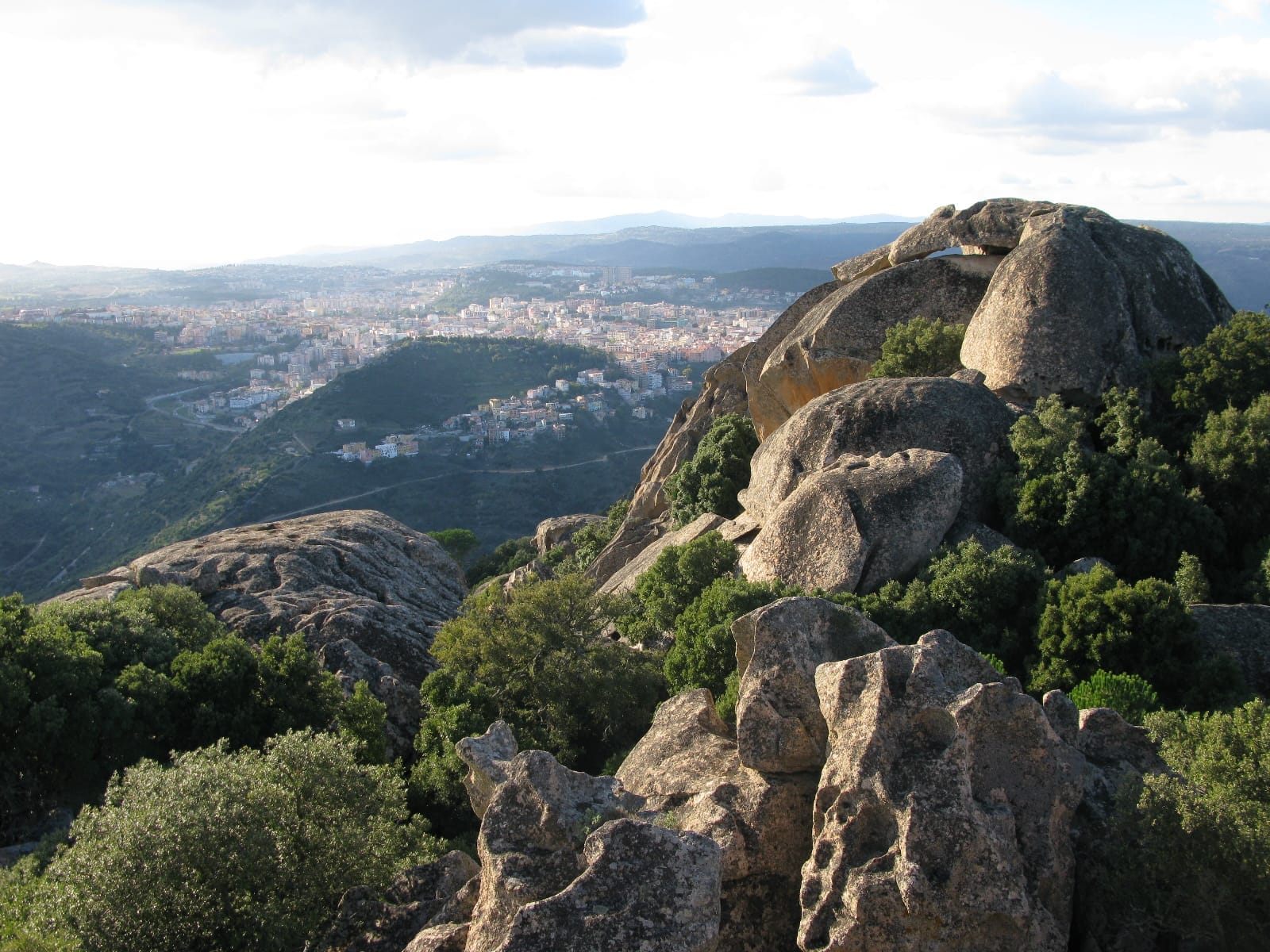
Monte Ortobene is a granite mountain reaching 955 metres at its highest peak, positioned immediately east of the city of Nuoro. It is not a remote wilderness peak requiring a long approach. The summit road runs from the city centre, the bus climbs to the top, and a bronze statue of Cristo Redentore has watched over the Barbagia from the highest point since 1901. What makes Monte Ortobene worth your time is the combination of things it offers in a compact area: genuine forest cover, sweeping views across the mountains of central Sardinia, a culturally significant monument, and almost no tourist infrastructure to speak of.
The mountain is thickly wooded with holm oaks, strawberry trees, and juniper, which means the air is noticeably different here from the coast. Resinous and cool even in summer, the forest absorbs sound in a way that feels immediately calming after the heat and noise of the city below. The local population has always treated this mountain as a kind of civic lung, somewhere to walk on Sunday mornings, bring children after school, and gather for the annual Sagra del Redentore.
💡 Local tip
Bus line 8 departs from Via Manzoni in central Nuoro and travels directly to the summit area. If you are staying in Nuoro without a car, this is the most straightforward way up. Verify current timetables locally before your visit, as schedules adjust seasonally.
The Summit and the Cristo Redentore
The bronze statue at the summit is the defining image of Monte Ortobene. Cast in a posture of outstretched blessing rather than the more commonly seen triumphant pose, it stands on the bare granite rock at the mountain's highest point. The consecration of Monte Ortobene took place in 1901, following the Great Jubilee of 1900, as part of a wider wave of mountaintop dedications across Catholic Italy at that time.
From the base of the statue, the view opens in multiple directions across the Barbagia highlands. On a clear day the ridgelines of the Gennargentu range are visible to the south, and the city of Nuoro spreads out below in the middle distance. The rock at the summit is rough-textured grey granite worn smooth in patches by decades of visitors. There are no barriers or guardrails at the top, so the sense of exposure is real and the photography is unobstructed.
The statue and the mountain are inseparable from the Sagra del Redentore, Nuoro's most important annual festival. Held at the end of August, the festival brings together costumed processions from across the Barbagia region in one of the most culturally authentic folk gatherings in Sardinia. For more on the calendar of traditional events, see the Sardinia festivals and events guide.
Tickets & tours
Hand-picked options from our booking partner. Prices are indicative; availability and final rates are confirmed when you complete your booking.
Supramonte Full-Day Jeep Off-Roading and Hiking Tour in Dorgali
From 95 €Instant confirmationFree cancellationVineyard Guided Tour and 7 Wine Tasting in Palau
From 84 €Instant confirmationFree cancellationFull-Day Sailboat Tour in La Maddalena Archipelago from Cannigione
From 112 €Instant confirmationFree cancellationHiking excursion to the Devil's Saddle
From 35 €Instant confirmationFree cancellation
How the Experience Changes Through the Day
Early morning is the most atmospheric time on Monte Ortobene. Before 9am in the summer months, the forest is almost entirely silent except for woodpigeons and the occasional crossbill moving through the oaks. The light comes in low from the east, casting long shadows across the granite outcrops, and there is often a faint mist sitting in the valleys below. If you are here to photograph the landscape, this window is worth the early start.
By late morning on weekends, Nuoro families begin arriving, particularly at the picnic areas and the bar-restaurant near the summit. The atmosphere shifts to something more sociable and domestic. Children run between the trees, groups spread out on the granite rocks, and the smell of coffee drifts from the cafe terrace. This is not a problem, it is actually part of what makes the mountain feel genuine rather than preserved for tourists. You are sharing the space with people for whom this is simply a local park.
Midday in July and August brings heat even at this altitude, though it is substantially cooler than the coast or the valley below. The forest provides real shade on the walking paths, and the temperature difference between sun and shadow is dramatic. In the afternoon, the light on the Barbagia ridgelines shifts to gold and the distant peaks become more defined. Sunset from the summit area, when the sky turns orange behind the mountains, is striking.
Walking the Mountain: Paths and Terrain
Monte Ortobene is not a technical hiking destination, but it rewards those who explore on foot rather than simply driving to the top. Signposted woodland trails wind through the forest below the summit, ranging from short loops accessible to most walkers to longer routes that require more care on uneven granite. The paths are well-defined and the forest cover keeps them identifiable, but the terrain is rocky in places and appropriate footwear matters.
The ascent on foot from the edges of Nuoro takes roughly an hour to ninety minutes depending on pace and the route chosen. The trail through the woods is markedly more interesting than the road, passing granite formations, dense scrubland, and occasional clearings with views back toward the city. Coming down on a different route than you climbed adds variety and allows you to see more of the forested flanks.
If you plan to combine Monte Ortobene with a broader exploration of Barbagia's landscapes and traditional culture, the wider Barbagia and Nuoro area offers nuragic sites, mountain villages, and one of the most intact folk cultures in Sardinia.
⚠️ What to skip
Wear closed, grippy footwear if you plan to walk the trails. The granite rock becomes slippery when wet, and sandals are unsuitable for anything beyond the paved summit area.
Historical and Cultural Context
Nuoro has always had a complicated relationship with the wider world. This is the city where Grazia Deledda was born and raised, the first Italian woman to win the Nobel Prize for Literature (1926), and her novels are saturated with the landscape and moral atmosphere of the Barbagia. Monte Ortobene appears in her work as a constant presence, the mountain above the city that shapes the psychology of its people. Understanding this connection makes the mountain feel less like a scenic viewpoint and more like a place with genuine narrative weight.
The Sagra del Redentore festival, held annually at the end of August, traces its origins to a tradition running back centuries. One source places an earlier version of the celebration as far back as 1656. The modern form of the festival, centered on the 1901 statue, draws costumed delegations from villages across the Barbagia in a procession that is less a tourist spectacle and more an act of communal identity. If your dates align with late August, attending even part of the Sagra transforms what you understand about this mountain.
For travelers interested in the deeper archaeological and historical layers of central Sardinia, the region contains some of the island's most significant Nuragic sites. The Sardinia Nuragic sites guide covers the key monuments within reach of Nuoro.
Practical Information and Honest Limitations
Access to Monte Ortobene is free, with no entrance fee, no timed tickets, and no booking required. The mountain is open-air and you can arrive at any hour. There is a small bar and restaurant near the summit that operates during daylight hours, particularly busy at weekends, though opening days and hours vary by season and should not be relied upon without checking locally.
By car, the summit is a straightforward drive from Nuoro along a winding but paved road. Parking is available near the statue area. Bus line 8 from Via Manzoni covers the route to Monte Ortobene, making this one of the few mountain viewpoints in inland Sardinia that can be reached by local bus from the city. That said, service frequency is limited and checking the current ARST timetable before your visit is essential.
Accessibility for visitors with limited mobility is partial. The car park at the summit and the immediate area around the statue are reachable without significant physical effort if you drive. The woodland walking paths involve uneven terrain and are not suitable for wheelchairs or pushchairs. There is no formal accessibility infrastructure on the mountain.
Monte Ortobene is best understood as one part of a Nuoro visit rather than a standalone day trip from the coast. Nuoro itself contains the Museo del Costume and the Museo Deleddiano, both of which pair naturally with a morning on the mountain. If you are planning a wider circuit of central Sardinia, the Sardinia road trip guide shows how to connect Nuoro with the Gennargentu, Ogliastra, and the eastern coast.
ℹ️ Good to know
Monte Ortobene is less visited by international tourists than coastal Sardinia. This is both its appeal and its limitation. Facilities are basic, English signage is minimal, and the experience is shaped by local rather than tourist rhythms. Come prepared to navigate without much infrastructure.
Who Should Skip This
If you have a single day in Sardinia and your priority is beaches, Monte Ortobene should not compete for that time. The mountain has no coastal views, no swimming, and no resort-style amenities. Visitors who find forest walking uninteresting and are mainly motivated by the statue alone may feel the journey from the coast is not justified by the destination. The mountain is also not a dramatic alpine environment, the altitude is modest and the terrain is not wild in the way that the Gennargentu or the Golfo di Orosei coastline can feel. It is an inland, forested, culturally layered place, and that has to be what you are after.
Insider Tips
- The bar near the summit makes coffee and simple snacks on weekends, but do not rely on it being open on weekday afternoons. Bring your own water and food if you plan to spend more than an hour on the mountain.
- The Sagra del Redentore takes place in late August and brings the mountain to life with costumed processions and folk music. If your dates overlap even partially, reorganize your itinerary to include it.
- For the best panoramic photographs, position yourself slightly to the east of the Cristo Redentore statue in the late afternoon. The statue faces west and the Barbagia ridgelines are behind it, so this angle captures both the monument and the mountain landscape in the same frame.
- The woodland paths are substantially quieter than the summit area. If you arrive on a weekend and find the picnic areas crowded, dropping down into the forest on any of the marked trails will give you near-solitude within five minutes of walking.
- Nuoro sits at around 550 metres above sea level, and Monte Ortobene’s highest point rises to 955 metres. Even in August, carry a light layer for the summit, where wind can make the temperature noticeably lower than the city below.
Who Is Monte Ortobene For?
- Hikers and walkers looking for forest trails in central Sardinia away from coastal crowds
- Culture-focused travelers interested in Sardinian folk traditions and the Sagra del Redentore
- Photographers wanting panoramic views of the Barbagia highlands and the Gennargentu range
- Literary travelers following the landscape of Grazia Deledda's Nobel Prize-winning novels
- Families based in Nuoro looking for a half-day outdoor excursion without long driving
Nearby Attractions
Other things to see while in Barbagia & Nuoro:
- Giara di Gesturi
Rising to around 550 metres above central Sardinia, the Giara di Gesturi is a 45-square-kilometre basalt plateau formed by Oligocene volcanic activity. Cork oak forests, seasonal wetlands, and an extraordinary population of small wild horses make it one of the most ecologically singular landscapes on the island.
- Gola di Su Gorropu
Gola di Su Gorropu is a karst canyon in Sardinia's Supramonte massif with walls rising over 500 metres and passages as narrow as 4 metres across. It's a serious hiking destination that rewards physical effort with one of the most dramatic landscapes in the Mediterranean.
- Murales di Orgosolo
Orgosolo, a small hill town in the Barbagia region of central Sardinia, has covered its streets in around 150 murals since the late 1960s. Free to visit at any hour, the Murales di Orgosolo form one of the most politically charged and visually striking open-air art experiences in Italy.
- Museo del Costume e della Tradizione Sarda (Nuoro)
Perched on the Sant'Onofrio hill above Nuoro, the Museo della Vita e delle Tradizioni Popolari Sarde holds one of the most significant ethnographic collections in Italy. With around 8,000 objects spanning ceremonial dress, silverwork, masks, and weaving tools, it offers a serious, rewarding portrait of the culture that shaped inland Sardinia.