Murales di Orgosolo: The Village That Painted Its Protest onto Every Wall
Orgosolo, a small hill town in the Barbagia region of central Sardinia, has covered its streets in around 150 murals since the late 1960s. Free to visit at any hour, the Murales di Orgosolo form one of the most politically charged and visually striking open-air art experiences in Italy.
Quick Facts
- Location
- Orgosolo, Province of Nuoro, central Sardinia — approx. 20 km south of Nuoro
- Getting There
- ARST bus line 512 from Nuoro (approx. 35–40 min). By car from Nuoro via SS389, about 35 minutes. No direct train service.
- Time Needed
- 1.5 to 3 hours for a thorough self-guided walk. Half a day if combining with lunch and the surrounding countryside.
- Cost
- Free to walk and view. Optional audio-guide tours from private operators cost around €5 (verify with local providers before visiting).
- Best for
- Art and history enthusiasts, photographers, travelers interested in Sardinian culture and political history
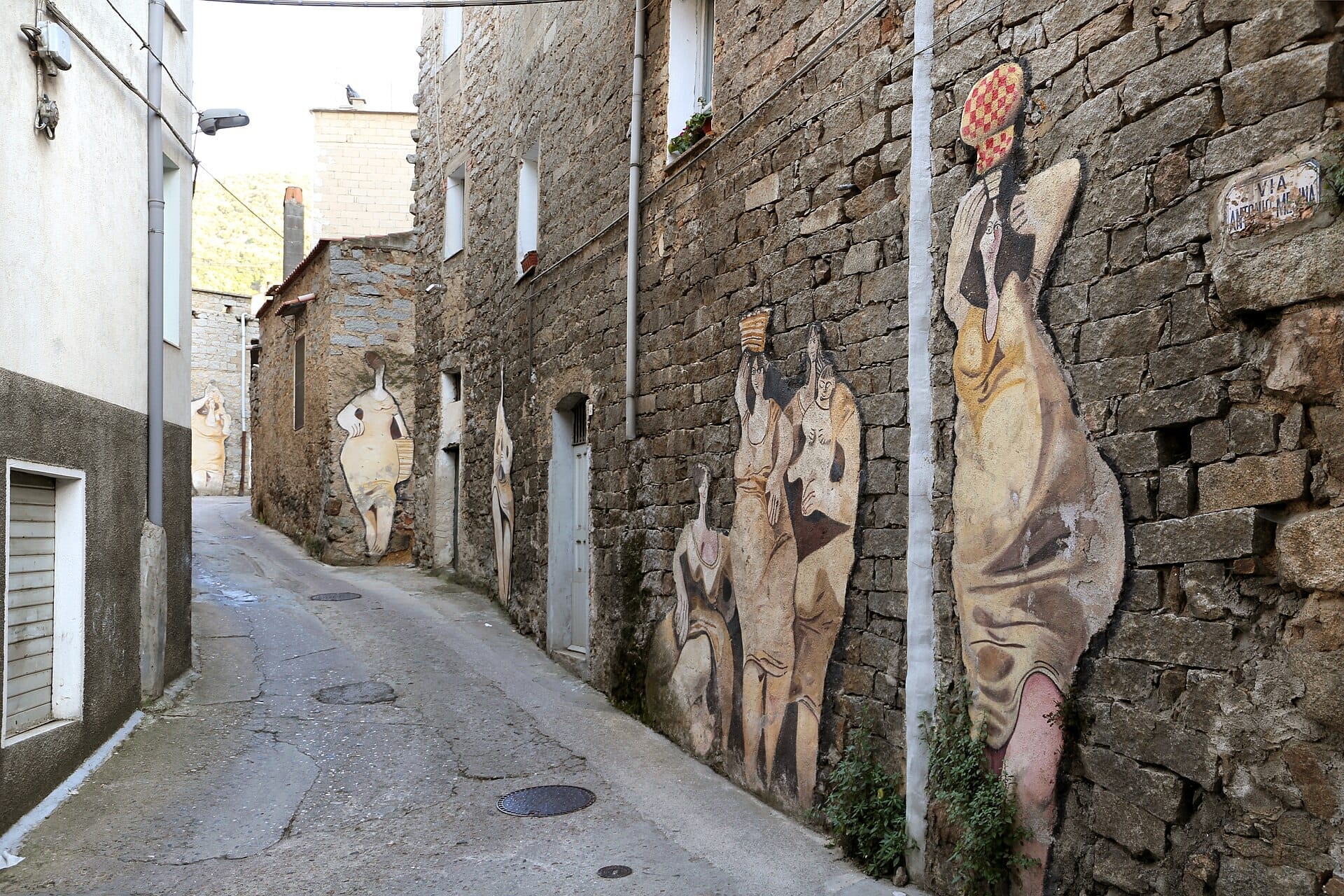
What Is the Murales di Orgosolo?
The Murales di Orgosolo, or Murals of Orgosolo, are a collection of around 150 painted wall murals spread across the streets and alleyways of the village of Orgosolo in the Barbagia region of central Sardinia. They are not decoration. They are testimony. The subjects range from Sardinian peasant life and local history to international politics, anti-war statements, and the struggles of indigenous communities around the world. Together, they transform an ordinary stone village into what regional tourism officials call a "museo a cielo aperto" — an open-air museum.
What makes this place different from most street art destinations is the depth of intent behind the work. These murals were never about beautification. They began as raw political speech painted directly onto the walls of a community that felt — and in many ways was — marginalized by Italian state authority. That tension, still visible in the imagery today, is what gives the experience its weight.
ℹ️ Good to know
The murals are painted on exterior walls throughout the village and are visible at all times, 24 hours a day, free of charge. There are no tickets, no turnstiles, and no closing time.
A Brief History: How the Walls Started Talking
Orgosolo had a reputation long before the murals arrived. Through the first half of the 20th century, the town was associated with banditry, clan violence, and the rigid codes of a pastoral society that had little use for outside authority. The Italian state viewed the Barbagia region with suspicion; the residents returned the sentiment. When the first murals appeared in 1968, they were a continuation of this resistance, just in paint rather than silence.
The movement accelerated significantly starting in the mid-1970s, when a Siena-based art teacher named Francesco Del Casino began involving local students in the project. Del Casino and his students painted with both skill and intention, producing detailed figurative works addressing Fascism, the Vietnam War, land reform conflicts, Sardinian autonomy, and the rights of ordinary workers. The murals multiplied. Other artists joined. By the 1980s, Orgosolo was known across Italy and beyond as a village that had turned collective anger and identity into art.
Today the murals number somewhere around 150, depending on what you count as a complete work. New ones are still occasionally added, and older ones are repainted to preserve them. For context on the broader political and cultural landscape these murals grew out of, the lesser-known cultural corners of Sardinia offer useful background on how deeply identity and resistance run through Barbagia's history.
Tickets & tours
Hand-picked options from our booking partner. Prices are indicative; availability and final rates are confirmed when you complete your booking.
Bread Workshop and Visit to the Bread Museum in Orgosolo
From 84 €Instant confirmationFree cancellationVineyard Guided Tour and 7 Wine Tasting in Palau
From 84 €Instant confirmationFree cancellationFull-Day Sailboat Tour in La Maddalena Archipelago from Cannigione
From 112 €Instant confirmationFree cancellationHiking excursion to the Devil's Saddle
From 35 €Instant confirmationFree cancellation
Walking the Murals: What You Actually See
The murals are concentrated along Corso Repubblica, Via Cavour, Via Mazzini, and Via Mani in Orgosolo's historic center. There is no official single route, but most visitors enter the village from the main parking area and follow the central streets, letting the images pull them along. You will not need a map to find the murals — they are simply everywhere.
The oldest murals have a rougher quality, faded slightly by decades of Sardinian sun and mountain winters, their paint cracked at the edges. The more recent works are technically sharper and sometimes cover entire building facades three stories high. One recurring motif is the Sardinian shepherd and his flock, presented not as a pastoral postcard but as a figure of dignity under economic and political pressure. Others show masked Sardinian carnival figures, references to Gramscian socialism, scenes from international conflicts, and direct portraits of historical figures both local and global.
The streets are narrow and the town sits on uneven terrain. You will be walking on cobblestones and through passageways where two people can barely pass side by side. Some of the best murals are tucked into corners or painted on the sides of buildings that you only see if you look back the way you came. Take your time and change direction regularly.
💡 Local tip
Walk the main streets first, then double back through the side alleys. Some of the most striking murals face inward toward small courtyards that first-time visitors walk straight past.
Time of Day and Light: When to Visit
Morning light, roughly from 8am to 10am, falls cleanly on the north-facing walls of Corso Repubblica and brings out the color in the older works. The village is also quietest at this hour. You may share the streets with a few residents heading to the bar for coffee, but tour groups have not yet arrived and you can stand in front of a mural for as long as you need without anyone jostling past.
Midday in summer brings direct overhead light that flattens the murals photographically and makes the narrow streets feel uncomfortably warm. If you are visiting in July or August, either arrive before 10am or wait until after 4pm when the light softens and the temperature eases. Late afternoon light on the south-facing walls along Via Mazzini is particularly good for photography.
The village receives coach tour groups primarily between late morning and early afternoon, particularly in the high season from June through September. These visits tend to be brief and focused on the most prominent murals. If you are there at the same time, the streets can feel crowded in a place that was designed for far fewer people. Shoulder season visits in May or October offer good light, manageable temperatures, and significantly fewer visitors.
For timing your wider Sardinian trip around conditions like these, the best time to visit Sardinia breaks down seasonal patterns across the island in practical detail.
Practical Walkthrough: Getting There and Moving Around
Orgosolo sits about 20 km south of Nuoro, the provincial capital, in the heart of the Barbagia region. By car, the drive from Nuoro takes roughly 35 minutes via the SS389. There is a parking area at the entrance to the village where most visitors leave their cars before walking into the historic center. The drive itself, through the mountains of central Sardinia, is worth the trip on its own terms.
If you are traveling without a car, ARST regional bus line 512 connects Nuoro and Orgosolo, with the journey taking approximately 35–40 minutes. Timetables vary by season and should be confirmed directly with ARST before your visit, as services are less frequent outside summer. There is no train service to Orgosolo.
Renting a car is by far the most practical way to reach Orgosolo and explore the wider Barbagia region at your own pace. The guide to getting around Sardinia covers car rental logistics and the realities of driving on Sardinia's mountain roads in clear terms.
Wear shoes with grip. The village streets are made of polished stone and older cobblestones that become slippery when wet. There are steps in multiple places, short inclines between different sections of the historic center, and no lift access to higher streets. Visitors with significant mobility limitations will be able to access the main murals along Corso Repubblica, but reaching the full extent of the collection requires navigating terrain that is not step-free.
⚠️ What to skip
Full step-free access to all murals is not guaranteed. The historic center of Orgosolo sits on sloping terrain with uneven surfaces throughout. Visitors using wheelchairs or with limited mobility can view a significant portion of the collection on the flatter main streets, but the full walk is not accessible.
Photography: What Works and What Doesn't
The murals are large, flat works on stone walls in tight streets. A wide-angle lens is useful for capturing the full scale of the bigger pieces without backing into the opposite wall. For detail work on older, faded sections, a longer focal length can isolate the most vivid surviving paint and cut out the visual noise of parked cars and street furniture.
Including people in your shots adds genuine scale. Some of the most impactful murals tower three floors above street level, and without a human figure in the frame, it is difficult to communicate how immersive the experience actually is. Early morning is best for avoiding cars parked directly in front of the main works, since residents leave for work and parking spots clear out naturally.
Context and Culture: Why This Matters Beyond the Art
The Barbagia region, where Orgosolo sits, is one of the most culturally distinct parts of Sardinia. It has maintained traditions in food, music, and social organization that diverge markedly from the coastal tourist Sardinia most visitors experience. The murals are inseparable from this context. They are not street art in the contemporary Western sense of youthful aesthetic rebellion. They are political memory, painted by people who had direct experiences with land seizures, military presence, economic exclusion, and the complex relationship between Sardinian identity and Italian nationhood. The Barbagia and Nuoro region retains a cultural character unlike anywhere else on the island.
A visit to Orgosolo pairs naturally with a broader understanding of Sardinian traditions and identity. The Sardinia Blue Zone — a phenomenon concentrated in these same inland mountain villages — reveals how the same insularity and self-reliance that generated the murals also produced some of the world's longest-lived communities.
Who Should Think Twice Before Visiting
Anyone expecting a polished cultural attraction with a visitor center, bilingual explanatory panels, and a souvenir shop will be disappointed. Orgosolo is a real working village, not a theme park. The murals have identifying plaques in some cases but many do not, and understanding the political references on some of the older works requires either background knowledge or a guided tour.
Travelers visiting Sardinia only for beaches and who are making a long inland detour on a tight schedule may find the two-hour round trip from the coast more time-consuming than the experience justifies for them personally. The murals are extraordinary, but they reward engagement. Passing through in 20 minutes and ticking the box will leave most people underwhelmed.
The village has limited tourist infrastructure. There are a few bars and a small number of restaurants, but services are modest. Do not arrive expecting a wide range of lunch options in peak summer.
Insider Tips
- Hire a local guide if you want to understand the murals rather than just photograph them. Private operators offer audio-guide tours for around €5, and a knowledgeable guide can explain which murals reference specific local events, court cases, or political figures that would otherwise be opaque to outside visitors.
- The parking area at the village entrance gets congested on summer weekend mornings when tour groups arrive. If you are driving, aim to be parked by 9am or plan a midweek visit. Weekday mornings in shoulder season are the quietest.
- Walk the streets in both directions. The murals are painted on both sides of buildings, and many visitors only see one face of a wall before moving on. Doubling back reveals entirely different works facing different orientations.
- Orgosolo has a small selection of bars where locals gather in the morning and again in the late afternoon. Sitting down for a coffee at one of these is a far better way to absorb the village's atmosphere than any souvenir could provide.
- If you are traveling between late September and early November, the surrounding mountains take on copper and gold tones that create a striking backdrop for photographs of the murals. The light at this time of year is also warmer and longer than in midsummer.
Who Is Murales di Orgosolo For?
- Travelers with a serious interest in political art, street art history, or Italian social history
- Photographers looking for a visually rich and technically challenging subject beyond Sardinia's coastline
- Cultural travelers wanting to understand the interior of Sardinia and the Barbagia identity
- Families with older children who can engage with the historical and political themes
- Anyone on a Sardinian road trip through the central mountains who wants to add genuine cultural depth to a beach-heavy itinerary
Nearby Attractions
Other things to see while in Barbagia & Nuoro:
- Giara di Gesturi
Rising to around 550 metres above central Sardinia, the Giara di Gesturi is a 45-square-kilometre basalt plateau formed by Oligocene volcanic activity. Cork oak forests, seasonal wetlands, and an extraordinary population of small wild horses make it one of the most ecologically singular landscapes on the island.
- Gola di Su Gorropu
Gola di Su Gorropu is a karst canyon in Sardinia's Supramonte massif with walls rising over 500 metres and passages as narrow as 4 metres across. It's a serious hiking destination that rewards physical effort with one of the most dramatic landscapes in the Mediterranean.
- Monte Ortobene
Reaching a maximum elevation of 955 metres above sea level near the inland city of Nuoro, Monte Ortobene is a forested mountain with panoramic views across central Sardinia, a landmark bronze statue of Cristo Redentore, and walking paths through fragrant Mediterranean scrubland. Access is free, the road reaches the summit, and the atmosphere is unlike anything on the coast.
- Museo del Costume e della Tradizione Sarda (Nuoro)
Perched on the Sant'Onofrio hill above Nuoro, the Museo della Vita e delle Tradizioni Popolari Sarde holds one of the most significant ethnographic collections in Italy. With around 8,000 objects spanning ceremonial dress, silverwork, masks, and weaving tools, it offers a serious, rewarding portrait of the culture that shaped inland Sardinia.