St. John's Co-Cathedral: Valletta's Baroque Masterpiece Worth Every Minute
Built by the Knights of St. John between 1573 and 1578, St. John's Co-Cathedral in Valletta is Malta's single most concentrated display of Baroque art. The plain limestone exterior gives no warning of what waits inside: a gilded nave, 400 marble tomb slabs underfoot, and two of Caravaggio's most important surviving canvases.
Quick Facts
- Location
- Triq San Ġwann, Valletta, Malta
- Getting There
- Walk 5 min from Valletta City Gate bus terminus; ferries from Sliema dock 15 min walk
- Time Needed
- 1.5 to 2.5 hours with the audio guide
- Cost
- Paid entry; audio guide included. Check current rates at stjohnscocathedral.com
- Best for
- Art lovers, history enthusiasts, first-time visitors to Malta
- Official website
- www.stjohnscocathedral.com
First Impressions: The Exterior Tells You Nothing
Approach St. John's Co-Cathedral from Republic Street and you will walk past the facade twice before realising it is one of the most significant religious buildings in Europe. Girolamo Cassar designed the exterior in 1573 with deliberate restraint: two squat bell towers, smooth honey-coloured limestone walls, and almost no ornamental detail. It reads more like a fortified warehouse than a cathedral. That austerity was intentional. The Knights of St. John were a military order, and their public face in Valletta projected strength, not opulence.
The entrance door is on the south side of the building, set slightly back from the street. In the morning, the facade sits in full sun and the stone glows a warm amber. By mid-afternoon that same surface turns flat and pale. For photography, the first two hours after opening produce the best light on the exterior stonework.
💡 Local tip
Dress modestly before you arrive: shoulders and knees must be covered to enter. Disposable paper coverings are sometimes available at the door, but do not rely on them during busy periods.
Crossing the Threshold: The Shock of the Interior
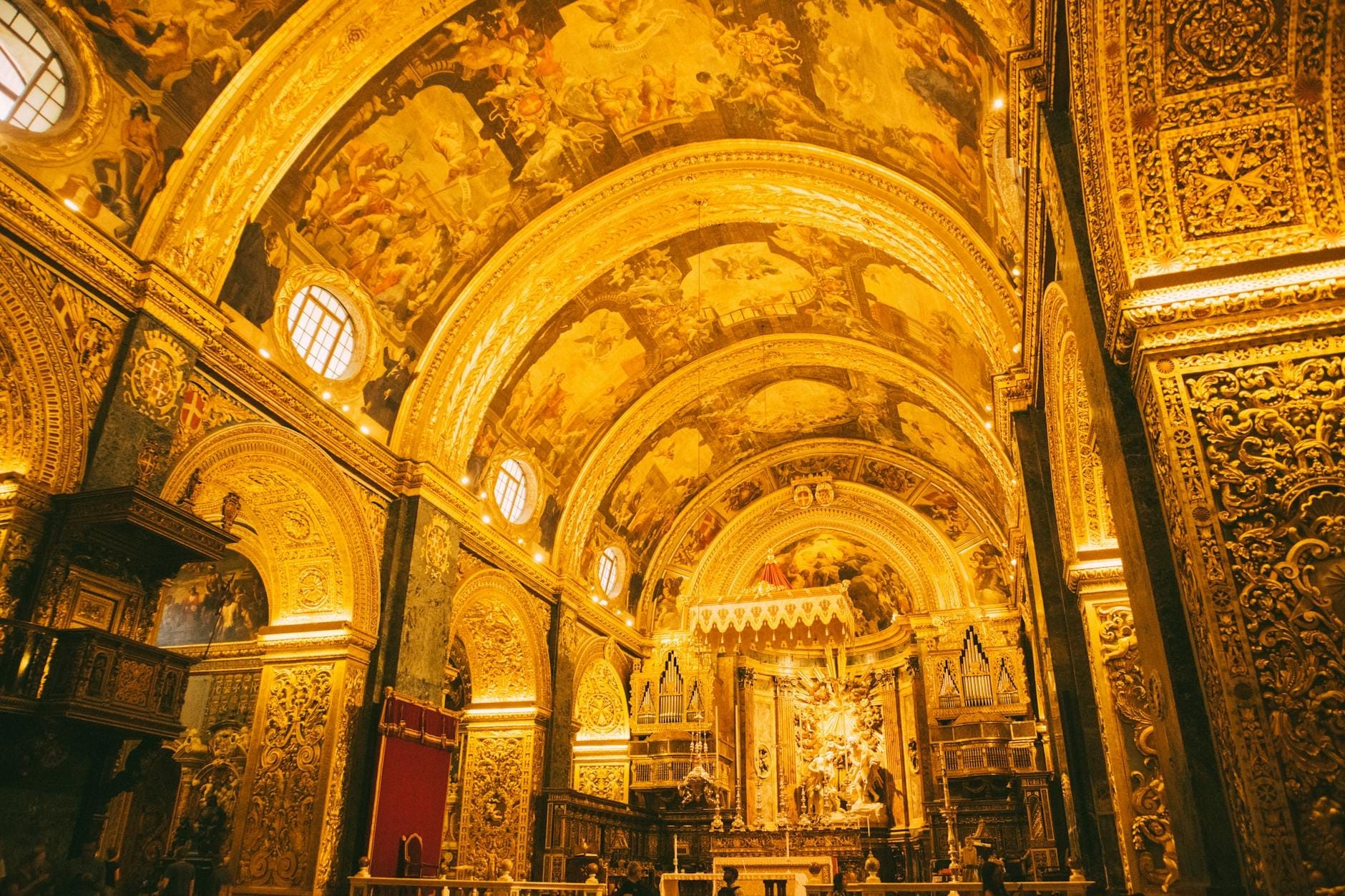
Nothing outside prepares you for the nave. The moment you pass through the entrance vestibule into the main body of the cathedral, the scale and density of decoration registers as a kind of visual shock. Every square centimetre of the stone barrel-vaulted ceiling has been gilded and carved in high relief by the Calabrian artist Mattia Preti, who worked on the project from 1661. The scenes depict the life of St. John the Baptist across eighteen separate compositions. The gold does not look restrained or ceremonial from below. It looks excessive, and deliberately so.
Look down almost immediately. The entire floor of the nave and side chapels is paved with approximately 400 inlaid marble tomb slabs, each one the memorial of a Knight of St. John. The slabs are polychrome, using reds, blacks, yellows, and whites to depict coats of arms, skeletons, hourglasses, and Latin inscriptions. Walking across them feels unusual, even unsettling. You are, quite literally, walking over centuries of the Knights' dead. The combination of the gilded ceiling above and the marble tombs below creates a sensory compression that photographs cannot replicate.
The cathedral shares co-cathedral status with St. Paul's Cathedral in Mdina, reflecting the Archdiocese of Malta's historical dual seat of authority. St. John's was elevated to co-cathedral status in 1816, long after its construction as the conventual church of the Knights.
Tickets & tours
Hand-picked options from our booking partner. Prices are indicative; availability and final rates are confirmed when you complete your booking.
Valletta walking tour with St. John's Co-Cathedral
From 18 €Instant confirmationFree cancellationValletta half-day guided tour with optional cathedral visit
From 39 €Instant confirmationFree cancellationCity Sightseeing hop-on hop-off bus tour of Gozo
From 20 €Instant confirmationFree cancellationThe Malta Experience Audio-Visual Show and La Sacra Infermeria Tour
From 20 €Instant confirmationFree cancellation
The Caravaggio Room: Malta's Greatest Art Secret
The oratory off the main nave holds the cathedral's most important works: two paintings by Michelangelo Merisi da Caravaggio, created during his stay in Malta in 1608. The larger of the two, 'The Beheading of St. John the Baptist', measures approximately 3.7 by 5.2 metres and is widely considered the largest painting Caravaggio ever produced. It is also the only work he ever signed, using the blood pooling beneath the Baptist's severed neck to write his name. The signature is small and easy to miss without the audio guide pointing it out.
The second painting in the oratory, 'St. Jerome Writing', is quieter and more intimate, showing the saint hunched over a manuscript with a skull nearby. Both works are displayed in relatively low light, which is actually appropriate for Caravaggio's chiaroscuro technique. The contrast between deep shadow and sharp, almost surgical illumination on the figures looks far more powerful under these conditions than it would under bright museum lighting.
ℹ️ Good to know
The audio guide included with entry is essential for the Caravaggio room. It provides context about Caravaggio's time in Malta, his subsequent arrest, escape, and the political drama surrounding his brief membership in the Order of St. John.
Crowds concentrate here. If you enter when a tour group is in the oratory, the small room becomes uncomfortably packed and the light levels make it hard to see the paintings clearly. Arriving at opening time, or in the final hour before closing, tends to give you better access. Patience pays off here more than anywhere else in the building.
The Eight Chapels of the Langues
Flanking the nave are eight chapels, each built and decorated by a different Langue, the national grouping within the Order of St. John. The Langues represented are Aragon, Auvergne, Castile, England, France, Germany, Italy, and Provence. Each chapel has a distinct character: the Chapel of Italy is among the most elaborate, while the Chapel of England reflects a more subdued aesthetic that predates the Reformation's disruption of English membership in the Order.
These chapels are easy to rush through, but they reward slow attention. The differences in artistic style between, say, the French and German chapels reflect distinct regional aesthetics and the relative wealth each Langue could draw on. Several chapels contain the tombs of Grand Masters, with effigies in full armour. The detail on some of these bronze and marble pieces is extraordinary up close, particularly the texture work on chainmail and the decorative elements on helmets.
When to Visit and How Crowds Work
St. John's Co-Cathedral draws around 500,000 visitors per year, which is a significant volume for a single building in a city of Valletta's size. The practical effect is that mornings from roughly 9:30 to 11:30 can be congested, particularly when cruise ship passengers have docked. The cathedral is a standard inclusion on guided shore excursions, and those groups move through in tight clusters with local guides talking loudly over each other in the nave.
The quietest windows are typically just after opening and in the final 45 minutes before closing. Midweek visits are calmer than weekends. Sunday access is limited or restricted to worshippers during services, so verify the schedule on the official website before planning a Sunday visit.
Valletta is compact enough that St. John's works well as either the first or last stop of a day. If you are planning a full day in the capital, the complete Valletta guide covers how to sequence the city's major sites efficiently.
⚠️ What to skip
Do not visit during a major religious service if you intend to tour the cathedral. Access to the interior, particularly the chapels and oratory, is restricted at these times. Check the official website for service times before you go.
The Cathedral Museum
Admission includes access to the adjacent museum, which occupies the former sacristy and several connecting rooms. The collection includes Flemish tapestries based on cartoons by Peter Paul Rubens and designs after Raphael, donated to the cathedral in 1702. These tapestries are large, finely preserved, and surprisingly undervisited compared to the cathedral itself. Most people spend the bulk of their time in the main building and move through the museum quickly. That is a mistake.
The museum also holds illuminated manuscripts, vestments, silver plate, and items documenting the history of the Order in Malta. For anyone with a serious interest in the Knights of St. John, this section is as informative as the main space is visually overwhelming.
For deeper context on the Knights before or after your visit, the Knights of Malta history guide provides a clear account of the Order's origins, its time in Malta, and its eventual departure after Napoleon's 1798 invasion.
Practical Notes for Your Visit
The cathedral is located centrally in Valletta, a short walk from the main City Gate entrance and the surrounding bus terminus, which connects to routes across Malta. The audio guide is included in the entrance price and covers the main nave, the chapels, the oratory, and the museum. It is available in Maltese, English, Italian, French, and German. The handheld device is straightforward to use and the commentary is detailed without being slow.
Photography inside the cathedral is permitted without flash. Tripods are generally not allowed. The low ambient light in the oratory makes handheld shots of the Caravaggio paintings difficult without adjusting ISO settings significantly. A smartphone with a capable night mode will manage, but results will vary.
If you are arriving from Sliema, the ferry across the harbour is faster and more enjoyable than the bus route. From the Valletta ferry terminus, the cathedral is roughly a 15-minute walk through the city centre. The Upper Barrakka Gardens and Grandmaster's Palace are both within easy walking distance and pair well with a St. John's visit for a half-day itinerary.
Accessibility within the building is limited by the age of the structure. The floor surfaces, particularly the marble tomb slabs in the nave, are uneven in places. The museum section involves some steps. Visitors with significant mobility impairments should contact the cathedral foundation directly before visiting to confirm current access arrangements.
Is It Worth It? An Honest Assessment
St. John's Co-Cathedral is not overhyped. For most visitors, it is the single most impressive interior space in Malta and ranks among the better Baroque religious buildings in the Mediterranean. The Caravaggio paintings alone would justify the entrance price in most European museums. The combination of the painted ceiling, the marble tombs, the chapels, and the museum produces an experience with genuine density.
Who might want to skip it: travellers with no particular interest in religious architecture or European art history may find the experience overwhelming and lacking context. Children under ten often struggle with the combination of required quiet behaviour and content that requires art literacy to engage with. The entrance fee is not trivial, and for travellers on very tight budgets, the choice between St. John's and other paid attractions in Malta deserves thought. That said, for any visitor who finds European history, Baroque art, or the story of the Knights even moderately interesting, this will likely be the highlight of a Malta trip.
If budget is a concern, note that many of Valletta's exterior architectural highlights are free to experience. The free things to do in Malta guide covers the best no-cost options across the island.
Insider Tips
- Arrive within the first 30 minutes of opening on a weekday. The nave is dramatically different when you have it largely to yourself, and the quality of your encounter with the Caravaggio paintings in the oratory depends heavily on whether a tour group is blocking access.
- Look for Caravaggio's signature in 'The Beheading of St. John the Baptist' before the audio guide tells you where it is. It appears in the blood pooling below the Baptist's neck, written in red. Finding it yourself first makes the discovery far more memorable.
- Spend at least 20 minutes in the cathedral museum's tapestry room. The Flemish tapestries donated in 1702 are based on Rubens cartoons and are kept in better condition than many comparable works in major European museums. Almost nobody lingers here.
- The marble tomb slabs are easier to read and appreciate in photographs taken from an angle rather than directly overhead. Crouching slightly and shooting at a low diagonal captures the depth of the inlaid colour work far better than straight-down shots.
- Check the official website for any temporary closures or special events. The cathedral occasionally hosts concerts and other cultural events, some of which are open to the public and offer an entirely different experience of the acoustic space.
Who Is St. John's Co-Cathedral For?
- First-time visitors to Malta who want to understand the island's history in a single visit
- Art history enthusiasts, particularly anyone with an interest in Baroque painting or Caravaggio specifically
- Travellers combining Valletta's major cultural sites in a single day
- Photography-focused travellers comfortable with low-light interior shooting
- Anyone researching or fascinated by the history of the Knights of St. John
Nearby Attractions
Other things to see while in Valletta:
- Basilica of Our Lady of Mount Carmel
The Basilica of Our Lady of Mount Carmel anchors Valletta's skyline with a 42-metre oval dome visible from across Marsamxett Harbour. Originally built in 1570 by the architect of Valletta himself, bombed flat in World War II, and rebuilt over two decades, this is a church with a remarkable story behind its serene facade.
- Casa Rocca Piccola
Casa Rocca Piccola is a 16th-century aristocratic palace on Valletta's Republic Street, home to the de Piro family for roughly 350 years and still occupied today. Guided tours take visitors through 50 furnished rooms stacked with Maltese silver, antique furniture, lace collections, and paintings, before descending into a genuine WWII air-raid shelter carved beneath the building.
- City Gate & Renzo Piano Parliament
The City Gate and Parliament House form Valletta's most architecturally charged entrance. Designed by Renzo Piano and completed between 2011 and 2015, this project replaced a clumsy 1960s gateway and derelict opera ruins with something genuinely bold. Entry to the public spaces is free and open around the clock.
- Fort St. Elmo & National War Museum
Standing at the tip of the Sciberras Peninsula, Fort St. Elmo has guarded Valletta's twin harbours for over five centuries. Inside, the National War Museum takes visitors from Bronze Age Malta through to the WWII siege that earned the island its George Cross, with artefacts that are genuinely difficult to find anywhere else in the Mediterranean.