Upper Barrakka Gardens: Valletta's Grand Harbour Viewpoint
Perched on St. Peter and Paul Bastion above Grand Harbour, the Upper Barrakka Gardens offer some of the most dramatic views in Malta — entirely free of charge. From the noon cannon salute to early-morning quiet overlooking the Three Cities, this is one of Valletta's most rewarding stops.
Quick Facts
- Location
- 292 Triq Sant’ Orsla, Il-Belt Valletta — off Castille Square, atop St. Peter and Paul Bastion
- Getting There
- Walk from Valletta's City Gate (~10 min); lift/elevator access from Grand Harbour waterfront
- Time Needed
- 30–60 minutes; longer if you combine with Castille Square or Lascaris War Rooms nearby
- Cost
- Free entry, no ticket required
- Best for
- Harbour views, photography, history lovers, a morning or sunset pause
- Official website
- www.visitmalta.com/en/attraction/upper-barrakka-gardens-malta
What the Upper Barrakka Gardens Actually Are
The Upper Barrakka Gardens (Maltese: Il-Barrakka ta' Fuq) sit atop one of Valletta's highest bastions, roughly 60 metres above the water of Grand Harbour. The gardens themselves are modest in scale — a series of colonnaded walkways framing a central garden, with fountains, busts of historical figures, and flower beds — but the panorama they frame is anything but modest. From the main terrace, your eye travels across the full width of Grand Harbour, taking in the domed skyline of Vittoriosa, the fortified headland of Senglea, and the industrial dockyard stretching toward Cospicua. On clear days, the view extends well into the open Mediterranean.
This is a viewpoint with historical backbone. The gardens were first laid out in the 1560s by the Knights of St. John, the same military-religious order that built much of Valletta. The elegant colonnaded arches — three tiers of Italian Renaissance stonework — were constructed in 1661 by Fra Flaminio Balbiani, an Italian Knight who used the space as a private retreat for the Italian Knights' Auberge. The roof of the loggia was removed in 1775, leaving the open arcade that visitors see today. The gardens were eventually opened to the public in 1800, and have since become one of the most recognizable vantage points in the entire country.
ℹ️ Good to know
Opening hours: Daily, 7:00 AM to 10:00 PM. Entry is free with no booking required.
The Noon Cannon: A Daily Ritual Worth Timing Your Visit Around
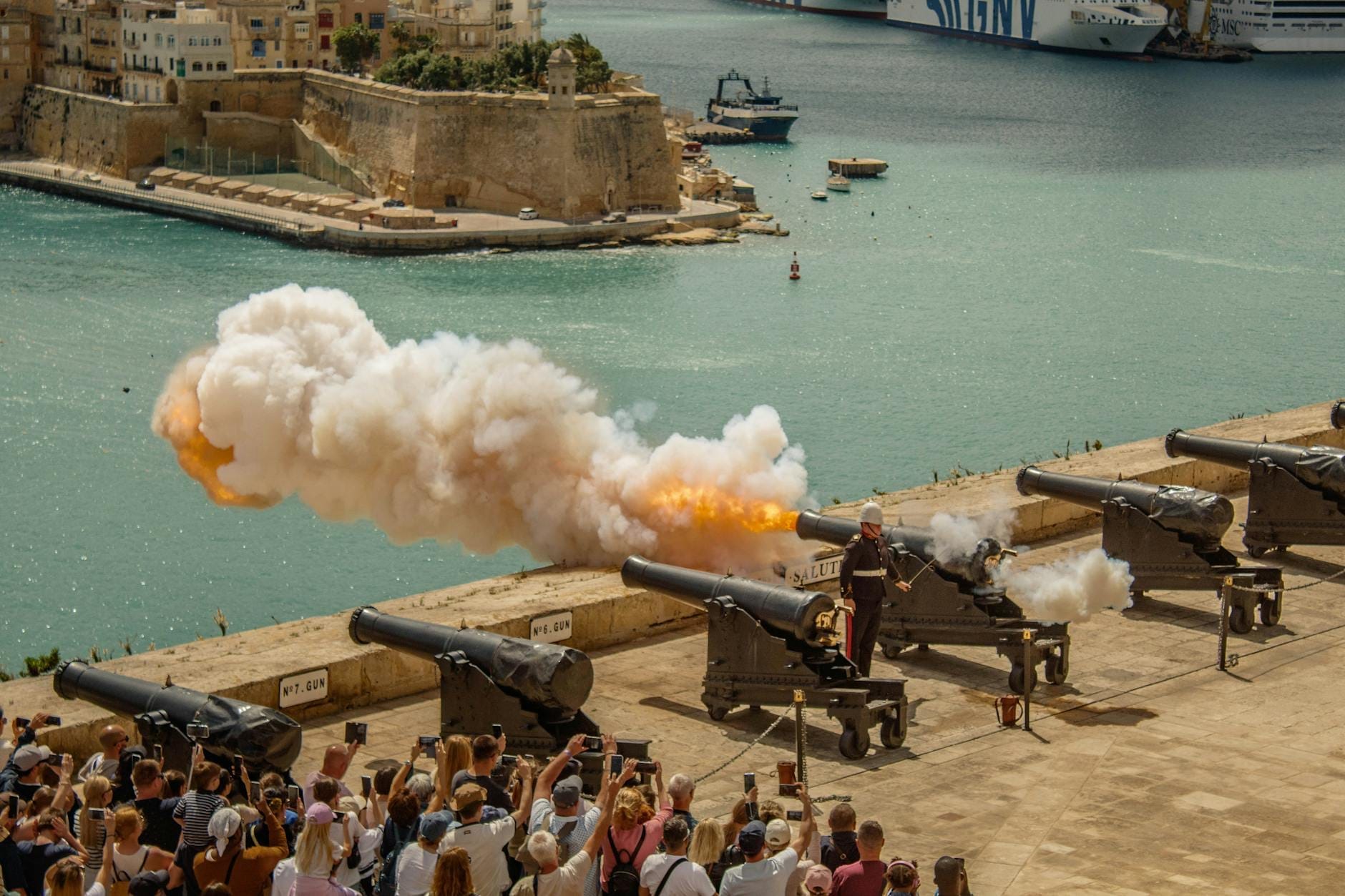
If you can only align one thing in your Valletta itinerary, make it the noon cannon. Every day at noon (and also at 4:00 PM), the Saluting Battery directly below the gardens fires a single artillery round over Grand Harbour. The sound is substantial — a deep, percussive boom that rolls across the water and echoes off the limestone bastions. The tradition dates back centuries, rooted in the practical need to synchronize ships' clocks anchored in the harbour.
Crowds tend to gather at the terrace railing 10 to 15 minutes before the noon firing. Arrive early to claim a spot at the front of the upper terrace. You won't see the cannon itself from the gardens — it sits on the Saluting Battery level below — but you'll feel the blast clearly, and the dramatic setting of Grand Harbour below makes the moment memorable. The 4:00 PM firing attracts somewhat fewer people and offers gentler afternoon light for photography. Note that the Saluting Battery itself can be visited separately and has its own entry fee.
💡 Local tip
Arrive at the main terrace by 11:45 AM or 3:45 PM to secure a front-row spot before the cannon firing.
Tickets & tours
Hand-picked options from our booking partner. Prices are indicative; availability and final rates are confirmed when you complete your booking.
City Sightseeing hop-on hop-off bus tour of Gozo
From 20 €Instant confirmationFree cancellationThe Malta Experience Audio-Visual Show and La Sacra Infermeria Tour
From 20 €Instant confirmationFree cancellationLuggage Storage in Malta
From 6 €Instant confirmationFree cancellation6-day heritage and attractions pass in Malta
From 80 €Instant confirmationFree cancellation
The View Itself: What You're Actually Looking At
Grand Harbour is one of the world's great natural harbours, and the Upper Barrakka Gardens offer the clearest possible overview of it. The sweep of fortified coastline in front of you took shape over several centuries of construction by the Knights of St. John. Directly across the water, the three peninsulas you see are the Three Cities — Vittoriosa (Birgu), Senglea (L-Isla), and Cospicua (Bormla) — each fortified and historically significant. Fort St. Angelo sits at the tip of the Vittoriosa peninsula, its limestone walls dropping straight into the water.
The view changes character significantly depending on the time of day. At 7:00 AM, when the gardens open, the harbour is quiet and the light is flat and soft. By mid-morning, ferries and tour boats cross the water below, and the limestone walls begin to glow a warm honey colour as the sun climbs. Midday is busy and the light is harsh for photography, though the cannon firing justifies the crowd. Late afternoon, roughly 4:00 to 6:00 PM, is arguably the best window: the sun shifts to the west, casting long shadows across the fortifications and turning the water a deep blue-green. Sunset from this terrace, when the sky above the Three Cities goes orange and pink, is a genuinely striking sight.
For photography, a wide-angle lens or your phone's standard lens will capture the full panorama. The wrought-iron railings at the terrace edge can intrude in lower shots, so either raise your camera above them or compose with the stone arcade columns framing the view instead.
The Garden Itself: Layout and What to Look For
Beyond the harbour view, the gardens reward a slower look. The central garden space is formally arranged, with manicured hedges, seasonal flowers, and a small fountain. Scattered throughout are bronze busts and commemorative monuments. The most prominent is the monument to Lord Strickland, a Maltese-British statesman, but there are others honoring figures significant to Malta's political and colonial history. The monuments are a quiet reminder that this was always a place for public commemoration, not just recreation.
The Italian loggia — the colonnaded arcade running along the garden's outer edge — is architecturally elegant without being overwhelming. The three tiers of arches frame sections of harbour and sky like paintings. In the morning, the arcade provides shade on one side while the garden remains sunlit. Pigeons have claimed parts of the upper arcade, which is more charming than it sounds. The stonework is Maltese limestone, the same pale golden material used throughout Valletta, and it softens beautifully in warm light.
💡 Local tip
The garden benches are genuinely useful. This is a good spot to sit, review your map, and plan the next few hours in Valletta before the midday heat sets in.
Getting There and Accessibility
The gardens are located off Castille Square in the upper part of Valletta, a roughly 10-minute walk from City Gate, Valletta's main entrance. The route up Republic Street and through the city center is straightforward and well-signed. If you are coming from the Grand Harbour waterfront or arriving by ferry from the Three Cities, there is a public lift (elevator) that connects the lower harbour level directly to the Barrakka area — this is both the practical and the most scenic approach, as it deposits you almost at the garden entrance.
Accessibility is reasonable for a historic site. The lift from the harbour provides step-free access for wheelchair users and those with limited mobility. Within the gardens, the main terrace and central garden paths are paved and mostly level, though some edges and secondary paths are less even. The colonnaded arcade and the lower garden section involve steps.
Most visitors pair the Upper Barrakka Gardens with other nearby attractions. The Lascaris War Rooms are directly below the gardens — carved into the bastion itself — and offer a stark contrast: the subterranean WWII operations centre where the Allied invasion of Sicily was coordinated in 1943. The Grandmaster's Palace is a 10-minute walk east along Republic Street. Combining all three makes for a focused half-day in Valletta's historic core.
Crowds, Timing, and Who This Attraction Suits
The Upper Barrakka Gardens get busy. During peak season (June through September) and around the noon cannon, the main terrace can feel crowded, especially when cruise ship passengers arrive in Valletta in the morning. The gardens are free, central, and well-known, so they function as a natural gathering point. If you dislike tight spaces with tour groups, visiting before 9:00 AM or after 6:00 PM will give you the place largely to yourself.
Travelers who enjoy Malta's complex layering of history will find the setting genuinely rewarding. The view connects directly to the story of the Knights of St. John, the history of the Knights of Malta, WWII sieges, and centuries of maritime trade. Families with children generally respond well to the cannon firing and the open terrace. Solo travelers and couples tend to linger longer than group tourists.
Visitors looking for a beach, a hike, or nightlife will find nothing here that interests them. The gardens are a calm, historic viewpoint — pleasant but not exciting. If your time in Valletta is very limited, a 20-minute stop is sufficient to take in the view. There is no café or food service inside the gardens, so bring water, particularly in summer when temperatures on the exposed terrace climb quickly.
For context on how the Upper Barrakka fits into a full visit to the capital, see our guide to things to do in Valletta.
Practical Notes for Your Visit
- Opening hours: Daily 7:00 AM to 10:00 PM. No advance booking needed.
- Admission: Free.
- Address: Battery Street, Valletta VLT 1220, off Castille Square.
- Lift access available from the Grand Harbour waterfront for step-free entry.
- No café or food inside the gardens. Bring water in summer.
- Nearest public bus stops are at City Gate (Valletta terminus), served by many Malta Public Transport routes.
- The Saluting Battery below the gardens operates cannon firings at noon and 4:00 PM daily (separate entry fee for the Battery itself).
- Weather note: The terrace is fully exposed. In summer, midday visits are hot and glary. In winter, wind off the harbour can make it cold.
- Photography is unrestricted. Golden hour (roughly one hour before sunset) produces the best harbour light.
Insider Tips
- The 4:00 PM cannon firing draws noticeably smaller crowds than the noon firing, and the afternoon light on the harbour is far better for photography. If you have flexibility, choose the later firing.
- For the clearest, least-obstructed view of Grand Harbour, walk to the far right end of the main terrace, past the main monument. This angle reduces the railing intrusion and frames Fort St. Angelo directly.
- The public lift from the Grand Harbour waterfront is used mainly by locals and is rarely crowded. Taking it up rather than walking through the city gives you an unexpectedly dramatic reveal of the gardens and view.
- In winter and shoulder seasons (November through March), the gardens can be nearly empty on weekday mornings. The light is softer, the air cooler, and the limestone walls glow rather than bleach in the lower sun angle.
- If you sit inside the colonnaded arcade rather than on the terrace, you get a framed, shaded view of the harbour through the arches — far less photographed than the standard terrace shot, and more interesting architecturally.
Who Is Upper Barrakka Gardens For?
- History and architecture travelers exploring Valletta's Knights of St. John legacy
- Photographers chasing grand harbour panoramas and golden hour light
- Families who want a free, accessible highlight with the drama of the noon cannon
- First-time visitors to Malta orienting themselves to the island's geography from above
- Anyone pairing a Valletta walking tour with nearby sites like the Lascaris War Rooms or Grandmaster's Palace
Nearby Attractions
Other things to see while in Valletta:
- Basilica of Our Lady of Mount Carmel
The Basilica of Our Lady of Mount Carmel anchors Valletta's skyline with a 42-metre oval dome visible from across Marsamxett Harbour. Originally built in 1570 by the architect of Valletta himself, bombed flat in World War II, and rebuilt over two decades, this is a church with a remarkable story behind its serene facade.
- Casa Rocca Piccola
Casa Rocca Piccola is a 16th-century aristocratic palace on Valletta's Republic Street, home to the de Piro family for roughly 350 years and still occupied today. Guided tours take visitors through 50 furnished rooms stacked with Maltese silver, antique furniture, lace collections, and paintings, before descending into a genuine WWII air-raid shelter carved beneath the building.
- City Gate & Renzo Piano Parliament
The City Gate and Parliament House form Valletta's most architecturally charged entrance. Designed by Renzo Piano and completed between 2011 and 2015, this project replaced a clumsy 1960s gateway and derelict opera ruins with something genuinely bold. Entry to the public spaces is free and open around the clock.
- Fort St. Elmo & National War Museum
Standing at the tip of the Sciberras Peninsula, Fort St. Elmo has guarded Valletta's twin harbours for over five centuries. Inside, the National War Museum takes visitors from Bronze Age Malta through to the WWII siege that earned the island its George Cross, with artefacts that are genuinely difficult to find anywhere else in the Mediterranean.