Basilica of Our Lady of Mount Carmel: Valletta's Oval Dome and the Church That Rose from the Rubble
The Basilica of Our Lady of Mount Carmel anchors Valletta's skyline with a 42-metre oval dome visible from across Marsamxett Harbour. Originally built in 1570 by the architect of Valletta himself, bombed flat in World War II, and rebuilt over two decades, this is a church with a remarkable story behind its serene facade.
Quick Facts
- Location
- Old Theatre Street corner Old Mint Street, Valletta, Malta
- Getting There
- Walk from Valletta Bus Terminus (~10 min); the entire city centre is pedestrianised
- Time Needed
- 30–45 minutes for the interior; longer if attending a service
- Cost
- Free entry (active parish church; donations appreciated)
- Best for
- Architecture enthusiasts, history seekers, photography of Valletta skyline
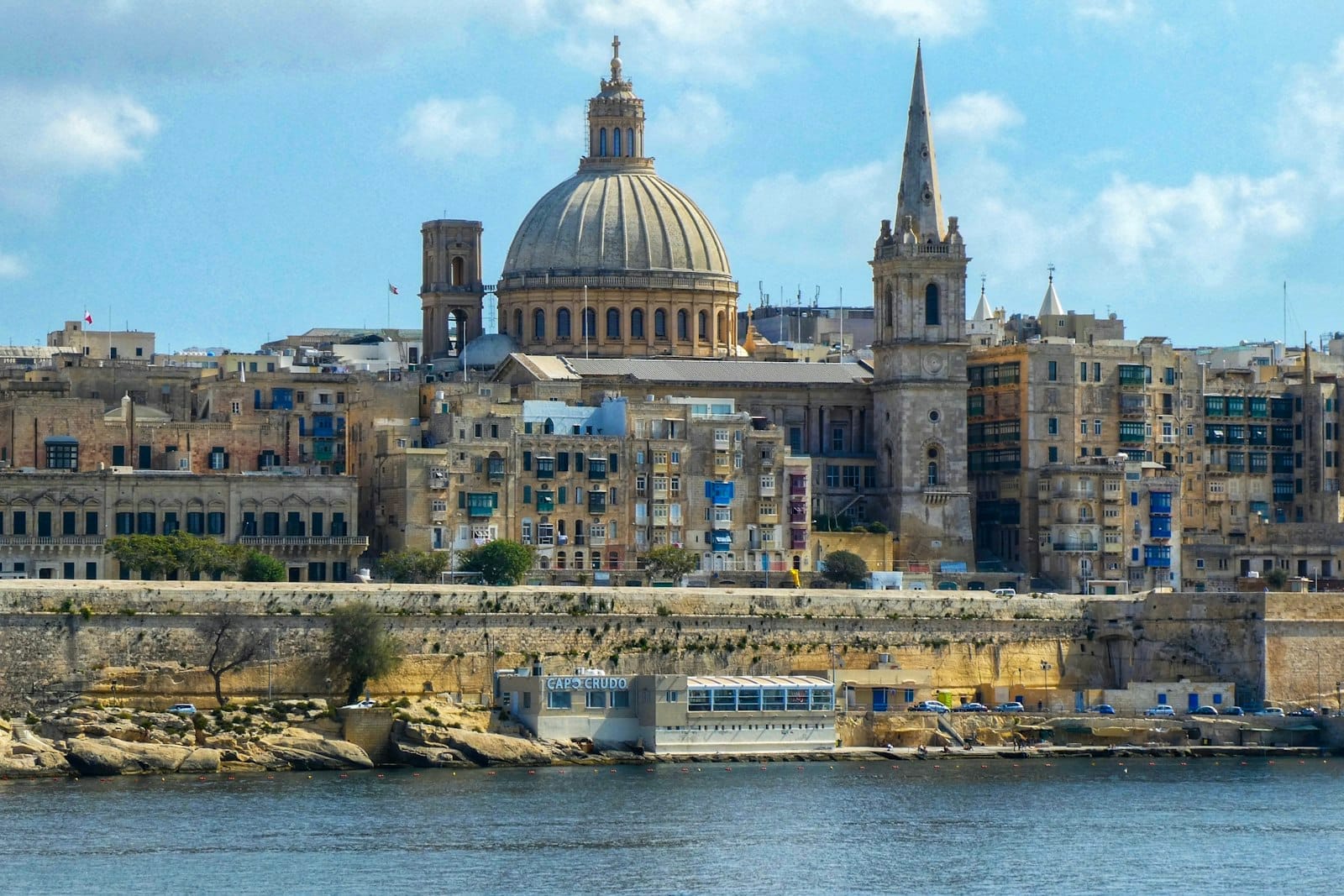
Why This Basilica Stands Apart in a City Full of Churches
Malta has more churches per square kilometre than almost anywhere else on Earth, so standing out takes something special. The Basilica of Our Lady of Mount Carmel manages it with an oval dome that rises 42 metres above Old Theatre Street and dominates the Valletta skyline from every approach across Marsamxett Harbour. It is the dome you see in almost every postcard shot of Valletta from the water, often photographed alongside the spire of St Paul's Anglican Cathedral.
What makes this place more than a photogenic silhouette is the weight of its history. The building you enter today is, architecturally speaking, a 20th-century construction, rebuilt between 1958 and 1981 after WWII bombing reduced the previous structure to rubble. Yet the story behind those walls stretches back to 1570, making this one of the oldest sacred sites in a city that was only founded in 1566.
💡 Local tip
Dress modestly before entering: cover shoulders and knees. This is an active parish church under the Archdiocese of Malta, not a museum, and services are held regularly.
A History Built on Ruins: From 1570 to WWII and Back
The original church on this site was built around 1570, designed by Girolamo Cassar, the same Maltese architect responsible for the Co-Cathedral of St John and much of Valletta's defining streetscape. At the time, it was dedicated to the Annunciation. In the 17th century, the building passed to the Carmelite Order and took on the dedication to Our Lady of Mount Carmel that it holds today.
The facade was significantly redesigned in 1852 by Giuseppe Bonavia, giving the exterior a Neoclassical character that replaced the earlier Baroque lines. The church was elevated to the status of minor basilica on 13 May 1895 by Pope Leo XIII, a designation that carries liturgical privileges and acknowledges both the building's antiquity and its significance to the Maltese Catholic community.
Then came WWII. Malta endured some of the most concentrated aerial bombardment of the entire war, and the basilica did not survive intact. The building was destroyed and sat in ruins for years before reconstruction began in 1958 under the designs of Maltese architect Ġużè Damato. The project was completed in 1981, with the enormous oval dome, the building's most recognisable feature, serving as both an architectural statement and an act of defiance against the destruction that came before.
Understanding this cycle of destruction and rebuilding is key to appreciating Valletta's texture as a city. For deeper context on the Knights and the military history that shaped this capital, the Knights of Malta history guide provides essential background before you visit.
Tickets & tours
Hand-picked options from our booking partner. Prices are indicative; availability and final rates are confirmed when you complete your booking.
City Sightseeing hop-on hop-off bus tour of Gozo
From 20 €Instant confirmationFree cancellationThe Malta Experience Audio-Visual Show and La Sacra Infermeria Tour
From 20 €Instant confirmationFree cancellationBeaches and bays catamaran sunset tour in Malta
From 55 €Instant confirmationFree cancellationValletta Food Tour
From 40 €Instant confirmationFree cancellation
What You Actually See Inside
Step through the entrance and the interior rewards patience. The nave is flanked by red marble columns that lend the space a sense of warm, grounded formality, a contrast to the cool, gold-heavy interiors you find in St John's Co-Cathedral a few minutes' walk away. The columns are not decorative afterthoughts but structural markers that draw the eye upward toward the base of the dome.
The centrepiece of the interior is a 17th-century painting of Our Lady of Mount Carmel, which survived the wartime destruction and was reinstalled in the rebuilt church. This painting is the devotional heart of the basilica and explains why Maltese worshippers continue to fill the pews on the patronal feast day of 16 July each year, one of the more atmospheric village-style festas you can witness in Valletta.
In a niche on the exterior facade, look for a statue of Our Lady carved by Salvatore Dimech in 1855. It predates the WWII destruction and remained in place through the reconstruction, giving the exterior a thread of continuity between the 19th-century facade redesign and the 20th-century dome.
ℹ️ Good to know
The 16 July feast of Our Lady of Mount Carmel is celebrated with street decorations, band marches, and fireworks in the streets around the basilica. Visiting on or around this date gives you a very different, far more lively experience of the church and its neighbourhood.
The Dome: Best Viewed From Outside Valletta
The great paradox of the Carmelite dome is that it is better appreciated from a distance than from directly below it. Inside the basilica, the dome is present but the scale is harder to read. From the Sliema waterfront or from a ferry crossing Marsamxett Harbour, the dome reads clearly against the sky, paired with the vertical accent of St Paul's Anglican spire to form what is arguably Valletta's most photographed skyline.
For photographers, the golden hour view from the Sliema side of the harbour is worth the short ferry crossing. The Sliema Promenade offers a long, unobstructed vantage point from which to frame the dome against the limestone fortifications of the city walls below.
Early morning, before the harbour ferries start moving, the water is calm enough to capture reflections. By midday in summer, the light is harsh and flat from the south. Late afternoon in spring or autumn produces the warmest tones on the honey-coloured stone.
How It Fits Into a Walk Around Valletta
The basilica sits at the junction of Old Theatre Street and Old Mint Street, roughly in the upper-western quarter of Valletta's grid. It is a short walk from the Teatru Manoel, Malta's national theatre and one of the oldest working theatres in Europe, and a few minutes from Republic Street, the city's main spine.
Most visitors fold the basilica into a broader circuit of Valletta's sacred and civic architecture. A logical route connects it with St John's Co-Cathedral, the Upper and Lower Barrakka Gardens, and the Grand Master's Palace. Allow a full half-day if you want to move through this circuit without rushing.
If you are planning a multi-day stay in Malta, these sites fit naturally into a structured first day in the capital. The guide to things to do in Valletta maps out how to sequence them efficiently.
⚠️ What to skip
The basilica is an active place of worship, not a museum. Visiting during a Mass or service means you should enter quietly, stay near the back, and refrain from photography until the service ends. Check locally for service times, as these change seasonally.
Who Should Skip This, and Honest Limitations
Travellers who are primarily drawn to Valletta for its Roman history, military fortifications, or the Knights of St John may find the basilica a brief stop rather than a destination in itself. The interior, while dignified, does not have the overwhelming visual density of St John's Co-Cathedral, with its floor of marble tombstones and Caravaggio paintings. If you are short on time and have to choose, the Co-Cathedral offers more layers of historical content per square metre.
The basilica also lacks the viewpoint infrastructure you find at the Upper Barrakka Gardens or the Saluting Battery. You cannot access the dome for views over the city. What it offers is architectural history, quiet reflection, and the specific pleasure of understanding how one building's story tracks the entire arc of Valletta's modern history, from foundation through war to reconstruction.
Visitors with mobility limitations should note that Valletta's streets are steep and often cobbled. The basilica itself is accessible at street level, but the surrounding area requires navigating uneven surfaces. Comfortable, flat-soled shoes are genuinely necessary, not just a polite suggestion.
Insider Tips
- The best single photograph of the dome requires you to leave Valletta entirely. Take the Marsamxett ferry to Sliema and look back at the city from the water at golden hour for the classic skyline shot with the dome prominent on the left.
- If you visit in mid-July, the patronal feast on 16 July transforms the streets around the basilica with coloured lights, brass band processions, and evening fireworks. It is one of the more authentic neighbourhood festas in Valletta, distinct from the larger tourist-facing events.
- The exterior niche statue by Salvatore Dimech (1855) survived the WWII destruction that flattened the rest of the church. Look for it in the facade niche before entering: it is one of the few original 19th-century elements still in its original position.
- Old Theatre Street, where the basilica stands, is also home to the Teatru Manoel directly opposite. The juxtaposition of sacred and secular Baroque-era institutions on the same street is a good encapsulation of how the Knights of Malta organised Valletta's civic life.
- The oval plan of the dome is relatively unusual for Malta, where circular and octagonal domes are more common. It is worth walking around the full exterior perimeter of the basilica to appreciate how the oval reads differently from each angle.
Who Is Basilica of Our Lady of Mount Carmel For?
- Architecture enthusiasts interested in Neoclassical and post-war ecclesiastical design
- Photographers building a complete Valletta skyline portfolio
- Travellers who want to understand Malta's WWII experience through physical evidence
- Anyone visiting Valletta during the 16 July feast period
- Quiet mid-morning visitors looking for a moment of calm away from Republic Street
Nearby Attractions
Other things to see while in Valletta:
- Casa Rocca Piccola
Casa Rocca Piccola is a 16th-century aristocratic palace on Valletta's Republic Street, home to the de Piro family for roughly 350 years and still occupied today. Guided tours take visitors through 50 furnished rooms stacked with Maltese silver, antique furniture, lace collections, and paintings, before descending into a genuine WWII air-raid shelter carved beneath the building.
- City Gate & Renzo Piano Parliament
The City Gate and Parliament House form Valletta's most architecturally charged entrance. Designed by Renzo Piano and completed between 2011 and 2015, this project replaced a clumsy 1960s gateway and derelict opera ruins with something genuinely bold. Entry to the public spaces is free and open around the clock.
- Fort St. Elmo & National War Museum
Standing at the tip of the Sciberras Peninsula, Fort St. Elmo has guarded Valletta's twin harbours for over five centuries. Inside, the National War Museum takes visitors from Bronze Age Malta through to the WWII siege that earned the island its George Cross, with artefacts that are genuinely difficult to find anywhere else in the Mediterranean.
- Grandmaster's Palace & State Rooms
The Grandmaster's Palace in Valletta has served as a seat of power for the Knights Hospitaller, British governors, and Malta's parliament. Today, its restored State Rooms and legendary Armoury offer one of the most historically rich indoor experiences in the Mediterranean.