Grandmaster's Palace & State Rooms: Valletta's Most Layered Historic Landmark
The Grandmaster's Palace in Valletta has served as a seat of power for the Knights Hospitaller, British governors, and Malta's parliament. Today, its restored State Rooms and legendary Armoury offer one of the most historically rich indoor experiences in the Mediterranean.
Quick Facts
- Location
- St. George's Square, Valletta, Malta
- Getting There
- Multiple public bus routes stop within 5 minutes on foot; plan via Malta Public Transport app
- Time Needed
- 1.5 to 2.5 hours for State Rooms and Armoury combined
- Cost
- Paid entry via Heritage Malta; check heritagemalta.mt for current ticket prices
- Best for
- History enthusiasts, architecture lovers, culture-focused travellers
- Official website
- heritagemalta.mt/explore/grand-masters-palace
What the Grandmaster's Palace Actually Is
The Grandmaster's Palace, known in Maltese as Il-Palazz tal-Granmastru, is the largest palace in Valletta and occupies an entire city block at the heart of the Maltese capital. It stands on St. George's Square, the main civic square of Valletta, directly opposite the Main Guard along Republic Street. Few buildings in Malta carry as much accumulated history within a single set of walls.
Construction began in the late 16th century, following the founding of Valletta after the Great Siege of 1565. The palace served as the official residence of the Grand Masters of the Knights of St. John from around 1571-1574 through to the French occupation in 1798. Under British rule from 1800 to 1964, it became the Governor's Palace. It has housed Malta's parliament (1921 to 2015) and remains the official office of Malta's President. That is five centuries of political and military power compressed into one building.
For context on the Knights who built this palace and their outsized role in Maltese culture, the Knights of Malta history guide provides essential background that will make your visit considerably more meaningful.
ℹ️ Good to know
The State Rooms underwent a major restoration, formally inaugurated by 2025. As of the restoration, approximately 85% of the building is open to the public, including the State Rooms, the Uccelliera, and the main corridors. Always verify the current schedule at heritagemalta.mt before visiting, as specific rooms may still have restricted access on certain dates.
The State Rooms: What You'll Actually See
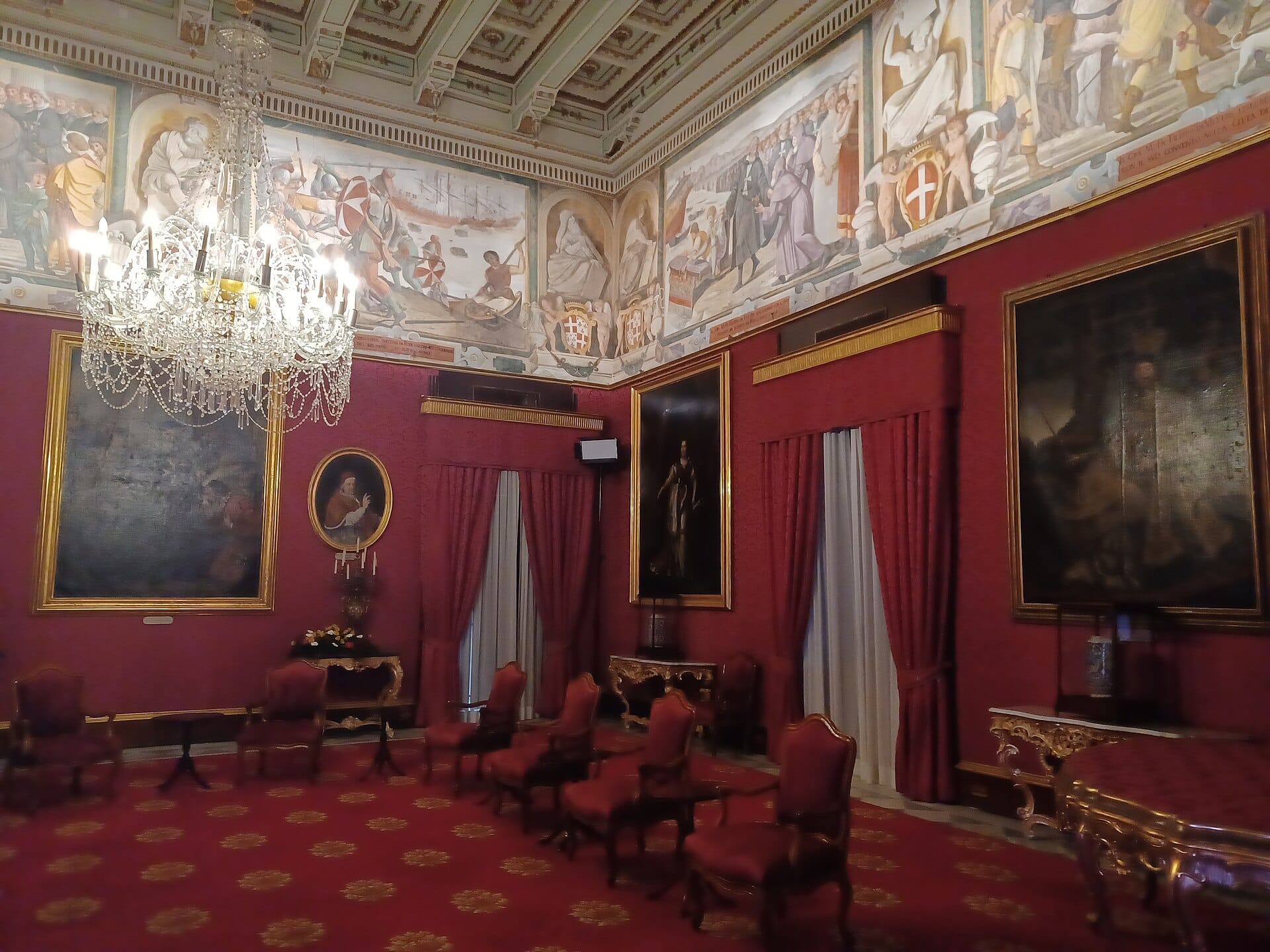
The restored State Rooms are the centrepiece of any visit. The sequence moves through spaces that were designed explicitly to impress and intimidate foreign envoys: the Ambassadors' Room, the Throne Room, the Pages' Room, and the Grand Master's Study. Each room reads differently, and the contrast between the ceremonial grandeur of the Throne Room and the more intimate scale of the Study is worth noticing.
The Throne Room is the most visually striking space. The ceiling is panelled in gold-heavy carved wood, and the frieze running below the cornice depicts the Great Siege of 1565 in a continuous sequence of paintings, commissioned in the late 16th century. These are not decorative historical scenes in any abstract sense; they were a deliberate political statement hung at the eye level of every diplomat who entered. The detail in the armour, ships, and fortifications rewards slow looking.
The Uccelliera, two small corner towers off the main courtyard, originally served as aviaries for the Grand Masters. They are quiet, slightly unexpected spaces that most visitors move through quickly. Slow down here. The courtyard below, with its Neptune fountain, is one of the calmer spots in the palace and worth a few minutes before you move on.
One honest note: the rooms are rich but the interpretive signage can vary in depth. If you want the full context behind specific tapestries, portraits, and furnishings, arriving with background knowledge or an audio guide will significantly improve the experience.
Tickets & tours
Hand-picked options from our booking partner. Prices are indicative; availability and final rates are confirmed when you complete your booking.
City Sightseeing hop-on hop-off bus tour of Gozo
From 20 €Instant confirmationFree cancellationThe Malta Experience Audio-Visual Show and La Sacra Infermeria Tour
From 20 €Instant confirmationFree cancellationLuggage Storage in Malta
From 6 €Instant confirmationFree cancellation6-day heritage and attractions pass in Malta
From 80 €Instant confirmationFree cancellation
The Armoury: Arguably the Most Impressive Room
The Armoury occupies the former stables of the palace and displays one of the most significant collections of arms and armour in Europe. The Knights of St. John were a military order, and the collection reflects that: over 5,000 objects spanning the 15th to 18th centuries, including suits of armour that belonged to individual Grand Masters, Ottoman weapons captured in battle, and an extraordinary range of firearms, swords, and pikes.
What makes the Armoury genuinely impressive rather than merely large is the specificity. Armour worn by Grand Master Alof de Wignacourt, who ruled from 1601 to 1622, sits alongside pieces from the 1565 siege. These are not generic period objects; they are the personal equipment of men whose names appear on the streets and fortifications of Valletta. That connection grounds the collection in a way that generic military museums rarely achieve.
The Armoury opened to the public in 1860, making it one of the longest-running public museum spaces in Malta. The lighting in the hall is functional rather than atmospheric, and the space itself is more warehouse than gallery. That is a minor limitation, but worth knowing if you are expecting the kind of dramatic theatrical presentation found in newer museums.
💡 Local tip
The Armoury may have specific opening dates; always verify the schedule. Cross-check these dates at heritagemalta.mt before planning around the Armoury specifically, as access schedules differ from the State Rooms.
How the Experience Changes by Time of Day
St. George's Square, directly outside, is one of Valletta's main gathering points. In the morning, especially before 10 am, the square is relatively quiet and the light entering the palace's upper windows is soft and flat, good for taking in the detail of the painted friezes without harsh shadows. By midday, tour groups arrive in clusters and the corridors become noticeably more crowded.
Afternoons in summer can be warm inside the palace, particularly in the State Rooms, which rely on natural ventilation rather than air conditioning. Wear breathable clothing if visiting between June and September. The stone walls retain heat. Late afternoon visits, from around 3 pm onwards, often see lighter crowds as day-trippers cycle back toward the waterfront areas.
Valletta is compact enough that a morning at the palace pairs well with an afternoon at St. John's Co-Cathedral a few minutes' walk away, or a quieter finish at the Upper Barrakka Gardens for views over the Grand Harbour.
Historical Weight and Why It Matters
Very few buildings in Europe have housed a medieval military order, a colonial administration, a national parliament, and a presidential office, all within the same walls. The Grandmaster's Palace is not a preserved historic house; it is a living institution that has continuously adapted to Malta's changing political reality for over 450 years.
The architectural fabric reflects this layering. The core structure dates to the late 16th century, attributed in part to the Maltese architect Girolamo Cassar, who designed several of Valletta's founding buildings. Subsequent Grand Masters modified and expanded the palace, and British-era renovations added their own visual register. The result is not a stylistically uniform building, and that is precisely what makes it interesting.
If the Knights' history is drawing you to Valletta more broadly, things to do in Valletta covers the city's other major sites and how to sequence a full day.
Practical Information for Your Visit
The palace is managed by Heritage Malta, the national agency for museums and heritage sites. Tickets are purchased at the entrance or can be checked online at heritagemalta.mt. Pricing is not reproduced here as Heritage Malta periodically updates admission rates; confirm before you go.
Getting here by public bus is straightforward. Malta's bus network covers Valletta well, and St. George's Square is within a five-minute walk of the main Valletta bus terminus. If you are coming from Sliema or St. Julian's, direct bus routes run regularly. Parking in Valletta is limited and paid; public transport is the practical choice for most visitors.
Photography is generally permitted in the public areas of the palace, though flash use and tripods may be restricted. The Throne Room in particular benefits from the natural light entering through its upper windows, and a phone camera on automatic settings usually handles it well. For the Armoury, the overhead fluorescent lighting produces flat images; adjust exposure compensation upward slightly for better results.
⚠️ What to skip
The palace still serves as the Office of the President of Malta. Certain areas may close without notice for official state functions. If visiting during a national event or public holiday, check ahead. This is not common but it happens.
Accessibility information for visitors with mobility requirements is not fully documented in publicly available sources. Heritage Malta should be contacted directly ahead of your visit to confirm current access across the restored sections of the building.
Who Should Consider Skipping This
The Grandmaster's Palace rewards visitors who come with curiosity about history, architecture, and the political story of Malta. If you are primarily here for beaches, outdoor experiences, or nightlife, the palace may feel like a slow two hours. The content is dense and the building does not perform for you the way a theme-driven attraction might. It requires engagement.
Families with very young children may find the State Rooms challenging: the spaces are formal, the objects are behind barriers, and there is limited interactive content. Older children with an interest in swords, armour, or medieval history will likely find the Armoury genuinely engaging.
Visitors who want outdoor Valletta experiences might prefer starting with Lower Barrakka Gardens or combining the palace with the Lascaris War Rooms for a full day of Valletta history at different registers.
Insider Tips
- Book tickets online via Heritage Malta before your visit rather than queuing at the door. During peak months (July, August), morning queues at popular Heritage Malta sites can be 20-30 minutes long.
- The Neptune Fountain courtyard is accessible from the main palace route and is frequently overlooked by visitors moving quickly between the State Rooms and Armoury. It is one of the few genuinely quiet spots in central Valletta at midday.
- The frieze paintings in the Throne Room depict the 1565 Great Siege in sequential order. Moving left to right along the walls, they tell a coherent narrative. Most visitors glance at individual panels; reading them as a sequence changes the experience entirely.
- If you are visiting multiple Heritage Malta sites during your trip, check whether a combined ticket offers better value. Heritage Malta manages sites across the islands and combination tickets are sometimes available.
- St. George's Square outside the palace is worth seeing after dark when it is lit up and largely empty of tourists. It reads very differently from its daytime self and gives a cleaner sense of the scale of the palace facade.
Who Is Grandmaster's Palace & State Rooms For?
- History travellers wanting to understand how Malta's political identity was shaped over five centuries
- Architecture enthusiasts interested in Baroque civic buildings and Maltese Mannerist interiors
- Anyone with a specific interest in the Knights of St. John and their military and artistic legacy
- Travellers doing a focused Valletta day who want a single major indoor attraction that covers significant historical ground
- Photography visitors looking for grand interior spaces with natural light and minimal crowds in the early morning
Nearby Attractions
Other things to see while in Valletta:
- Basilica of Our Lady of Mount Carmel
The Basilica of Our Lady of Mount Carmel anchors Valletta's skyline with a 42-metre oval dome visible from across Marsamxett Harbour. Originally built in 1570 by the architect of Valletta himself, bombed flat in World War II, and rebuilt over two decades, this is a church with a remarkable story behind its serene facade.
- Casa Rocca Piccola
Casa Rocca Piccola is a 16th-century aristocratic palace on Valletta's Republic Street, home to the de Piro family for roughly 350 years and still occupied today. Guided tours take visitors through 50 furnished rooms stacked with Maltese silver, antique furniture, lace collections, and paintings, before descending into a genuine WWII air-raid shelter carved beneath the building.
- City Gate & Renzo Piano Parliament
The City Gate and Parliament House form Valletta's most architecturally charged entrance. Designed by Renzo Piano and completed between 2011 and 2015, this project replaced a clumsy 1960s gateway and derelict opera ruins with something genuinely bold. Entry to the public spaces is free and open around the clock.
- Fort St. Elmo & National War Museum
Standing at the tip of the Sciberras Peninsula, Fort St. Elmo has guarded Valletta's twin harbours for over five centuries. Inside, the National War Museum takes visitors from Bronze Age Malta through to the WWII siege that earned the island its George Cross, with artefacts that are genuinely difficult to find anywhere else in the Mediterranean.