City Gate & Renzo Piano's Parliament: Where Old Valletta Meets Radical Design
The City Gate and Parliament House form Valletta's most architecturally charged entrance. Designed by Renzo Piano and completed between 2011 and 2015, this project replaced a clumsy 1960s gateway and derelict opera ruins with something genuinely bold. Entry to the public spaces is free and open around the clock.
Quick Facts
- Location
- Republic Street at City Gate, Valletta, Malta
- Getting There
- Valletta Bus Terminus (all routes); ferry from Sliema or Three Cities to Valletta Waterfront, then 10-min walk uphill
- Time Needed
- 30–60 minutes for the gate, Parliament exterior, and open-air theatre ruins
- Cost
- Free (exterior and public spaces); Parliament interior access varies by session schedule
- Best for
- Architecture enthusiasts, photographers, history walkers, and anyone entering Valletta on foot
- Official website
- parlament.mt
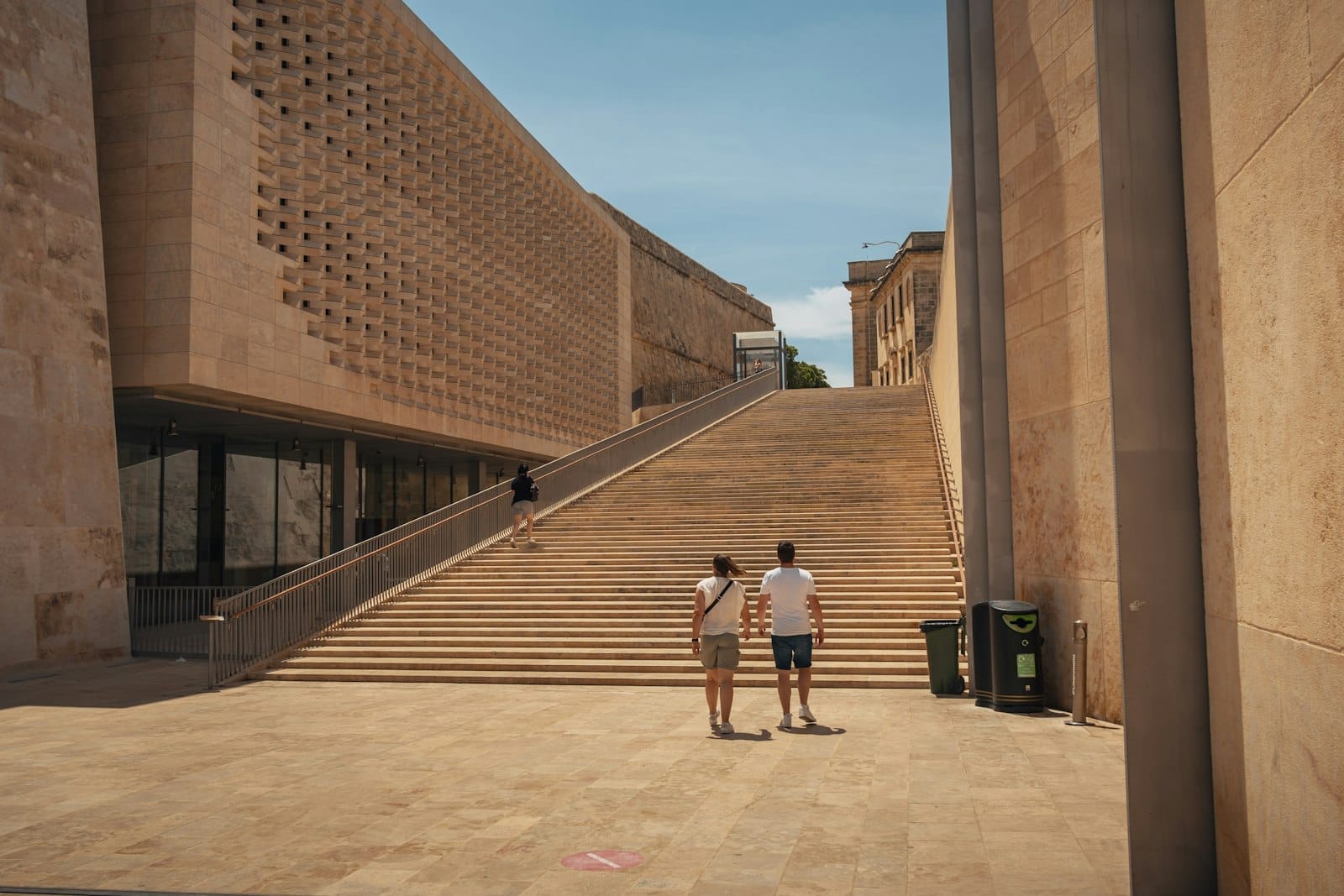
First Impressions: Arriving at Valletta's New Gateway
Most visitors arrive at Valletta's City Gate with a practical purpose: they want to get into the city. What stops them is what Renzo Piano did to the entrance. Instead of a conventional archway, Piano cut a clean 8-metre breach through the 16th-century limestone bastions, framing it with tall, angled steel blades that catch morning light in ways the old 1960s gate never could. The effect is stark and deliberate: you are not being welcomed through a triumphal arch but invited to step through a wound in the city wall.
The approach across the narrow bridge over the historic dry ditch sets the scene. Below, the ditch that once served as Valletta's first line of defence is now a landscaped promenade. Locals walk dogs there in the early morning. Tourists rarely find their way down. Above, the limestone bastions built under Grand Master Jean de Valette in the 1560s rise with the same ochre solidity they have carried for nearly five centuries. The contrast with the slim steel blades framing the gate is not subtle, but it earns its boldness.
💡 Local tip
Arrive before 9am to experience the gate area without coach-tour crowds. The morning light hits the limestone bastions at a low angle and the steel blades cast long parallel shadows across the bridge — easily the best time for photographs.
The Architecture in Detail: What Renzo Piano Actually Built
The City Gate is only one piece of a larger project. Piano's commission, announced in 2009 and completed between 2011 and 2015, covered four interconnected elements: the new City Gate breach, the Parliament House (Dar il-Parlament), an open-air theatre built within the ruins of the Royal Opera House, and the redesign of the surrounding public spaces. The total cost of the Parliament component alone was approximately 90 million euros, a figure that generated significant public debate in Malta.
Parliament House sits immediately to the right as you pass through the gate, occupying a site left vacant since the Royal Opera House was bombed in April 1942 during the WWII Siege of Malta. Piano chose not to reconstruct the Victorian opera house but to build something new that acknowledged the ruin. The Parliament is a two-storey limestone block elevated on a grid of stone pillars, giving the ground floor a semi-transparent, colonnaded quality. Look closely at the facade: the Maltese limestone panels are cut and textured to echo the perforated quality of traditional Maltese balconies and screens, known as gallariji, without mimicking them directly.
The glazed ground level creates an almost public feel. You can walk through the colonnade freely and observe the building's structure. At night, internal lighting turns the Parliament into a glowing lantern above Republic Street, visible from the lower end of the city near the Grand Harbour. For architecture students and urban design enthusiasts, this is one of the more intellectually rewarding contemporary buildings in the Mediterranean.
Tickets & tours
Hand-picked options from our booking partner. Prices are indicative; availability and final rates are confirmed when you complete your booking.
Valletta Food Tour
From 40 €Instant confirmationFree cancellationValletta small-group walking tour
From 20 €Instant confirmationFree cancellationLa Valletta self-guided discovery pack in Malta
From 8 €Instant confirmationValletta food tour
From 85 €Instant confirmationFree cancellation
Pjazza Teatru Rjal: The Opera Ruins Beside It
Immediately adjacent to the Parliament, Piano incorporated the remaining outer walls of the bombed Royal Opera House into an open-air performance venue called Pjazza Teatru Rjal. The original opera house was designed by English architect Edward Middleton Barry and opened in 1866. After it was destroyed by Luftwaffe bombing, its ruins sat unrestored for over six decades, becoming one of the most contested architectural spaces in Valletta's modern history.
Piano's solution was to treat the ruins as a found object: he preserved the original stone perimeter walls, inserted a modern stage, and arranged tiered stone seating within the shell. The venue now hosts performances during the Valletta cultural season, including outdoor concerts and theatrical events. Outside performance season, the space is accessible to walk through freely, and the contrast between the weathered 19th-century stone shell and the clean modern interventions is quietly arresting.
Even without a performance scheduled, it is worth stepping inside the theatre shell to look up. The sky appears framed by ruined arches and the smell of old limestone, slightly mineral and dry in summer, is distinct from the rest of Valletta's streets.
How the Experience Changes Through the Day
The City Gate area is technically open 24 hours, and each time of day offers a meaningfully different encounter. Before 8am, the bridge and gate are nearly empty and the dry ditch below holds the sounds of birds and distant ferry horns from the Grand Harbour. The limestone glows gold as the sun lifts above Floriana. This is the hour serious photographers come for.
From mid-morning through the early afternoon, Republic Street behind the gate fills quickly. Tour groups stack up on the bridge. The Parliament building attracts glances but rarely much time, as most people simply want to push through into the city. If you are travelling with someone interested in architecture, agreeing to pause here for fifteen minutes requires a gentle act of persuasion against the flow of foot traffic.
Late afternoon, particularly in the hour before sunset, brings a second peak of quality light. The western face of the Parliament and the limestone bastions both take on a warm amber tone, and the steel gate blades shift from silver to near-bronze. Evening, especially during summer months, sees the Parliament illuminate from within and the Pjazza Teatru Rjal occasionally used for performance. Check the venue's schedule if an evening visit is possible.
ℹ️ Good to know
The dry ditch (il-Fosse) below the City Gate bridge is accessible via steps on either side of the bridge. It connects to a shaded promenade running along the base of the bastions. Most visitors miss it entirely. In warm months, it is significantly cooler than street level.
Historical Context: Five Gates and Five Centuries
The current City Gate is the fifth built on or near this location since Valletta was founded in 1566. The Knights of St John, who built the city following the Great Siege of 1565, constructed the original entrance as a functional military gap in the defensive circuit. Over the following centuries, it was rebuilt, embellished, and repeatedly argued over. The 1960s version that Piano replaced was widely considered an architectural embarrassment: a low, broad arch with tacked-on ornamentation that bore no relationship to either the 16th-century fortifications or the Baroque streetscape of the city behind it. You can read more about the Knights' role in shaping Valletta in the Knights of Malta history guide.
Piano's commission was controversial from announcement through completion. Critics argued that a living architect of global stature had no business redesigning a UNESCO World Heritage Site entrance. Supporters countered that every previous City Gate was the product of its era, and the 21st century deserved its own interpretation. The debate says something important about Malta's ongoing negotiation between preservation and modernity, a tension visible across the entire island.
Valletta was designated a UNESCO World Heritage Site in 1980 and served as European Capital of Culture in 2018, a designation that accelerated several urban renewal projects including improvements to public spaces near the gate. The city as a whole rewards time beyond this entrance point. Our Malta 3-day itinerary covers how to use City Gate as a logical starting point for a full walking day through Valletta.
Practical Walkthrough: What to Do and Where to Go Next
The City Gate and Parliament complex requires no pre-booking and no entry fee for public spaces. Parliament interiors are accessible during official parliamentary sessions, but visiting the legislative chamber is not a structured tourist experience in the way it is in some European capitals. The exterior, colonnade, and Pjazza Teatru Rjal are the relevant spaces for most visitors.
Once through the gate, Republic Street runs in a straight line through the heart of Valletta. Within ten minutes of walking, you reach St John's Co-Cathedral, one of the finest Baroque interiors in Europe and home to Caravaggio's largest surviving painting. Further along Republic Street sits the Grand Master's Palace, now housing the President's office and a state rooms museum. Both are within a 10-minute walk of the City Gate.
For views over the Grand Harbour and across to the Three Cities, continue to the Upper Barrakka Gardens at the far end of the city. The walk from City Gate to Upper Barrakka takes about 15 minutes at a relaxed pace. The contrast between Piano's minimalist entrance and the Baroque grandeur of the city interior is part of what makes this walk worthwhile.
⚠️ What to skip
Valletta's streets are almost entirely pedestrianised but involve consistent uphill gradients and uneven limestone paving. Visitors with mobility limitations should note that the approach bridge and ditch access involve steps. The Parliament colonnade at ground level is flat and accessible.
Photography Tips
- Shoot the steel gate blades from below and slightly to one side for the strongest geometric effect.
- The view back through the gate toward Floriana and the bus terminus is underused — turn around after entering for a clean shot of the steel blades against open sky.
- The Parliament facade photographs well in late afternoon when the limestone panels catch directional light from the west.
- From the dry ditch below, you can photograph the underside of the bridge and the bastions without any foot traffic in the frame.
- Night photography of the Parliament's illuminated ground floor works best on weekday evenings when street light pollution from tour buses is reduced.
Who Should Skip This
Visitors with no interest in architecture or urban design will find the City Gate functional but unremarkable as a tourist destination in itself. It is, first and foremost, an entrance. If you are primarily chasing beaches, ancient temples, or restaurants, you will pass through here without needing to stop. Those expecting a dramatic medieval gate in the style of Mdina's entrance will be surprised by how deliberately understated Piano's design is. The ambition is intellectual, not theatrical.
Insider Tips
- Descend into the dry ditch via the steps on the left side of the bridge before entering the city. Almost no one does this, and the view looking up at the limestone bastions from below gives you a genuine sense of Valletta's defensive scale.
- The Parliament's colonnade at ground level is public and open. Walk through it and look at the stone-panel texture up close: the perforations vary in pattern across different sections of the facade, referencing traditional Maltese architectural screens.
- Check the Pjazza Teatru Rjal events calendar before your trip. Summer outdoor concerts inside the opera ruins are an exceptional evening experience that most short-stay visitors miss entirely.
- If you are visiting during a parliamentary session day, it is sometimes possible to observe proceedings from the public gallery. Check the official parliament website at parlament.mt for session schedules.
- The view looking back through the City Gate from inside Valletta (rather than the standard inward approach shot) captures both the steel blades and the open sky over Floriana with no competing visual clutter. Take it early when foot traffic is minimal.
Who Is City Gate & Renzo Piano Parliament For?
- Architecture enthusiasts who want to see a serious contemporary intervention in a UNESCO heritage context
- Photographers looking for geometric, light-sensitive compositions at different hours of the day
- First-time Valletta visitors who want to orient themselves at the city's main entrance before exploring Republic Street
- Travellers interested in WWII history who want to understand what the Royal Opera House ruins represent
- Evening visitors who can combine the illuminated Parliament with a performance at Pjazza Teatru Rjal
Nearby Attractions
Other things to see while in Valletta:
- Basilica of Our Lady of Mount Carmel
The Basilica of Our Lady of Mount Carmel anchors Valletta's skyline with a 42-metre oval dome visible from across Marsamxett Harbour. Originally built in 1570 by the architect of Valletta himself, bombed flat in World War II, and rebuilt over two decades, this is a church with a remarkable story behind its serene facade.
- Casa Rocca Piccola
Casa Rocca Piccola is a 16th-century aristocratic palace on Valletta's Republic Street, home to the de Piro family for roughly 350 years and still occupied today. Guided tours take visitors through 50 furnished rooms stacked with Maltese silver, antique furniture, lace collections, and paintings, before descending into a genuine WWII air-raid shelter carved beneath the building.
- Fort St. Elmo & National War Museum
Standing at the tip of the Sciberras Peninsula, Fort St. Elmo has guarded Valletta's twin harbours for over five centuries. Inside, the National War Museum takes visitors from Bronze Age Malta through to the WWII siege that earned the island its George Cross, with artefacts that are genuinely difficult to find anywhere else in the Mediterranean.
- Grandmaster's Palace & State Rooms
The Grandmaster's Palace in Valletta has served as a seat of power for the Knights Hospitaller, British governors, and Malta's parliament. Today, its restored State Rooms and legendary Armoury offer one of the most historically rich indoor experiences in the Mediterranean.