Lower Barrakka Gardens: Valletta's Quiet Harbour Overlook
Lower Barrakka Gardens sits at the southeastern tip of Valletta's city walls, offering one of the most open and unobstructed views of the Grand Harbour available without paying an entrance fee. Anchored by an 1810 neoclassical monument to Sir Alexander Ball, the gardens offer a calmer, less photographed alternative to Valletta's more famous Upper Barrakka Gardens.
Quick Facts
- Location
- Southeastern Valletta city walls, Valletta, Malta
- Getting There
- Walk from Valletta Bus Terminus (8–10 min); no direct bus stop
- Time Needed
- 20–40 minutes
- Cost
- Free entry
- Best for
- Harbour views, quiet reflection, history enthusiasts, photography
- Official website
- www.visitmalta.com/en/attraction/lower-barrakka
What the Lower Barrakka Gardens Actually Are
The Lower Barrakka Gardens (Maltese: Il-Barrakka t'Isfel) is a small public garden perched on the bastions at the southeastern corner of Valletta, overlooking the Grand Harbour and its breakwater. It is officially twinned with the Upper Barrakka Gardens, but the two feel entirely different in character. Where the Upper Barrakka draws tour groups and the famous noon cannon salute, the Lower Barrakka is quieter, less curated, and more genuinely local.
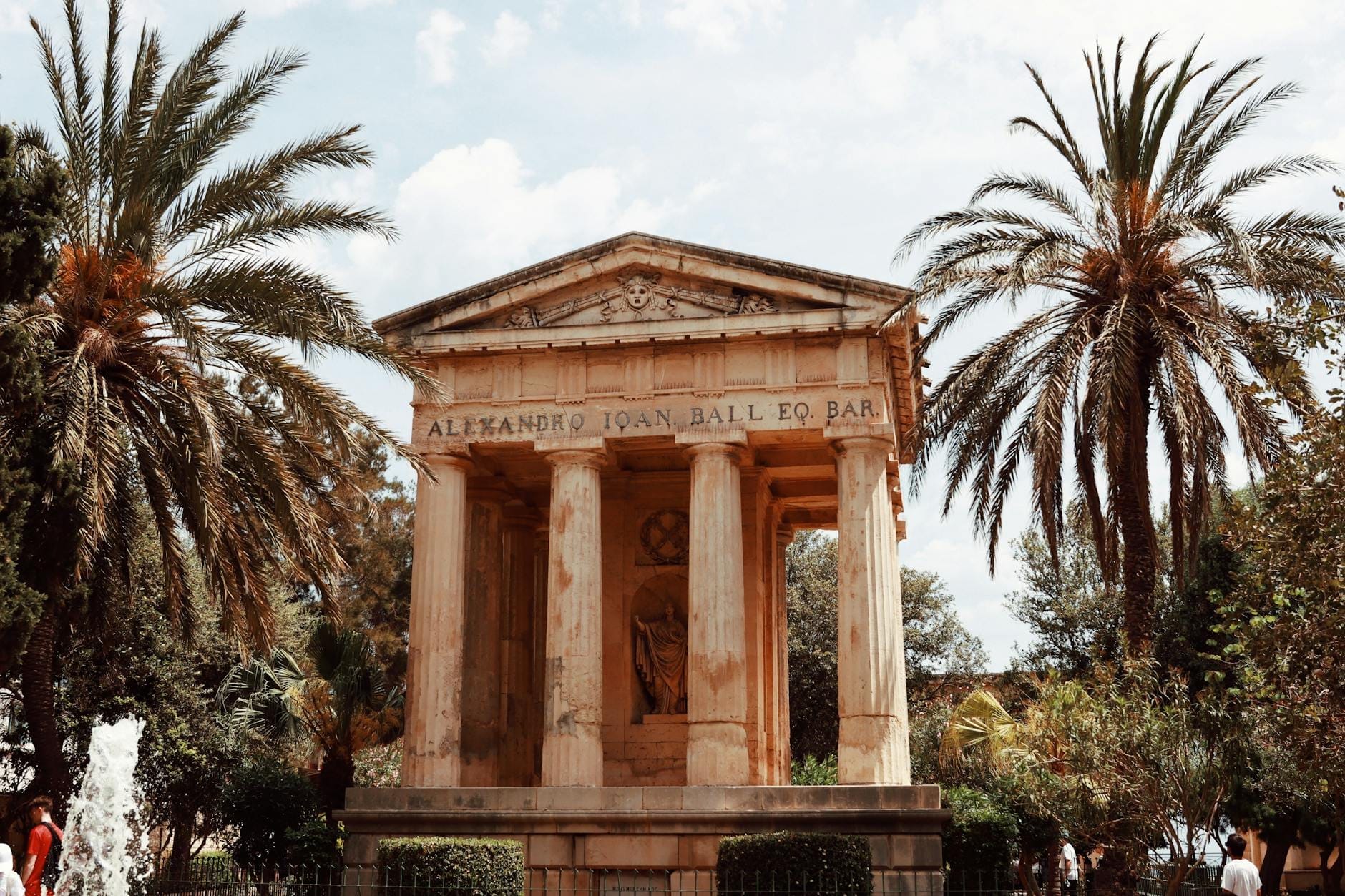
The garden's focal point is the Monument to Sir Alexander Ball, a neoclassical structure built in 1810 and designed by architect Giorgio Pullicino. It takes the form of an ancient Greek temple: a circular colonnade of pale stone columns rising from a low platform, with an open interior housing a commemorative inscription. Ball was the first Civil Commissioner of Malta under British rule, and the monument's positioning on the city walls reflects both his political significance and the British colonial instinct for ceremonial grandeur in elevated, visible locations.
ℹ️ Good to know
Admission is free and the gardens are open to the public. For current opening hours, check the Visit Malta website before visiting.
The View: Grand Harbour, Unobstructed
The view from Lower Barrakka is broader and more exposed than what you get at Upper Barrakka. You're looking south and east across the full mouth of the Grand Harbour, with the breakwater stretching across the middle ground and Fort Ricasoli on the opposite shore. Cruise ships enter this stretch of water; tankers sit at anchor in the distance; traditional Maltese luzzu fishing boats occasionally pass below. On clear days, you can see as far as the open Mediterranean.
The light changes dramatically depending on the time of day. In the early morning, the harbour catches a warm, low-angle glow that turns the limestone fortifications golden. By midday, the glare off the water is intense and photography becomes difficult without a polarizing filter. Late afternoon, particularly in the hour before sunset, brings the most saturated colors and the longest shadows across the bastions below.
If harbour views are a priority for your trip, this garden pairs well with a walk along the Upper Barrakka Gardens, which sits further along the city walls and offers a different angle on Marsamxett Harbour and the Three Cities.
💡 Local tip
Photography tip: Arrive before 9:00 AM for soft morning light and near-empty benches. The view faces roughly south, so the best directional light is in the morning rather than at sunset.
Tickets & tours
Hand-picked options from our booking partner. Prices are indicative; availability and final rates are confirmed when you complete your booking.
City Sightseeing hop-on hop-off bus tour of Gozo
From 20 €Instant confirmationFree cancellationThe Malta Experience Audio-Visual Show and La Sacra Infermeria Tour
From 20 €Instant confirmationFree cancellationLuggage Storage in Malta
From 6 €Instant confirmationFree cancellation6-day heritage and attractions pass in Malta
From 80 €Instant confirmationFree cancellation
The Monument to Sir Alexander Ball: A Closer Look
Most visitors who find their way to Lower Barrakka give the monument a quick glance and move on. It deserves a few extra minutes. The structure was erected in 1810, just two years after Ball's death, making it one of the earliest British-era monuments in Malta. Its design by Giorgio Pullicino drew directly from Greco-Roman temple forms: a circular peristyle, plain column shafts with simple capitals, and a stone dome above.
The monument was restored in 2001 as part of a broader rehabilitation of the Lower Barrakka Gardens. The restoration brought the stonework back to legibility after decades of salt-air weathering, though the columns still carry a fine patina that hints at their age. The inscription inside commemorates Ball's role in securing Malta's relationship with Britain, framing him as a protector of the Maltese people during the turbulent Napoleonic era.
Scattered around the garden are historical plaques that most visitors never read. These commemorate the 1956 Hungarian Revolution, the Prague Spring of 1968, the EU's 50th Anniversary, and Italian nationalist Giuseppe Garibaldi. The combination is eclectic, but it reflects Valletta's role as a city that has always absorbed the political currents of the broader Mediterranean and European world.
When to Visit and What to Expect
Lower Barrakka is significantly quieter than its upper counterpart for most of the day. Weekday mornings between 7:00 and 9:30 AM you are likely to share the space only with Valletta residents cutting through on their way to work and the occasional jogger. By mid-morning, small groups of tourists begin arriving, but numbers rarely reach the density you find at Upper Barrakka.
Summer afternoons (June to August) can be uncomfortably hot on the open bastion, with limited shade outside the colonnade of the monument itself. The stone and concrete surfaces reflect heat, and the exposed position means there is little protection from the sun between roughly 11:00 AM and 4:00 PM. If you are visiting in high summer, aim for early morning or the late-afternoon window after 5:00 PM.
Winter visits, particularly between November and February, bring cooler temperatures (typically 12 to 16°C) and the possibility of wind off the harbour. The garden is fully exposed on three sides, so on blustery days the chill can be sharper than the thermometer suggests. That said, winter light is excellent for photography and the garden is almost entirely crowd-free.
⚠️ What to skip
There is very limited seating and almost no shade during peak afternoon hours in summer. Bring water, and consider visiting early or late in the day if temperatures are above 28°C.
Getting There: Walking Valletta's Wall
Lower Barrakka Gardens sits at the far southeastern end of Valletta, a 12 to 15 minute walk from the main Valletta Bus Terminus and City Gate. The most straightforward route follows St. Paul's Street or Old Theatre Street down through the city grid, then cuts south toward the harbour bastions. There are no direct bus stops at the garden itself.
The walk from City Gate is worth doing slowly. Valletta is a UNESCO World Heritage Site and one of the most concentrated collections of Baroque architecture in Europe. For context on what you are passing, the things to do in Valletta guide covers the city's key streets and sights in sequence.
Accessibility note: The path to the gardens involves steps and uneven stone surfaces. Parts of Valletta's street grid are steep, and the final approach to the bastion garden may be challenging for visitors using wheelchairs or mobility aids. Contact the Parks in Malta authority (+356 2149 3170) in advance to ask about accessible routes.
If you are arriving from Sliema or St. Julian's, the ferry crossing from Sliema to Valletta is a practical option that deposits you near the waterfront, from where you can walk up into the city. The getting around Malta guide has details on ferry schedules and bus routes.
The Honest Assessment: Is It Worth Your Time?
Lower Barrakka Gardens is not an attraction that will anchor your day. It is not a museum, not a grand spectacle, and not somewhere most people would travel specifically to see. What it offers is a moment of genuine calm in a capital city that can feel overwhelming in summer: an open-air pause with a serious historical monument, a wide harbour view, and, for most of the day, fewer people than the surrounding streets.
Travelers who prefer crowd-free spaces, who enjoy pairing architectural details with harbour scenery, or who are building a slow walking circuit of Valletta's perimeter will find it a satisfying stop. Travelers on a tightly packed itinerary looking for Malta's headline attractions can reasonably skip it, though the 20-minute detour is rarely regretted.
For those combining this with a broader Valletta circuit, the Grandmaster's Palace and St. John's Co-Cathedral are the city's essential interior spaces and sit within easy walking distance.
Who should skip it: visitors primarily seeking beaches, nightlife, or family activities with young children will find little to hold their attention. The garden is small, the facilities are minimal, and the monument requires some historical background to appreciate.
Insider Tips
- The view of the Grand Harbour from the lower bastion wall, rather than from the formal garden level, is often better. Walk right up to the stone parapet for an unobstructed sight line down to the waterline below.
- The garden's historical plaques, including the one commemorating the 1956 Hungarian Revolution, are largely overlooked but make for an interesting five minutes of reading if you have any interest in Cold War European history.
- If you visit around midday in summer, the interior of the Ball monument colonnade offers a small patch of shade. It is technically a public monument and not cordoned off, so standing inside for a few minutes is perfectly fine.
- Combine this garden with the nearby Lascaris War Rooms, a WWII underground command center built into the bastions just a short walk away, for a fuller understanding of how these walls have been used across different eras.
- The garden sees almost no foot traffic after 7:00 PM in summer, when the light is still good and the heat has dropped. This is when the space feels most like a local retreat rather than a tourist stop.
Who Is Lower Barrakka Gardens For?
- History and architecture enthusiasts interested in British colonial Malta and neoclassical design
- Photographers targeting harbour light in the early morning or late afternoon
- Slow travelers building a walking circuit around Valletta's perimeter bastions
- Anyone seeking a quieter, less crowded alternative to the Upper Barrakka Gardens
- Visitors who want a free, uncrowded spot to sit and orient themselves before exploring the city
Nearby Attractions
Other things to see while in Valletta:
- Basilica of Our Lady of Mount Carmel
The Basilica of Our Lady of Mount Carmel anchors Valletta's skyline with a 42-metre oval dome visible from across Marsamxett Harbour. Originally built in 1570 by the architect of Valletta himself, bombed flat in World War II, and rebuilt over two decades, this is a church with a remarkable story behind its serene facade.
- Casa Rocca Piccola
Casa Rocca Piccola is a 16th-century aristocratic palace on Valletta's Republic Street, home to the de Piro family for roughly 350 years and still occupied today. Guided tours take visitors through 50 furnished rooms stacked with Maltese silver, antique furniture, lace collections, and paintings, before descending into a genuine WWII air-raid shelter carved beneath the building.
- City Gate & Renzo Piano Parliament
The City Gate and Parliament House form Valletta's most architecturally charged entrance. Designed by Renzo Piano and completed between 2011 and 2015, this project replaced a clumsy 1960s gateway and derelict opera ruins with something genuinely bold. Entry to the public spaces is free and open around the clock.
- Fort St. Elmo & National War Museum
Standing at the tip of the Sciberras Peninsula, Fort St. Elmo has guarded Valletta's twin harbours for over five centuries. Inside, the National War Museum takes visitors from Bronze Age Malta through to the WWII siege that earned the island its George Cross, with artefacts that are genuinely difficult to find anywhere else in the Mediterranean.