Square des Batignolles: The Neighborhood Park That Rewards Slow Visitors
Designed in 1862 by Jean-Charles Adolphe Alphand in the English landscape style, Square des Batignolles is the largest green space in Paris's 17th arrondissement. Free to enter and largely overlooked by tourists, it offers a genuine window into everyday Parisian life, with a scenic pond, grotto, waterfall, carousel, and pétanque courts all packed into just four acres.
Quick Facts
- Location
- 144 bis Rue Cardinet, 75017 Paris (Batignolles, 17th arrondissement)
- Getting There
- Brochant (M13, 6-min walk); Pont Cardinet (Line 14 & Transilien L); Bus 28, 31, 66, 163
- Time Needed
- 45 minutes to 1.5 hours
- Cost
- Free entry
- Best for
- Families, slow travelers, picnics, getting off the tourist trail
- Official website
- parisjetaime.com/eng/culture/square-des-batignolles-p1005
What Square des Batignolles Actually Is
Square des Batignolles is a 16,615 square metre (roughly 4.1 acres) public park in the 17th arrondissement, and the largest green space in that part of the city. Commissioned under Napoleon III and completed in 1862, it belongs to the tradition of English landscape gardens that Baron Haussmann introduced to Paris during his sweeping transformation of the capital. The man who designed it, Jean-Charles Adolphe Alphand, also created Parc des Buttes-Chaumont and Parc Montsouris, and his signature touches are everywhere: curved pathways, a grotto of faux-stratified rock, stone bridges, a pond fed by a natural stream, and a small waterfall arranged to look entirely accidental.
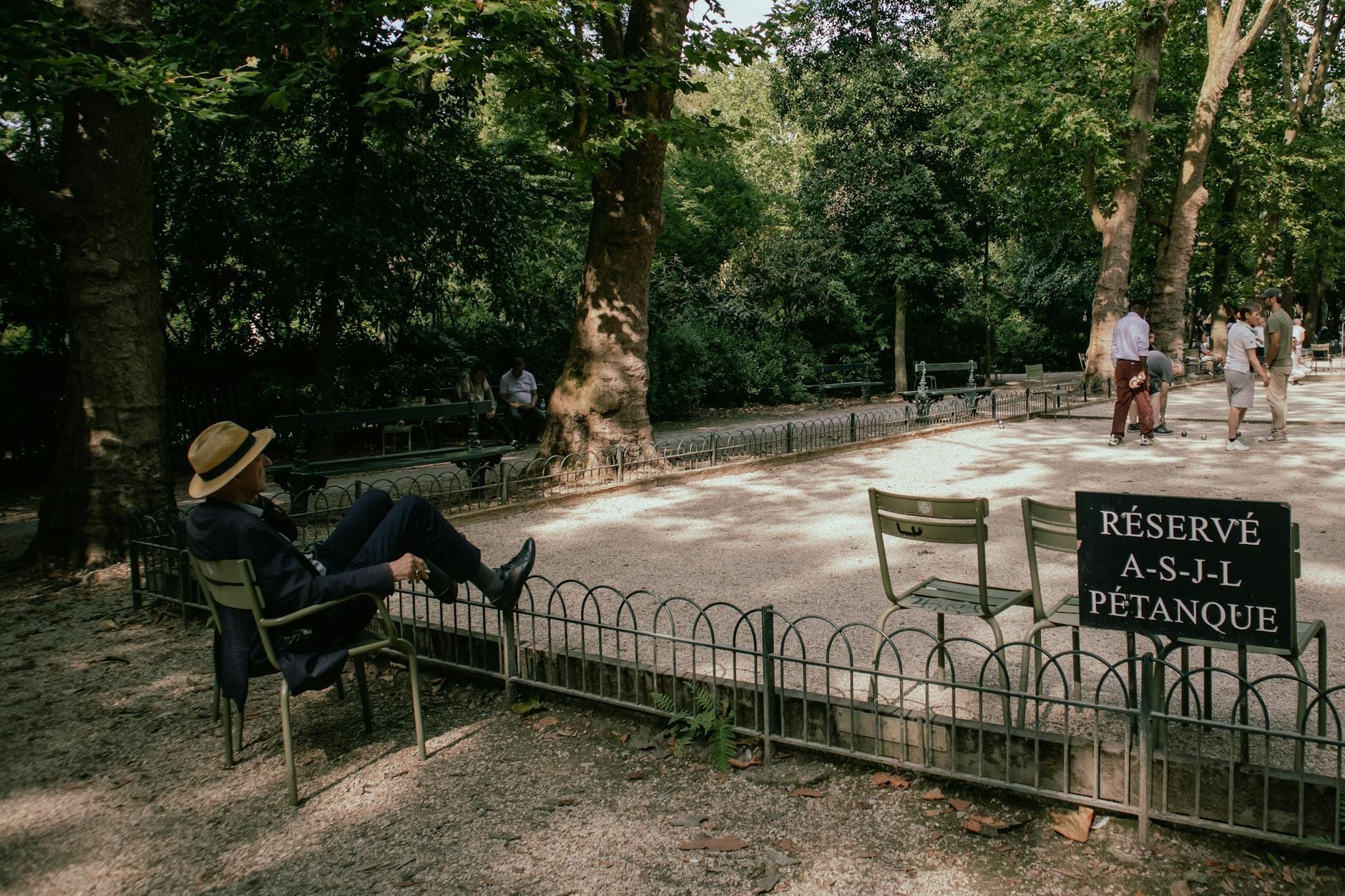
Unlike the grand parks of central Paris, this square was built for a specific neighborhood, not for spectacle. It still functions that way. On a Tuesday morning you will find retirees at the pétanque courts, parents pushing strollers along the gravel paths, and schoolchildren queuing for the antique wooden-horse carousel. The tourist infrastructure here is zero: no ticket booth, no audio guide, no souvenir kiosk. For travelers who want to understand how Parisians actually spend their days off, this park delivers more per square metre than many of the city's celebrated attractions. If you're building an itinerary around Paris's quieter side, the hidden gems in Paris guide offers useful context for the neighborhoods worth combining with a visit here.
💡 Local tip
Opening hours vary significantly by season. In summer (roughly April to September) the park stays open until 9:30pm on weekdays and weekends. In winter (October to March) it closes around 5:45pm. Arrive in the final hour before closing on a summer evening for the most atmospheric light.
The Landscape: Reading What Alphand Built
The English landscape style that Alphand brought to Paris was a deliberate illusion: hours of engineering work arranged to suggest that nature had simply happened this way. Napoleon III had developed an affection for this approach during his years of exile in England before 1848, and he instructed Haussmann to replicate it across the capital. The result at Square des Batignolles is a circuit you can complete in twenty minutes or linger inside for an hour, depending on how closely you look.
The central pond is the park's anchor point. A natural stream feeds it, and the water moves just enough to catch the light. At the far end, a small waterfall descends from a grotto of concrete formed to mimic layered limestone, the same technique Alphand used at Parc des Buttes-Chaumont. Stone bridges cross the stream at two points, and the paths curve in ways that prevent you from seeing the whole park at once, preserving the illusion of space. The tree collection is genuinely unusual: alongside the standard plane trees and chestnuts you will find purple beech (Fagus sylvatica purpurea), a Gleditsia triacanthos from North America, a Chinese willow with spiralling branches (Salix matsudana 'Tortuosa'), a Turkish hazel, and a young giant sequoia. A glass pavilion at one end serves as a greenhouse for a tropical palm that would not survive a Paris winter outdoors.
The lawn areas are generous enough for picnics without the packed shoulder-to-shoulder conditions you encounter in, say, the Jardin du Luxembourg on a June afternoon. On dry weekends, several families will be spread across the grass simultaneously without it feeling crowded, which speaks to how undervisited this park remains.
Tickets & tours
Hand-picked options from our booking partner. Prices are indicative; availability and final rates are confirmed when you complete your booking.
Pastry and chocolate tour in Saint-Germain-des-Pres neighborhood
From 109 €Instant confirmationFree cancellationWalking tour of Saint-Germain-des-Pres neighborhood
From 104 €Instant confirmationFree cancellationGuided tour of Les Invalides with Tomb of Napoleon
From 89 €Instant confirmationGluten-free and organic dessert cooking class
From 129 €Instant confirmationFree cancellation
Morning, Afternoon, and Evening: How the Park Changes
Early mornings, roughly 8am to 10am on weekdays, belong almost entirely to locals: dog walkers circling the pond, joggers on the outer path, and the first café-goers cutting through the park on their way to work. The light at this hour is flat and cool, the birdsong audible above the distant traffic of Rue de Rome. The air carries the mineral smell of damp gravel and cut grass. This is the time to have the grotto essentially to yourself.
By late morning and early afternoon on weekends, the park fills with families. The carousel and playground areas become the loudest zones, while the pétanque courts near the perimeter draw an older crowd. The sound of boules clicking together and the murmur of debated throws is one of the more specifically Parisian soundscapes you can still encounter without traveling to the outer arrondissements.
Summer evenings from around 6pm onward are arguably the best time to visit. The low sun hits the water at an angle that makes the pond look far more dramatic than it does at midday. Groups of young adults gather on the benches, and the park empties slowly rather than all at once. In the final thirty minutes before closing the paths are tranquil enough that you can hear the stream clearly. In winter, the closing time of 5:45pm means the park is effectively dark by arrival for much of December and January.
History and Cultural Weight
The Batignolles district itself was independent countryside until Napoleon III annexed it to Paris in 1860. The name may derive from the Latin word 'batillus', meaning mill, or from the Provençal 'bastidiole', a small farmhouse, reflecting the rural character the area retained well into the 19th century. Two years after annexation, Alphand received the commission to create the square, working alongside engineer Jean Darcel and architect Gabriel Davioud, the same team responsible for most of Haussmann's park infrastructure across the city.
The park carries a quiet literary legacy. The French singer-songwriter Barbara, born Monique Andrée Serf, grew up in the Batignolles area and referenced Square des Batignolles directly in her song 'Perlimpinpin'. Singer Yves Duteil later dedicated a song specifically to 'Les Batignolles', describing fording the stream and chasing pigeons across the park. These cultural references root the square in a tradition of working-class Parisian neighborhood life that the grand boulevards do not capture. The nearby Batignolles district, now undergoing slow gentrification, still retains this quality in its market streets and independent shops. For a deeper look at the character of the 17th arrondissement and surrounding areas, the best parks and gardens in Paris guide places it within the broader picture of the city's green spaces.
Practical Walkthrough: What to Do Here
The main entrance on Rue Cardinet is the most logical starting point. From there, a gravel path leads directly toward the pond, which is visible within about thirty seconds of entering. Walking the perimeter of the pond takes five to eight minutes at a slow pace, crossing both bridges and passing the waterfall. The grotto is worth pausing at: look at the concrete formwork closely and you can see the deliberate stratification lines Alphand's team scored into the surface. It is a 19th-century trompe-l'oeil that holds up at close range.
If you have children, the playgrounds are concentrated toward the eastern section of the park and include sandboxes, swings, and the wooden-horse carousel that has been operating here for many years. An area with ping-pong tables sits adjacent to the playground zone. The pétanque terrain is toward the western edge; spectating is entirely normal and the players rarely mind.
ℹ️ Good to know
There are no cafés or food vendors inside the park. The streets immediately surrounding it, particularly along Rue Cardinet and Rue des Batignolles, have bakeries and small cafés where you can pick up food to bring in. Picnics on the lawn are common and entirely accepted.
The park pairs naturally with a walk through the nearby Batignolles market streets or a visit to the adjacent Parc Clichy-Batignolles (also called Martin Luther King Park), a much larger and more contemporary green space created as part of the 2024 Olympic Village development. Together they offer a full half-day in the neighborhood. For those building a broader itinerary, the 3-day Paris itinerary suggests how to incorporate quieter neighborhood stops alongside the major sites.
Photography and Accessibility
The pond and waterfall area is the most photogenic section, particularly in morning light or during the golden hour before closing in summer. The reflection of trees on the pond surface is clearest on still mornings before the wind picks up. The stone bridges make good framing elements; position yourself at the water level by crouching near the bank to make the waterfall appear larger than it is. The spiral-branched Chinese willow near the greenhouse is an unusual specimen worth photographing for anyone interested in botanical photography.
The main paths are wide, flat gravel and accessible for prams and wheelchairs, though the grotto area and some of the grass-adjacent paths have uneven surfaces. No specific accessibility facilities have been confirmed; visitors with mobility requirements should note that the terrain is generally manageable but not uniformly smooth throughout.
⚠️ What to skip
After heavy rain, the gravel paths near the waterfall and stream can become soft and muddy. Wear shoes that can handle damp ground, especially in autumn and winter. The pond area may smell of algae during hot July and August spells.
Getting There
The most convenient Metro connection is Brochant on Line 13, a six-minute walk from the park's main entrance. Pont Cardinet station, served by Line 14 and the Transilien Line L, is about nine minutes on foot and useful for those coming from central Paris or from Gare Saint-Lazare. Bus lines 28, 31, and 163 stop at Pont Cardinet; line 66 stops nearby at Batignolles. If you are combining the visit with the Parc des Buttes-Chaumont or other northern Paris parks, note that you will need to cross the city: there is no direct Metro link between the 17th and 19th arrondissements without a change.
Cycling is practical: the Batignolles area has dedicated bike lanes along Rue Cardinet, and Vélib' stations operate on the surrounding streets. Parking is available nearby at the Wagram-Courcelles underground car park for those arriving by car.
Insider Tips
- The park's summer closing time of 9:30pm means you can visit after dinner and still have daylight. The pond in late July light, with few other visitors, is the park at its most tranquil.
- The exotic tree specimens are unlabelled, so bring a plant-identification app if botanical curiosity is part of your visit. The spiral-branched Chinese willow near the glass pavilion is the most striking specimen.
- The pétanque courts are open for anyone to use. If you want to try a game, arrive on a weekday morning when the regulars are most likely to be in a welcoming mood and the courts less occupied.
- The Barbara connection is largely unknown to visitors but matters locally. The song 'Perlimpinpin' is still played in some of the traditional cafés in the Batignolles quartier nearby.
- Combine this park with Rue des Batignolles, a pedestrian-friendly street with independent food shops about five minutes' walk away, for a complete neighborhood morning.
Who Is Square des Batignolles For?
- Families with young children looking for playgrounds, a carousel, and open lawn space without museum fatigue
- Slow travelers who want to observe everyday Parisian neighborhood life rather than landmark-hop
- Photographers seeking botanical subjects and reflective water in an uncrowded setting
- Picnic seekers who find the Jardin du Luxembourg and Tuileries too crowded in summer
- Paris returnees who have already covered the major sights and want to explore the residential arrondissements
Nearby Attractions
Combine your visit with:
- Bois de Vincennes
Covering nearly 1,000 hectares on the eastern edge of Paris, the Bois de Vincennes is the city's largest green space, combining ancient woodland, three lakes, a botanical garden, a world-class zoo, and a medieval royal castle. It rewards both casual afternoon strollers and full-day explorers.
- Château de Fontainebleau
Older than Versailles and used by more French monarchs, the Château de Fontainebleau is a UNESCO World Heritage palace 55 km southeast of Paris. With over 1,900 rooms, free formal gardens, and a manageable crowd count compared to other royal sites, it rewards visitors who make the 40-minute train trip from Paris.
- Château de Vaux-le-Vicomte
Built between 1656 and 1661 for finance minister Nicolas Fouquet, Château de Vaux-le-Vicomte is the largest privately owned château in France. Its formal gardens, gilded state rooms, and extraordinary backstory make it one of the most rewarding half-day trips from Paris.
- Château de Vincennes
Rising at the eastern edge of Paris, Château de Vincennes is one of the most complete medieval royal fortresses in Europe. Home to France's tallest medieval keep and a stunning Gothic chapel, it rewards visitors who venture beyond the tourist centre with centuries of largely undisturbed royal history.