Peggy Guggenheim Collection: Venice's Grand Canal Modern Art Museum
Housed in Peggy Guggenheim's former Grand Canal palazzo, the Peggy Guggenheim Collection holds one of Europe's most important surveys of 20th-century art. From Pollock to Picasso to Dalí, the collection is compact, intelligently curated, and far quieter than its reputation suggests — if you choose your timing carefully.
Quick Facts
- Location
- Palazzo Venier dei Leoni, Dorsoduro 701, Venice — on the Grand Canal between Accademia Bridge and Santa Maria della Salute
- Getting There
- Vaporetto Line 1, stop Accademia (3 min walk) or Salute (5 min walk). Entrance on Calle San Cristoforo, behind the palazzo.
- Time Needed
- 1.5 to 2.5 hours for the main collection; allow extra time for the sculpture garden and terrace
- Cost
- Adult admission typically around €17; discounted rates for students and other categories. Verify current prices at guggenheim-venice.it before visiting.
- Best for
- Modern art enthusiasts, architecture lovers, adult couples, serious culture travelers
- Official website
- www.guggenheim-venice.it/en
What the Peggy Guggenheim Collection Actually Is
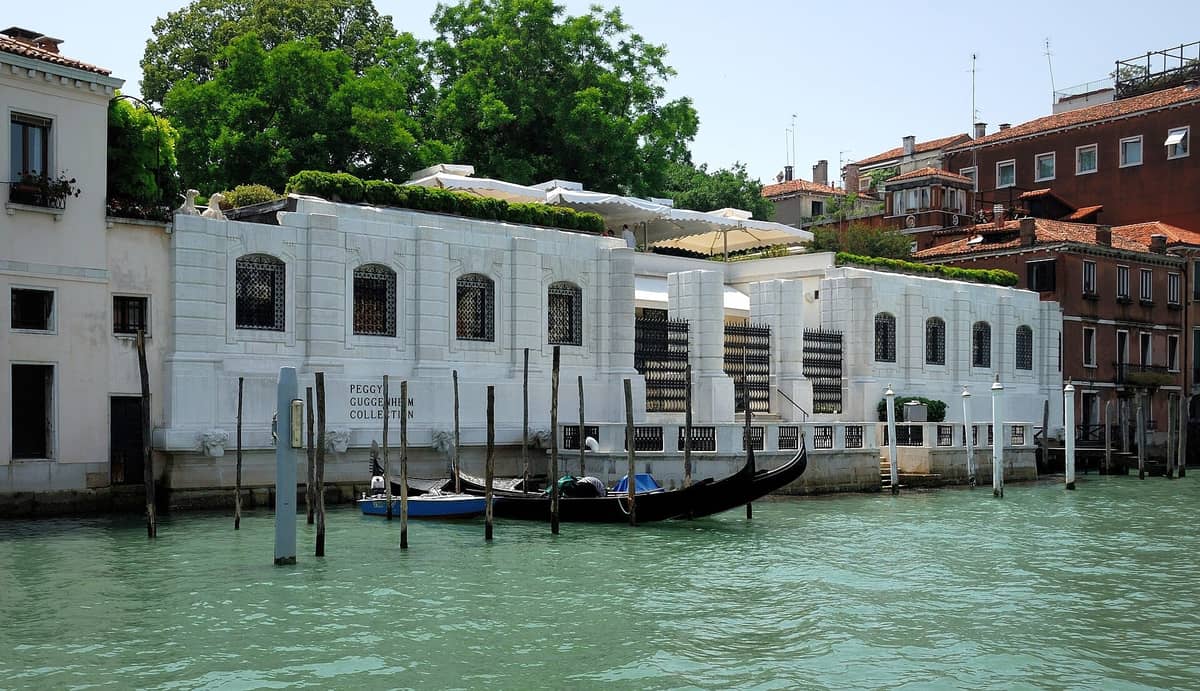
The Peggy Guggenheim Collection is not a vast encyclopedic institution. It is a focused, single-collector survey of modernism spanning roughly 1910 to 1970, arranged across a single-storey 18th-century palazzo that Peggy Guggenheim bought in 1949 and lived in until her death in 1979. That intimacy is the museum's defining quality: you are walking through someone's home, and the art was chosen by a person with genuine obsessive conviction, not a committee.
The collection concentrates on Cubism, Surrealism, and Abstract Expressionism, with major works by Picasso, Braque, Léger, Dalí, Ernst, Miró, Magritte, Mondrian, and Pollock. Jackson Pollock's early career was significantly shaped by Guggenheim's patronage, and several of his most historically important canvases are here. The museum also holds significant sculptures — Constantin Brancusi's bronze 'Bird in Space' and Marino Marini's equestrian figure on the canal terrace among the most-photographed. The collection was gifted by Guggenheim to the Solomon R. Guggenheim Foundation, which continues to operate it.
ℹ️ Good to know
Opening hours: Daily, 10:00–18:00. Closed Tuesdays and December 25. Last admission is at 17:00 and closing procedures begin at 17:50. The ticket office does not accept walk-ins after 17:00.
The Palazzo and Its Setting on the Grand Canal
Palazzo Venier dei Leoni is unusual even by Venetian standards. Construction began in 1749 but was never completed beyond the first storey, earning it the local nickname 'il palazzo nonfinito' (the unfinished palace). That low profile, unusual on a canal lined with three- and four-storey facades, is why the terrace commands such an unobstructed view of the Grand Canal. From the garden side, you approach through a quiet courtyard; from the water, the building barely rises above the fondamenta, and the Marino Marini sculpture appears almost level with passing gondolas.
The palazzo sits between two of Dorsoduro's most significant landmarks: the Accademia Bridge to the northwest and the Basilica di Santa Maria della Salute to the southeast. This position in Dorsoduro means the museum fits naturally into a longer cultural walk along the southern shore of the Grand Canal — one of Venice's most rewarding afternoon routes.
The terrace garden deserves more time than most visitors give it. Peggy Guggenheim is buried here, beside her beloved dogs, beneath a plain stone slab set into the garden floor. The garden holds a rotating selection of large-scale sculptures and is used for temporary exhibitions. In late afternoon, the canal light reaches the terrace at a low angle, and the garden takes on a quality that the interior rooms, pleasant as they are, cannot match.
Tickets & tours
Hand-picked options from our booking partner. Prices are indicative; availability and final rates are confirmed when you complete your booking.
Peggy Guggenheim Collection tickets
From 11 €Instant confirmationPeggy Guggenheim Collection tickets
From 16 €Instant confirmationPeggy Guggenheim Collection tickets
From 18 €Instant confirmationPeggy Guggenheim gallery and Sestiere Dorsoduro tour in Venice
From 75 €Instant confirmationFree cancellation
Moving Through the Collection: Room by Room
The museum is genuinely small. The main collection occupies roughly 23 rooms arranged in a loosely chronological and movement-based sequence. Signage is bilingual in Italian and English throughout. The rooms are scaled to a domestic palazzo, meaning ceilings are lower and spaces more intimate than in a purpose-built institution — which works well for the collection's scale and character, but can feel crowded during peak hours.
The Cubist rooms are logically the opening statement — Picasso's 'The Poet' (1911) establishes the analytic period clearly, while Léger and Braque represent the movement's breadth. The Surrealist galleries are the rooms most visitors spend the longest time in: Dalí's 'Birth of Liquid Desires,' Max Ernst's 'Attirement of the Bride,' and Magritte's 'Empire of Light' are all present, and each rewards slow looking rather than a quick pass.
The Pollock room is architecturally modest but historically significant. Several canvases from the early 1940s, before his poured technique fully developed, demonstrate the transition from Surrealist influence to what became Abstract Expressionism. For visitors with serious interest in Pollock's development, this room is more valuable than it first appears. The adjacent works by Mark Rothko and Franz Kline round out the American abstraction section.
💡 Local tip
Pick up a free floor plan at the entrance. The layout is not always intuitive and the room numbering in the audio guide differs from the physical sequence. Having the plan saves time and reduces backtracking.
Time of Day and Crowd Patterns
The museum is open daily except Tuesdays, which means Tuesday is the one day you cannot visit — plan accordingly if your Venice itinerary is short. Mornings from opening at 10:00 until around noon are consistently the quietest. The Surrealist galleries in particular, which draw the densest crowds in the afternoon, are comfortable and unhurried in the first two hours of the day.
By 13:00 to 15:00, tour groups from Piazza San Marco arrive in noticeable numbers, and the main rooms become congested enough that sustained looking at individual works becomes difficult. If you arrive in this window, the sculpture garden is a useful retreat — it stays comparatively uncrowded even at peak times. Late afternoon from 15:30 onward sees crowds thinning again, and the canal terrace is at its most atmospheric as the light shifts.
During Venice's busiest periods — late spring through summer, and Carnival in February — expect sustained high attendance throughout the day. Booking tickets online in advance is advisable during these periods, both to guarantee entry and to avoid queuing at the ticket window.
⚠️ What to skip
The museum closes on Tuesdays and December 25. Last admission is strictly at 17:00. Arriving at 16:45 gives you only 15 minutes before the ticket office closes, and staff begin directing visitors toward the exit from 17:50.
Getting There and Practical Navigation
The museum entrance is not directly on the Grand Canal waterfront. You approach from Calle San Cristoforo, a narrow calle behind the palazzo. Coming from the Accademia vaporetto stop (Line 1), cross the Accademia Bridge, turn left along the fondamenta, and follow the canal-side path for roughly three minutes until you see the museum signage. Coming from the Salute stop, walk northwest along the fondamenta for approximately five minutes.
For visitors building a full day in Dorsoduro, the Peggy Guggenheim Collection pairs naturally with the Gallerie dell'Accademia (a ten-minute walk) and the Punta della Dogana contemporary art space at the tip of Dorsoduro. Combining all three in a single day is possible but demanding — the Accademia alone justifies three to four hours for anyone serious about Italian painting.
There is no cloakroom for large luggage, so visitors with bulky bags may be asked to leave them at the entrance. The museum has a bookshop near the exit that carries one of the better selections of 20th-century art publications in Venice, along with exhibition catalogues and prints. There is also a small café in the garden area, most useful as a place to sit between the collection and the sculpture garden, though it has limited seating.
Accessibility, Photography, and What to Wear
The museum's single-storey layout makes most of the collection wheelchair accessible without the stair challenges common in older Venetian buildings. The sculpture garden has some uneven surfaces. The museum offers tactile tours for visitors with visual impairments — contact doppiosenso@guggenheim-venice.it to arrange in advance. For general information queries, reach the museum at info@guggenheim-venice.it or +39 041 2405 411; for visitor services, use visitorinfo@guggenheim-venice.it or +39 041 2405 440.
Photography without flash is permitted throughout the permanent collection rooms. The low domestic ceilings and the quality of natural light in certain rooms — particularly those facing the garden — make for genuinely good photographs of the art in context. The Marino Marini sculpture on the canal terrace is the single most photogenic spot in the museum: the bronze figure on horseback, arms outstretched, with the Grand Canal and Santa Maria della Salute in the background.
Venice's lagoon weather means the museum is a sensible option on rainy days. The best time to visit Venice for museum-going is generally autumn through early spring, when outdoor sites lose some of their appeal and the Guggenheim's indoor collection becomes proportionally more rewarding. Comfortable shoes matter: the walk from either vaporetto stop involves cobblestones and campo paving.
Is It Worth the Admission Price?
At around €17 for adults (verify current prices at guggenheim-venice.it), the Peggy Guggenheim Collection is competitively priced against Venice's major museum category. The collection is smaller than many visitors expect, and travelers who arrive hoping for the scale of a national gallery or a major American art museum may find it brief. The museum rewards people who come prepared: knowing something about Surrealism, Abstract Expressionism, or Guggenheim's collecting history significantly deepens the visit.
Travelers primarily focused on Venetian painting, Byzantine art, or the city's own history may find the Gallerie dell'Accademia or the Scuola Grande di San Rocco more satisfying. The Guggenheim's collection is resolutely international modernism and makes no attempt to connect with Venice's own artistic tradition — which is either exactly what you want, or a reason to look elsewhere.
What the museum does offer, beyond the art itself, is the setting: a morning spent in Palazzo Venier dei Leoni, moving between galleries and stepping into the garden to watch a water taxi pass on the Grand Canal, is a particular kind of pleasure that very few museums in the world can replicate. The combination of significant works and an extraordinary location makes this one of Venice's more defensible admissions fees.
Insider Tips
- Book tickets online via the official museum website before you arrive. The ticket window queue can add 20–30 minutes on busy mornings, and online booking costs the same as the door price.
- The Marino Marini sculpture on the canal terrace ('Angel of the City') originally featured a removable element that Guggenheim would switch based on whether dignitaries were visiting by boat. Ask at the information desk — staff enjoy discussing the story.
- The museum shop near the exit sells exhibition catalogues at the same price as the museum's online store. If you see a catalogue you want inside during the visit, you can buy it on the way out without returning to the galleries.
- If you are visiting the Gallerie dell'Accademia on the same day, do the Guggenheim first. The Accademia is larger and more taxing, and museum fatigue will affect how much attention you give to individual works in the Guggenheim's Surrealist rooms.
- The garden is open to all ticket holders and is free to re-enter during your visit. If the interior rooms are crowded, step outside and return — crowd density shifts noticeably within a 30-minute window.
Who Is Peggy Guggenheim Collection For?
- Modern art enthusiasts who want to see major Surrealist and Abstract Expressionist works in an intimate, non-institutional setting
- Architecture and design travelers interested in the unusual history of Palazzo Venier dei Leoni and its Grand Canal position
- Couples and adult pairs who want a quieter, more contemplative museum experience than Piazza San Marco's major attractions offer
- Rainy-day visitors looking for a full half-day cultural option with good indoor facilities and a café
- Travelers interested in Peggy Guggenheim as a biographical subject — the museum communicates her collecting history clearly throughout
Nearby Attractions
Other things to see while in Dorsoduro:
- Accademia Bridge (Ponte dell'Accademia)
The Ponte dell'Accademia is a wooden pedestrian bridge spanning the Grand Canal between San Marco and Dorsoduro. Free to cross at any hour, it delivers what many consider the most photographed canal view in Venice, with a sweeping upstream panorama toward the Rialto. It also sits at the heart of one of the city's most rewarding walking neighborhoods.
- Basilica di Santa Maria della Salute
Standing at the mouth of the Grand Canal where it meets St Mark's Basin, the Basilica di Santa Maria della Salute is one of the most recognizable silhouettes in Venice. Built as a vow to the Virgin Mary after the plague of 1630–1631, this baroque octagonal church took 56 years to complete and remains an active place of worship, a repository of significant art, and one of the finest viewpoints in the city.
- Ca' Rezzonico — Museum of 18th Century Venice
Ca' Rezzonico is a palazzo on the Grand Canal that houses the Museum of 18th-Century Venice. Three floors of frescoed ballrooms, lacquered furniture, Tiepolo paintings, and period pharmacy recreations make it one of the most immersive museum experiences in the city.
- Campo Santa Margherita
Campo Santa Margherita is the largest square in Dorsoduro and one of the few places in Venice where locals genuinely outnumber tourists. A flat, open campo ringed with cafes, a daily market, and a student-fueled nightlife scene, it offers a rare window into how Venetians actually use their city.