Punta della Dogana: Where Venice's Past Meets the Pinault Collection
A 17th-century customs house transformed into one of Europe's most ambitious contemporary art spaces, Punta della Dogana occupies the dramatic tip of Dorsoduro where the Grand Canal and Giudecca Canal converge. Even visitors who bypass the galleries will find the exterior and surrounding fondamenta among the most visually arresting spots in the city.
Quick Facts
- Location
- Dorsoduro 2, 30123 Venice — tip of Dorsoduro sestiere
- Getting There
- Vaporetto Line 1 or 2, stop: Salute (2-min walk); or Line 5.1 to Zattere (~10 min on foot)
- Time Needed
- 1–2 hours inside; 20–30 min for exterior and viewpoint
- Cost
- Combined ticket with Palazzo Grassi: verify current price at palazzograssi.it. Under-19 entry is free. Exterior/viewpoint is always free.
- Best for
- Contemporary art lovers, architecture enthusiasts, photographers, anyone chasing landmark lagoon views
- Official website
- www.palazzograssi.it
What Is Punta della Dogana?
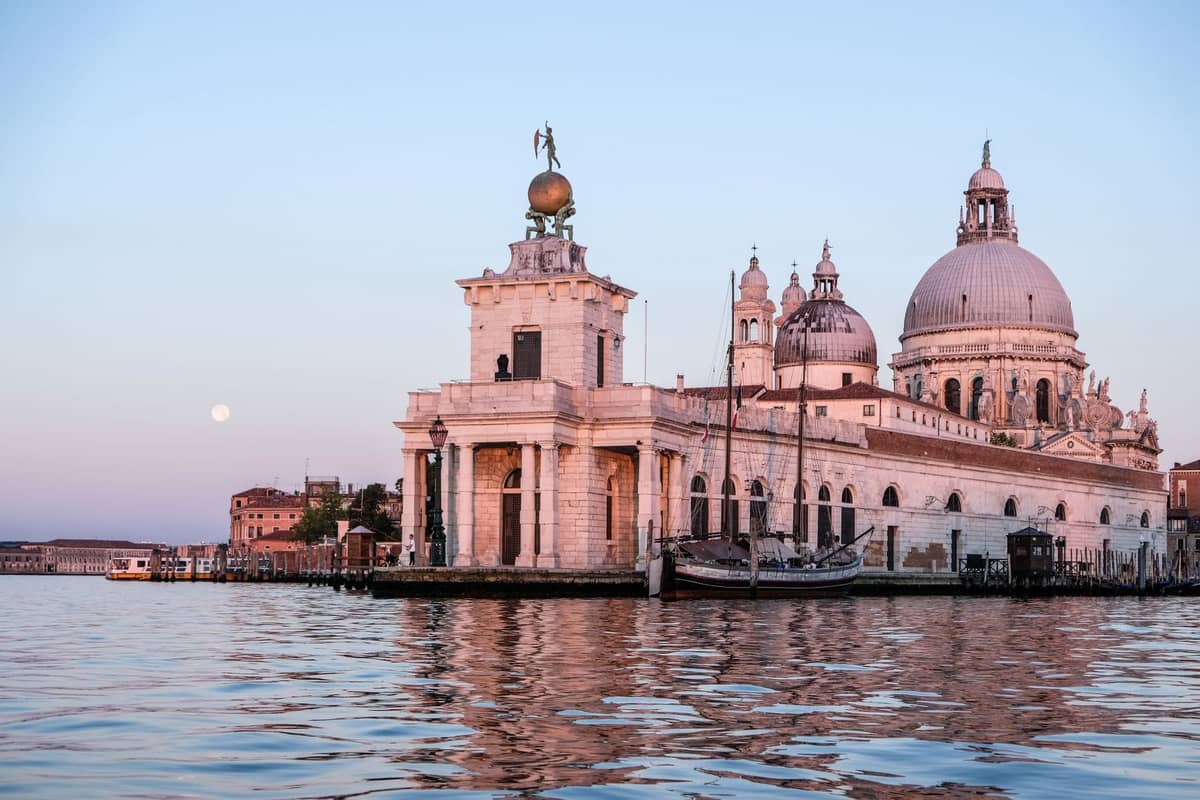
Punta della Dogana, formally the Punta della Dogana – Centro d'Arte Contemporanea, Pinault Collection, occupies one of the most geographically loaded spots in Venice. The triangular customs warehouse stands at the exact point where the Grand Canal sweeps into the Giudecca Canal, with the San Marco basin spreading out ahead. On three sides, water. On the fourth, the tree-lined approach to the Basilica di Santa Maria della Salute. The building is impossible to miss from a vaporetto, and that prominence is precisely what makes it so compelling — both as a landmark and as a place worth entering.
The structure dates to the late 17th century, built between 1677 and 1682 by architect Giuseppe Benoni to replace an earlier customs facility that had handled sea trade since the early 1400s. The Republic of Venice was still a major commercial power at that point, and goods arriving by ship had to be declared and taxed here before entering the city. The long, low warehouses with their distinctive triangular plan were a deliberate statement: authority, order, control over the wealth flowing through the lagoon. The building served as the Dogana da Mar until the 1980s, after which it sat largely unused for nearly three decades.
In 2009, French billionaire collector François Pinault — who had previously acquired Palazzo Grassi on the Grand Canal — reopened Punta della Dogana as a contemporary art centre after a sensitive renovation by Japanese architect Tadao Ando. The transformation is careful and deliberate: Ando stripped the interior back to raw brick and introduced his signature concrete insertions without erasing the building's mercantile bones. The result is a space that feels simultaneously ancient and surgical.
The Exterior: A Viewpoint Worth Seeking Out on Its Own
Before you even consider a ticket, walk to the very tip of Dorsoduro. The prow-like point, topped by a golden globe and two bronze Atlas figures supporting a weather vane, is one of Venice's defining silhouettes. It appears in countless paintings and photographs, but experiencing it at ground level is different: the wind comes in off the lagoon, the smell of salt and diesel from passing water taxis mingles with the cooler air drifting from the water, and the noise of San Marco — just across the basin — feels surprisingly distant.
The surrounding fondamenta is public and freely accessible at all hours. Early morning, before 8:00, the area is almost entirely empty except for local joggers and the occasional delivery boat. This is when the light is best for photography: the low sun catches the facade of San Giorgio Maggiore directly across the water, and the Salute dome behind you glows in a way that afternoon haze often obscures. For more information on where to find views like this across the city, the guide to the best views in Venice covers the full range of vantage points, from campanile tops to waterfront promenades.
💡 Local tip
The fondamenta around Punta della Dogana is one of the few spots in Venice where you can sit on the stone edge looking directly across at the San Marco basin without paying for a cafe seat. Bring a coffee from a bar on the Zattere and take your time.
Tickets & tours
Hand-picked options from our booking partner. Prices are indicative; availability and final rates are confirmed when you complete your booking.
Murano, Burano and Torcello day tour from Punta Sabbioni
From 30 €Instant confirmationFree cancellationVenice lagoon boat transfer from Punta Sabbioni
From 15 €Instant confirmationFree cancellationVenice panoramic boat tour at sunset from Punta Sabbioni
From 35 €Instant confirmationFree cancellationVenice, Murano and Burano day tour from Punta Sabbioni
From 0 €Instant confirmationFree cancellation
Inside the Museum: The Pinault Collection in Context
The Pinault Collection is one of the most significant private contemporary art collections in the world, and Punta della Dogana functions as its Venice satellite alongside Palazzo Grassi. The holdings run heavily toward post-1980 work — artists such as Cindy Sherman, Jeff Koons, Marlene Dumas, Takashi Murakami, and Luc Tuymans have all featured in past exhibitions — though the specific shows rotate and the collection is never displayed in its entirety at any one time. This matters practically: what you see on any given visit depends entirely on the current exhibition program, so checking palazzograssi.it before you go is essential, not optional.
Tadao Ando's intervention inside the building is itself worth study for architecture enthusiasts. He used poured concrete walls to create a series of defined circulation paths through the long warehouse spaces, letting natural light fall through skylights and high windows onto both the raw brick walls and the art below. The contrast between Benoni's 17th-century masonry and Ando's minimalist concrete is never accidental: the two systems of construction are placed in deliberate dialogue. Where the building's original timber beams remain, they are exposed. Where Ando inserted new elements, the material difference is stated clearly.
The galleries are divided across two main floors. Ground-level rooms tend to handle larger installations, while upper rooms carry painted and photographic work. A combined ticket covers both Punta della Dogana and Palazzo Grassi, which is the stronger curatorial choice if you have a full afternoon: the two venues often run complementary exhibitions, and the contrast between the Grassi's Grand Canal palazzo setting and the Dogana's stripped-back customs warehouse gives the same collection very different atmospheres.
ℹ️ Good to know
Opening hours are generally Monday to Sunday, 10:00–19:00, with last admission at 18:00. The museum is typically closed on Tuesdays, and some sources note possible winter closures. Always verify current hours at palazzograssi.it before visiting, as seasonal programs can alter the schedule.
How the Experience Changes by Time of Day
Morning visits, particularly midweek before noon, offer the quietest experience inside the galleries. The exhibition rooms are large enough that even moderate crowds feel dispersed, but the approach from the Salute vaporetto stop fills with group tours by mid-morning. If you arrive at opening time on a weekday, you will often have the first rooms largely to yourself for thirty to forty minutes.
Late afternoon is when the exterior becomes genuinely theatrical. The light shifts to a warm orange that picks out the patina on the bronze Atlas figures and turns the water in the Giudecca Canal a deep green-gold. The Zattere promenade, running along the south side of Dorsoduro, fills with locals in the early evening, and the fondamenta around the Dogana point becomes a natural gathering spot before dinner. If you are not visiting the museum, this is the ideal time to be outside.
Weather has a real effect here. On grey winter days, the lagoon takes on a pewter quality that flattens distances and makes the far shore of the Giudecca almost dissolve into the sky. In summer, direct afternoon sun on the water creates glare that can make the exterior uncomfortable between roughly 12:00 and 15:00. Autumn is the most variable season: beautiful clear light one morning, acqua alta flooding the next. The fondamenta at the point sits low, and in high-water events the area can be partially submerged.
Getting There and Moving On
The most direct approach is vaporetto Line 1 to the Salute stop, which deposits you in front of the Salute basilica; from there, a two-minute walk along the fondamenta brings you to the Dogana point. Alternatively, Line 5.1 to Zattere B leaves you at the southern edge of Dorsoduro, from which the walk east along the Zattere promenade to the Dogana tip takes roughly ten minutes and passes some of the sestiere's quieter waterfront cafes.
Dorsoduro rewards time spent beyond the Dogana itself. The Peggy Guggenheim Collection is a ten-minute walk along the Grand Canal fondamenta, and the Gallerie dell'Accademia — Venice's primary museum of pre-20th-century Venetian painting — is only slightly further. Together, the three institutions make a full day's cultural itinerary covering five centuries of art without leaving the sestiere.
💡 Local tip
If you plan to visit both Punta della Dogana and Palazzo Grassi in one day, start at the Dogana in the morning (when it is quieter) and make your way up the Grand Canal to Palazzo Grassi in the afternoon. The journey by vaporetto Line 1 between the two venues takes about 15–20 minutes and passes some of the Grand Canal's most impressive palazzo facades.
Photography, Practicalities, and Who Should Reconsider
Photography policies inside the museum change with each exhibition — some shows permit non-flash photography, others restrict it entirely for rights reasons. Check the current policy on arrival. Outside, there are no restrictions, and the point of Dorsoduro is one of the most photographically rewarding spots in the city. A wide-angle lens or a phone with a wide mode handles the three-direction water views comfortably; a longer focal length picks out architectural details on the San Giorgio Maggiore church directly across the basin.
Accessibility within the museum relies on ramps and a lift to reach upper floors, though visitors with specific mobility requirements should contact the venue directly before visiting, as the historic structure imposes some constraints. The exterior fondamenta is paved stone and generally level, though uneven in sections. There are a few steps between the vaporetto landing at Salute and the Dogana point.
Who might reasonably skip the interior: visitors with limited time whose primary interest is in Venice's historic art and architecture rather than international contemporary work. The Pinault Collection is serious and often challenging — it is not a crowd-pleasing greatest-hits survey. Visitors expecting a traditional Italian museum experience, or those drawn more to Venetian painting, will find the Gallerie dell'Accademia a better use of two hours. The exterior and viewpoint, however, cost nothing and deserve a stop regardless of whether the galleries appeal.
Fitting Punta della Dogana Into Your Venice Itinerary
Punta della Dogana fits naturally into a Dorsoduro walking day. The sestiere has a lower daily visitor volume than San Marco and is noticeably calmer in the late morning, making it a sensible choice for the middle portion of a trip when San Marco fatigue sets in. The area around Campo Santa Margherita, a twenty-minute walk north, has some of the best value eating and drinking in the historic city and makes a logical lunch stop before or after visiting the Dogana.
If you are working through a broader Venice itinerary, the guides to 2 days in Venice and the best museums in Venice both position the Dogana within the context of the city's wider cultural offer, which helps with prioritization when time is short.
Insider Tips
- The combined Punta della Dogana and Palazzo Grassi ticket is the better value if you have a full day, but if the current Dogana exhibition does not interest you, buy a single-venue ticket at Palazzo Grassi instead — the shows are not always complementary.
- The Salute vaporetto stop is almost always crowded by 10:30. If you walk from the Zattere B stop along the southern fondamenta instead, you approach the Dogana from the less-trafficked side and get a longer view of the building's facade before reaching the tip.
- The bronze globe and Atlas figures at the tip are most striking from the water. If you are taking a vaporetto or water taxi past, look back toward the Dogana as you pass the point — the three-dimensional composition of globe, figures, and Salute dome behind is better from the canal than from land.
- The museum bookshop stocks a well-curated selection of monographs and exhibition catalogues, including some out-of-print Pinault Collection titles not easily found elsewhere. Worth browsing even if you bypass the galleries.
- Winter visits to the exterior at dusk, when acqua alta lights are active along the fondamenta and the Salute is lit from below, produce photographs that look nothing like the typical summer postcard version of this view.
Who Is Punta della Dogana For?
- Contemporary art enthusiasts wanting to engage seriously with one of Europe's strongest private collections
- Architecture followers interested in Tadao Ando's approach to adaptive reuse in a historic building
- Photographers seeking the classic Venice three-way water view at the convergence of the Grand Canal and Giudecca Canal
- Travelers planning a full Dorsoduro cultural day combining the Dogana, Peggy Guggenheim, and the Gallerie dell'Accademia
- Anyone who wants a free, world-class viewpoint without a queue or an entry fee
Nearby Attractions
Other things to see while in Dorsoduro:
- Accademia Bridge (Ponte dell'Accademia)
The Ponte dell'Accademia is a wooden pedestrian bridge spanning the Grand Canal between San Marco and Dorsoduro. Free to cross at any hour, it delivers what many consider the most photographed canal view in Venice, with a sweeping upstream panorama toward the Rialto. It also sits at the heart of one of the city's most rewarding walking neighborhoods.
- Basilica di Santa Maria della Salute
Standing at the mouth of the Grand Canal where it meets St Mark's Basin, the Basilica di Santa Maria della Salute is one of the most recognizable silhouettes in Venice. Built as a vow to the Virgin Mary after the plague of 1630–1631, this baroque octagonal church took 56 years to complete and remains an active place of worship, a repository of significant art, and one of the finest viewpoints in the city.
- Ca' Rezzonico — Museum of 18th Century Venice
Ca' Rezzonico is a palazzo on the Grand Canal that houses the Museum of 18th-Century Venice. Three floors of frescoed ballrooms, lacquered furniture, Tiepolo paintings, and period pharmacy recreations make it one of the most immersive museum experiences in the city.
- Campo Santa Margherita
Campo Santa Margherita is the largest square in Dorsoduro and one of the few places in Venice where locals genuinely outnumber tourists. A flat, open campo ringed with cafes, a daily market, and a student-fueled nightlife scene, it offers a rare window into how Venetians actually use their city.