Campo Santa Margherita: Venice's Most Authentic Public Square
Campo Santa Margherita is the largest square in Dorsoduro and one of the few places in Venice where locals genuinely outnumber tourists. A flat, open campo ringed with cafes, a daily market, and a student-fueled nightlife scene, it offers a rare window into how Venetians actually use their city.
Quick Facts
- Location
- Dorsoduro, Venice, Italy (Campo Santa Margherita, 30123)
- Getting There
- Vaporetto: Ca' Rezzonico (Line 1) or San Basilio (Line 2) – both about a 5–7 minute walk away
- Time Needed
- 30 minutes to browse; 2+ hours if you sit, eat, or explore side streets
- Cost
- Free to enter – a public square, open 24 hours
- Best for
- Local atmosphere, outdoor dining, people-watching, morning markets
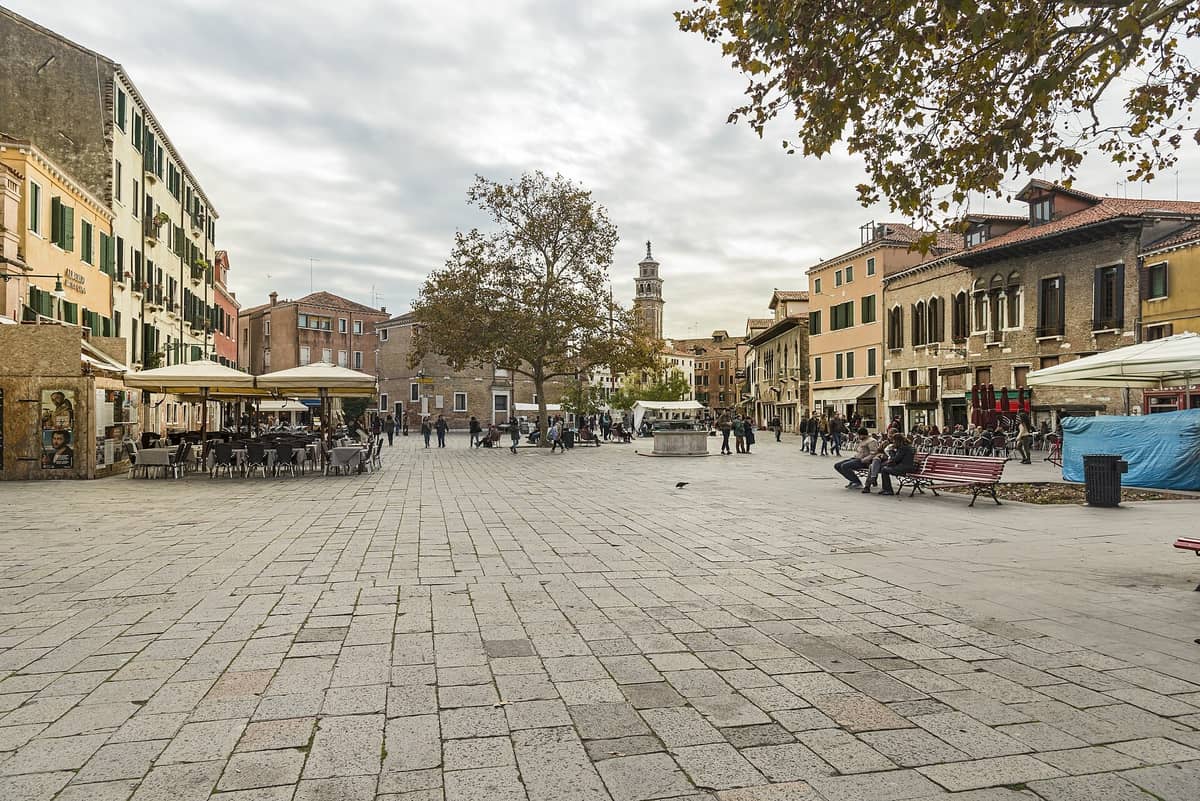
What Campo Santa Margherita Actually Is
Campo Santa Margherita is a public square in the Dorsoduro sestiere of Venice, roughly 8,045 square metres in area, making it one of the largest campi on the historic island. Unlike Piazza San Marco, which is primarily a monument to Venetian grandeur, this campo functions as a genuine neighbourhood hub: fishmongers set up in the morning, students from the nearby Ca' Foscari University gather in the afternoon, and the bar terraces fill right through to late evening.
The square sits in a part of Dorsoduro that rewards unhurried exploration. The Ca' Rezzonico museum and the Gallerie dell'Accademia are both within a ten-minute walk, making Campo Santa Margherita a natural anchor for a half-day circuit through Dorsoduro.
💡 Local tip
Arrive before 9:00 AM if you want to see the daily market at its fullest: fruit and vegetable stalls, a fish vendor, and a handful of other traders set up along the central spine of the campo. By late morning much of this activity has wound down.
History Compressed Into One Square
The campo takes its name from the Church of Santa Margherita, consecrated in 853 AD. The church was later deconsecrated and has since served various civic purposes; today it functions as an auditorium for Ca' Foscari University. Its truncated bell tower – shortened at some point in its history – still stands at the northern end of the square and gives the campo its most distinctive vertical accent. The rough-hewn stonework of the tower contrasts with the more ornate Gothic and Renaissance facades of the palazzi lining the perimeter.
The square's present form dates largely from the second half of the 19th century, when several canals that originally fed into it were filled in or covered. This is why the campo feels so unusually spacious by Venetian standards: beneath the paving stones, old watercourses were essentially buried to create the broad, open floor that now makes it so useful as a social space. A small scuola (confraternity building) also borders the campo, a reminder that Venice's civic and religious organisations once used these spaces as intensively as any modern community centre.
Tickets & tours
Hand-picked options from our booking partner. Prices are indicative; availability and final rates are confirmed when you complete your booking.
Doge's Palace skip-the-line tour
From 67 €Instant confirmationFree cancellationVenice Legends, Anecdotes and Ghost Stories Tour
From 35 €Instant confirmationFree cancellationGhosts and legends tour of Venice
From 29 €Instant confirmationFree cancellationSkip-the-line guided tour of Doge's Palace and Saint Mark's Basilica
From 106 €Instant confirmationFree cancellation
How the Campo Changes Through the Day
Morning is the most practical hour. The market stalls are operating, the light is low and clear, and the campo belongs largely to local residents collecting provisions and cafe owners stacking chairs. The smell of fresh produce and salt water drifts through together – the canal network is close enough that you catch it on the breeze. Sparrows work the ground between the stalls while cats patrol the perimeter walls.
By late morning and lunchtime, the university population asserts itself. Ca' Foscari students take up the benches and the lower steps of the old church entrance, eating lunch from nearby bakeries and pizzerias by the slice. The outdoor seating at the square's several bars fills steadily, and the acoustics of the open campo mean you hear a gentle, layered noise: conversation, chair legs on stone, the occasional wheeled trolley from a delivery boat nearby.
Evenings here have a character you won't find in the tourist-heavy zones around San Marco. Groups spill out from bars with glasses of spritz (the aperol or select version is standard in Venice), and in warmer months the campo itself becomes an extension of the bars, with people standing and talking across a wide radius. Noise carries, and after 22:00 it can feel genuinely lively in a way that surprises visitors expecting Venice to be entirely quiet after dark. If you have an early start the next day or a preference for calm evenings, the square after 21:00 in summer is not the place for quiet reflection.
⚠️ What to skip
The square is ringed by residential buildings. Late-night noise from bar terraces has historically been a point of friction between bar owners and residents. Be aware that local regulations on outdoor serving hours can change; verify current hours with specific bars before planning a late evening.
Walking the Perimeter: What to Look For
The square rewards a slow walk around its edges. On the western side, several palazzi retain their original Gothic window tracery, with the deep-set arched openings that characterise Venetian domestic architecture from the 14th and 15th centuries. Ground-floor units are occupied by a mix of small shops, osterie (traditional wine bars), and the kind of unpretentious neighbourhood restaurants that are increasingly rare in the more visited parts of the city.
At the southern end, look for the small scuola building with its carved relief above the doorway – a saint's figure set against a simple architectural frame. These confraternity buildings are everywhere in Venice but easy to miss; at Campo Santa Margherita, the intimate scale of the campo means you're naturally close enough to read the carving without craning your neck.
Photography here is most productive in the first two hours after sunrise, when the long, flat light throws the texture of the paving stones into relief and the campo is nearly empty. The truncated bell tower photographs well from the southern end of the square, framed against whatever sky the morning offers. Avoid midday, when overhead light flattens the stone and shadows disappear.
💡 Local tip
For one of Venice's better aperitivo experiences without tourist markup, sit at one of the bar terraces on the campo's western side in the early evening and order a spritz or a glass of local white wine. Cicchetti (small bar snacks) are usually available alongside drinks.
Getting There
The most direct vaporetto stop is Ca' Rezzonico on ACTV Line 1, which runs the full length of the Grand Canal. From the stop, follow Calle dei Traghetti and the signs for Dorsoduro; the walk takes around five minutes. From Piazzale Roma (the main bus and car terminus), the walk along Rio Novo towards Accademia takes approximately ten to twelve minutes. From the Rialto, allow around twenty to twenty-five minutes on foot via San Polo and the area around the Frari.
There is no vaporetto stop directly at the campo, which is part of why it stays comparatively quieter than waterfront squares. The few minutes of walking through narrower calli acts as a natural filter on casual tourist traffic.
The square itself is flat and paved, with no steps to access the open space. The former church (now university auditorium) has a main entrance with two steps and there is a secondary entrance near Ponte di San Pantalon with a ramped access point. For travellers with mobility requirements, the campo's main open area presents no significant obstacles, though the surrounding alleyways vary in surface quality.
What Campo Santa Margherita Is Not
It would be misleading to frame this square as a purely photogenic Venetian set piece. It has no world-class monument at its centre, no famous painting to track down. The Church of Santa Margherita is closed to general visitors as a functioning church. If you are working through Venice's major cultural institutions on a tight schedule, this campo is not where you'll find the next tick on a checklist.
What it offers instead is context. Spending an hour here gives you a baseline sense of how daily Venetian life is actually structured: the market economy, the university population, the aperitivo ritual, the way a campo functions as both corridor and destination simultaneously. For travellers interested in the texture of the city rather than just its highlights, this is worth more than a second visit to Piazza San Marco. For travellers who want to maximise iconic sights per hour, it is frankly skippable.
If you want to understand Venice's food culture more broadly, the morning market here pairs naturally with a later visit to the Rialto Market, which operates on a larger scale and includes a more extensive fish market. For a deeper sense of how Venetians eat and drink informally, the cicchetti culture of Venice is worth understanding before you arrive.
Insider Tips
- The fish stall on the campo operates in the mornings only and typically sells whatever came in fresh that day; it's one of the few remaining market vendors in a campo that once had a much more extensive market tradition.
- If the bar terraces on the campo are full in the evening, the narrow calle just off the southwestern corner has a small wine bar with outdoor standing room that locals use as an overflow.
- The truncated bell tower of the former church casts a long shadow across the northern end of the campo in the late afternoon; positioning yourself in that shadow gives you cooler viewing in summer without retreating to an indoor space.
- Ca' Foscari University's auditorium (the former church) occasionally hosts free or low-cost public lectures and cultural events; check their programme if your visit coincides with the academic term.
- Acqua alta rarely reaches serious levels in this part of Dorsoduro, but the campo's paving can become slippery during wet autumn weather. Rubber-soled shoes are a practical choice, not a style suggestion.
Who Is Campo Santa Margherita For?
- Travellers wanting a break from the tourist circuit and a look at genuine neighbourhood life
- Food and market enthusiasts visiting in the morning for fresh produce
- Architecture observers interested in Venetian Gothic domestic buildings outside the obvious monuments
- Students and younger travellers looking for affordable aperitivo and a relaxed evening atmosphere
- Photographers seeking early-morning light on a large, quiet campo before the city wakes up
Nearby Attractions
Other things to see while in Dorsoduro:
- Accademia Bridge (Ponte dell'Accademia)
The Ponte dell'Accademia is a wooden pedestrian bridge spanning the Grand Canal between San Marco and Dorsoduro. Free to cross at any hour, it delivers what many consider the most photographed canal view in Venice, with a sweeping upstream panorama toward the Rialto. It also sits at the heart of one of the city's most rewarding walking neighborhoods.
- Basilica di Santa Maria della Salute
Standing at the mouth of the Grand Canal where it meets St Mark's Basin, the Basilica di Santa Maria della Salute is one of the most recognizable silhouettes in Venice. Built as a vow to the Virgin Mary after the plague of 1630–1631, this baroque octagonal church took 56 years to complete and remains an active place of worship, a repository of significant art, and one of the finest viewpoints in the city.
- Ca' Rezzonico — Museum of 18th Century Venice
Ca' Rezzonico is a palazzo on the Grand Canal that houses the Museum of 18th-Century Venice. Three floors of frescoed ballrooms, lacquered furniture, Tiepolo paintings, and period pharmacy recreations make it one of the most immersive museum experiences in the city.
- Gallerie dell'Accademia
The Gallerie dell'Accademia is the world's most important repository of Venetian painting, spanning five centuries of art from the Gothic period through the 18th century. Set in a converted monastery complex in Dorsoduro, this is the one art museum in Venice that genuinely rewards dedicated time rather than a quick walk-through.