Piazza San Marco: Venice's Grand Civic Stage
Piazza San Marco is the ceremonial center of Venice, flanked by the Basilica, the Doge's Palace, and two towering colonnaded wings. It is free to enter, open at all hours, and one of the most architecturally layered public spaces in Europe. Knowing when to arrive makes all the difference.
Quick Facts
- Location
- San Marco sestiere, Venice, Italy
- Getting There
- Vaporetto: San Zaccaria (lines 1, 4.1, 4.2) or San Marco Vallaresso (line 1, 2)
- Time Needed
- 1–3 hours for the square; half a day if visiting surrounding monuments
- Cost
- Free to enter the square; surrounding monuments charge separately
- Best for
- First-time visitors, architecture, photography, early-morning walks
- Official website
- www.veneziaunica.it
What Piazza San Marco Actually Is
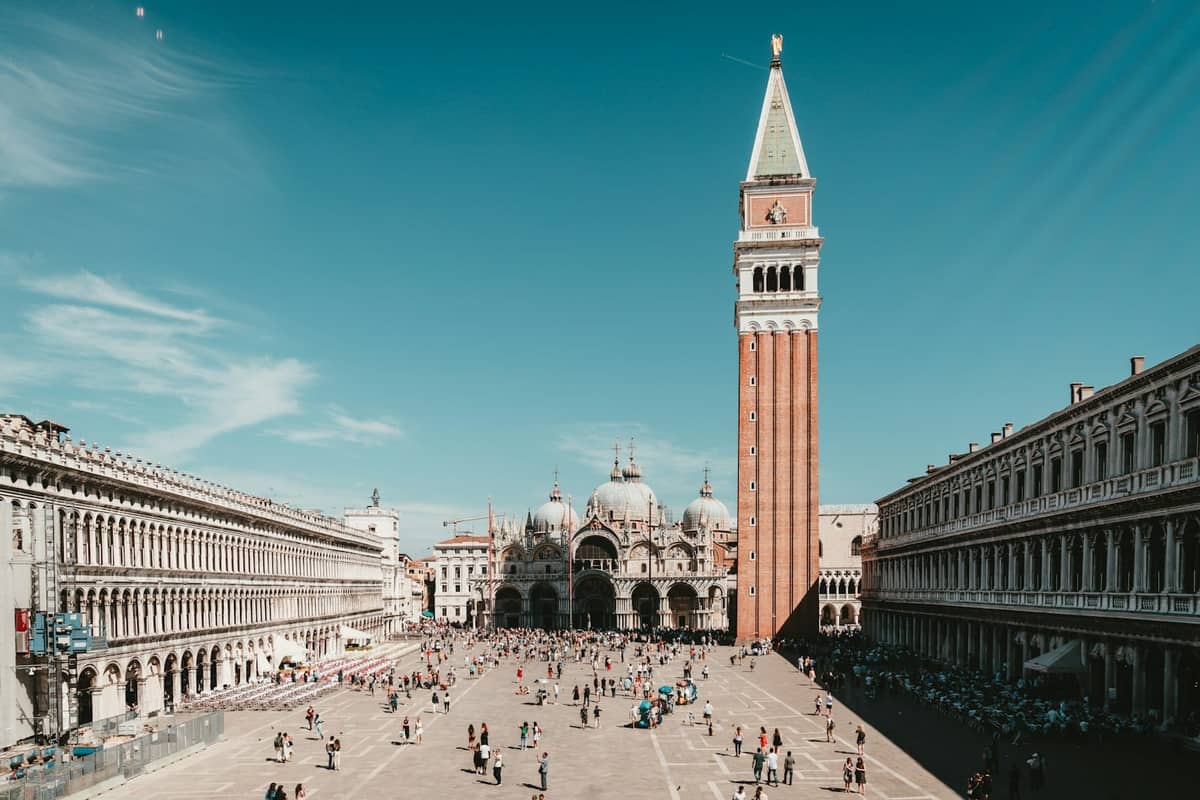
Piazza San Marco is the only space in Venice officially called a 'piazza'. Every other public square in the city carries the humbler designation 'campo'. That linguistic distinction is not accidental: this is the city's formal seat of power, its processional arena, and its window onto the lagoon. Stretching roughly 170–175 meters in length and 82 meters across at its widest point, the square is large enough to feel genuinely monumental even when it is busy.
The square's origins trace back to the 9th century, when it served as the forecourt to the first Basilica of San Marco. The layout visitors see today largely dates from medieval and early modern alterations and was substantially reshaped again around 1807 under Napoleonic rule, and the distinctive grey trachyte paving was laid approximately a century after that. Over the following centuries, the three arcaded wings of the Procuratie buildings were added, giving the square its enclosed, theatrical quality. Napoleon, who entered Venice in 1797, reportedly called it “the drawing room of Europe”, though he also demolished one end of it to build a ballroom.
💡 Local tip
Arrive before 8:00 AM to experience the square without the midday crush. In the early morning, the light hits the gold mosaics of the Basilica at a low angle, and the only sounds are pigeons and the distant echo of a vaporetto.
The Architecture Around You
Standing in the center of the square, the buildings form a deliberate hierarchy. To the east, the Basilica di San Marco dominates with its five portal arches, gilded mosaics, and four bronze horses (replicas; the originals are inside). The facade is a layered accumulation of materials looted and imported across centuries: Syrian columns, Egyptian granite, Venetian-Byzantine goldwork. It looks like no single architectural period because it genuinely represents several.
Immediately to the south of the Basilica stands the Doge's Palace, its lower arcade of white Istrian stone giving way to a salmon-pink piano nobile above. The effect is an inversion of conventional structural logic, with the heavier visual mass sitting on top of delicate Gothic columns, and it remains striking no matter how many photographs you have seen of it.
The long flanking buildings, the Procuratie Vecchie on the north side and the Procuratie Nuove on the south, were built across roughly two centuries. They house the upper arcade that gives the square its colonnaded rhythm. At the western end, the Ala Napoleonica closes the square. Beneath the arcades on the south side, the historic Caffè Florian has operated since 1720, making it one of the oldest continuously operating coffee houses in Italy. Expect to pay several times the standard price for a coffee served with live music, and to feel entirely fine about it.
The square connects at its southeastern corner to the smaller Campanile of San Marco, the brick bell tower that was rebuilt in 1912 after the original collapsed without warning in 1902. At about 98.6 meters, it remains among the tallest structures in Venice and offers one of the best elevated views of the city.
Tickets & tours
Hand-picked options from our booking partner. Prices are indicative; availability and final rates are confirmed when you complete your booking.
Alilaguna transport from Marco Polo Airport to Venice city centre
From 15 €Instant confirmationPrivate speed boat transfer from Marco Polo Airport to Venice
From 300 €Instant confirmationFree cancellationSelf-guided Discovery Walk in Venice's Castello and San Marco
From 28 €Instant confirmationFree cancellationAlilaguna transport from Marco Polo Airport to Venice city centre
From 27 €Instant confirmation
How the Square Changes Through the Day
The square operates on a rhythm that most visitors arrive too late to appreciate. Before 8:00 AM, it belongs to early-rising locals, delivery workers crossing on foot with trolleys, and photographers with tripods. The paving stones are damp and reflective, and the Basilica's mosaics glow with almost no one blocking the view. This is when the square makes its best case for itself.
By 10:00 AM in peak season, the first cruise ship groups have arrived and the density increases sharply. By noon, the square can feel less like a public space and more like a transit corridor with monuments on each side. The famous pigeons, once deliberately fed and now officially discouraged, are still present in significant numbers and tend to congregate around visitors who hesitate near food.
Late afternoon brings a second spike in visitor numbers as day-trippers try to fit in the square before returning to the mainland. After 6:00 PM, the tone changes. The tour groups thin out, the light over the lagoon turns amber, and the outdoor orchestras at Florian and Quadri begin their evening sets. If the weather is clear, staying through dusk costs nothing and the square is considerably more pleasant than it was four hours earlier.
⚠️ What to skip
In autumn and early winter, Piazza San Marco is one of the first areas in Venice to flood during 'acqua alta' events, as it sits at one of the city's lowest points. Temporary raised walkways (passerelle) are installed during high-water alerts. Check the city's real-time acqua alta alerts before visiting in October through February.
Acqua Alta and the Square's Relationship with Water
Because Piazza San Marco sits near sea level and is directly adjacent to the lagoon, it floods more frequently than almost any other part of the city. During significant acqua alta events, the square can be covered with up to around 60 centimeters of water. The city's MOSE barrier system is now activated during sustained high tides to reduce flooding, but the square remains vulnerable to moderate tidal events that fall below the MOSE activation threshold. For more on how to navigate this, the acqua alta guide covers what to expect and what to bring.
A flooded Piazza San Marco has its own visual appeal, and some visitors find it genuinely memorable. The reflections of the Basilica in still water can be extraordinary. But it does require waterproof boots or rubber overshoes to move around comfortably, and access to some monuments may be restricted during heavy flooding events.
What to Actually Do in the Square
The square itself is free to enter and requires no ticket. You can walk its full length, sit on the steps near the Campanile, and study the Basilica facade without spending a euro. The monuments surrounding it each charge separately: general admission to St Mark's Basilica is paid (typically about €3–€10 depending on ticket type and time of day — check the official site for current prices), and access to the Pala d'Oro, the Treasury, and the Museo Marciano (where the original bronze horses are kept) may require additional tickets. The Doge's Palace has a full admission fee and is worth budgeting serious time for.
The Campanile charges admission for the elevator ride to the top, and it offers one of the clearest panoramic views of the city's rooftop geography, the surrounding lagoon, and on clear days, the Dolomites to the north. For a more detailed look at the city's best elevated viewpoints, see the guide to best views in Venice.
The Museo Correr, which occupies much of the Procuratie Nuove and the Ala Napoleonica, is frequently overlooked by visitors focused on the Basilica and Doge's Palace. It covers Venetian civic history, holds a significant painting collection, and tends to be far less crowded than the headline attractions, making it a good option in the middle of the day when the square is at its most congested.
Getting There and Getting Around
There is no road access to the San Marco district; all arrivals are on foot or by water. The most direct vaporetto stop for the square is San Marco Vallaresso (line 1 or 2), which deposits you at the waterfront just a two-minute walk from the square's western entrance via the Piazzetta. The San Zaccaria stop, served by several lines including 1, 4.1, and 4.2, is a slightly longer walk along the Riva degli Schiavoni but usefully avoids the waterfront crowds around the main landing stage.
From Santa Lucia train station, the most practical approach is vaporetto line 1 along the Grand Canal, which stops at San Marco Vallaresso after roughly 35 to 40 minutes. Walking the entire route through the city's alleys takes around 30 to 40 minutes from the Rialto area and is a reasonable option if you want to see the city on foot rather than from the water.
ℹ️ Good to know
The square is flat and its main perimeter is generally accessible to wheelchair users. However, the Piazzetta connecting it to the waterfront and surrounding bridges can present obstacles. The Basilica and Doge's Palace have their own accessibility provisions; check directly with each monument before visiting if mobility is a consideration.
Photography in the Square
The most commonly photographed angle of the Basilica is from the center of the square, looking east along the long axis. This shot works best in early morning or late afternoon when the gold mosaics catch warm light and the shadow lines across the facade are defined rather than flat. At midday in summer, the Basilica facade faces into direct overhead light, which tends to wash out the detail in the mosaics.
The Piazzetta, the smaller sub-space connecting the main square to the lagoon waterfront, offers a frame of the Doge's Palace against the water with the island of San Giorgio Maggiore in the background. The two granite columns at the waterfront end, one topped with the Lion of Saint Mark and the other with Saint Theodore, make a natural foreground for wide shots looking south toward the lagoon. Early morning is again the most productive time: by mid-morning the waterfront is heavily trafficked and the quality of available shots drops considerably.
Insider Tips
- The Musei di Piazza San Marco combined ticket grants access to the Doge's Palace along with Museo Correr and related museums. If you plan to visit both, buy the combined pass rather than separate tickets at each monument.
- The covered arcades around the square provide shelter during rain without requiring you to leave. If a sudden storm breaks, the café umbrellas outside will collapse within seconds, but the Procuratie arcades are wide enough to wait out most showers.
- If you want to sit without paying café prices, the steps around the base of the Campanile are a legitimate resting spot. Seating on the square pavement itself has been subject to fines in certain circumstances under local regulations, so a fixed structure like the steps is a safer bet.
- The Basilica's interior is dimly lit and photographed poorly on auto-settings. If you want usable interior photographs, bring a camera that handles low light well, or accept that the interior visit is better experienced in person than through a lens.
- The clock tower on the north side of the square, the Torre dell'Orologio, offers guided tours that take visitors up into the tower mechanism and onto the roof. The two bronze Moors that strike the bell at the top are one of Venice's more specific and undervisited spectacles. Tours must be booked in advance.
Who Is Piazza San Marco For?
- First-time visitors who need a geographic and cultural orientation to the city
- Architecture and history travelers willing to read the layers of the Basilica and Doge's Palace facades carefully
- Early-morning photographers seeking the gold mosaic light before the crowds arrive
- Anyone visiting Venice during acqua alta season who wants to see the city's distinctive relationship with the tides in its most dramatic setting
- Travelers who want to base a half-day around multiple monuments without covering significant ground
Nearby Attractions
Other things to see while in San Marco:
- Bridge of Sighs (Ponte dei Sospiri)
The Ponte dei Sospiri is one of Venice's most photographed structures, an enclosed white limestone bridge linking the Doge's Palace to the New Prisons over the narrow Rio di Palazzo canal. You can see it for free from the Ponte della Paglia, or cross it from the inside as part of a Doge's Palace ticket. Here is everything you need to visit it well.
- Doge's Palace (Palazzo Ducale)
Doge's Palace is the Gothic heart of Venice's political history, rising at the edge of Piazza San Marco with a facade unlike anything else in Italy. This guide covers what you'll actually experience inside, when to visit for smaller crowds, and how to make the most of one of Europe's most significant civic buildings.
- Grand Canal (Canal Grande)
The Canal Grande is the main artery of Venice, a reverse-S shaped waterway stretching 3.8 km through the heart of the city and lined with more than 170 palaces spanning six centuries of Venetian architecture. Free to view at any hour, it rewards visitors who know when and how to travel it.
- Museo Correr
Occupying the grand Napoleonic Wing and part of the Procuratie Nuove above Piazza San Marco, the Museo Correr holds centuries of Venetian civic history, Renaissance painting, and lavishly decorated royal apartments. It rewards visitors who take their time, and it's consistently overlooked by crowds fixated on the Doge's Palace next door.