Museo Correr: Venice's Most Underappreciated Museum Above the Piazza
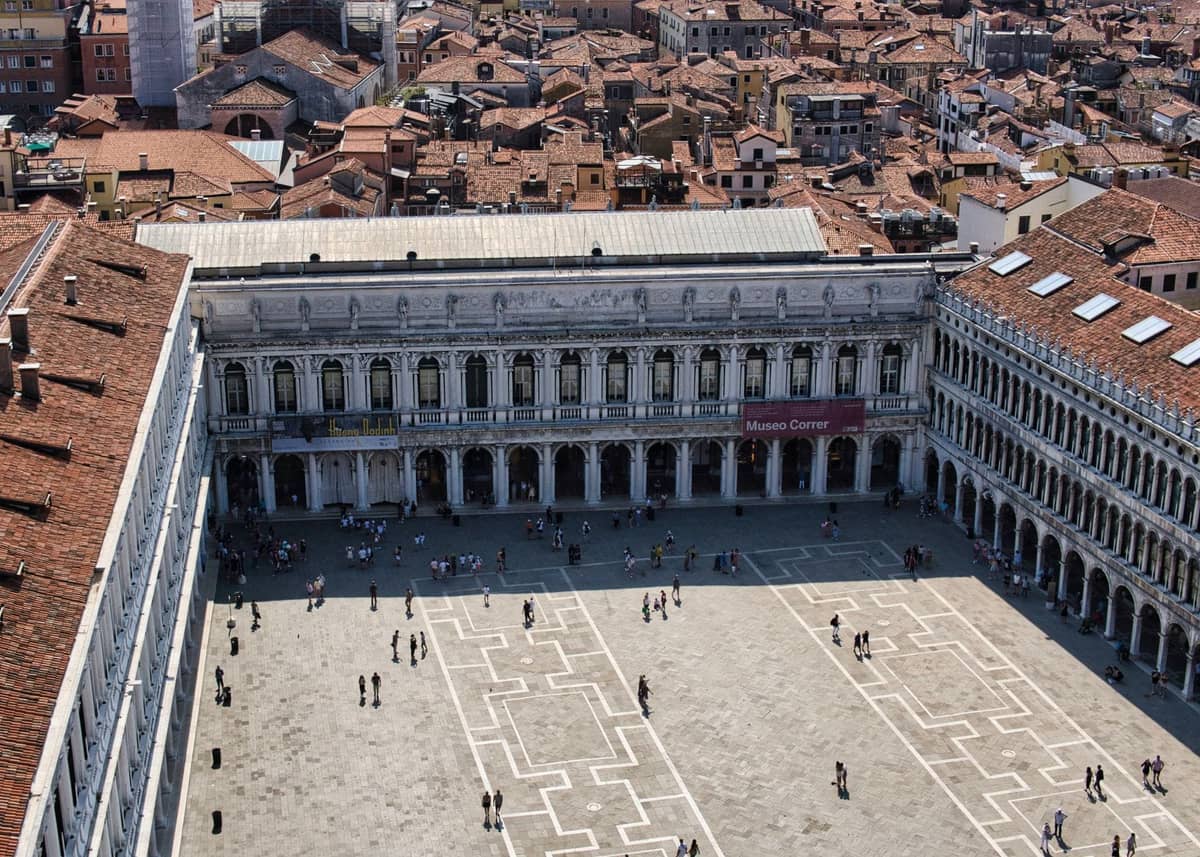
Occupying the grand Napoleonic Wing and part of the Procuratie Nuove above Piazza San Marco, the Museo Correr holds centuries of Venetian civic history, Renaissance painting, and lavishly decorated royal apartments. It rewards visitors who take their time, and it's consistently overlooked by crowds fixated on the Doge's Palace next door.
Quick Facts
- Location
- San Marco 52, Piazza San Marco (Ala Napoleonica entrance), Venice
- Getting There
- Vallaresso or San Zaccaria; 2-minute walk across the piazza
- Time Needed
- 2 to 3 hours for a thorough visit; 90 minutes if you're selective
- Cost
- Included in the St. Mark's Square Museums ticket (adult €30, reduced €15; covers Correr, Archaeological Museum, Biblioteca Marciana rooms, and Doge's Palace — not the Basilica). Verify current prices before visiting
- Best for
- History enthusiasts, art lovers, visitors seeking shelter from rain or summer heat, anyone wanting depth beyond the Basilica queue
- Official website
- correr.visitmuve.it/en
What the Museo Correr Actually Is
The Museo Correr is Venice's principal civic history museum, spread across the upper floors of the Napoleonic Wing and the Procuratie Nuove, the long colonnade that forms the southern edge of Piazza San Marco. The museum takes its name from Teodoro Correr (1750-1830), a Venetian nobleman and collector who spent decades amassing paintings, manuscripts, coins, maps, and objects tied to the history of the Serenissima. When he died in 1830, he left the entire collection to the city. It is managed by the Fondazione Musei Civici di Venezia.
Three distinct sections fill the building: the Neo-Classical Royal Apartments decorated for Napoleon and later the Habsburg court, a set of rooms tracing Venetian civic and social history, and the Picture Gallery (Quadreria) on the upper level, which holds a serious collection of Byzantine-influenced panel painting through to Venetian Renaissance work. Each section has a completely different atmosphere, which is part of what makes the museum worth the time investment.
ℹ️ Good to know
The Museo Correr ticket is bundled with the St. Mark's Square Museums ticket, which also covers the Doge's Palace, the Archaeological Museum, and the monumental rooms of the Biblioteca Marciana — but not St Mark's Basilica, which requires a separate ticket. If you plan to visit the Doge's Palace on the same day, buy your ticket online in advance.
The Royal Apartments: Where History Sits in the Furniture
The entrance staircase deposits you into a sequence of rooms that Napoleon ordered redesigned after he seized Venice in 1797, demolishing a church on this end of the square to complete the wing. The Habsburgs later refined the interiors further during their long occupation of the city. The result is a suite of reception halls, ballrooms, and private chambers that map political power through wallpaper, gilded ceilings, and carefully chosen portrait subjects.
What sets these rooms apart from similar royal apartments elsewhere in Europe is context. You are standing directly above one of the most recognized public squares in the world, and the people who used these rooms understood that. The windows that look down onto the piazza were not incidental design choices. Visiting in the late morning, when pale Venetian light comes off the stone of the piazza and filters into the ballroom, is a noticeably different experience from the flat afternoon light. If your schedule allows, aim for arrival between 10:00 and 11:30.
Tickets & tours
Hand-picked options from our booking partner. Prices are indicative; availability and final rates are confirmed when you complete your booking.
Doge's Palace skip-the-line tickets and guided tour with museums around St. Mark's Square
From 67 €Instant confirmationFree cancellationCa' Pesaro - International Gallery of Modern Art and Oriental Art Museum entrance ticket
From 8 €Instant confirmationCa' Rezzonico 18th century Venice Museum entrance tickets
From 8 €Instant confirmationCa' Rezzonico 18th century Venice Museum entrance tickets
From 10 €Instant confirmation
The History Rooms: Reading Venice Through Objects
Beyond the royal apartments, the museum transitions into a detailed account of Venetian civic life from the early medieval period through the fall of the Republic in 1797. The approach here is object-led rather than text-heavy, which works well. A carved ducal ceremonial throne, a glass case of trade coins, navigation instruments from Venetian merchant galleys, the golden stola worn by a doge during ceremonies - these items communicate the scale and sophistication of the Republic more directly than any wall panel could.
A section on the Arsenal and Venetian naval power is particularly strong, connecting naturally to the broader story of how a city built on islands became a maritime empire for over a thousand years. Scale models of galleys sit alongside original rope, tackle, and metalwork. For visitors who have already walked past the exterior of the Arsenal in Castello, this section gives context to what those walls once contained.
One room focuses on Venetian dress codes and sumptuary laws, the regulations that governed what different social classes were permitted to wear in public. It is a small section but an unexpected one, and it adds nuance to the more polished image of the city that you get from the Doge's Palace across the arcade. The Republic was meticulous about public order, and clothing was part of that system.
The Picture Gallery: Venetian Painting Before Titian
The Quadreria on the upper level is where the Museo Correr earns its place among serious art destinations. The collection focuses on Venetian painting from the late Byzantine period through to the early sixteenth century, covering a range of work that most visitors have never encountered because it predates the painters that dominate the Gallerie dell'Accademia's collection.
The standout piece is Jacopo de' Barbari's extraordinary bird's-eye view map of Venice from 1500, a woodcut printed from six blocks that depicts the city in forensic detail at a moment when the Republic was at or near its political peak. It functions as both a work of art and a historical document. Alongside it, paintings by Cosmè Tura, Giovanni Bellini, and Vittore Carpaccio offer a coherent picture of Venetian painting in the decades before Venice became the style-setter for all of European art. For visitors who plan to continue to the Gallerie dell'Accademia, the Correr's Quadreria works well as an introduction, providing the earlier context that the Accademia's collection largely picks up from.
The gallery is rarely crowded, even when the piazza below is packed. Midday in July, you may share these rooms with a handful of people. The lighting is calibrated, the labeling is in Italian and English, and the benches between cases give you space to sit with individual works. This is the part of the museum where an hour can disappear without effort.
Practical Walkthrough: Hours, Access, and What to Know Before You Go
The museum entrance is through the Ala Napoleonica, the wing that closes the far end of the piazza opposite the Basilica. The monumental staircase is well-signed. From April through October, the museum opens daily at 10:00 with last admission at 17:00 and closing at 18:00. From November through March, last admission is 16:00 and the museum closes at 17:00. From Friday 1 May to Saturday 26 September 2026, Friday and Saturday evening openings extend to 23:00 with last admission at 22:00 — check the official site for the current season's extended hours.
The museum is closed on 25 December and 1 January. Vaporetto lines serving the museum (lines 1 and 2, plus 4.1/5.1/5.2 depending on departure point) drop you at Vallaresso, Giardinetti, or San Zaccaria, a short walk from the piazza entrance. The museum occupies upper floors, reached by staircase. The Fondazione Musei Civici recommends contacting their visitor services team directly to confirm current accessibility arrangements before visiting if mobility is a concern.
💡 Local tip
Photography without flash is permitted throughout most of the museum. The bird's-eye map of Venice by de' Barbari and the view from the Royal Apartment windows looking down onto Piazza San Marco are two of the most distinctive shots available in the whole complex. Neither requires a tripod or special timing.
If you are visiting Venice in winter or autumn and are concerned about acqua alta, the Museo Correr sits well above street level and stays accessible even during moderate flooding events that affect the piazza below. For more on navigating high water, the acqua alta guide for Venice covers what to expect and how to plan around it.
Is the Museo Correr Worth It, and Who Might Want to Skip It
The museum is not a short or light experience. If you are visiting Venice for two days and your primary interest is the canal landscape, the neighborhoods, and a few iconic monuments, the Correr may not be your best use of three hours. The building itself does not offer dramatic views of the lagoon, and the material is historically dense. Travelers who find civic history collections dry, or who are visiting with young children seeking interactive exhibits, will likely find the ratio of effort to reward unfavorable.
For everyone else, particularly those with a serious interest in Venetian history, Italian Renaissance art, or the mechanics of how the Republic actually functioned, the Museo Correr is one of the strongest museums in the city. It is less visited than the Doge's Palace, less specialized than the Scuola Grande di San Rocco, and less fashionable than the Peggy Guggenheim Collection, which means you can actually spend time with the objects rather than moving with a crowd.
Pairing the Correr with a morning at the Basilica di San Marco and the Doge's Palace makes for a full day in and around the piazza. The St. Mark's Square Museums ticket covers the Correr, the Archaeological Museum, the Biblioteca Marciana rooms, and the Doge's Palace — not the Basilica, which is ticketed separately. Expect to be tired by the end of that day, but genuinely informed about the city you are walking through.
Insider Tips
- Visit on a Friday or Saturday evening between May and late September (check the current year's schedule) when the museum opens until 23:00. The piazza below is animated at night, and the Royal Apartment windows frame the lit square in a way that daytime light does not replicate.
- The Quadreria's de' Barbari woodcut map of Venice (1500) is printed at a scale large enough to locate individual buildings. Bring a small phone flashlight if the overhead lighting feels dim in that section - it helps trace canal routes and island details.
- Buy your St. Mark's Square Museums ticket online at least a few days in advance. This gives you access to the Doge's Palace without a separate wait in that queue, which during summer can run 45 minutes or longer.
- The museum café and bookshop are worth a stop. The bookshop carries scholarly titles on Venetian history that are difficult to find elsewhere, including reproduction prints of historical maps and engravings at reasonable prices.
- The rooms covering Venetian dress and social regulation are easy to walk past quickly, but they repay slow reading. The sumptuary laws on display explain class distinctions that you will keep noticing in Venetian painting throughout the rest of your visit.
Who Is Museo Correr For?
- History travelers who want to understand how the Venetian Republic actually worked as a political and commercial system
- Art enthusiasts interested in pre-High Renaissance Italian painting, particularly the Byzantine-to-Bellini transition in Venetian workshops
- Visitors looking for a quieter, climate-controlled alternative on a hot summer afternoon or a rainy autumn day
- Travelers on a multi-day Venice itinerary who have already covered the Doge's Palace and want comparable depth elsewhere
- Photography-minded visitors seeking interior architectural shots with good natural light and minimal crowds
Nearby Attractions
Other things to see while in San Marco:
- Bridge of Sighs (Ponte dei Sospiri)
The Ponte dei Sospiri is one of Venice's most photographed structures, an enclosed white limestone bridge linking the Doge's Palace to the New Prisons over the narrow Rio di Palazzo canal. You can see it for free from the Ponte della Paglia, or cross it from the inside as part of a Doge's Palace ticket. Here is everything you need to visit it well.
- Doge's Palace (Palazzo Ducale)
Doge's Palace is the Gothic heart of Venice's political history, rising at the edge of Piazza San Marco with a facade unlike anything else in Italy. This guide covers what you'll actually experience inside, when to visit for smaller crowds, and how to make the most of one of Europe's most significant civic buildings.
- Grand Canal (Canal Grande)
The Canal Grande is the main artery of Venice, a reverse-S shaped waterway stretching 3.8 km through the heart of the city and lined with more than 170 palaces spanning six centuries of Venetian architecture. Free to view at any hour, it rewards visitors who know when and how to travel it.
- Museo Fortuny (Palazzo Fortuny)
Tucked into a quiet campo in the heart of San Marco, Museo Fortuny occupies a 15th-century Gothic palace that served as the live-in atelier of polymath artist Mariano Fortuny. Part museum, part time capsule, it rewards visitors who seek something beyond the standard Venetian circuit.