Doge's Palace (Palazzo Ducale): What to Know Before You Go
Doge's Palace is the Gothic heart of Venice's political history, rising at the edge of Piazza San Marco with a facade unlike anything else in Italy. This guide covers what you'll actually experience inside, when to visit for smaller crowds, and how to make the most of one of Europe's most significant civic buildings.
Quick Facts
- Location
- Piazza San Marco, 1, 30124 Venice
- Getting There
- Line 1 to Vallaresso or San Zaccaria; Line 2 to San Zaccaria
- Time Needed
- 2 to 3 hours for a thorough visit; allow 30 extra minutes for the courtyard and loggia
- Cost
- Approx. €30 adult, €15 reduced (verify current prices before visiting)
- Best for
- History lovers, architecture enthusiasts, first-time Venice visitors
- Official website
- palazzoducale.visitmuve.it/en
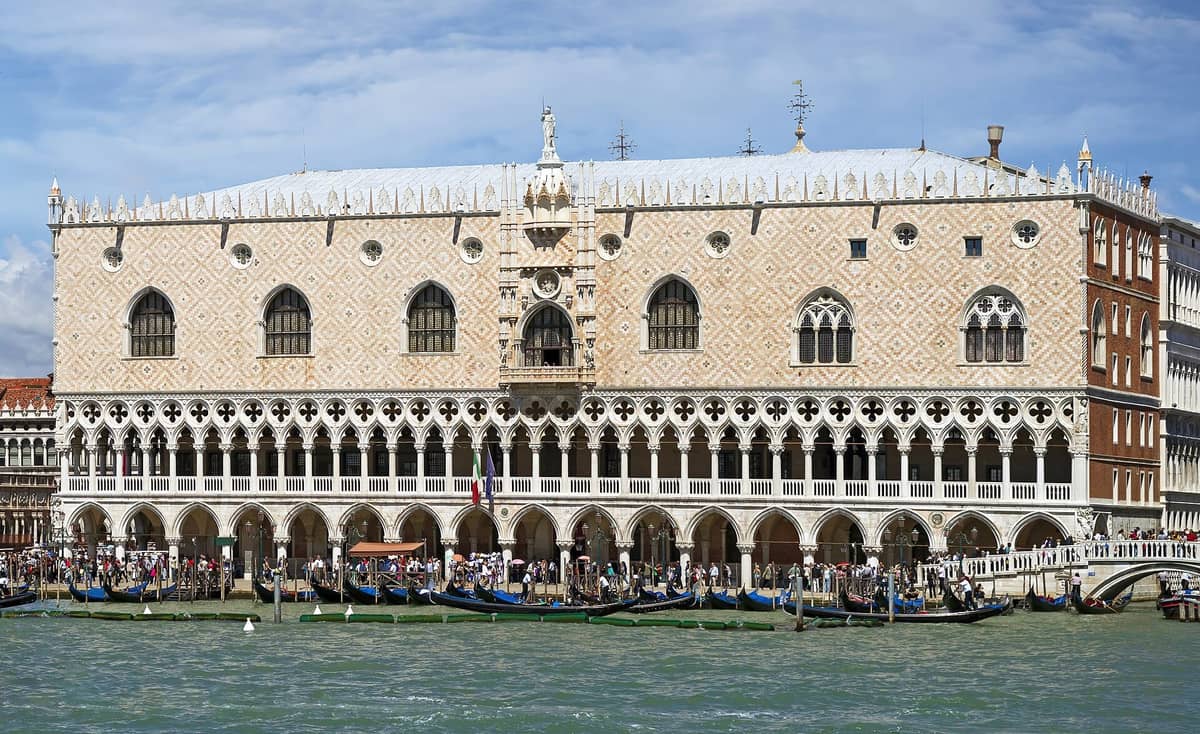
What the Doge's Palace Actually Is
Palazzo Ducale is not simply a palace. For centuries it was the center of one of Europe's most powerful and long-lived republics, housing the Doge (Venice's elected head of state), the city's law courts, its prisons, and the council chambers where foreign policy was decided and wars were authorized. The building you see today was constructed between 1309 and 1424, though the site has been the seat of Venetian power since the 9th century. It became a public museum in 1923.
The palace anchors the southeastern edge of Piazza San Marco, facing the lagoon across the Piazzetta. Its position was deliberate: arriving by boat, which nearly everyone did, the first thing a visitor saw was this building. That theatrical first impression still works today.
💡 Local tip
Book tickets online in advance. Walk-up queues at the main entrance can stretch 45 minutes or more in peak season, and online booking costs the same as the door price.
The Architecture: Gothic on the Outside, Renaissance Inside
The exterior is the most distinctive element. The lower two floors are open arcaded loggias of white Istrian stone and pink Veronese marble, with the heavier walls sitting on top rather than below, a structural inversion that gives the building its almost weightless appearance. The diamond-pattern stonework on the upper walls catches light differently at every hour, shifting from pale cream at midday to deep amber in late afternoon.
The main facade facing the lagoon and the Piazzetta was completed in the Venetian Gothic style, with tracery and pointed arches that absorb Moorish and Byzantine details alongside the more recognizably Western European Gothic framework. The carved capitals on the lower loggia columns are 14th and 15th century originals, each depicting different themes from justice, virtue, and biblical narrative, though some have been replaced with copies to protect the originals from weathering.
Step through into the internal courtyard and the vocabulary shifts. The courtyard facade is Renaissance, built after fires in 1574 and 1577 destroyed significant sections of the interior. The Arco Foscari, which frames the courtyard entrance from the western wing, is a triumph of 15th-century Venetian decorative carving, its niches filled with statues though many of the originals are now held in the museum's interior collection.
Tickets & tours
Hand-picked options from our booking partner. Prices are indicative; availability and final rates are confirmed when you complete your booking.
Doge's Palace skip-the-line tour
From 67 €Instant confirmationFree cancellationSkip-the-line guided tour of Doge's Palace and Saint Mark's Basilica
From 106 €Instant confirmationFree cancellationExclusive Saint Mark's Basilica After Dark and Doge's Palace Tour
From 149 €Instant confirmationFree cancellationDoge's Palace skip-the-line tickets and guided tour with museums around St. Mark's Square
From 67 €Instant confirmationFree cancellation
Moving Through the Interior: Room by Room
The standard visitor route takes you up the Scala dei Giganti, the ceremonial staircase flanked by Sansovino's enormous statues of Mars and Neptune. From there the route continues to the upper loggia and into the palace's main administrative and ceremonial rooms.
The rooms accumulate in scale as you move through them. The Sala del Collegio and the Sala del Senato are impressive but relatively intimate, their ceilings covered in paintings by Tintoretto and Veronese. Then the route opens into the Sala del Maggior Consiglio, the Grand Council Chamber, which is one of the largest rooms in any secular building in Europe. The ceiling painting alone, Veronese's Apotheosis of Venice, is over 7 meters by 9 meters. The three walls carry a continuous frieze of portraits of every Doge, except one: the black-painted rectangle where Doge Marino Falier would appear is a deliberate absence, marking his execution for treason in 1355.
Tintoretto's Paradise, at the far end of the chamber, is thought to be one of the largest oil paintings on canvas in the world. Up close, it resolves into hundreds of individual figures arranged around the central figures of Christ and the Virgin. From the far end of the room, where most visitors stand, the full composition becomes visible, a tightly packed celestial crowd that only makes sense at distance.
ℹ️ Good to know
Audio guides are available for rent at the entrance and add real depth to rooms like the Sala del Maggior Consiglio and the prisons. Without some context, the political significance of individual paintings can be easy to miss.
The Bridge of Sighs and the Prisons
The standard route connects the palace to the New Prison (Prigioni Nuove) across the Bridge of Sighs. The bridge's interior is narrow and dark, lit by two small stone-grilled windows. The romantic legend that condemned prisoners sighed their last view of Venice through those windows is largely 19th-century invention, but the physical reality of the passage is genuinely affecting: the corridor is barely wide enough for two people and smells faintly of damp stone.
The prison cells themselves are small and low-ceilinged, their walls covered in centuries of graffiti scratched by inmates. Some inscriptions are legible: names, dates, prayers, geometric patterns. This is not a sanitized display. The cells look roughly as they did when in use, and the contrast with the gilded council chambers you've just come from is intentional and stark.
When to Visit and How the Experience Changes by Time of Day
The palace opens at 09:00 year-round. The first 90 minutes after opening are noticeably quieter than midday, when cruise passengers and tour groups converge. By 11:00, the Sala del Maggior Consiglio can feel cramped. Arriving at 09:00 on a weekday in spring or autumn gives you a very different experience from arriving at noon in July.
The palace sometimes stays open later on special dates, with last admission set later than usual. An evening visit is worth considering seriously. The light through the loggia windows drops away, the courtyard glows with artificial illumination, and the council chambers take on a different quality entirely. Visitor numbers are substantially lower in the evening hours.
Opening hours: 1 April to 31 October, 09:00 to 19:00 (last admission 18:00). 1 November to 31 March, 09:00 to 18:00 (last admission 17:00). For current ticket prices and booking, visit the best museums in Venice guide or the official museum website directly.
⚠️ What to skip
The palace is right on Piazza San Marco, which is among the first places to flood during acqua alta. In autumn and winter, check tide forecasts before visiting and bring waterproof footwear. The elevated walkways (passerelle) are set up when flooding is forecast, but the Piazzetta approach can still get several centimeters of water.
Practical Details Worth Knowing
The entrance is through the Porta del Frumento on the Piazzetta side, facing the water. Do not walk to the main Piazza San Marco entrance first: the Piazzetta entrance is the correct starting point for standard visits, and it reduces the walk through the thickest part of the crowds.
Getting there by vaporetto is straightforward. Line 1 from Santa Lucia Railway Station stops at Vallaresso or San Zaccaria, both a short walk from the palace. Line 4.1, 5.1, and 5.2 also serve San Zaccaria. Walking from the Rialto area takes around 15 to 20 minutes through the San Marco sestiere.
The palace sits in the San Marco sestiere, the most visited district in Venice. Everything around it is busy. If you are visiting multiple major sites in the area, plan the palace as either your first stop of the day or your last, not the middle of an exhausting afternoon.
Accessibility: the palace has multiple levels connected by staircases, and the historic structure creates real limitations for step-free access. Visitors with mobility concerns should check the official museum website directly for current accessibility information before visiting, as provisions may have been updated.
Photography is permitted in most areas without flash. The Grand Council Chamber is the single most photographed interior, but the upper loggia overlooking the lagoon and the courtyard are equally compelling from a composition standpoint and far less crowded with camera phones.
Worth It?
At approximately €30 for adults, Palazzo Ducale is one of Venice's more expensive attractions. It earns the price for visitors with genuine interest in Venetian history, Renaissance painting, or Gothic civic architecture. For visitors primarily interested in a quick photo and a landmark checkmark, the exterior is visible for free from the Piazzetta and the waterfront, and that view is genuinely impressive.
If you are traveling on a tight budget, there are free things to do in Venice that may compete for your time. But if you allocate two to three hours and arrive with some background knowledge, the palace rewards the investment. No other single building gives you such a complete picture of how the Venetian Republic actually functioned.
People with limited mobility who find multi-floor historic buildings difficult, or families with very young children who are unlikely to engage with 16th-century political allegory, may find the experience frustrating relative to its cost. The rooms are visually spectacular but require some patience to appreciate.
Insider Tips
- The Secret Itinerary tour (Itinerari Segreti) is a separately bookable guided visit to rooms not on the standard route, including the Inquisitors' Room, the torture chamber, and the attic cells where Casanova was famously imprisoned. It runs at fixed times and sells out quickly; book well in advance through the official museum site.
- The upper loggia on the second floor offers one of the best elevated views of the lagoon and the island of San Giorgio Maggiore without any admission charge beyond your palace ticket. Most visitors walk through it quickly to reach the painted rooms. Slow down here, especially in morning light.
- Tintoretto's Paradise is best viewed from the far end of the Grand Council Chamber, but the painting's detail is best seen up close in sections. Walk the full length of the room and back rather than stopping at one end.
- The carved column capitals on the ground-floor loggia are often overlooked because visitors are looking up at the facade. Many are 14th and 15th century originals and remarkably detailed. A few minutes spent at ground level here is time well spent.
- If you visit in summer, the interior is notably cooler than the streets outside. This is not air conditioning, just the thermal mass of stone. It is one of the more comfortable ways to spend a hot midday in San Marco.
Who Is Doge's Palace (Palazzo Ducale) For?
- First-time visitors to Venice who want to understand the city's republican history in one visit
- Architecture enthusiasts interested in Venetian Gothic and the transition to Renaissance civic building
- Art history lovers, particularly those interested in Tintoretto, Veronese, and large-scale Renaissance fresco and canvas cycles
- Travelers visiting during a heat wave who want a substantive, shaded interior attraction
- Anyone combining a San Marco morning with the Bridge of Sighs and the waterfront
Nearby Attractions
Other things to see while in San Marco:
- Bridge of Sighs (Ponte dei Sospiri)
The Ponte dei Sospiri is one of Venice's most photographed structures, an enclosed white limestone bridge linking the Doge's Palace to the New Prisons over the narrow Rio di Palazzo canal. You can see it for free from the Ponte della Paglia, or cross it from the inside as part of a Doge's Palace ticket. Here is everything you need to visit it well.
- Grand Canal (Canal Grande)
The Canal Grande is the main artery of Venice, a reverse-S shaped waterway stretching 3.8 km through the heart of the city and lined with more than 170 palaces spanning six centuries of Venetian architecture. Free to view at any hour, it rewards visitors who know when and how to travel it.
- Museo Correr
Occupying the grand Napoleonic Wing and part of the Procuratie Nuove above Piazza San Marco, the Museo Correr holds centuries of Venetian civic history, Renaissance painting, and lavishly decorated royal apartments. It rewards visitors who take their time, and it's consistently overlooked by crowds fixated on the Doge's Palace next door.
- Museo Fortuny (Palazzo Fortuny)
Tucked into a quiet campo in the heart of San Marco, Museo Fortuny occupies a 15th-century Gothic palace that served as the live-in atelier of polymath artist Mariano Fortuny. Part museum, part time capsule, it rewards visitors who seek something beyond the standard Venetian circuit.