Museo Fortuny (Palazzo Fortuny): Venice's Most Atmospheric Palace Museum
Tucked into a quiet campo in the heart of San Marco, Museo Fortuny occupies a 15th-century Gothic palace that served as the live-in atelier of polymath artist Mariano Fortuny. Part museum, part time capsule, it rewards visitors who seek something beyond the standard Venetian circuit.
Quick Facts
- Location
- San Marco 3958, Campo San Beneto, Venice (sestiere of San Marco)
- Getting There
- Vaporetto Line 1 to Sant'Angelo stop (Grand Canal), then 5-minute walk
- Time Needed
- 1 to 2 hours for the permanent collection; longer during major temporary exhibitions
- Cost
- Adult €10, Reduced €7.50 (ages 6–14, students 15–25, over 65). Combo ticket with Ca' Pesaro (Modern & Contemporary Museums): Adult €15, Reduced €12, valid for three months with one entry per museum. Free for children 0–5, Venice residents, and visitors with disabilities plus one companion. Verify current prices before visiting.
- Best for
- Art and design lovers, fashion history enthusiasts, lovers of atmospheric interiors, repeat visitors to Venice seeking lesser-known museums
- Official website
- fortuny.visitmuve.it/en
What Is Palazzo Fortuny, and Why Does It Matter?
Museo Fortuny, formally known as Palazzo Pesaro Fortuny, is one of Venice's most singular cultural spaces. It sits in Campo San Beneto, a small square off the main tourist flow between the Rialto and Piazza San Marco, in the sestiere of San Marco. The building itself is a 15th-century Venetian Gothic palace, originally constructed for the Pesaro family and for centuries known as Palazzo Pesaro degli Orfei. Its soaring facades, pointed arched windows, and internal courtyard are as compelling as anything on the Grand Canal, yet most visitors walk past the campo without knowing what is inside.
The name Fortuny refers to Mariano Fortuny y Madrazo (1871–1949), a Spanish-born polymath who settled in Venice in 1899 and took up residence in the palace from 1902. Painter, photographer, stage designer, inventor, and fabric innovator, Fortuny transformed the palazzo into a laboratory and living space. He is best known internationally for the Delphos gown, a finely pleated silk dress inspired by ancient Greek sculpture, and for his patented textured fabrics that influenced fashion houses across Europe. After his death in 1949, his wife Henriette donated the building to the Municipality of Venice in 1956, stipulating that it be used perpetually as a centre of culture. The museum first opened to the public in 1975 and, following recent restoration and reconfiguration, has been reopened since 2022 as a museum dedicated exclusively to Fortuny, now managed by the Fondazione Musei Civici di Venezia (MUVE), the same body that oversees Ca' Rezzonico, Palazzo Mocenigo, and the Museo Correr.
ℹ️ Good to know
Opening hours are seasonal. April 1 to October 31: 10:00–18:00 (last entry 17:00). November 1 to March 31: 10:00–17:00 (last entry 16:00). Closed every Tuesday. Closing procedures begin around 20 minutes before the listed closing time. Always check the official site's Announcements section for temporary closures, especially during exhibition changeovers.
The Building: Gothic Architecture That Has Never Been Renovated Into Blandness
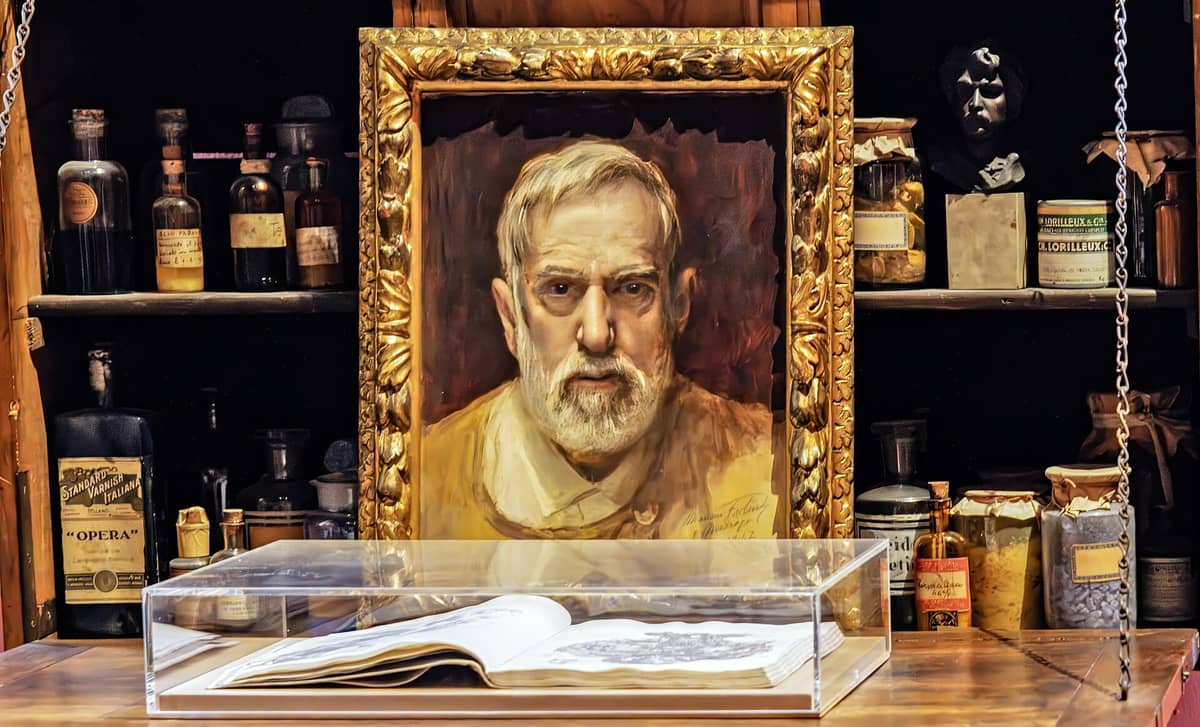
The first thing that strikes you on entering is how deliberately unrenovated the space feels. This is not carelessness; it is a deliberate preservation of the atmosphere Fortuny himself cultivated. The main hall on the upper floor is cavernous, with heavy wooden furniture, draped fabrics in deep jewel tones, canvases in various states of completion, stage-set props, and custom printing equipment. The walls absorb the light rather than reflect it. Even on a bright Venetian morning, the interior stays shadowy and theatrical. Visiting on a grey November afternoon amplifies this quality considerably.
The palace occupies multiple floors connected by stone staircases. The Gothic windows facing the campo admit angular shafts of light that shift through the morning, making the textiles and painted surfaces change in character as the hours pass. Arriving at opening time, around 10:00, gives you the interior largely to yourself and the best natural light on the upper-floor collection. By early afternoon, school groups and guided tours can compress the narrow stairwells, though the palazzo never becomes as crowded as the major circuit museums.
⚠️ What to skip
The museum is housed in a genuine 15th-century Gothic palace with original historic stairways. It is not fully wheelchair accessible due to the building's structure. Visitors with mobility impairments should contact the MUVE call centre in advance to discuss available options. Visitors with disabilities and one companion are currently eligible for free admission.
Tickets & tours
Hand-picked options from our booking partner. Prices are indicative; availability and final rates are confirmed when you complete your booking.
Doge's Palace skip-the-line tickets and guided tour with museums around St. Mark's Square
From 67 €Instant confirmationFree cancellationCa' Pesaro - International Gallery of Modern Art and Oriental Art Museum entrance ticket
From 8 €Instant confirmationCa' Rezzonico 18th century Venice Museum entrance tickets
From 8 €Instant confirmationCa' Rezzonico 18th century Venice Museum entrance tickets
From 10 €Instant confirmation
Mariano Fortuny: The Artist You Didn't Expect to Find in Venice
Understanding who Fortuny was makes the museum far more rewarding. Born in Granada in 1871 and raised partly in Paris, he arrived in Venice at the turn of the 20th century and never really left. He was not a specialist. In the palazzo, he designed and built innovative theatrical lighting systems, developed photographic techniques, created hand-printed velvets using methods he largely invented, and painted large Symbolist canvases. Several of his patented fabric designs are still in production today under the Fortuny brand.
The Delphos gown on display here, a column of finely pleated silk held with Venetian glass beads at the sides, looks as contemporary now as it did when it was first produced in the early 20th century. Fortuny's approach to textile design drew directly from ancient Greek and Japanese sources, filtered through his own technical patents. Fashion historians regard him as one of the most original designers of the 20th century, yet he worked from inside a Venetian Gothic palace and rarely sought the conventional attention of the Paris fashion world.
For visitors who want broader context on Venice's design and craftsmanship heritage, the Palazzo Mocenigo Museum in Santa Croce covers Venetian costume and perfume history from a different angle, and is worth pairing with a visit here on the same day.
What You Actually See Inside
The permanent collection is arranged across the palazzo's grand upper floors and includes Fortuny's own paintings (primarily large-format works in a Symbolist and Orientalist register), his photographic equipment and prints, samples of his fabric designs, and the original machinery used in textile production. The studio spaces retain their original fittings, giving the impression less of a traditional museum and more of a working environment that was simply never cleared out.
The palazzo also hosts temporary exhibitions, typically contemporary art shows and design retrospectives organised under the auspices of MUVE and international partners. These exhibitions can take over significant portions of the building and dramatically change the atmosphere of a visit. It is worth checking the current exhibition calendar before you go, as the character of the museum shifts considerably depending on what is installed. During Biennale years, temporary shows here often attract a more contemporary-art-oriented crowd.
If you are timing your visit around Venice's major cultural events, the Venice Biennale guide explains how the biennial art and architecture exhibitions affect museum programming across the city, including venues like Palazzo Fortuny.
Getting There: The Logistics of Reaching Campo San Beneto
The most direct vaporetto route from any direction is Line 1 on the Grand Canal to the Sant'Angelo stop. From there, it is roughly a five-minute walk through a sequence of narrow calli into Campo San Beneto. The walk itself passes through some of the less touristed lanes in this part of San Marco, which tend to be considerably quieter than the main pedestrian arteries toward the Rialto or Piazza San Marco.
If you are coming from the Rialto area, you can also reach the campo on foot in about ten minutes by heading south through San Polo and crossing one of the smaller bridges. The palazzo is signposted with MUVE yellow arrows from the Sant'Angelo vaporetto landing, though Venetian signage can be inconsistent. Having the address, San Marco 3958, Campo San Beneto, on a map app is the most reliable method.
💡 Local tip
Campo San Beneto itself is a good orientation point. It is small, mostly residential, and has a handful of quiet cafés. Arriving here feels noticeably different from the main tourist routes. If you find yourself in front of the large Gothic facade of the palazzo, you have arrived.
How the Experience Changes by Time of Day and Season
Morning visits offer the quietest conditions inside and the best natural light on the permanent collection. The palazzo's Gothic windows angle light onto the fabrics and canvases from mid-morning onward, and the effect is noticeably richer than what you get under purely artificial lighting. If you visit in autumn or winter, mist over the campo in the early morning is an atmospheric bonus, and the museum's darkly furnished interiors feel particularly appropriate to the season.
Summer afternoons bring more visitors, particularly in July and August when Venice hits peak tourist density. Even then, Palazzo Fortuny rarely reaches the crush levels of the Doge's Palace or St Mark's Basilica. Its relative obscurity in the standard tourist itinerary works in the visitor's favour. That said, during major temporary exhibitions, visitor numbers do rise and the upper-floor rooms can become congested around the most photographed pieces.
For guidance on navigating Venice at different times of year, the best time to visit Venice guide covers seasonal crowd patterns and weather conditions across the city's major attractions.
Photography Inside Palazzo Fortuny
Photography policies at Museo Fortuny can vary depending on whether a temporary exhibition is installed, as some contemporary shows include works under specific copyright restrictions. In general, non-flash photography of the permanent collection and building interiors is permitted for personal use, but you should confirm current policy at the ticket desk on arrival. The Gothic windows and the layered textile installations create genuinely photogenic interiors, particularly in morning light when the contrast between the bright window arches and the dark wooden furnishings is strongest.
Who Will Get the Most From This Museum, and Who Might Not
Palazzo Fortuny rewards visitors who have some appetite for context. If you walk in knowing nothing about Fortuny and expecting the kind of chronological narrative that a larger civic museum provides, the space can feel disorienting. The labelling is not always comprehensive, particularly in areas of the permanent collection, and the curatorial logic is closer to a preserved studio environment than a conventional exhibition. Visitors who engage with it as a space rather than a conventional didactic museum tend to leave more satisfied.
Visitors who are primarily interested in checking major Venetian sights off a list will probably find more satisfaction at the Gallerie dell'Accademia or the Doge's Palace. Families with young children may find the interior less engaging than outdoor spaces or more interactive venues. Anyone with significant mobility limitations should contact the museum in advance given the building's historic staircase structure.
If you are building a broader museum itinerary for Venice, the best museums in Venice guide places Palazzo Fortuny in the context of the city's full museum offer, from the Accademia to the smaller civic collections.
Insider Tips
- The combo ticket combining Palazzo Fortuny with Ca' Pesaro (the Modern & Contemporary Museums combo on the Grand Canal) costs €15 for adults and €12 for reduced tickets, and is valid for three months with one entry per museum. If you have any interest in 20th-century art, this is worth buying even if you visit Ca' Pesaro separately on another day.
- Check the temporary exhibition calendar before you go, not just to see what is on but to judge whether the palazzo is in a changeover period. During installation and deinstallation weeks, significant portions of the building may be closed to visitors without notice.
- The building's closing procedure begins 20 minutes before the advertised closing time. If you arrive less than 30 minutes before closing, you may find yourself rushed through or turned away at the door. Budget at least 90 minutes for a relaxed visit.
- Campo San Beneto has a low-key café on its edge that is far less expensive than anything near Piazza San Marco. It makes a practical stop before or after your visit.
- If you are visiting Venice during the Biennale period, Palazzo Fortuny sometimes hosts associated or satellite exhibitions that draw a notably different crowd from the standard tourism circuit. These shows can be among the most interesting uses of the building's theatrical spaces.
Who Is Museo Fortuny (Palazzo Fortuny) For?
- Art and design enthusiasts with an interest in early 20th-century textile and decorative arts
- Fashion history lovers who want to see Fortuny's original Delphos gowns and fabric innovations in the space where they were created
- Repeat visitors to Venice who have already covered the main circuit and want to explore the city's less obvious civic museums
- Architecture enthusiasts drawn to Venetian Gothic palaces with original interiors intact
- Visitors who find large crowded museums exhausting and prefer a quieter, more atmospheric experience
Nearby Attractions
Other things to see while in San Marco:
- Bridge of Sighs (Ponte dei Sospiri)
The Ponte dei Sospiri is one of Venice's most photographed structures, an enclosed white limestone bridge linking the Doge's Palace to the New Prisons over the narrow Rio di Palazzo canal. You can see it for free from the Ponte della Paglia, or cross it from the inside as part of a Doge's Palace ticket. Here is everything you need to visit it well.
- Doge's Palace (Palazzo Ducale)
Doge's Palace is the Gothic heart of Venice's political history, rising at the edge of Piazza San Marco with a facade unlike anything else in Italy. This guide covers what you'll actually experience inside, when to visit for smaller crowds, and how to make the most of one of Europe's most significant civic buildings.
- Grand Canal (Canal Grande)
The Canal Grande is the main artery of Venice, a reverse-S shaped waterway stretching 3.8 km through the heart of the city and lined with more than 170 palaces spanning six centuries of Venetian architecture. Free to view at any hour, it rewards visitors who know when and how to travel it.
- Museo Correr
Occupying the grand Napoleonic Wing and part of the Procuratie Nuove above Piazza San Marco, the Museo Correr holds centuries of Venetian civic history, Renaissance painting, and lavishly decorated royal apartments. It rewards visitors who take their time, and it's consistently overlooked by crowds fixated on the Doge's Palace next door.