Grand Canal (Canal Grande): Venice's Most Spectacular Waterway
The Canal Grande is the main artery of Venice, a reverse-S shaped waterway stretching 3.8 km through the heart of the city and lined with more than 170 palaces spanning six centuries of Venetian architecture. Free to view at any hour, it rewards visitors who know when and how to travel it.
Quick Facts
- Location
- Runs through central Venice from Piazzale Roma / Santa Lucia station to the Bacino di San Marco
- Getting There
- Vaporetto lines 1 and 2 (ACTV) travel the full length of the canal; board at Santa Lucia, Piazzale Roma, Rialto, Accademia, or San Marco
- Time Needed
- 30–40 min end-to-end on vaporetto line 1 (all stops); 2–4 hours if exploring by foot across bridges and embankments
- Cost
- Free to view from bridges and embankments; ACTV vaporetto ticket required to ride (verify current fares with ACTV); gondola rides priced separately by private operators
- Best for
- First-time visitors, architecture lovers, photographers, anyone arriving by water from the station
- Official website
- www.veneziaunica.it
What the Grand Canal Actually Is
The Canal Grande is not a constructed canal in the engineering sense. It follows a natural tidal channel that has served as Venice's primary waterway since the city's earliest settlements in the lagoon. Stretching approximately 3.8 km in a wide reverse-S curve, it runs from the rail and road terminus at Piazzale Roma and Santa Lucia station down to the broad Bacino di San Marco near St Mark's Basin. It ranges between 30 and 90 metres wide, with an average depth of around 5 metres, making it fully navigable by vaporetti, delivery barges, gondolas, and other working boats.
It divides the historic city into two halves, connected at four crossing points: the Ponte di Rialto, the Ponte degli Scalzi, the Ponte dell'Accademia, and the modern Ponte della Costituzione (also called the Calatrava Bridge, completed in 2008). The canal is a working waterway: vaporetti (water buses), gondolas, delivery barges, ambulance boats, and private water taxis all share the same water at the same time. Watching that traffic is itself a lesson in how the city functions.
💡 Local tip
Vaporetto line 1 is the slow local service that stops at every landing stage along the canal. It costs the same as the faster line 2 and gives you significantly more time at water level to observe the palaces. Sit at the front or back of the boat, not inside the cabin, for unobstructed sightlines.
The Architecture Along the Banks
More than 170 palaces and major buildings line the Grand Canal, representing nearly every phase of Venetian architectural history from the 13th century to the 18th. The families who built here were among the wealthiest trading dynasties in Europe, and they used their canal-facing facades as statements of power and taste. The result is an open-air gallery that no museum could replicate.
The Ca' d'Oro, completed around 1440, is one of the finest examples of Venetian Gothic on the canal: its lacework facade of white Istrian stone and red Verona marble once shimmered with gilding, which explains the name (House of Gold). The Ca' Pesaro and Ca' Rezzonico represent the baroque period, their heavy stone facades a deliberate contrast to the delicate Gothic tracery of earlier centuries. The Palazzo Grassi, now a contemporary art space, anchors the canal's middle stretch near the San Samuele stop.
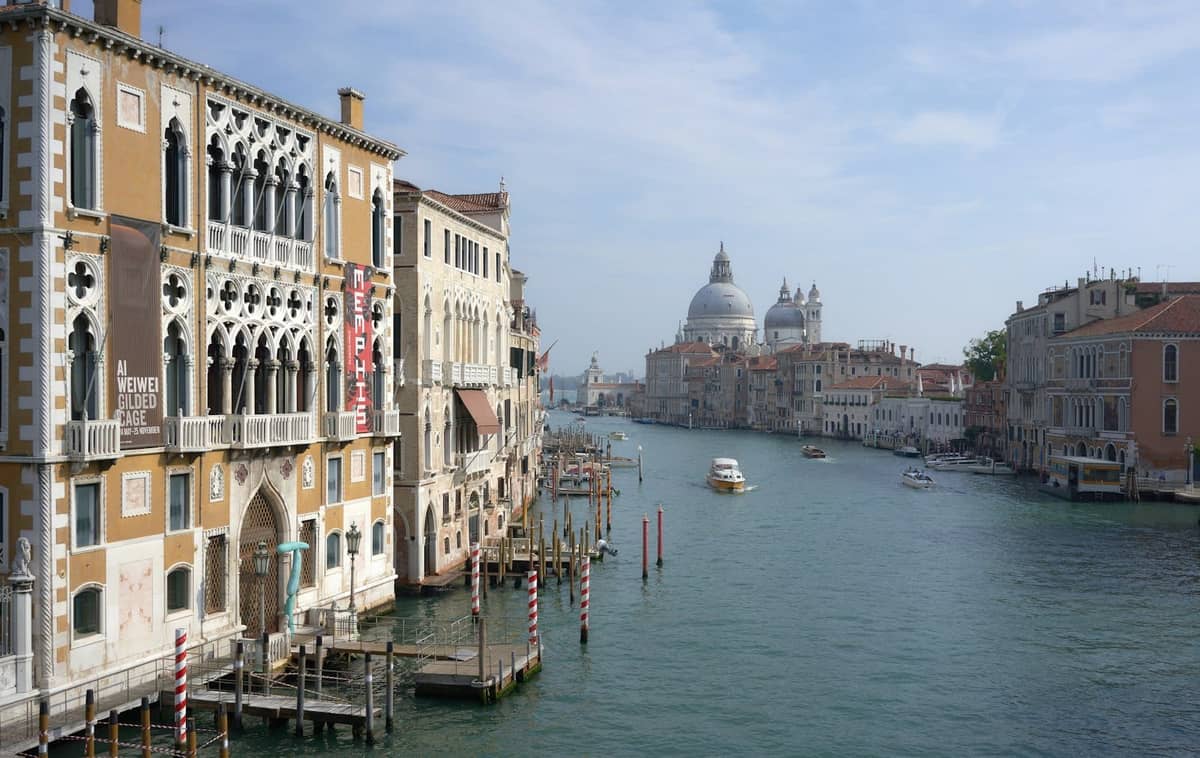
At the southern end, where the canal opens into the Bacino di San Marco, the domed Basilica di Santa Maria della Salute rises on the Dorsoduro bank. Built between 1631 and 1687 as a votive church after a devastating plague, its placement at the canal's mouth was deliberate: it was meant to be seen from the water, and it still reads as a full-stop at the end of the canal's long curve.
Tickets & tours
Hand-picked options from our booking partner. Prices are indicative; availability and final rates are confirmed when you complete your booking.
Grand Canal by gondola with commentary
From 36 €Instant confirmationFree cancellationSelf-guided Discovery Walk in Venice's Cannaregio
From 28 €Instant confirmationFree cancellationPrivate Gondola Ride on Grand Canal in Venice
From 149 €Instant confirmationFree cancellationVenice Boat Tour with Grand Canal and Tower Climb
From 119 €Instant confirmationFree cancellation
How the Canal Changes Through the Day
Early morning, roughly between 6:30 and 8:30, is when the canal belongs to the city rather than its visitors. Delivery barges loaded with produce, bottled water, and construction materials nudge up to side canals. Gondoliers prepare their boats at their moorings. The light at this hour, especially in spring and autumn, is pale and even, casting no harsh shadows on the palace facades. This is the best time for photography of the architecture, and vaporetti are rarely crowded.
By mid-morning, tourist traffic on vaporetto line 1 becomes significant, particularly between San Marco, Rialto, and Accademia. Standing room can fill quickly at peak season. Midday light on the canal is strong and contrasty, which flattens architectural detail but turns the water itself into a mosaic of reflections. It is a good time to be on a bridge rather than a boat.
Late afternoon, from around 16:30 onward, brings the most photographed light in Venice: warm, directional, and low, catching the upper floors of the palaces in gold while the water below turns deep green-grey. Gondola traffic increases at this hour. By early evening, the vaporetto crowds thin again, and the canal takes on a quieter character. The reflections of lit palazzo windows on the water after dark are the visual payoff for anyone willing to stay out past dinner.
ℹ️ Good to know
In autumn and winter, acqua alta (high water) events can affect vaporetto schedules and boarding points. Check the Comune di Venezia's official tide forecast or the Città di Venezia app before planning a morning trip on the canal during these seasons.
How to Travel the Canal: Your Practical Options
The most cost-effective way to see the Grand Canal is by ACTV vaporetto. Line 1 makes all intermediate stops and takes roughly 30 to 40 minutes end-to-end. Line 2 skips most stops and is faster but less useful for sightseeing. A standard ACTV ticket covers a single journey; multi-day travel cards cover unlimited rides on the vaporetto network and are worth calculating if you plan to use water transport across multiple days. Tickets and passes are available at ACTV booths at major stops, at Venice Santa Lucia station, and via the ACTV app. Verify current fares directly with ACTV before travel, as prices are subject to change.
Gondola rides are the traditional alternative. Official regulated fares in Venice are set for standard routes (verify current prices with official Venezia Unica information before booking, as fares are reviewed periodically). A gondola seats up to five passengers and provides a lower, quieter vantage point than a vaporetto. For the Grand Canal itself, gondoliers tend to use side canals rather than the main waterway. If you want the Grand Canal specifically, confirm the route before boarding. For a practical overview of what to expect, the gondola ride guide for Venice covers pricing, negotiation, and how to avoid common tourist traps.
Walking the canal is only partially possible, as no continuous embankment runs the full length. The four bridges offer the best elevated views. The Rialto Bridge is the most central and most crowded; the Accademia Bridge gives a clear sightline toward the Salute; the Scalzi Bridge sits near the station and is useful for orientation on arrival. The Ponte della Costituzione is the only bridge with ramp access, making it the most accessible crossing for those with mobility equipment. The other three bridges have steps and no lift alternatives.
Key Stops and What to Notice at Each
Santa Lucia / Ferrovia: This is the northern entry point to the canal. The station itself is a 1950s building, functional rather than ornamental, but stepping outside onto the water immediately resets expectations. The Ponte degli Scalzi is a few steps to the right. From here, the canal begins its slow curve south. The Rialto Bridge is the most recognizable landmark mid-canal, built in white Istrian stone between 1588 and 1591 after the previous wooden bridge collapsed. The arch spans about 28 metres with a clearance of roughly 7.5 metres above the water, with shops running along both sides.
The Rialto stop itself is adjacent to the Rialto Market, which has operated on this site since the 11th century. The fish hall (Pescheria) and produce stalls are active from early morning until early afternoon, and the sounds and smells from the water, the sharp brine of fish mingling with the sweetness of stone fruit in summer, are among the most immediate sensory experiences the canal offers.
At the Accademia stop, the Gallerie dell'Accademia is a two-minute walk from the landing stage. The wooden Accademia Bridge was originally built as a temporary structure in 1933; it has remained ever since and is now considered a characteristic feature of the canal. From its midpoint, the view south toward the Salute is the one reproduced most often in paintings of Venice.
The final stop before the Bacino opens is the Salute, directly in front of the basilica. A short walk along the Dorsoduro waterfront from here leads to the Peggy Guggenheim Collection, housed in the low, unfinished Palazzo Venier dei Leoni, the only building on the Grand Canal that has never been completed to its planned height. The terrace fronting the canal is one of the best free viewpoints in Venice, visible from passing water buses.
What to Know Before You Go
The Grand Canal is free to view from any bridge, embankment, or open waterfront area, and there is no ticket, booking, or reservation required. It is accessible 24 hours a day, every day of the year. The experience does not degrade in bad weather: grey skies and light rain can produce dramatic atmospheric effects, and winter fog, while occasionally inconvenient, gives the canal a quality that is impossible to photograph in summer.
Summer visitors should expect significant crowding on vaporetto line 1, particularly between approximately 10:00 and 18:00. If you are travelling during July or August, an early departure from your accommodation, before 8:00, will give you the canal largely to yourself. Winter, particularly January and February, offers the most uncrowded experience and the lowest prices across accommodation and services in Venice generally.
⚠️ What to skip
Vaporetto platforms can be genuinely crowded during peak season. Passengers with wheeled luggage, pushchairs, or mobility aids should allow extra boarding time and use the wider gangways at larger stops like Rialto and San Marco. Not all stops have step-free access to the floating platform.
From a photography standpoint, the ideal position for wide shots of the canal is from the midpoint of any bridge, particularly at the Rialto and Accademia. A longer focal length (85mm equivalent or more) compresses the perspective and emphasises the stacking of palaces. For drone photography, Venice has strict aviation regulations over the historic centre; check current rules with the Italian Civil Aviation Authority (ENAC) before any flight. For broader context on the best vantage points across the city, the guide to the best views in Venice covers rooftop terraces, campanile lookouts, and waterfront positions.
Insider Tips
- Board vaporetto line 1 at Santa Lucia station in the late afternoon rather than at a mid-canal stop. You get a full end-to-end trip with the best evening light hitting the facades as you travel south, and you avoid the scramble for seats that happens at Rialto.
- The San Toma vaporetto stop, between Rialto and Accademia, is one of the least crowded boarding points on the canal. If you are staying in San Polo or Santa Croce, use it instead of fighting the queues at Rialto.
- Free views of the canal from inside some of Venice's museums are easy to miss. The Ca' Rezzonico has canal-facing windows on upper floors, and the Palazzo Grassi's rear exit opens onto a small water-level terrace. Neither requires a detour.
- Water taxis are significantly more expensive than vaporetti but allow you to request a specific route. If you are arriving from Marco Polo Airport with luggage and want a single uninterrupted trip down the Grand Canal to your hotel, the cost difference may be worth it as a one-off arrival experience rather than a daily habit.
- The view from a traghetto (the traditional gondola ferry that crosses the canal at several points for a minimal fare) is brief but genuinely low on the water. These crossings take about 90 seconds and are used by locals daily. Look for them at the Santa Sofia, Riva del Carbon, and San Toma crossing points.
Who Is Grand Canal (Canal Grande) For?
- First-time visitors to Venice who want to understand the city's layout and scale before exploring on foot
- Architecture and art history enthusiasts who can identify the Gothic, Renaissance, and Baroque periods in the palace facades
- Photographers who want to plan their sessions around early morning or late afternoon light on the water
- Travellers arriving at Santa Lucia station, for whom the canal is the natural and recommended first impression of the city
- Anyone travelling with older children who will find the boat journey, traffic mix of gondolas and vaporetti, and activity on the water immediately engaging
Nearby Attractions
Other things to see while in San Marco:
- Bridge of Sighs (Ponte dei Sospiri)
The Ponte dei Sospiri is one of Venice's most photographed structures, an enclosed white limestone bridge linking the Doge's Palace to the New Prisons over the narrow Rio di Palazzo canal. You can see it for free from the Ponte della Paglia, or cross it from the inside as part of a Doge's Palace ticket. Here is everything you need to visit it well.
- Doge's Palace (Palazzo Ducale)
Doge's Palace is the Gothic heart of Venice's political history, rising at the edge of Piazza San Marco with a facade unlike anything else in Italy. This guide covers what you'll actually experience inside, when to visit for smaller crowds, and how to make the most of one of Europe's most significant civic buildings.
- Museo Correr
Occupying the grand Napoleonic Wing and part of the Procuratie Nuove above Piazza San Marco, the Museo Correr holds centuries of Venetian civic history, Renaissance painting, and lavishly decorated royal apartments. It rewards visitors who take their time, and it's consistently overlooked by crowds fixated on the Doge's Palace next door.
- Museo Fortuny (Palazzo Fortuny)
Tucked into a quiet campo in the heart of San Marco, Museo Fortuny occupies a 15th-century Gothic palace that served as the live-in atelier of polymath artist Mariano Fortuny. Part museum, part time capsule, it rewards visitors who seek something beyond the standard Venetian circuit.