Rialto Bridge (Ponte di Rialto): Venice's Grand Canal Crossing
The Ponte di Rialto is Venice's oldest and most photographed bridge, spanning the Grand Canal between San Polo and San Marco. Free to cross at any hour, it rewards early risers with calm and night owls with golden reflections. Here's everything you need to know before you go.
Quick Facts
- Location
- Ruga degli Orefici, 30125 Venice (connecting San Polo and San Marco)
- Getting There
- Vaporetto stop: Rialto (lines 1 and 2)
- Time Needed
- 15–30 minutes on the bridge; 1–2 hours with the surrounding market area
- Cost
- Free; no ticket required
- Best for
- Architecture lovers, photographers, Grand Canal views, and first-time visitors to Venice
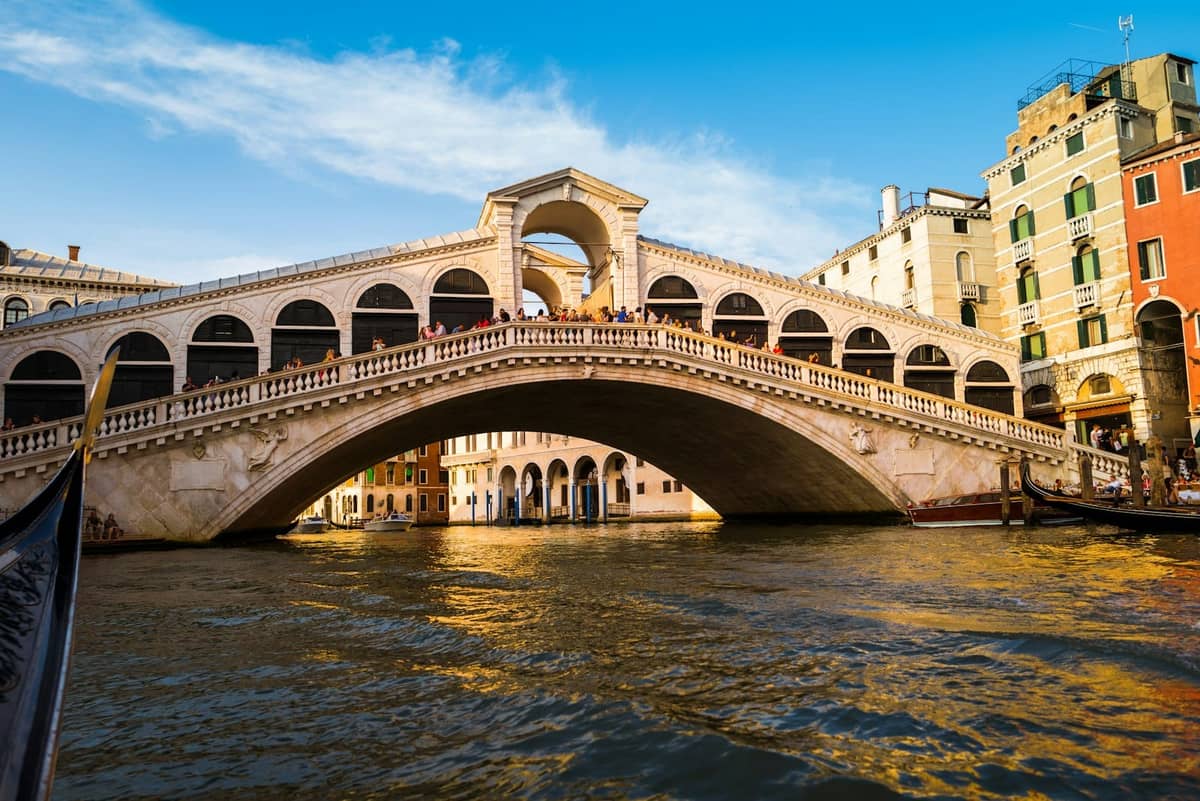
What the Rialto Bridge Actually Is
The Rialto Bridge, known in Italian as the Ponte di Rialto, is a white Istrian stone arch bridge that spans the Grand Canal at its narrowest point, with an arch span of roughly 28 metres at this crossing. It connects the sestiere of San Polo on the west bank with San Marco on the east, and has functioned as a commercial and civic hub for centuries. Completed in 1591 by architect Antonio da Ponte after a construction period beginning in 1588, it replaced a series of earlier wooden drawbridges that had served the same crossing since the medieval period.
The bridge is not just a crossing. It is a covered arcade with two parallel rows of shops running along its length, separated by a central open walkway and two lateral walkways with balustrades facing the canal. The shops have historically sold gold, jewellery, and textiles, and many still deal in similar goods today, though souvenirs have become increasingly common. This commercial character is not a modern intrusion; it dates back to the original design, which required shops to generate revenue and offset construction costs.
ℹ️ Good to know
The Rialto Bridge is open 24 hours a day, every day of the year. There is no admission charge. You do not need to queue, book, or register. Simply walk across.
The History Behind the Stone
Before the current stone structure, this crossing was a wooden pontoon bridge, then a wooden drawbridge. The site was a natural commercial focal point: the Rialto district had been Venice's mercantile heart since the eleventh century, and the bridge was the only fixed crossing of the Grand Canal for hundreds of years. When the wooden predecessor collapsed in 1524, debate over its replacement dragged on for decades. Proposals came from some of the most celebrated architects of the Renaissance, including Michelangelo and Andrea Palladio, but the commission ultimately went to Antonio da Ponte, a local architect whose practical, load-bearing design proved more appropriate to the site than the grander classical schemes proposed by his competitors.
The choice was controversial at the time but has aged well. Da Ponte's single-arch design, 48 metres in overall length with an arch span of about 28 metres, was structurally bold for its era and has required no major structural intervention in over four centuries. The bridge rests on thousands of timber piles driven into the canal bed, a standard Venetian foundation technique that, counterintuitively, preserves wood well in the anaerobic lagoon sediment.
Tickets & tours
Hand-picked options from our booking partner. Prices are indicative; availability and final rates are confirmed when you complete your booking.
Venice Legends, Anecdotes and Ghost Stories Tour
From 35 €Instant confirmationFree cancellationVenice highlights historical walking tour
From 27 €Instant confirmationFree cancellationRialto Market Tour, Cooking Class, and Lunch in Venice
From 149 €Instant confirmationFree cancellationShared gondola ride underneath the Bridge of Sighs
From 39 €Instant confirmationFree cancellation
What It Looks and Feels Like to Visit
Approach from the San Polo side and you climb a broad flight of stone steps that curves gently upward with the arch of the bridge. The steps are worn smooth and slightly uneven underfoot; rubber-soled shoes give better grip than leather-soled ones, especially in damp weather. At the apex, the view opens in both directions along the Grand Canal: a corridor of Renaissance and Gothic palaces framing water traffic below. Gondolas, delivery barges, vaporetti, and private water taxis all move through the same channel, creating a layered visual scene that shifts constantly.
The sound environment is distinctive. Traffic noise from boats mixes with the murmur of the market stalls in the nearby Rialto market, and with the general hum of pedestrian crowds passing through the arcade. On a busy afternoon in summer, the bridge becomes genuinely congested: the lateral walkways offer slightly more space than the central corridor, and the balustrade overlooks on each side are often occupied by people photographing or simply watching the canal.
The shops inside the arcade sell mostly jewellery, Murano glass items, leather goods, and souvenir merchandise. Prices in these particular shops tend to reflect their location rather than their product quality. Browsing is fine; buying requires the same scrutiny you would apply anywhere on a major tourist route.
💡 Local tip
The two lateral walkways along the outer edges of the bridge offer the best unobstructed views of the Grand Canal and are slightly less crowded than the central corridor. Step to the side balustrades to get a clear sightline for photographs.
When to Visit: Time of Day Makes a Significant Difference
Between roughly 10:00 and 18:00, particularly in spring and summer, the Rialto Bridge is one of the most crowded single points in Venice. Moving through the arcade at pace is difficult, and stopping for photographs can feel like swimming against a current. If you are arriving in peak season, the bridge at midday is an exercise in patience more than pleasure.
Early morning, before 8:00, is a different experience. The arcade is quiet, the canal light is soft and low, and you can stand at the balustrades for as long as you like without anyone pressing past. The Rialto market on the San Polo side begins setting up from around 7:30, so combining an early bridge crossing with a walk through the fish and produce market gives you two of Venice's most atmospheric experiences back to back.
After dark, the bridge takes on a different quality. The pale Istrian stone reflects the warm lighting installed beneath the arcade, and the Grand Canal below mirrors the lights of surrounding palaces. The crowds thin substantially after 21:00. If your itinerary allows flexibility, a late evening crossing, when the canal is quieter and the reflections are at their most photogenic, is one of the most rewarding ways to experience the structure.
For context on how to structure your day around the bridge and nearby sites, the Venice things to do guide covers the full range of the city's major attractions and how to sequence them efficiently.
The Surrounding Area: Rialto Market and San Polo
The bridge sits at the northern edge of the San Polo sestiere, and within a few minutes' walk you reach the Rialto market complex. The fish market, or Pescheria, operates Tuesday through Saturday mornings in a neo-Gothic hall built in 1907. Alongside it, the produce market (Erberia) spreads along the Grand Canal embankment. Both markets wind down by early afternoon, so timing your visit accordingly matters.
The Rialto market is where Venice shops for food, and the atmosphere at 8:00 on a weekday morning, when restaurant buyers are selecting the day's fish alongside local residents, reads as a functioning city rather than a stage set. This is one of the more grounding experiences available in central Venice.
From the San Polo side of the bridge, the Grand Canal extends southwest toward the Accademia and the Salute. From the San Marco side, it curves northeast toward the railway station. Both directions are worth photographing from the bridge at different times of day, as the light quality and canal activity vary considerably by hour.
Getting There and Practical Notes
Vaporetto lines 1 and 2 both stop at Rialto, on the San Marco side of the bridge. Line 1 is the slower local service that stops at every landing stage along the Grand Canal; line 2 makes fewer stops. From Piazzale Roma or the Santa Lucia train station, line 1 takes approximately 25 minutes to the Rialto stop. From the San Marco Vallaresso stop near St Mark's Square, line 1 takes roughly 10 minutes.
On foot, the bridge is reachable from Piazza San Marco in approximately 15 to 20 minutes by following the main route through the San Marco sestiere, well-signed with yellow directional arrows. From the Santa Lucia station, the walk takes around 30 to 35 minutes through Cannaregio and across the bridge at Santi Apostoli.
⚠️ What to skip
The Rialto Bridge is not accessible for wheelchair users or those with significant mobility limitations. The approach on both sides consists of stone steps, and there is no ramp or lift alternative at this crossing. The nearest accessible Grand Canal crossing is the Scalzi Bridge near the railway station, which also has steps, though some wider alternative routes exist; check current accessibility maps before planning your route.
In autumn and winter, acqua alta, the tidal flooding that affects low-lying parts of Venice, can make the approach routes around the bridge temporarily difficult. The bridge itself sits high enough to remain above typical flood levels, but the surrounding calli and campielli may have raised platforms installed. Check the Venice municipality's acqua alta forecast if you are visiting between October and February.
Photography Considerations
The Rialto Bridge is among the most photographed structures in Italy. Getting a composition that feels personal rather than generic requires either timing or a different angle. From the bridge itself, the Grand Canal views are straightforward. For photographs of the bridge as a subject, the most effective positions are from the water level embankments on either side: the Fondamenta del Vin on the San Polo bank, and the Riva del Carbon on the San Marco side. Both give you a low, direct sight line to the arch.
Gondolas passing beneath the arch are a reliable compositional element in the morning; delivery barges are more common later in the day. A wide-angle lens or the equivalent focal length on a phone camera handles the full arch comfortably from street level. In summer, direct sun hits the bridge facade from the southeast in the morning and from the northwest in the late afternoon; overcast days actually produce more even, usable light on the stone.
If Grand Canal views from an elevated or unusual perspective interest you, the best views in Venice guide covers other vantage points across the city that complement a Rialto visit.
Insider Tips
- Cross the bridge before 8:00 and then walk directly into the Rialto fish market while it is still busy with restaurant buyers. Both experiences together take less than an hour and represent the most efficient way to see Venice functioning as a real city.
- The Fondamenta del Vin, the embankment running along the San Polo side of the canal just south of the bridge, has several cafe tables facing the water. Sitting there with a coffee while watching canal traffic below the bridge gives you a slower, less compressed version of the Rialto experience than fighting through the arcade.
- If you want to photograph the bridge without crowds in the frame, 06:30 to 07:30 is your window in summer. Later than 08:00, even in winter, you will begin encountering other visitors.
- The shops inside the arcade, while part of the bridge's historical commercial character, are not where you should buy Murano glass or jewellery. The markup at this specific location tends to be higher than at comparable shops a few streets away.
- On a vaporetto (line 1 in particular), you pass directly beneath the Rialto Bridge as the boat travels the Grand Canal route. Looking up at the arch from water level as you pass under it is a perspective most visitors on foot never get, and the line 1 ride itself is one of the most cost-effective ways to see the Grand Canal's palaces.
Who Is Rialto Bridge (Ponte di Rialto) For?
- First-time visitors to Venice who want to orient themselves along the Grand Canal
- Architecture enthusiasts interested in late Renaissance engineering and urban design
- Photographers working early morning or late evening when light and crowds cooperate
- Travellers combining a canal walk with the Rialto market on a weekday morning
- Anyone planning a Grand Canal vaporetto ride who wants to understand the route before boarding
Nearby Attractions
Other things to see while in San Polo:
- Basilica di Santa Maria Gloriosa dei Frari
The Basilica di Santa Maria Gloriosa dei Frari is one of Venice's largest and most significant churches, home to Titian's luminous Assumption of the Virgin, Canova's pyramid tomb, and centuries of Venetian history carved in stone and marble. It rewards slow, attentive visitors far more than a quick walkthrough.
- Rialto Market (Mercato di Rialto)
The Mercato di Rialto has supplied Venice with fish, vegetables, and the rhythms of daily life for nearly a thousand years. Spread along the Grand Canal in the San Polo sestiere, it opens early, closes by midday, and rewards visitors who show up before the tour groups arrive.
- Scuola Grande di San Rocco
The Scuola Grande di San Rocco houses over 60 paintings by Tintoretto, displayed in the very rooms they were commissioned for. This 16th-century confraternity hall in San Polo is one of the most concentrated displays of Renaissance painting in Italy, and it remains far less visited than its reputation deserves.