Scuola Grande di San Rocco: Venice's Greatest Painting Cycle, Exactly Where It Was Made
The Scuola Grande di San Rocco houses over 60 paintings by Tintoretto, displayed in the very rooms they were commissioned for. This 16th-century confraternity hall in San Polo is one of the most concentrated displays of Renaissance painting in Italy, and it remains far less visited than its reputation deserves.
Quick Facts
- Location
- Campo San Rocco, San Polo 3052, Venice
- Getting There
- Vaporetto: San Tomà (lines 1, 2) — 3-minute walk. Also 5 min on foot from Piazzale Roma, 8 min from Santa Lucia train station.
- Time Needed
- 60–90 minutes for the full cycle; 45 minutes if focused
- Cost
- Scuola admission typically around €10–€12 full / reduced rates available; Church of San Rocco charged separately. Verify current rates on the official site.
- Best for
- Art history enthusiasts, Renaissance painting, architecture, quiet museum-going
- Official website
- www.scuolagrandesanrocco.org/en
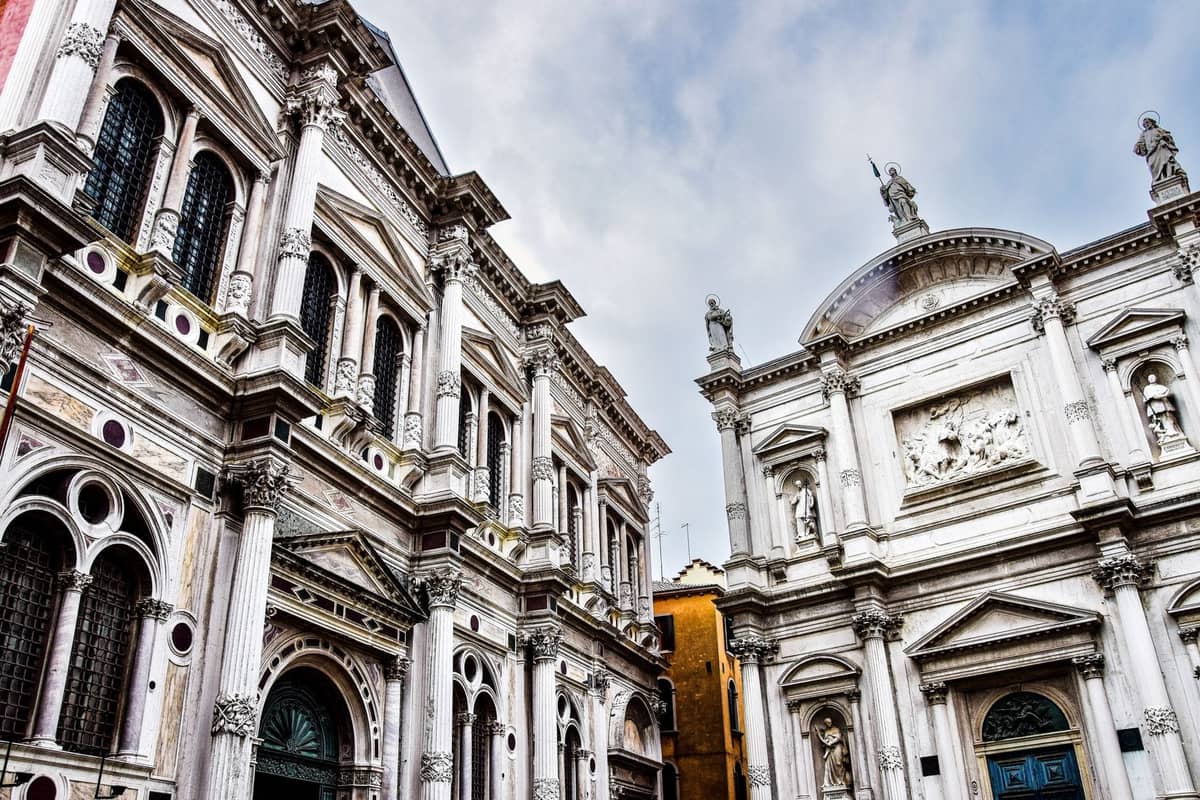
What the Scuola Grande di San Rocco Actually Is
Most visitors walking through San Polo come here on their way to the Frari basilica and nearly walk past it. That would be a serious mistake. The Scuola Grande di San Rocco is not a museum in the conventional sense. It is the preserved headquarters of a lay confraternity, a wealthy brotherhood founded in 1478 and elevated to Scuola Grande status by Venice's Council of Ten a few years later. The building that stands today was constructed between 1517 and 1549, and it remains one of the most complete examples of a functioning Renaissance institution anywhere in Italy.
What makes the building extraordinary is not just its architecture but what happened inside it between 1564 and 1588. Jacopo Tintoretto, one of the most technically daring painters of the 16th century, won the commission to decorate the Scuola and then spent the rest of his working life doing so. The result is a cycle of over 60 paintings covering the walls and ceilings of three interconnected rooms. They have never been moved. The scale and density of the commission is comparable only to the Sistine Chapel, and unlike the Sistine, you can stand two meters from the work.
💡 Local tip
The Scuola provides large mirrors on wheels in the upper hall so you can view the ceiling paintings without craning your neck. Use them. The Crucifixion panel alone stretches 12 meters across and requires the mirror to be fully appreciated.
The Three Rooms: A Practical Walkthrough
Entering from Campo San Rocco, you pass through the ground-floor hall, the Sala dell'Albergo on the main floor, and then into the vast Upper Hall before doubling back. The spatial sequence matters because Tintoretto planned it that way. Each room has a distinct theological program, and moving through them in order gives the cycle its cumulative weight.
The ground floor focuses on the life of the Virgin Mary: the Annunciation, Adoration of the Magi, and the Flight into Egypt are here, painted with a theatricality that borders on cinematic. Light cuts through these canvases at sharp angles. Tintoretto's figures move with physical urgency that sets him apart from contemporaries like Veronese, whose work in Venice tends toward stately elegance. These paintings in the ground hall were among the last Tintoretto completed, added in 1583 to 1587, but they are often the first rooms visitors see.
The Sala dell'Albergo, reached by a staircase off the upper hall, contains the single most important work in the building: the Crucifixion of 1565. At roughly 5.4 by 12 meters, it is one of the largest paintings executed on a single canvas in history. Henry James, visiting in the 19th century, wrote that it was 'the greatest picture in the world,' and while that judgment is subjective, the painting's command of crowd, light, and psychological weight is genuinely difficult to overstate. Give this room fifteen minutes on its own.
The Upper Hall ceiling presents 21 panels depicting scenes from the Old Testament, with Moses striking water from the rock, the gathering of manna, and the fall of quail among the subjects. The mirrors come into their own here. Standing on the stone floor and tilting the wheeled mirror to the angle you want, you can study individual passages of paint at close range. The color, particularly the quality of blue in the sky panels, holds a luminosity that defies the age of the work.
Tickets & tours
Hand-picked options from our booking partner. Prices are indicative; availability and final rates are confirmed when you complete your booking.
Self-guided Discovery Walk in Venice's Cannaregio
From 28 €Instant confirmationFree cancellationGrand Canal by gondola with commentary
From 36 €Instant confirmationFree cancellationPrivate Gondola Ride on Grand Canal in Venice
From 149 €Instant confirmationFree cancellationVenice Boat Tour with Grand Canal and Tower Climb
From 119 €Instant confirmationFree cancellation
History and Why the Confraternity Matters
The lay confraternities of Venice, called scuole, were not schools in the modern sense. They were mutual aid societies organized around devotion to a patron saint, and by the 15th century the six Scuole Grandi had accumulated substantial wealth and political influence. The Scuola Grande di San Rocco was dedicated to Saint Roch, a 14th-century French pilgrim venerated as a protector against plague. In 1485 the confraternity acquired what it claimed were the relics of the saint's body, a transaction that dramatically increased its prestige at a moment when plague remained an existential fear in the lagoon city.
That prestige funded the building and the art program. When Tintoretto competed for the Sala dell'Albergo commission in 1564, he famously bypassed the competition format entirely. Rather than submitting a preparatory sketch as the other candidates did, he installed a completed ceiling panel overnight and presented the governing board with the finished work as a gift. The Scuola accepted it, and Tintoretto had effectively secured a relationship with the building that would define both his career and the institution's identity.
The confraternity still exists today. The entry fees collected from visitors contribute directly to restoration, conservation, and the charitable activities the brotherhood has maintained for over five centuries. This is not incidental: you are not paying to see a museum collection that happened to end up in a civic building. You are entering a living institution. For more on how Venice's historic institutions fit into the wider art landscape, see our guide to the best museums in Venice.
How the Experience Changes by Time of Day
The Scuola opens at 09:30. For the first hour, visitor numbers are low enough that the Upper Hall is often nearly empty. The natural light through the upper windows is cool and raking in the morning, which tends to flatten some of the warmer tones in the ceiling panels but reveals the impasto texture of Tintoretto's brushwork with unusual clarity. If close observation of paint surface is your interest, morning is the better choice.
By midday the rooms fill, primarily with tour groups moving quickly through. The narrow staircase between the ground floor and upper rooms becomes briefly congested around 11:00 to 13:00 on busy days. Tour group sizes are capped at 25 people by Venetian municipal regulation, which helps, but the Sala dell'Albergo in particular can feel tight when multiple groups arrive simultaneously. The Crucifixion benefits from solitude; if you arrive and find the room occupied, wait.
Late afternoon, roughly 15:30 onward, brings warmer light from the west-facing windows, which deepens the reds and golds in the ground-floor Magi scene considerably. The ticket office closes at 17:00 and the building at 17:30, so there is a natural emptying of visitors in the final hour. This is arguably the best window for unhurried viewing, particularly in the Upper Hall where the low afternoon sun adds warmth to panels that can look cold under midday light.
Photography Conditions and Practical Considerations
Photography without flash is permitted throughout the Scuola. The biggest challenge is light: the interior relies on a combination of natural light from high windows and artificial illumination that is deliberately kept low to protect the canvases. A wide aperture and steady hands are essential for ceiling shots. The mirror carts are legitimately useful here because they double as a stable surface to rest a phone or small camera against when composing ceiling images.
The Crucifixion in the Sala dell'Albergo is too wide to capture in a single frame from any position inside the room. The conventional approach is to photograph it in sections or accept a stitched panorama in post-processing. The overall composition, with Christ's cross at center-left and the crowd activity spreading across the canvas, is better understood in person than in any photograph.
ℹ️ Good to know
The adjacent Church of San Rocco requires a separate ticket (often a small additional fee — verify on site). It contains additional Tintoretto paintings in their original altar positions. The church is worth 20 minutes if you want to extend the Tintoretto experience, though the Scuola itself is the primary destination.
The Scuola sits in the heart of the San Polo sestiere, a short walk from the Basilica dei Frari and the Rialto Market. Planning these three together makes for a coherent half-day in San Polo without unnecessary doubling back.
Who Will Not Enjoy This Place
Travelers with no particular interest in Italian Renaissance painting will find the Scuola difficult. There is very little interpretive signage in the building beyond basic labels. The rooms are dark, the ceiling panels require physical effort to view, and the theological programs that structure each room are not explained at the point of entry. Visitors who want context benefit considerably from reading in advance or booking a guided visit.
Those with mobility difficulties should note that the main upper floor and Sala dell'Albergo are accessed by stairs. Accessibility information is limited on the official site, so contact the Scuola directly before visiting if this is a concern. The building also has no cafe, no gift shop of note, and no seating in most rooms. It is purely a space for looking at paintings.
If you are building a wider art itinerary for Venice, the Gallerie dell'Accademia and the Peggy Guggenheim Collection offer very different experiences with stronger interpretive infrastructure. The Scuola rewards preparation and patience.
Getting There and Practical Logistics
The most reliable approach is vaporetto lines 1 or 2 to the San Tomà stop, then a three-minute walk west through Calle del Traghetto toward Campo San Rocco. The campo is not large and is easy to navigate even without a map once you are in the vicinity: the white Istrian stone facade of the Scuola faces the campo directly. If arriving on foot from Santa Lucia station, the walk takes roughly eight minutes through Calle dei Preti and Campo San Stin; from Piazzale Roma, approximately five minutes via Calle dei Preti.
The Scuola is open daily from 09:30 to 17:30, with the ticket office closing at 17:00. It is closed on 25 December, 1 January, and Easter. Payment is accepted by cash, debit card, or credit card. Admission is typically in the €10–€12 range for a full-price ticket, with reduced rates available; verify the current rates on the official site before visiting, as prices change periodically. The adjacent church is ticketed separately.
⚠️ What to skip
Venice's acqua alta (high tide flooding) primarily affects low-lying streets near the Grand Canal and around San Marco. Campo San Rocco sits at a slightly higher elevation and may be less affected, but check tide alerts on the official Venezia Unica app if visiting between October and February.
Insider Tips
- Before you enter, spend two minutes looking at the exterior facade from the middle of the campo. The carved reliefs on the lower level and the rhythm of the upper windows are part of the same artistic program as the interior, designed by Bartolomeo Bon and Pietro Bon, and they set the visual tone for what Tintoretto was responding to.
- Use the wheeled mirrors in the Upper Hall systematically rather than randomly. Start at the far end of the hall away from the staircase and work back toward it. This roughly follows the chronological order of the ceiling commissions and gives the iconographic program a legible sequence.
- The Sala dell'Albergo tends to empty briefly around 13:00 when tour groups break for lunch. If you time your visit to arrive at the Scuola around 12:30 and head to the Sala first, you may have the Crucifixion largely to yourself for fifteen to twenty minutes.
- A single audio guide or a dedicated guidebook to the Tintoretto cycle (Tom Nichols's 'Tintoretto: Tradition and Identity' is the most thorough English-language resource) will multiply the value of a visit significantly. The wall labels alone are too sparse to explain the narrative and theological choices in each room.
- The Church of San Rocco directly adjacent is traditionally believed to house the remains of Saint Roch, acquired in 1485. The €2 entry is worth it specifically for Tintoretto's 'Saint Roch Curing the Plague' on the right nave wall, which gives concrete visual form to the devotional purpose that funded the entire Scuola.
Who Is Scuola Grande di San Rocco For?
- Art history enthusiasts with specific interest in Venetian Renaissance and Mannerist painting
- Visitors who have already seen the major ticket attractions and want the experience that serious art travelers consider unmissable
- Anyone building a half-day San Polo itinerary combining the Frari, the Rialto Market, and the Scuola
- Photographers who can work in low light and want to attempt ceiling composition without the physical difficulty of the Sistine Chapel
- Travelers interested in Venetian civic and religious history beyond the standard San Marco narrative
Nearby Attractions
Other things to see while in San Polo:
- Basilica di Santa Maria Gloriosa dei Frari
The Basilica di Santa Maria Gloriosa dei Frari is one of Venice's largest and most significant churches, home to Titian's luminous Assumption of the Virgin, Canova's pyramid tomb, and centuries of Venetian history carved in stone and marble. It rewards slow, attentive visitors far more than a quick walkthrough.
- Rialto Bridge (Ponte di Rialto)
The Ponte di Rialto is Venice's oldest and most photographed bridge, spanning the Grand Canal between San Polo and San Marco. Free to cross at any hour, it rewards early risers with calm and night owls with golden reflections. Here's everything you need to know before you go.
- Rialto Market (Mercato di Rialto)
The Mercato di Rialto has supplied Venice with fish, vegetables, and the rhythms of daily life for nearly a thousand years. Spread along the Grand Canal in the San Polo sestiere, it opens early, closes by midday, and rewards visitors who show up before the tour groups arrive.