Basilica dei Frari: Venice's Gothic Masterpiece in San Polo
The Basilica di Santa Maria Gloriosa dei Frari is one of Venice's largest and most significant churches, home to Titian's luminous Assumption of the Virgin, Canova's pyramid tomb, and centuries of Venetian history carved in stone and marble. It rewards slow, attentive visitors far more than a quick walkthrough.
Quick Facts
- Location
- Campo dei Frari 3072, San Polo, Venice
- Getting There
- Vaporetto San Tomà (lines 1, 2, and N), then a 5-minute walk
- Time Needed
- 45 minutes to 1.5 hours
- Cost
- Adult admission typically around €8; reduced rates available. Verify current prices at basilicadeifrari.it before visiting.
- Best for
- Art lovers, history enthusiasts, and anyone seeking calm away from the San Marco crowds
- Official website
- www.basilicadeifrari.it
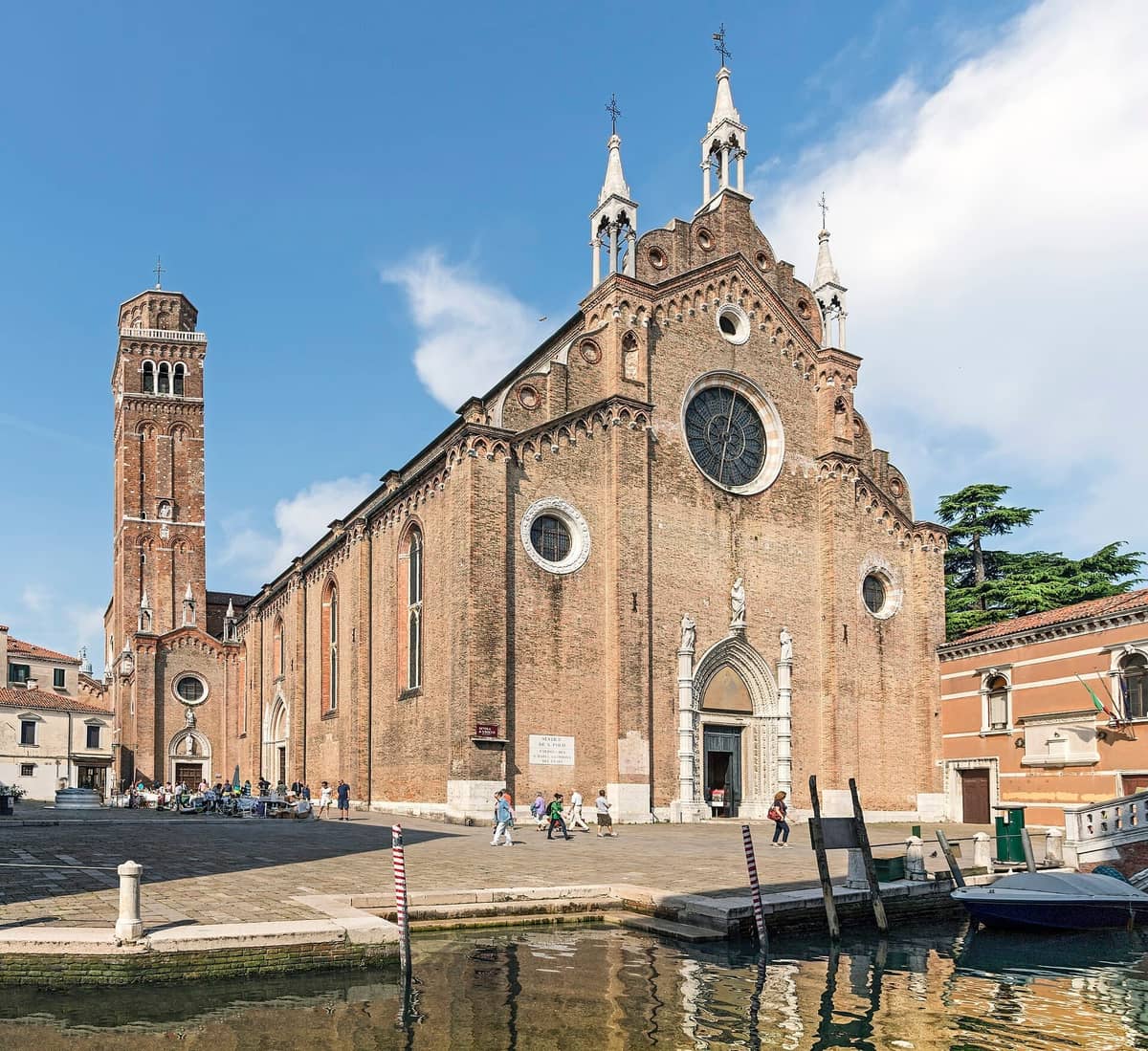
What the Frari Actually Is
The Basilica di Santa Maria Gloriosa dei Frari, universally known as "I Frari," is a Franciscan Gothic church in the San Polo sestiere that ranks among the most important sacred buildings in Italy, not just Venice. It was originally built between 1236 and 1338 and then thoroughly rebuilt in the 14th and 15th centuries, though the Franciscan presence on the site dates to around 1250. The church was elevated to the status of minor basilica in 1926. Its brick exterior is plain to the point of severity, which makes the interior all the more striking.
Unlike many Venetian churches that feel like compact jewel boxes, the Frari is genuinely vast: three broad naves, a soaring Gothic apse, and a depth that makes the altarpiece at the far end look almost unreachable when you first step through the door. That altarpiece is Titian's Assumption of the Virgin (1516-1518), and it is not a painting you stumble across. It fills the apse window, backlit in a way that turns the reds and golds molten on a sunny afternoon.
💡 Local tip
Visit on a sunny morning or early afternoon rather than overcast days. Natural light through the apse transforms the Titian altarpiece in a way no artificial lighting can replicate.
The Art Inside: What to Actually Look For
Titian dominates the Frari, but the church holds more than one landmark work. In the sacristy hangs Giovanni Bellini’s Madonna di Ca' Pesaro triptych (1488-1490), which is quieter and more intimate than the Assumption but rewards close attention for its almost optical warmth. Titian's second major work here, the Pesaro Madonna altarpiece (1519-1526) on the left nave, broke with centuries of convention by placing the Virgin off-center. Standing in front of it, you notice that the diagonal composition still feels entirely natural.
At the western end of the nave, Antonio Canova's tomb is unmistakable: a pyramidal marble mausoleum that looks more like a work of Romantic imagination than a funerary monument. Canova designed the pyramid monument in the early 19th century as his own funerary monument; his heart is entombed here, while his body is in Possagno. Directly opposite stands the monument to Titian himself, built by his students in the 19th century.
The wooden choir screen (jubé) dividing the nave is a piece of Gothic woodcarving that most visitors walk past without slowing down. The choir stalls inside it, dating from the late 15th century, contain over 100 intarsia panels depicting Venice in miniature. Give them five minutes. They are some of the finest decorative woodwork in northern Italy.
Tickets & tours
Hand-picked options from our booking partner. Prices are indicative; availability and final rates are confirmed when you complete your booking.
Skip-the-line guided tour of Doge's Palace and Saint Mark's Basilica
From 106 €Instant confirmationFree cancellationExclusive Saint Mark's Basilica After Dark and Doge's Palace Tour
From 149 €Instant confirmationFree cancellationMorning walking tour of Venice with St. Mark's Basilica and gondola ride
From 105 €Instant confirmationFree cancellationVenice small-group walking tour with St. Mark's Basilica and Gondola Ride
From 79 €Instant confirmationFree cancellation
What It Feels Like at Different Times of Day
At 9:00, when the doors open on weekdays, the church belongs almost entirely to early-arriving visitors and a handful of people attending morning prayers. The stone floor is cold underfoot even in summer. The nave echoes with footsteps and the distant sound of canals outside. This is the best window for photography: the light entering the high Gothic windows is soft and directional, and there are no crowds positioned between you and the altarpiece.
By midday the atmosphere shifts. Tour groups begin to arrive, and voices accumulate under the vault. The Titian altarpiece is being explained in multiple languages simultaneously. The church can absorb a fair number of people without feeling overwhelming, but if you want silence, come before 10:30 or after 16:30.
On Sunday afternoons the church opens to visitors from 13:00, but morning services mean the space feels more inhabited by its religious purpose. The incense from the morning lingers faintly in the air for hours.
Getting There and Practical Details
The closest vaporetto stop is San Tomà, served by lines 1 and 2 on the Grand Canal. From the stop it is a five-minute walk through the streets of San Polo: follow signs for Frari and you will not get lost. The walk takes you past small shops and residential calli that feel nothing like the area around Piazza San Marco.
Opening hours operate on a seasonal schedule. In summer, the church is open Monday to Friday 9:00-19:30, Saturday 9:00-18:00, and Sunday and holidays 13:00-18:00. In winter, hours are Monday through Saturday 9:00-18:00 and Sunday/holidays 13:00-18:00. These hours can change; confirm at the official website before visiting.
Adult admission is typically around €8, with reduced rates for students and seniors. The Frari is not covered by the Chorus Pass, Venezia Unica, or standard city museum passes, so plan for a separate ticket. Verify current pricing at basilicadeifrari.it.
⚠️ What to skip
Modest dress is required to enter: covered shoulders and knees. This is enforced, not just suggested. Carry a scarf or light layer if you are visiting in summer.
Context: Where It Sits in Venice's Artistic Landscape
The Frari sits at the center of a remarkable concentration of art in San Polo. The Scuola Grande di San Rocco, next door (a few minutes' walk), contains Tintoretto's cycle of 50-plus paintings that John Ruskin called the greatest in the world. The two institutions together form one of the most significant artistic pairings in any city, and visiting both in sequence on the same morning is entirely feasible.
For context on where the Frari fits within Venice's full museum and church landscape, the guide to Venice's best churches compares it with other major religious sites across the city. The Gallerie dell'Accademia in Dorsoduro holds Bellini's and Titian's panel paintings in a secular setting, which makes for an interesting contrast with the devotional context here.
Photography and Accessibility
Photography without flash is generally permitted in the nave and side chapels. The Titian altarpiece is difficult to photograph well in the middle of the day due to the strong backlight from the apse windows. Early morning, when the angle is lower, produces far better results. A wide lens is useful in the nave; a 24mm equivalent or wider will capture the full height of the Gothic apse without distorting too severely.
The church floor is largely flat and stone-paved. There is no official accessibility statement on the primary source materials reviewed for this guide, so visitors with mobility requirements should contact the basilica directly via the official website before visiting.
ℹ️ Good to know
The Campo dei Frari square outside the basilica is a good resting point. It has a few benches and a quieter energy than the main tourist arteries, and the brick facade of the church itself is worth examining before you go in.
Insider Tips
- Buy tickets at the basilica entrance or check basilicadeifrari.it in advance. The Frari is not covered by the Chorus Pass, Venezia Unica, or standard city museum passes — budget a separate admission.
- The sacristy is included in the entry price and contains Giovanni Bellini's triptych in its original frame and original location. Most visitors skip it. It is arguably the most serene space in the entire building.
- Arrive within the first 30 minutes of opening on weekdays. By 10:00 the first organized tours begin to stack up at the altarpiece. By 11:00 the acoustic texture of the nave changes noticeably.
- The intarsia choir stalls are set slightly behind the wooden screen in the center of the nave. You need to step inside the choir enclosure to see the full panels. The entry is included in your ticket.
- Combine the visit with the Scuola Grande di San Rocco next door. Together they take 2.5 to 3 hours and cover an enormous breadth of 16th-century Venetian painting in a single walk.
Who Is Basilica di Santa Maria Gloriosa dei Frari For?
- Art history enthusiasts who want to see Titian's work in its original devotional setting
- Travelers building a church-and-art itinerary in San Polo
- Anyone looking for a substantive alternative to the crowds concentrated around St. Mark's Basilica
- Architecture-focused visitors interested in Gothic brickwork and Venetian ecclesiastical design
- Photographers seeking interior Gothic spaces with good natural light conditions in the morning
Nearby Attractions
Other things to see while in San Polo:
- Rialto Bridge (Ponte di Rialto)
The Ponte di Rialto is Venice's oldest and most photographed bridge, spanning the Grand Canal between San Polo and San Marco. Free to cross at any hour, it rewards early risers with calm and night owls with golden reflections. Here's everything you need to know before you go.
- Rialto Market (Mercato di Rialto)
The Mercato di Rialto has supplied Venice with fish, vegetables, and the rhythms of daily life for nearly a thousand years. Spread along the Grand Canal in the San Polo sestiere, it opens early, closes by midday, and rewards visitors who show up before the tour groups arrive.
- Scuola Grande di San Rocco
The Scuola Grande di San Rocco houses over 60 paintings by Tintoretto, displayed in the very rooms they were commissioned for. This 16th-century confraternity hall in San Polo is one of the most concentrated displays of Renaissance painting in Italy, and it remains far less visited than its reputation deserves.