Gallerie dell'Accademia: Venice's Greatest Collection of Venetian Art
The Gallerie dell'Accademia is the world's most important repository of Venetian painting, spanning five centuries of art from the Gothic period through the 18th century. Set in a converted monastery complex in Dorsoduro, this is the one art museum in Venice that genuinely rewards dedicated time rather than a quick walk-through.
Quick Facts
- Location
- Campo della Carità, Dorsoduro 1050, Venice
- Getting There
- Vaporetto lines 1 or 2, Accademia stop
- Time Needed
- 2 to 3 hours minimum; 4 hours for a thorough visit
- Cost
- €12 full price; €2 reduced (ages 18–25); free under 18
- Best for
- Art history enthusiasts, serious museum-goers, Venetian Renaissance lovers
- Official website
- www.gallerieaccademia.it
The Gallerie dell'Accademia di Venezia stands at the southern end of the Ponte dell'Accademia, a short walk from the wooden bridge that has served as one of the Grand Canal's most photographed crossings since the 1930s. The museum complex occupies three historic religious buildings: the Church of Santa Maria della Carità, its adjoining monastery, and the Scuola Grande di Santa Maria della Carità. Together they form a layered architectural ensemble that is itself worth studying before you step inside the galleries.
💡 Local tip
Book tickets online in advance through the official site (gallerieaccademia.it). Walk-up queues on busy mornings can add 30–45 minutes to your visit, and the ticket office typically closes at 18:15, about an hour before the museum itself on days with a 19:15 closing.
What the Gallerie dell'Accademia Actually Is
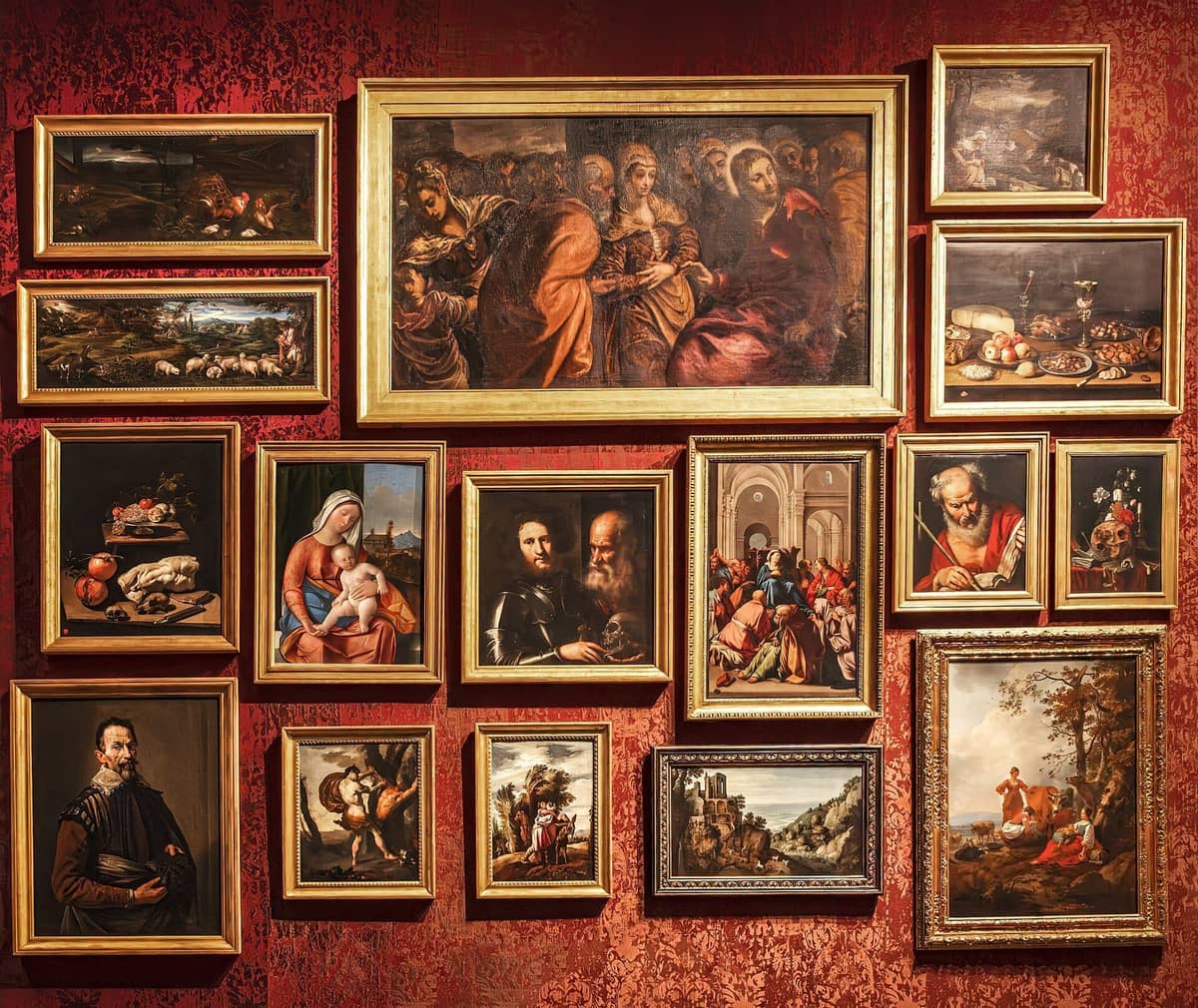
Opened to the public in 1817, the Gallerie dell'Accademia was established as a separate institution from the Accademia di Belle Arti di Venezia specifically to house pre-19th-century Venetian art. Its founding coincided with a period when Napoleonic suppression of religious institutions had flooded the city with displaced artworks, and the galleries became a kind of ark for paintings that had been stripped from churches, scuole grandi, and palaces across the Republic. That origin story matters for understanding what you are looking at: this is not a collection built by a single aristocratic taste, but an accumulation of civic memory.
Today the museum holds more than 800 works, making it the largest and most important collection of Venetian painting in the world. The chronological arc runs from 14th-century Byzantine-influenced Gothic panels to the confident, light-saturated canvases of the 18th century. Bellini, Carpaccio, Giorgione, Titian, Veronese, Tintoretto, Tiepolo: this is the full lineage of Venetian art in a single building.
The Collection Room by Room: What to Prioritize
The galleries are organized broadly in chronological sequence across 24 rooms. Room 1 sets the tone with gold-ground altarpieces from the 14th and early 15th centuries: Lorenzo Veneziano and Paolo Veneziano anchor this space with the flat, hieratic grandeur typical of the Byzantine tradition still dominant in Venice at the time. The shift in the following rooms is dramatic. Giovanni Bellini, represented here in depth, shows you exactly how Venetian painting began absorbing the Renaissance fascination with light, atmosphere, and believable human emotion.
Room 5 holds Giorgione's 'La Tempesta', a small canvas that has generated more scholarly debate than almost any other Italian painting. Its subject remains unresolved after five centuries, but standing in front of it in person, the uncanny stillness of the scene and the bruised green sky above the lightning strike create an atmosphere that reproductions never quite convey. Nearby, Bellini's 'San Giobbe Altarpiece' demonstrates the mature mastery of color and architectural setting that made Venetian painting distinctively its own school rather than a provincial echo of Florence.
Rooms 10 and 11 contain the museum's largest and most theatrically impressive canvases. Veronese's 'Feast in the House of Levi' fills an entire wall: originally painted as a Last Supper, it was ordered revised by the Inquisition in 1573 after Veronese refused to remove the dogs, dwarfs, and German soldiers he had included. He solved the problem by simply renaming the scene. Tintoretto's cycle nearby shows a more turbulent approach to the same Counter-Reformation era, with figures caught in violent diagonal compositions and chiaroscuro drama.
Room 20 houses Carpaccio's cycle of nine large canvases depicting the Legend of Saint Ursula, originally painted for the Scuola di Sant'Orsola between 1490 and 1498. This is one of the most detailed documentary records of late 15th-century Venetian civic life in existence: the costumes, the harbor architecture, the ships, and the ceremonial landscapes give you a picture of the Republic at its height that no history book matches. Allow at least 20 minutes here.
ℹ️ Good to know
Leonardo da Vinci's Vitruvian Man is held by the Accademia but is only displayed at certain times of year due to its extreme fragility. Check the official website before your visit if seeing it is your primary goal.
Tickets & tours
Hand-picked options from our booking partner. Prices are indicative; availability and final rates are confirmed when you complete your booking.
Accademia Galleries Venice entrance tickets
From 20 €Instant confirmationDoge's Palace skip-the-line tour
From 67 €Instant confirmationFree cancellationVenice Legends, Anecdotes and Ghost Stories Tour
From 35 €Instant confirmationFree cancellationGhosts and legends tour of Venice
From 29 €Instant confirmationFree cancellation
How the Experience Changes by Time of Day
The museum opens at 08:15, and the first hour is noticeably calmer than the rest of the day. The light in the older rooms near the church end of the complex is cool and slightly diffuse in the morning, which suits the gold-ground panels in Room 1 particularly well. The Gothic gilding responds differently under the flat morning light compared to the warmer midday conditions further into the visit.
By 10:30 to 11:00, tour groups begin arriving in earnest. The rooms containing the Veronese and Tintoretto canvases become crowded with guided parties, and the audioguide narration from multiple groups can overlap uncomfortably in the larger spaces. If you arrive at opening and move through the early rooms at a measured pace, you will typically reach Rooms 10 and 11 just as the first groups are still forming near the entrance, giving you a window of relative quiet.
Late afternoon, from about 16:00 onward, is the second-best window. Many visitors have moved on, and the ticket office having closed at 18:15 means the population thins steadily. The Carpaccio cycle room in particular becomes more contemplative in the lower light of late afternoon, though the museum closes at 19:15, so this approach requires discipline to reach the rooms you most want to see before the final hour.
Getting There and Getting In
The Accademia vaporetto stop is served by lines 1 and 2. From Piazzale Roma or the Ferrovia (Santa Lucia train station), take either line in the direction of Lido and ride to the Accademia stop; the journey takes roughly 25 to 30 minutes on line 1, somewhat less on the faster line 2. From Piazza San Marco, the same lines run in the opposite direction and reach the Accademia stop in about 5 minutes. The museum entrance at Campo della Carità is a two-minute walk from the vaporetto landing.
On foot from Rialto, the walk through San Polo and across the Accademia bridge takes about 15 to 20 minutes and passes through some of Dorsoduro's quieter streets. It is a worthwhile approach if you want to arrive without the vaporetto crowds.
Opening hours are Tuesday through Sunday, 08:15 to 19:15, and Monday from 08:15 to 14:00. The museum is closed on Monday afternoons, as well as on 25 December and 1 January. Full admission is €12; visitors aged 18 to 25 pay a reduced rate of €2; those under 18 enter free. Verify current prices on the official website before your visit, as tariffs are subject to periodic adjustment.
The Building Itself: Architecture and Atmosphere
The complex was built over several centuries, and you can feel the accumulation of different functions in the fabric of the building. The Scuola Grande di Santa Maria della Carità dates to the 15th century and retains its carved wooden ceiling in the Sala dell'Albergo, a space that now displays large devotional works but still carries the proportions and gravity of its original civic-religious purpose. The church nave, stripped of most of its furniture, functions as a gallery space but its dimensions remind you that these paintings were made for settings very different from a modern white-wall museum.
The floors throughout much of the museum are the original Venetian terrazzo, a mixture of marble chips and plaster smoothed and polished to a faint sheen. The slight irregularities underfoot are a reminder that the building sits on the same waterlogged subsoil as the rest of the city. In winter or during periods of high humidity, the air inside carries a faint mineral quality, cool and dense, that is characteristic of older Venetian stone buildings.
Practical Details Worth Knowing
The museum has a cloakroom where large bags must be deposited. Photography without flash is generally permitted in the permanent collection rooms, though specific works or temporary exhibition spaces may have restrictions indicated by signage. Audio guides are available for hire, and guided tours can be booked in advance through the official site.
The Accademia sits in the heart of Dorsoduro, one of Venice's most walkable and architecturally coherent neighborhoods. After your visit, the Zattere promenade is about a ten-minute walk south and offers a wide waterfront facing the Giudecca Canal, a useful contrast to the interior intensity of a long museum session.
The Peggy Guggenheim Collection is a five-minute walk east along the Grand Canal, offering 20th-century art as a counterpoint to the Accademia's historical sweep. Visiting both in a single day is possible but demanding: most visitors find one major museum visit per day is more productive than rushing through two.
⚠️ What to skip
The museum is closed every Monday afternoon without exception. This catches many visitors off guard, particularly those whose itinerary places the Accademia on a rest day. Check the day of the week carefully when planning.
Who Will Not Enjoy This Visit
Visitors who find narrative or context essential to engage with historical painting, and who have not done any background reading, may find the Accademia's depth overwhelming without guidance. This is not a museum designed for passive wandering: the sheer scale of the collection rewards preparation but can feel like an undifferentiated sea of altarpieces and devotional scenes without it. An audio guide or a focused floor plan identifying ten to fifteen key works will make the difference between a meaningful visit and two hours of passive fatigue.
Travelers with limited mobility should contact the museum in advance to confirm the current state of step-free access routes, as the historic building presents genuine challenges in certain sections. The combination of stone steps, uneven floors, and the building's multi-level layout can be difficult to navigate with a wheelchair or stroller without advance information.
Visitors primarily interested in Venice's contemporary art scene will find more relevant content at the Venice Biennale venues or at Palazzo Grassi. The Accademia is unambiguously a museum of historical Venetian painting, and it makes no attempt to be anything else.
Insider Tips
- Room 20, the Carpaccio cycle of Saint Ursula, is one of the most chronically under-visited rooms in the museum despite being arguably its most remarkable. Most visitors slow down at the Veronese and Tintoretto rooms and run short on time. Budget the Carpaccio cycle explicitly into your visit plan.
- The Sala dell'Albergo within the former Scuola Grande retains its original 15th-century carved and gilded ceiling. Stand in the center of the room and look up before you look at the paintings: the ceiling alone is one of the best-preserved examples of Venetian Gothic decorative woodwork in the city.
- If seeing the Vitruvian Man is your purpose for visiting, email or check the official site at least two weeks before your trip. The drawing is fragile enough that it is only exhibited for limited periods each year and is frequently not on display.
- The museum shop, located near the exit, carries high-quality art history publications including monographs on individual works in the collection. These are rarely available at general bookshops in the city and make worthwhile purchases for anyone planning to continue studying Venetian art.
- Visit on a Tuesday or Wednesday morning if your schedule allows. Weekends and Fridays see noticeably higher visitor numbers, particularly in the peak months of April through October.
Who Is Gallerie dell'Accademia For?
- Art history enthusiasts seeking the definitive survey of Venetian Renaissance and Baroque painting
- Travelers with two or more days in Venice who want depth alongside the city's famous exterior sights
- Students and academics with an interest in late medieval through 18th-century Italian art
- Visitors who have already seen the major churches and want to understand the full arc of the tradition those churches represent
- Anyone combining the museum with a walk through Dorsoduro, ending at the Zattere or Campo Santa Margherita
Nearby Attractions
Other things to see while in Dorsoduro:
- Accademia Bridge (Ponte dell'Accademia)
The Ponte dell'Accademia is a wooden pedestrian bridge spanning the Grand Canal between San Marco and Dorsoduro. Free to cross at any hour, it delivers what many consider the most photographed canal view in Venice, with a sweeping upstream panorama toward the Rialto. It also sits at the heart of one of the city's most rewarding walking neighborhoods.
- Basilica di Santa Maria della Salute
Standing at the mouth of the Grand Canal where it meets St Mark's Basin, the Basilica di Santa Maria della Salute is one of the most recognizable silhouettes in Venice. Built as a vow to the Virgin Mary after the plague of 1630–1631, this baroque octagonal church took 56 years to complete and remains an active place of worship, a repository of significant art, and one of the finest viewpoints in the city.
- Ca' Rezzonico — Museum of 18th Century Venice
Ca' Rezzonico is a palazzo on the Grand Canal that houses the Museum of 18th-Century Venice. Three floors of frescoed ballrooms, lacquered furniture, Tiepolo paintings, and period pharmacy recreations make it one of the most immersive museum experiences in the city.
- Campo Santa Margherita
Campo Santa Margherita is the largest square in Dorsoduro and one of the few places in Venice where locals genuinely outnumber tourists. A flat, open campo ringed with cafes, a daily market, and a student-fueled nightlife scene, it offers a rare window into how Venetians actually use their city.