Ca' Rezzonico: Inside Venice's Greatest 18th-Century Palazzo
Ca' Rezzonico is a palazzo on the Grand Canal that houses the Museum of 18th-Century Venice. Three floors of frescoed ballrooms, lacquered furniture, Tiepolo paintings, and period pharmacy recreations make it one of the most immersive museum experiences in the city.
Quick Facts
- Location
- Dorsoduro 3136, Venice — facing the Grand Canal in the Dorsoduro sestiere
- Getting There
- Vaporetto Line 1 to 'Ca' Rezzonico' stop — the palazzo is directly on the landing
- Time Needed
- 1.5 to 2.5 hours for a thorough visit; the ballroom floor alone warrants 30 minutes
- Cost
- €8 full price (verify current rates at carezzonico.visitmuve.it before visiting)
- Best for
- Art lovers, architecture enthusiasts, travelers who want a quieter alternative to the Doge's Palace
- Official website
- carezzonico.visitmuve.it/en/home
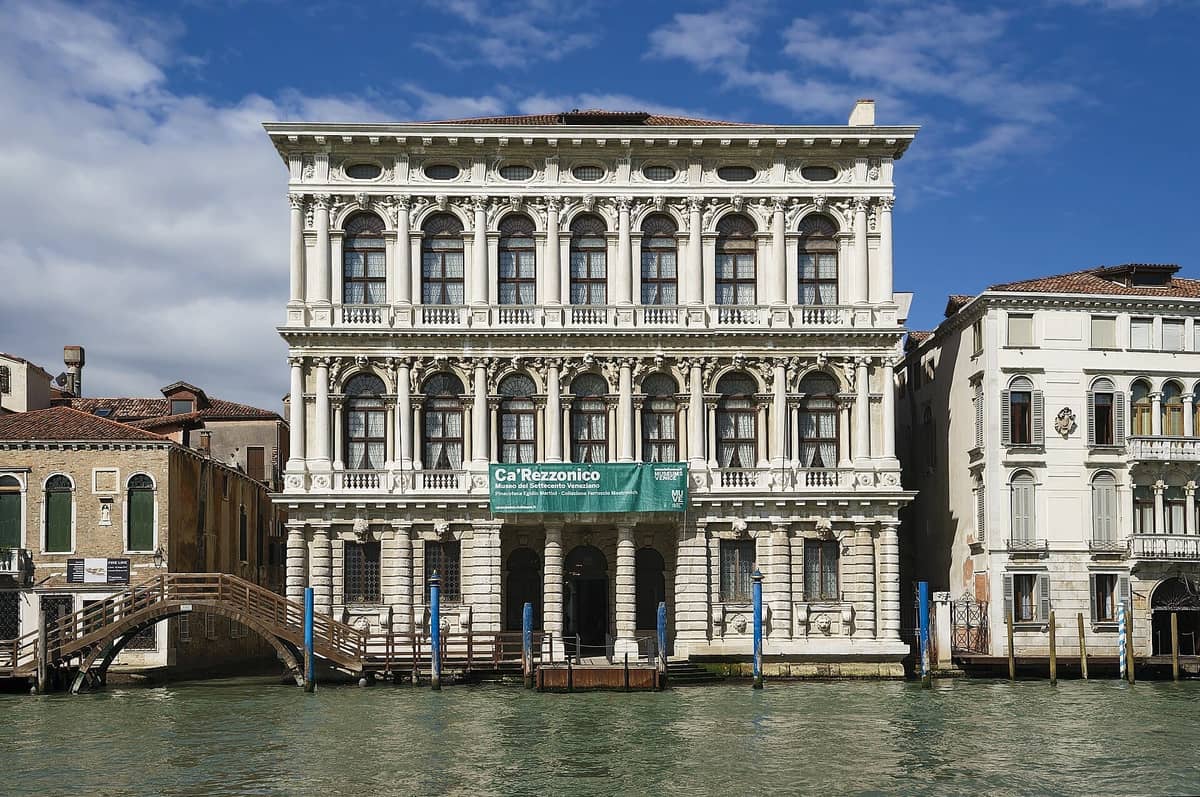
What Ca' Rezzonico Actually Is
Ca' Rezzonico — officially the Museo del Settecento Veneziano — is part of the Fondazione Musei Civici di Venezia network of civic museums. The building is a full baroque palace on the Grand Canal, begun in 1649 by Baldassare Longhena (the same architect responsible for Santa Maria della Salute) and completed by Giorgio Massari in the 1750s after the Rezzonico family acquired it. It opened as a public museum dedicated to 18th-century Venice in 1936, and reopened after a major restoration in June 2001.
The museum does something few civic institutions manage: it doesn't just display objects from the 1700s, it reconstructs the sensory world of Venetian aristocracy at the height of the Republic's final, decadent century. Ballrooms are furnished as they would have been used. Bedchambers retain their original lacquered panels. A recreated apothecary shop on the top floor feels less like an exhibit and more like an interruption.
This is not a small museum. Three floors cover painting, furniture, textiles, Murano glasswork, theatrical design, and satirical art. Budget at least 90 minutes, and closer to two and a half if you read the room labels or linger in the frescoed halls.
The Building: What You See Before You Enter
Arriving by vaporetto on Line 1 is the correct approach. The Ca' Rezzonico landing drops you directly at the water gate of the palace, and the facade — three stories of Istrian stone, topped with stone balustrades — is immediately imposing in a way that photographs don't quite convey. The rusticated base sits at canal level, and at high water, the lower arches stand just centimeters above the surface. In morning light, the pale stone reads almost white against the green water.
The entrance courtyard, reached through the water gate or from the landward side on Dorsoduro, is smaller than the canal facade suggests. The grand staircase inside — wide, ceremonial, built to announce arrivals — rises immediately from the ground floor. The stone feels cold underfoot even in summer, and the proportions shift noticeably from the intimate street scale of Dorsoduro to something designed for theater.
💡 Local tip
Approach from the Grand Canal by vaporetto if possible. The water-level view of the facade, framed between the neighboring palazzi, is one of the better Grand Canal compositions and sets the scale of the building before you go inside.
Tickets & tours
Hand-picked options from our booking partner. Prices are indicative; availability and final rates are confirmed when you complete your booking.
Ca' Rezzonico 18th century Venice Museum entrance tickets
From 8 €Instant confirmationCa' Rezzonico 18th century Venice Museum entrance tickets
From 10 €Instant confirmationTickets to Villa Widmann Rezzonico Foscari
From 20 €Instant confirmationDoge's Palace skip-the-line tour
From 67 €Instant confirmationFree cancellation
Floor by Floor: What to Expect Inside
First Floor: The Ballroom and the Tiepolo Ceiling
The first piano nobile (main floor) is where most visitors spend the majority of their time, and rightly so. The Grand Ballroom — the Salone da Ballo — runs nearly the full width of the building. Its ceiling fresco, painted in 1753, depicts allegorical figures in the Tiepolo tradition: bright, confident, slightly theatrical. The room is furnished with gilded furniture, enormous candelabras, and carved wooden figures in the corners that act as torchbearers.
Adjacent rooms display lacquered furniture typical of the Venetian fashion for chinoiserie, tapestries, and portraits. The sequence of salons along the Grand Canal side of the floor — each with its own ceiling treatment and view over the water — creates a rhythm that feels less like museum-going and more like walking through a house that was never quite vacated.
Second Floor: Painting and the Tiepolo Room
The second floor contains the museum's painting collection, and the centerpiece is a set of ceiling frescoes by Giambattista Tiepolo, transferred from a demolished Venetian palace. Tiepolo is the defining painter of 18th-century Venice — brilliant, airy, and capable of making ceilings feel like open sky. Seeing his work in a palazzo context rather than a church or gallery changes the relationship considerably: you understand immediately that these were paintings made for rooms, not for contemplation.
The floor also holds works by Pietro Longhi, whose small genre paintings document the daily life of 18th-century Venetians with an anthropologist's precision and a satirist's eye. Carnival masks, rhinoceros viewings, chocolate houses, and morning levees — Longhi painted the theater of ordinary wealthy life in a way that feels unnervingly contemporary. His paintings are some of the most useful things in the museum if you want to understand what Venice actually looked and felt like in the 1700s.
Third Floor: The Apothecary and the Parlor
The top floor is quieter and often overlooked by visitors who run out of energy before reaching it. It contains a completely reconstructed 18th-century pharmacy with its original wooden cabinets, ceramic jars, and equipment. The scale and detail of the reconstruction are striking. Also on this floor: a marionette theater, theatrical design sketches, and a recreated parlor from a Venetian convent — an unexpectedly intimate counterpoint to the grandeur below.
ℹ️ Good to know
The museum is closed on Tuesdays, and also on 25 December, 1 January, and 1 May. Summer hours run April 1 to October 31 (10:00–18:00, ticket office 10:00–17:00). Winter hours are November 1 to March 31 (10:00–17:00, ticket office 10:00–16:00). Confirm current hours at carezzonico.visitmuve.it before your visit.
How the Experience Changes by Time of Day
Ca' Rezzonico draws a fraction of the crowds that queue for the Doge's Palace or St. Mark's Basilica, which means timing matters less here than at most Venetian institutions. That said, late mornings on weekend days bring the largest groups, typically tour parties who arrive between 10:30 and noon. The museum empties noticeably after 2:00 pm, and the last hour before closing is often the quietest.
Natural light makes a significant difference in the ballroom and the canal-facing rooms. Morning light from the east floods the Grand Canal and bounces off the water onto the ceilings — the frescoes read differently under reflected canal light than under midday overhead light. If you arrive at opening (10:00), the first-floor rooms on the Grand Canal side are genuinely luminous for the first 90 minutes.
In winter, the museum's moody half-light suits the lacquered interiors particularly well. The canals outside the windows are quieter, and the combination of damp cold, dark water, and gilded salons conveys something closer to what Venice was like in its final republican decades. If you're visiting in the colder months, pair the museum with a walk along the Zattere promenade afterward — it runs along the southern edge of Dorsoduro and provides a complete contrast in scale and openness.
Getting There and Practical Notes
The most direct route is vaporetto Line 1, which stops at the Ca' Rezzonico landing on the Grand Canal — the palazzo entrance is steps from the dock. From Rialto Bridge, Line 1 takes roughly 10 minutes. From the San Marco area, it is about 15 minutes by water or a 20-minute walk across the Accademia Bridge and through Dorsoduro.
On foot from Piazzale Roma, the walk through Santa Croce and into Dorsoduro takes approximately 20 to 25 minutes. The route through Campo Santa Margherita — the large campo at the heart of Dorsoduro — is straightforward and passes through one of the most genuinely local squares in Venice before reaching the museum.
Accessibility within a historic palazzo is inherently limited. The museum has made efforts to improve access, but the grand staircase and multi-floor layout present challenges for visitors with mobility limitations. Contact the museum directly at +39 041 2410100 or carezzonico@fmcvenezia.it to confirm current accessibility provisions before visiting.
⚠️ What to skip
Ticket prices listed online vary considerably between sources. The official museum site (carezzonico.visitmuve.it) is the authoritative source. If you hold a Venezia Unica city pass or a Musei Civici pass, Ca' Rezzonico is included — verify current pass options and prices before booking.
Photography and What to Bring
Non-flash photography is generally permitted in the museum rooms, though this should be confirmed at the entrance on the day of your visit, as policies can change for temporary exhibitions. The ballroom ceiling is the most photographed interior, and getting a clean shot requires positioning yourself at one end of the room and using a wide-angle lens or stitching multiple frames. Phone cameras with ultra-wide modes work reasonably well.
Wear comfortable shoes. The floors are the original terrazzo and stone, uneven in places, and a thorough visit covers three floors with no shortcuts. In summer, bring a light layer — the thick walls keep the interior cool in a way that can feel pleasant or chilly depending on the weather outside. There is no café inside the museum, so arrive fed or plan lunch in the Dorsoduro area before or after.
Ca' Rezzonico in Context: Why Dorsoduro?
The museum sits in Dorsoduro, the sestiere that holds a disproportionate share of Venice's serious cultural institutions. Within walking distance are the Gallerie dell'Accademia, the Peggy Guggenheim Collection, and the Punta della Dogana. Ca' Rezzonico makes natural sense as part of a Dorsoduro museum day — though attempting all four in a single day is ambitious and produces diminishing returns.
The contrast between Ca' Rezzonico and the Peggy Guggenheim Collection — which sits a short walk along the Grand Canal — is instructive. Guggenheim fills a low, unfinished palazzo with 20th-century modernism; Ca' Rezzonico fills a completed baroque palace with the world that modernism replaced. Visiting both in sequence gives you a compressed history of Western art's pivot from aristocratic splendor to something deliberately different.
For travelers interested in how Venice presents its own history across multiple institutions, our guide to the best museums in Venice places Ca' Rezzonico in a broader context alongside the Doge's Palace, the Correr, and the city's other civic museums.
Insider Tips
- The Musei Civici pass (Venezia Unica) covers Ca' Rezzonico along with the Correr, Ca' Pesaro, and several other civic museums — if you plan to visit more than two, the pass can be worthwhile. Verify current pass options at veneziaunica.it before booking.
- The rooms on the Grand Canal side of the first floor are far brighter in the morning than the afternoon. If you care about seeing the frescoes and lacquered panels at their best, arrive as close to the 10:00 opening as possible.
- The third floor is where crowds thin to almost nothing. The reconstructed pharmacy and the convent parlor receive a fraction of the attention given to the ballroom below, yet they tell a more complete story of 18th-century Venetian daily life.
- Pietro Longhi's small genre paintings on the second floor are easy to walk past. Slow down for them. Each one is a precise social document of who Venetians were, how they dressed, and what they found entertaining — more useful context for understanding the city than most guidebook text.
- Campo Santa Margherita, five minutes' walk from the museum, is one of the best places in Venice to sit at a cafe table without paying tourist-district prices. Use it as a decompression point after the museum.
Who Is Ca' Rezzonico — Museum of 18th Century Venice For?
- Art and history travelers who want depth over spectacle — Ca' Rezzonico rewards slow looking
- Anyone building a full Dorsoduro museum day combining multiple institutions in the sestiere
- Visitors frustrated by the crowds at the Doge's Palace who want comparable architectural grandeur without the queues
- Photographers interested in interior architecture and 18th-century decorative arts under natural canal light
- Travelers visiting in winter or off-season, when the museum's atmospheric interiors suit the ambient mood of the city
Nearby Attractions
Other things to see while in Dorsoduro:
- Accademia Bridge (Ponte dell'Accademia)
The Ponte dell'Accademia is a wooden pedestrian bridge spanning the Grand Canal between San Marco and Dorsoduro. Free to cross at any hour, it delivers what many consider the most photographed canal view in Venice, with a sweeping upstream panorama toward the Rialto. It also sits at the heart of one of the city's most rewarding walking neighborhoods.
- Basilica di Santa Maria della Salute
Standing at the mouth of the Grand Canal where it meets St Mark's Basin, the Basilica di Santa Maria della Salute is one of the most recognizable silhouettes in Venice. Built as a vow to the Virgin Mary after the plague of 1630–1631, this baroque octagonal church took 56 years to complete and remains an active place of worship, a repository of significant art, and one of the finest viewpoints in the city.
- Campo Santa Margherita
Campo Santa Margherita is the largest square in Dorsoduro and one of the few places in Venice where locals genuinely outnumber tourists. A flat, open campo ringed with cafes, a daily market, and a student-fueled nightlife scene, it offers a rare window into how Venetians actually use their city.
- Gallerie dell'Accademia
The Gallerie dell'Accademia is the world's most important repository of Venetian painting, spanning five centuries of art from the Gothic period through the 18th century. Set in a converted monastery complex in Dorsoduro, this is the one art museum in Venice that genuinely rewards dedicated time rather than a quick walk-through.