Accademia Bridge (Ponte dell'Accademia): Venice's Grand Canal Viewpoint
The Ponte dell'Accademia is a wooden pedestrian bridge spanning the Grand Canal between San Marco and Dorsoduro. Free to cross at any hour, it delivers what many consider the most photographed canal view in Venice, with a sweeping upstream panorama toward the Rialto. It also sits at the heart of one of the city's most rewarding walking neighborhoods.
Quick Facts
- Location
- Between Campo San Vidal (San Marco) and Campo della Carità (Dorsoduro), Venice
- Getting There
- Accademia stop (lines 1, 2)
- Time Needed
- 10–20 minutes at the bridge; allow 2–3 hours if combining with nearby museums
- Cost
- Free – no ticket required, open 24 hours year-round
- Best for
- Grand Canal views, photography, connecting Dorsoduro to San Marco on foot
What the Accademia Bridge Actually Is
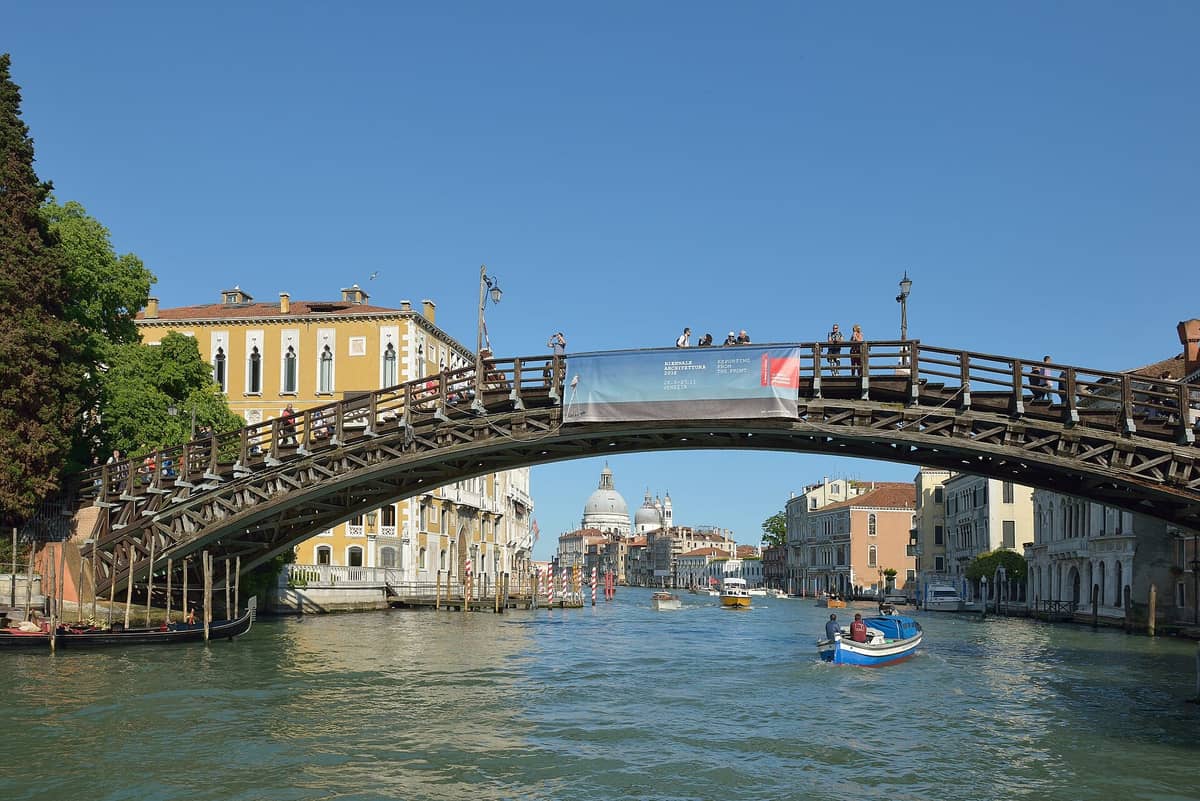
The Ponte dell'Accademia is one of only four bridges that cross the Grand Canal in Venice's historic center. At 48 meters long, it is a modest wooden structure by any engineering standard, but its position on the canal curve is exceptional. Standing at the apex of its gentle arch, you look northeast (upstream) toward the Rialto along one of the most storied waterways in the world, with a parade of Renaissance and Gothic facades lining both banks.
The bridge connects Campo San Vidal on the San Marco side to Campo della Carità on the Dorsoduro side. It is purely pedestrian, completely free, and open at every hour of every day. No queue, no ticket booth, no time slot. In a city where most significant experiences carry a fee and a wait, that is worth noting.
💡 Local tip
To reach the bridge by water, take vaporetto Line 1 or Line 2 to the Accademia stop. The bridge is visible the moment you step off the boat.
A Brief History of the Crossing
The idea of a bridge at this location dates to 1488, but centuries passed before anything was built. The first bridge at this spot opened on 20 November 1854, constructed as a temporary iron structure to replace a pontoon boat bridge that had served the crossing before it. That iron bridge was later redesigned and replaced in turn, and the wooden version standing today The first bridge at this spot opened on 20 November 1854, constructed as a temporary iron structure to replace a pontoon boat bridge that had served the crossing before it. That iron bridge was later redesigned and replaced in turn, and the wooden version standing today dates to 1985, when the current structure was installed after earlier versions were deemed inadequate.
The wooden design was always intended to be provisional. Over decades, debates about a permanent replacement in stone or steel came and went without resolution. Today, the wooden bridge has outlasted the controversy and become an emblem of the city in its own right. Its warm-toned planks and wide steps feel entirely at home in Venice's material palette of stone, plaster, and aged timber.
The bridge takes its name from the Gallerie dell'Accademia, Venice's foremost collection of Venetian painting, which occupies the former Scuola della Carità near the Dorsoduro end of the bridge.
Tickets & tours
Hand-picked options from our booking partner. Prices are indicative; availability and final rates are confirmed when you complete your booking.
Venice Legends, Anecdotes and Ghost Stories Tour
From 35 €Instant confirmationFree cancellationAccademia Gallery of Venice and Sestiere Dorsoduro private tour
From 60 €Instant confirmationFree cancellationVenice highlights historical walking tour
From 27 €Instant confirmationFree cancellationShared gondola ride underneath the Bridge of Sighs
From 39 €Instant confirmationFree cancellation
The View: What You See and When It Matters
From the top of the arch, the Grand Canal unfolds in both directions. Looking northeast (upstream), you see the canal curving away toward the Rialto, lined with palaces that include Ca' Rezzonico and a succession of Gothic and Baroque facades. Looking southeast, the dome of Santa Maria della Salute fills the far end of the view, with the mouth of the canal opening toward the lagoon beyond. This dual panorama is the reason the bridge attracts more photographers than almost any other crossing in the city.
Early morning, roughly from 7:00 to 9:00, is when the light falls at its most useful angle for the upstream (northeast) view, catching the upper stories of the canal palaces in warm direct sun while the water below remains in gentle shadow. The foot traffic at that hour is mostly local: residents crossing with groceries, delivery workers with trolleys, the occasional jogger. The contrast with midday is significant.
By 10:30 on any day from April through October, the bridge becomes genuinely crowded. Groups pause at the top for photos, tour leaders gather their parties at the foot of the steps, and the width of the wooden deck feels suddenly insufficient. This is not a reason to avoid the bridge, but it is a reason to plan your lingering visit for earlier in the day or after 19:00, when the light in summer is still good and the crowds thin noticeably.
⚠️ What to skip
The bridge steps are steep and have no handrails along the central section. In wet weather the wooden planks become slippery. Wear shoes with grip, especially in autumn and winter.
At night, the bridge is a different experience entirely. The canal reflects the lights of the palaces in long broken columns on the water, vaporetti pass with their green and red running lights, and the constant ambient noise of the city drops to something quieter. For a romantic evening walk, this crossing fits naturally into a route through Dorsoduro toward the waterfront.
How to Fold the Bridge Into a Dorsoduro Walk
The Accademia Bridge works best not as a destination in itself but as a pivot point for a longer walk. Cross from San Marco in the morning, pause at the top for the upstream view, then descend into Campo della Carità on the Dorsoduro side. The campo is quiet, shaded, and anchored by the entrance to the Gallerie dell'Accademia on your left.
The Gallerie dell'Accademia holds the definitive collection of Venetian painting from the 14th to the 18th century, including works by Bellini, Carpaccio, Titian, and Veronese. The Gallerie dell'Accademia holds the definitive collection of Venetian painting from the 14th to the 18th century, including works by Bellini, Carpaccio, Titian, and Veronese. It opens at 8:15 on Tuesdays through Sundays. Booking ahead is strongly advised in peak season. If the queue outside is long, check in advance whether timed entry slots are still available online. Booking ahead is strongly advised in peak season. If the queue outside is long, check in advance whether timed entry slots are still available online.
A short walk east/southeast along the canal fondamenta brings you to the Peggy Guggenheim Collection, housed in the unfinished 18th-century Palazzo Venier dei Leoni directly on the Grand Canal. Together, the Accademia and the Guggenheim form one of the most concentrated art itineraries in Europe within a ten-minute walking radius.
Continue further southeast and you reach the Basilica di Santa Maria della Salute, the domed 17th-century church that anchors the mouth of the Grand Canal. This is the building you see in the southeast view from the bridge. From the Salute steps at water level, you can look back northeast and understand exactly why the Accademia Bridge view is so compelling: the dome closes the composition perfectly.
Getting There and Getting Around
The easiest approach by water is vaporetto Line 1, which stops at every landing on both banks of the Grand Canal, or Line 2, which makes fewer stops. Both serve the Accademia stop, which is on the Dorsoduro bank immediately beside the bridge. From Piazzale Roma or Ferrovia (Santa Lucia train station), Line 1 takes approximately 25–30 minutes and passes the full length of the Grand Canal. This is also a worthwhile journey in itself.
On foot from Piazza San Marco, the bridge is about a 15-minute walk heading west along Calle Larga XXII Marzo and through the small squares of San Marco sestiere. The route is well-signposted with the yellow direction signs that mark Venice's main pedestrian corridors. From the Rialto Bridge, allow around 20 minutes on foot heading south through San Polo.
There are no lifts or ramps on the Accademia Bridge. The steps rise steeply on both sides of the arch. Travelers with pushchairs, wheelchairs, or mobility limitations will find this crossing difficult or impossible. The nearest Grand Canal crossing with flat access is the Scalzi Bridge near the train station, though it also has steps. It is worth checking current accessibility guidance with the Venice tourist office before planning routes.
ℹ️ Good to know
Venice's Access Fee applies to day visitors entering the historic center on selected high-attendance dates, with exemptions for overnight guests and residents. Check the official portal cda.ve.it for current dates and fees before your visit.
Photography: Making the Most of the Position
The classic shot from the Accademia Bridge looks northeast (upstream) along the Grand Canal. In the morning, the light comes from behind and slightly to the right of the camera for this view, putting the palace facades in good illumination. A wide-angle lens or the standard camera app on a phone captures the full sweep without distortion. If you use a longer focal length, you can compress the canal to emphasize the density of architecture along the banks.
For the southeast view toward the Salute, afternoon light works better, hitting the dome and the facade of the church directly. This is also the direction where you will often see gondolas, water taxis, and vaporetti passing in the foreground, which adds movement and scale to the frame.
If you are serious about photography, pairing the bridge with a walk along the Zattere promenade to the south of Dorsoduro gives a completely different perspective on Venice at water level, particularly in the soft light of late afternoon.
Worth It?
The Accademia Bridge delivers its best value as a free, unhurried moment with one of the world's great urban views. It rewards people who stop, look both ways, and take their time with the panorama. If you are crossing quickly between San Marco and Dorsoduro as part of a packed itinerary, you will notice the view but may not fully appreciate it.
Travelers who expect a grand historic structure, comparable in scale to the Rialto, will be surprised by the simplicity of the wooden design. The Accademia Bridge is understated. Its appeal is the view it offers, not the bridge itself. If you have seen photographs of the Grand Canal panorama from a high vantage point and want to stand in that exact spot, this is the bridge. If you are looking for ornate stonework and Venetian Gothic detail, the Rialto is the more architecturally dramatic crossing.
Visitors with limited mobility or those traveling with prams will face real difficulty with the steep wooden steps and should plan alternative routes. For broader planning of how the bridge fits into a day in Venice, the Venice things to do guide covers the main options across all six sestieri.
Insider Tips
- Arrive at or before 8:00 for the cleanest photos and a genuine sense of space on the bridge. By 10:30 in spring and summer, the deck is congested with group tours.
- The Dorsoduro bank of the bridge has a small fondamenta where you can watch Grand Canal traffic at eye level. Spend a few minutes here before or after crossing: the perspective from water level is entirely different from the top of the arch.
- The campo on the San Marco side, Campo San Vidal, has benches and is rarely as crowded as the bridge itself. It is a useful spot to rest, review your map, or wait for a quieter moment before crossing.
- In autumn and winter, acqua alta flooding can affect the streets on the Dorsoduro side below the bridge. The bridge itself stays above water, but approach routes may require rubber boots. Check the Comune di Venezia tide forecast the evening before.
- If you want to photograph the Accademia Bridge from the canal rather than from it, board a vaporetto Line 1 toward the Rialto and position yourself on the deck as the boat passes beneath the arch. The wooden understructure is photogenic from below and rarely captured in guidebook images.
Who Is Accademia Bridge (Ponte dell'Accademia) For?
- First-time visitors to Venice wanting the definitive Grand Canal panorama without paying an entrance fee
- Photographers working the Grand Canal light in early morning or late afternoon
- Travelers building a Dorsoduro art day combining the Gallerie dell'Accademia and the Peggy Guggenheim Collection
- Evening walkers looking for a romantic crossing between San Marco and the quieter streets of Dorsoduro
- Anyone orienting themselves spatially in Venice: the view from the bridge makes the layout of the Grand Canal immediately legible
Nearby Attractions
Other things to see while in Dorsoduro:
- Basilica di Santa Maria della Salute
Standing at the mouth of the Grand Canal where it meets St Mark's Basin, the Basilica di Santa Maria della Salute is one of the most recognizable silhouettes in Venice. Built as a vow to the Virgin Mary after the plague of 1630–1631, this baroque octagonal church took 56 years to complete and remains an active place of worship, a repository of significant art, and one of the finest viewpoints in the city.
- Ca' Rezzonico — Museum of 18th Century Venice
Ca' Rezzonico is a palazzo on the Grand Canal that houses the Museum of 18th-Century Venice. Three floors of frescoed ballrooms, lacquered furniture, Tiepolo paintings, and period pharmacy recreations make it one of the most immersive museum experiences in the city.
- Campo Santa Margherita
Campo Santa Margherita is the largest square in Dorsoduro and one of the few places in Venice where locals genuinely outnumber tourists. A flat, open campo ringed with cafes, a daily market, and a student-fueled nightlife scene, it offers a rare window into how Venetians actually use their city.
- Gallerie dell'Accademia
The Gallerie dell'Accademia is the world's most important repository of Venetian painting, spanning five centuries of art from the Gothic period through the 18th century. Set in a converted monastery complex in Dorsoduro, this is the one art museum in Venice that genuinely rewards dedicated time rather than a quick walk-through.