Zattere Promenade: Venice's Sunniest Walk Along the Giudecca Canal
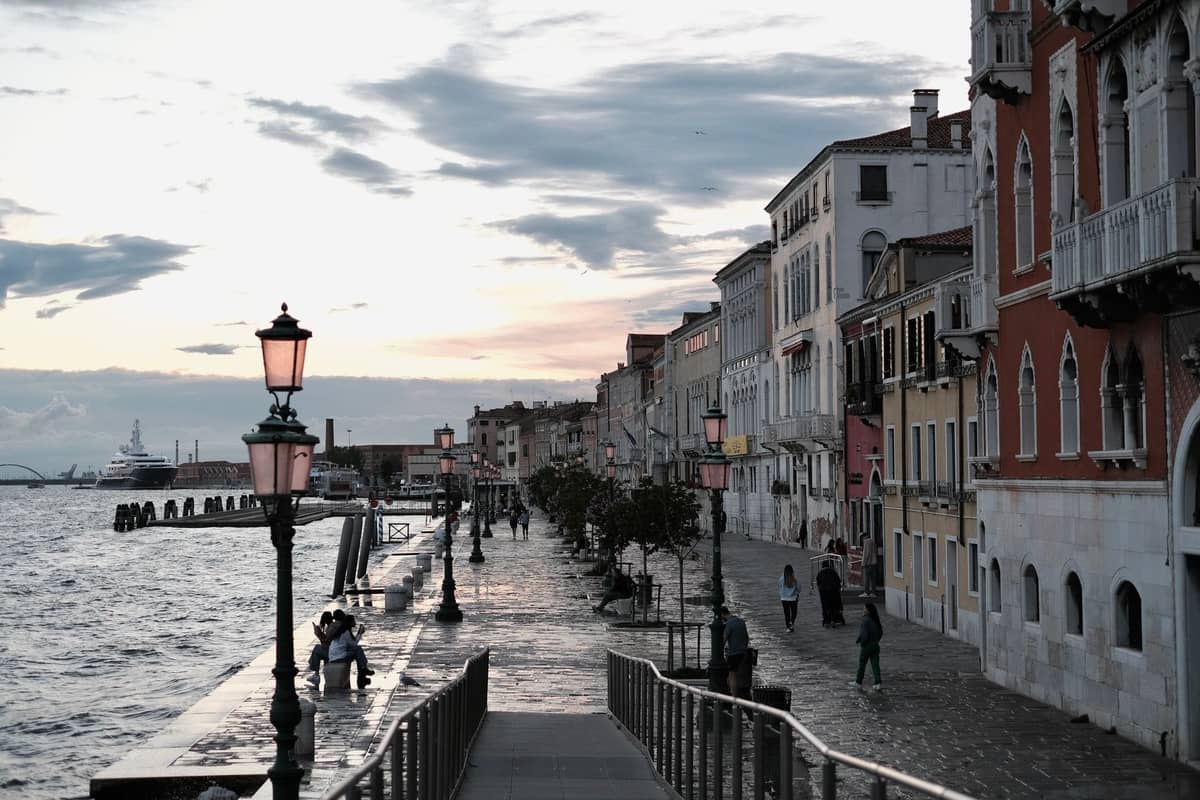
Stretching 1.7 kilometres along the southern edge of Dorsoduro, the Fondamenta delle Zattere is Venice's longest and most open waterfront promenade. Facing the broad Giudecca Canal, it offers unobstructed southern light, calm water views, and a pace of life noticeably different from the crowded alleys near San Marco.
Quick Facts
- Location
- Fondamenta delle Zattere, Dorsoduro, Venice — running from San Basilio to Punta della Dogana along the Giudecca Canal
- Getting There
- ACTV lines 2, 5.1, 5.2, and 6 — stops: Zattere, Spirito Santo, San Basilio
- Time Needed
- 45 minutes to walk end-to-end; 2–3 hours if stopping at cafés, churches, or Punta della Dogana
- Cost
- Free to walk. Nearby Punta della Dogana museum charges approx. €18 (verify before visiting)
- Best for
- Morning walks, sunset views, outdoor dining, photography of the Giudecca waterfront
What the Zattere Actually Is
The Fondamenta delle Zattere is a continuous paved waterfront promenade running approximately 1.7 kilometres along the southern edge of the Dorsoduro sestiere. It faces the Giudecca Canal, one of the widest navigable channels in the lagoon city, and ends at Punta della Dogana where the Grand Canal meets the Giudecca. Unlike most of Venice's narrow calli, this is a broad, flat embankment where you can walk two or three abreast without stepping aside for oncoming foot traffic.
The name has a practical origin. "Zattere" means rafts in Italian, and for centuries this quay served as the main landing point for timber — floated in on log rafts from the forests of the Dolomites and the Veneto interior — destined for the shipyards of the Arsenale and for building construction across the city. The pavement as it exists today was largely completed in the early 16th century, though the embankment itself is older. That working-class industrial past is largely invisible now, replaced by café terraces and leisure walkers, but the unusually wide fondamenta is a direct legacy of the space required to offload and stack heavy materials.
💡 Local tip
The Zattere faces due south, which means it catches more direct sunlight than almost any other outdoor space in Venice. On a clear winter day, the temperature on the promenade can feel several degrees warmer than in the shadowed alleys of the interior. Locals know this well — on bright February afternoons, every bench fills up.
How the Promenade Changes Through the Day
Early morning, between roughly 7 and 9am, the Zattere belongs to Venetian residents: dog walkers, people heading to work, older men reading newspapers on the stone benches facing the water. The canal surface at this hour is quieter, crossed mainly by delivery barges and the occasional vaporetto. The light arrives low from the southeast, painting the facade of the Redentore church across on Giudecca in pale gold. The smell at this hour is clean and brackish, carrying the faint mineral trace of the lagoon.
By mid-morning the café terraces open properly, and by noon the promenade shifts into its most photogenic phase. Ferries, cargo barges, and other working boats transiting the Giudecca Canal create slow, dramatic wakes that take several minutes to reach the embankment wall and wash quietly against the stone. The sound of that water hitting the fondamenta edge is one of the more underrated sensory details of this walk. Sitting at a table with a coffee, watching a container ship move silently past at closer range than feels entirely normal, is a distinctly Venetian experience.
Afternoons in summer draw the largest crowds, mostly day visitors walking the promenade as a scenic alternative route toward San Marco. By late afternoon the angle of light shifts across the Giudecca Canal and the far waterfront of the Giudecca island turns warm and luminous. Sunset, viewed from the Punta della Dogana end, can be exceptional — the water reflects the colour directly and the silhouette of the Redentore sits cleanly on the horizon. This is among the best sunset positions in the city.
For more organised perspectives on where to catch the best light across Venice at different times of day, the best views in Venice guide covers rooftop and waterfront options across all six sestieri.
Tickets & tours
Hand-picked options from our booking partner. Prices are indicative; availability and final rates are confirmed when you complete your booking.
Doge's Palace skip-the-line tour
From 67 €Instant confirmationFree cancellationVenice Legends, Anecdotes and Ghost Stories Tour
From 35 €Instant confirmationFree cancellationGhosts and legends tour of Venice
From 29 €Instant confirmationFree cancellationSkip-the-line guided tour of Doge's Palace and Saint Mark's Basilica
From 106 €Instant confirmationFree cancellation
The Architecture Along the Route
Walking the Zattere from west to east, the built environment changes character several times. The western stretch near San Basilio is the most workmanlike, with loading areas, the ferry terminal for lines to Giudecca and Fusina, and warehouse-style buildings that still carry the memory of industrial use. The facades here are plainer, the atmosphere quieter.
Moving east, the promenade passes the Chiesa dei Gesuati (formally Santa Maria del Rosario), a mid-18th-century Dominican church with an interior containing ceiling frescoes by Tiepolo. The building's neoclassical facade faces directly onto the canal, making it one of the few churches in Venice with an unobstructed waterfront approach. Further along, the ex-Incurabili hospice, one of Venice's historic ospedali, occupies a long stretch of embankment. These ospedali were Renaissance institutions providing care for the incurable sick and, notably, musical education for orphaned girls — the musical tradition of Venice's ospedali is historically significant and connected to composers including Vivaldi, who taught at the Pietà.
The eastern terminus at Punta della Dogana is anchored by the 17th-century customs house, now home to the Punta della Dogana contemporary art museum. Its triangular tip, topped by a golden globe balanced by two Atlas figures, marks the precise point where the Grand Canal and the Giudecca Canal converge. Even if you skip the museum, standing at this point offers one of the most complete panoramic views available anywhere in the city: the Salute basilica immediately to your left, San Giorgio Maggiore island directly across the water, and the full sweep of the Grand Canal opening ahead.
Practical Walkthrough: Getting There and Moving Along
The Zattere is best reached by vaporetto. ACTV lines 2, 5.1, 5.2, and 6 all serve stops along the promenade: San Basilio at the western end, Spirito Santo in the middle section, and Zattere toward the eastern stretch. If you are arriving from the San Marco area, line 2 running toward San Basilio will deliver you to the heart of the promenade within minutes. From Santa Lucia train station, line 2 also connects through the Grand Canal.
On foot from the Accademia area, it is a short walk south through Dorsoduro to reach the promenade. The walk from the Accademia bridge to the Zattere takes about ten to fifteen minutes through the campo and calli of Dorsoduro, passing through one of Venice's most genuinely residential neighbourhoods.
The full promenade is flat and wide, making it one of the more accessible walking routes in Venice. That said, the connecting streets at either end involve standard Venetian bridges with steps, so full step-free movement requires planning. For broader guidance on moving around the city, the getting around Venice guide covers vaporetto routes, walking logistics, and accessibility across the main areas.
ℹ️ Good to know
The promenade is public and open at all hours with no admission fee. Vaporetto tickets and passes are required to board ACTV boats; single tickets, multi-day passes, and the Venezia Unica city pass are all valid options — verify current prices through the official ACTV or Venezia Unica websites before your visit.
Weather and Seasonal Considerations
Because the Zattere is entirely exposed to the sky and the broad canal, weather conditions affect the experience more here than in most parts of Venice. In strong Bora wind conditions — cold northeasterly gusts that push across the lagoon in winter — the promenade becomes exposed and raw, with spray occasionally reaching the walkway. Café terraces close their windscreens and the benches empty quickly. The flip side: on calm winter days with clear skies, this is one of the few places in Venice where sitting outdoors in January feels genuinely pleasant.
Acqua alta events primarily affect the lower-lying areas of Venice, particularly around San Marco and parts of the Rialto. The Zattere is less frequently inundated than those zones, though high tides can still reach the promenade during exceptional events. If you are visiting during autumn or early winter, checking the tide forecast in advance is worth the effort. The acqua alta guide for Venice explains how the tidal system works, how to check forecasts, and what to do if water reaches street level.
Summer afternoons can be warm to hot on the Zattere, with little shade beyond the café awnings. The stone surface reflects heat, and the southerly aspect means maximum sun exposure throughout the day. For anyone sensitive to heat, the morning hours before 10am or the early evening after 5pm are the most comfortable times in July and August.
What to Eat and Drink Here
The Zattere has a concentration of outdoor dining options that is unusual for Venice. Several gelaterie and cafés line the promenade with canal-facing terraces. The Gelateria Nico, near the Zattere vaporetto stop, has been a Venetian institution for decades and is closely associated with its gianduiotto — a dense hazelnut-chocolate gelato served with whipped cream, eaten outside at tables overlooking the Giudecca. It is not the most refined gelato in Venice by any objective measure, but the combination of the setting and the ritual makes it worth experiencing.
The Dorsoduro neighbourhood behind the Zattere is also one of the better areas in Venice for straightforward, unpretentious eating and drinking, particularly around Campo Santa Margherita, a short walk north from the promenade. If you want to eat on the Zattere itself, book ahead in summer — the terrace tables at the better-known spots fill quickly on warm evenings.
Photography Notes
The Zattere is a reliable location for wide-angle waterfront photography. The Giudecca Canal is broad enough that the buildings on the far shore, particularly the Redentore church by Palladio, appear at a natural perspective rather than distorted by proximity. Early morning provides the cleanest light with minimal foot traffic in frame. The golden hour before sunset is excellent for shooting back toward the Giudecca island with the warm western light falling across the water.
For dramatic wide compositions, the Punta della Dogana tip gives a 180-degree view that includes both the Salute basilica and the opening of the Grand Canal. Long-exposure shots of the Giudecca Canal at dusk, capturing the light trails from passing vaporetti, work well from the stone embankment wall. A standard tripod can be placed on the flat pavement without obstruction.
Insider Tips
- Walk the Zattere from east to west (starting at Punta della Dogana) on winter mornings: the sun rises over your left shoulder and illuminates the Giudecca waterfront ahead of you, making the entire walk feel like moving through a painting.
- The benches built into the embankment wall are original stone fixtures, not tourist installations. The ones near Spirito Santo are slightly set back from the main foot traffic and are the best spots for sitting undisturbed while watching the canal traffic.
- Vaporetto lines such as 5.1/5.2 or 6 between San Basilio and Giudecca Palanca run directly across the canal and take under three minutes. Combining a walk along the Zattere with the short crossing to Giudecca gives a completely different perspective on the promenade from the water.
- The Gelateria Nico gets a queue after midday on warm weekends. Arriving before 11am or after 4pm means shorter waits and a calmer experience on the terrace.
- If you are visiting in late autumn, look for the trompe l'oeil details on the facade of the ex-Incurabili building mid-promenade — the painted architectural elements are subtle and most visitors walk past without noticing them.
Who Is Zattere Promenade For?
- Travellers who want a genuine sense of how Venetians use public space on a daily basis, away from the San Marco crowds
- Photographers looking for wide, open waterfront compositions with consistent southern light
- Couples or solo walkers who want a leisurely, flat route that requires no map-reading or bridge-counting
- Visitors staying in Dorsoduro who want a morning or evening walk built into their neighbourhood routine
- Anyone combining a visit to Punta della Dogana or the Peggy Guggenheim Collection with an outdoor walk along the canal
Nearby Attractions
Other things to see while in Dorsoduro:
- Accademia Bridge (Ponte dell'Accademia)
The Ponte dell'Accademia is a wooden pedestrian bridge spanning the Grand Canal between San Marco and Dorsoduro. Free to cross at any hour, it delivers what many consider the most photographed canal view in Venice, with a sweeping upstream panorama toward the Rialto. It also sits at the heart of one of the city's most rewarding walking neighborhoods.
- Basilica di Santa Maria della Salute
Standing at the mouth of the Grand Canal where it meets St Mark's Basin, the Basilica di Santa Maria della Salute is one of the most recognizable silhouettes in Venice. Built as a vow to the Virgin Mary after the plague of 1630–1631, this baroque octagonal church took 56 years to complete and remains an active place of worship, a repository of significant art, and one of the finest viewpoints in the city.
- Ca' Rezzonico — Museum of 18th Century Venice
Ca' Rezzonico is a palazzo on the Grand Canal that houses the Museum of 18th-Century Venice. Three floors of frescoed ballrooms, lacquered furniture, Tiepolo paintings, and period pharmacy recreations make it one of the most immersive museum experiences in the city.
- Campo Santa Margherita
Campo Santa Margherita is the largest square in Dorsoduro and one of the few places in Venice where locals genuinely outnumber tourists. A flat, open campo ringed with cafes, a daily market, and a student-fueled nightlife scene, it offers a rare window into how Venetians actually use their city.