Bridge of Sighs (Ponte dei Sospiri): What to See, Know, and Expect
The Ponte dei Sospiri is one of Venice's most photographed structures, an enclosed white limestone bridge linking the Doge's Palace to the New Prisons over the narrow Rio di Palazzo canal. You can see it for free from the Ponte della Paglia, or cross it from the inside as part of a Doge's Palace ticket. Here is everything you need to visit it well.
Quick Facts
- Location
- Rio di Palazzo, San Marco, Venice — steps from Piazza San Marco
- Getting There
- Vaporetto stops: San Zaccaria (including lines 1, 2, 4.1, 4.2) or San Marco Vallaresso (lines 1, 2) — then 5 min on foot
- Time Needed
- 5–10 min for exterior viewing; 2–3 hours if visiting Doge's Palace to cross inside
- Cost
- Exterior view: free. Interior crossing: included in Doge's Palace ticket (~€30 — verify before visiting)
- Best for
- History lovers, photography, first-time Venice visitors, architecture enthusiasts
- Official website
- palazzoducale.visitmuve.it
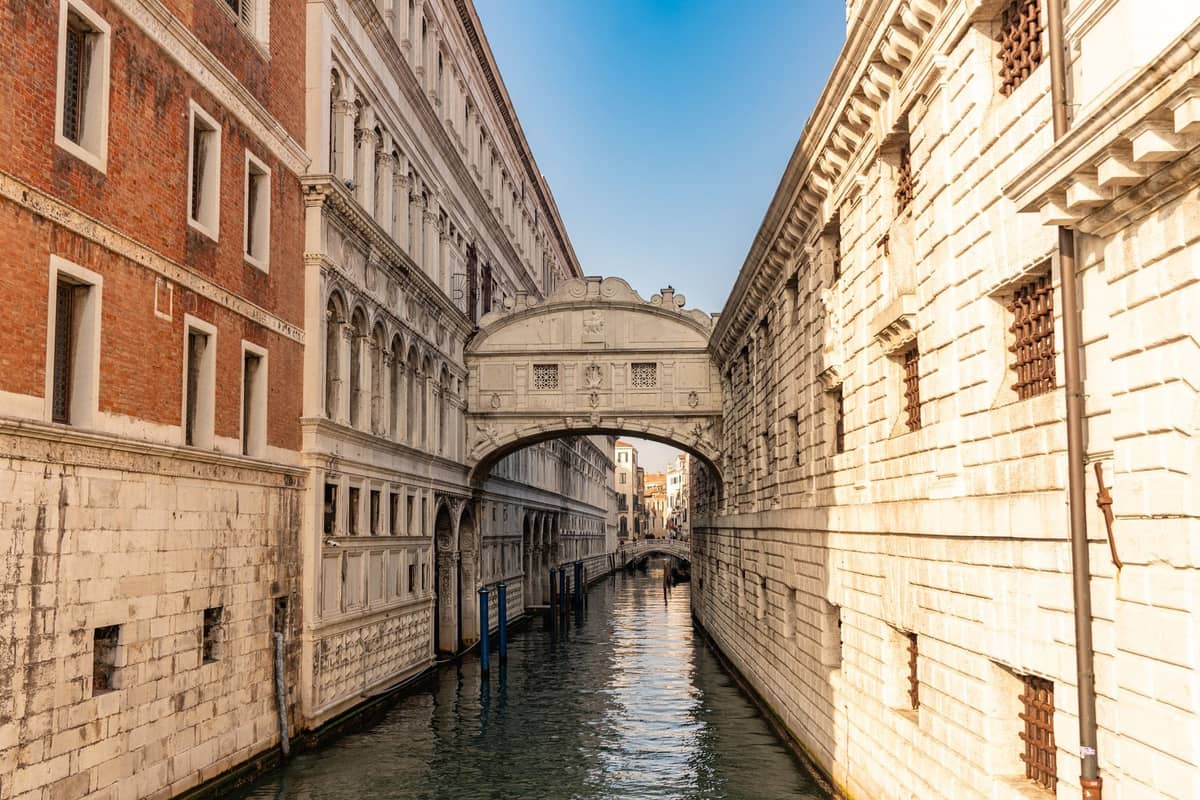
What the Bridge of Sighs Actually Is
The Ponte dei Sospiri is an enclosed limestone bridge built around 1600, commissioned by Doge Marino Grimani and attributed to architect Antonio Contino. It crosses the Rio di Palazzo — a narrow canal running along the eastern flank of the Doge's Palace — and connects the palace's interrogation rooms to the Prigioni Nuove, the New Prisons. The bridge is approximately 11 metres long, carved from white Istrian stone, and sealed on both sides with ornate Baroque facades punctuated by small stone-barred windows. Those windows, no larger than a face framed by hands, are the bridge's only opening onto the outside world.
The name comes from a later, romantic invention. In the 19th century, writers and poets — Lord Byron most famously — imagined condemned prisoners glimpsing their last view of Venice through those narrow grates before descending into the cells below. Whether that poetic story reflects historical reality is questionable. By the time the bridge was completed in the early 17th century, the Republic of Venice was already in political decline, and the prisoners crossing it were far more likely to be common criminals than tragic heroes. But the image was irresistible, and the name stuck.
ℹ️ Good to know
The exterior of the bridge can be seen at any hour, free of charge, from the Ponte della Paglia — the small stone bridge just off the Riva degli Schiavoni. This is the classic viewing angle and it costs nothing. Interior access requires a Doge's Palace ticket.
Viewing It From Outside: The Ponte della Paglia Experience
The standard viewing spot is the Ponte della Paglia, a low stone bridge a few steps from the waterfront promenade of the Riva degli Schiavoni. From here, the Bridge of Sighs frames itself perfectly between the palace wall and the prison building, reflected in the canal below when the water is calm. On a clear morning, the Istrian stone picks up a warm amber light. By midday in summer, the scene is flooded with a flat, bright glare and the bridge itself can be nearly obscured by the crowd pressing onto the Ponte della Paglia.
At peak season — spring through early autumn, especially between 10am and 4pm — the Ponte della Paglia can feel almost impassable. Dozens of people stop mid-crossing to photograph the bridge, creating a slow, shuffling jam. If you are visiting in high summer, arriving before 8:30am makes a significant difference. The canal is quiet, gondolas have not yet crowded the water, and the light from the east angles warmly across the facade. Winter mornings offer the same calm, sometimes with a faint mist lifting off the canal, which turns an already theatrical scene into something genuinely atmospheric.
The surrounding waterfront, the Riva degli Schiavoni, runs east toward the Arsenale and is pleasant to walk regardless of the bridge itself. If you arrive early to beat crowds at the bridge, the promenade at dawn is one of the quieter stretches of water in central Venice — with the lagoon opening up toward San Giorgio Maggiore and the sound of gulls rather than selfie-sticks.
Tickets & tours
Hand-picked options from our booking partner. Prices are indicative; availability and final rates are confirmed when you complete your booking.
Shared gondola ride underneath the Bridge of Sighs
From 39 €Instant confirmationFree cancellationVenice Legends, Anecdotes and Ghost Stories Tour
From 35 €Instant confirmationFree cancellationVenice highlights historical walking tour
From 27 €Instant confirmationFree cancellationFlorence City Sightseeing from Venice by high-speed train
From 145 €Instant confirmationFree cancellation
Crossing It From the Inside: The Doge's Palace Route
Walking across the Bridge of Sighs is included in the standard Doge's Palace ticket, currently priced at approximately €30 (prices should be verified before your visit, as they are subject to change). The ticket also covers the Museo Correr, the Museo Nazionale Marciano, and the Archaeological Museum — a substantial cultural package for a single admission.
Inside the bridge, the experience is more restrained than the mythology suggests. Two narrow stone corridors run parallel, separated by a central wall, with a low vaulted ceiling and rough stone underfoot. The barred windows are small — you can see the canal and the Ponte della Paglia below, and if there is a crowd outside, you will see dozens of camera lenses pointed upward at you. The crossing takes under a minute. It is intimate and slightly claustrophobic, and the thin strip of Venice visible through the grates does carry a certain weight when you understand what the space was actually used for.
The bridge is encountered partway through the Doge's Palace visitor circuit, after the ornate state rooms on the upper floors and before the descent into the prison cells. The contrast between the gilded ceilings of the Sala del Maggior Consiglio and the bare stone corridors of the cells below is one of the most effective pieces of architectural storytelling in Venice. Allow at least two hours for the full palace visit, and consider booking online in advance to avoid queuing in Piazza San Marco.
💡 Local tip
Book your Doge's Palace ticket online in advance. The queue at the palace entrance, especially between April and October, can add 45 minutes or more to your visit before you even enter. Online tickets are typically the same price or slightly cheaper than the door.
History and Architectural Context
Antonio Contino designed the bridge in a Baroque style that was still emerging in Venice at the turn of the 17th century. The facade is more decorative than the city's earlier Gothic bridges, with scrolled stone brackets, relief carvings, and a rounded arch over the canal. It was built as a functional piece of civic infrastructure: the Republic needed a secure, covered passage between the judicial chambers and the newly expanded prison building across the water. The aesthetic care given to even this utilitarian structure reflects how seriously the Venetian state took its public image.
The New Prisons it connects to were themselves a relatively modern construction for the time, built in the late 16th century to expand the city's incarceration capacity beyond the older cells within the palace. The whole complex — palace, bridge, prison — sits within the dense institutional core of San Marco, the sestiere that concentrated the political, religious, and judicial functions of the Venetian Republic in a few hundred meters of waterfront.
The Romantic-era mythology around the bridge owes much to Byron's 1818 poem Childe Harold's Pilgrimage, where he described 'the Bridge of Sighs, a palace and a prison on each hand.' The image of prisoners sighing at their last glimpse of beauty before a grim fate was compelling in an era that prized ruins and melancholy grandeur. Venice, then a city in decline after Napoleon's conquest ended the Republic in 1797, was a perfect canvas for that sensibility.
Photography: Getting the Shot Worth Having
The classic frame is from the Ponte della Paglia, shooting west along the Rio di Palazzo. For the clearest reflection in the canal, you want still water and low light — which means either early morning or dusk on a calm day. In summer, the canal can have enough foot traffic and boat wash to break up any reflection by mid-morning. A wide-angle lens or even a smartphone works well for the full bridge-and-canal composition; the distance from the Ponte della Paglia is short enough that you do not need a telephoto.
A less-used angle: from a gondola or water taxi passing under the bridge itself. Some gondola routes pass through the Rio di Palazzo, and looking up through the arch at the carved underside of the bridge is a dramatically different perspective from the standard tourist view. It is also the angle that best communicates the actual scale of the structure — which is, in truth, quite small.
⚠️ What to skip
The Ponte della Paglia gets extremely crowded between 10am and 3pm in peak season. If you position yourself at the railing for a long exposure or careful composition during these hours, expect to be jostled. Keep your phone or camera secure and be aware of your surroundings.
Practical Details and Getting There
The bridge is located at the eastern edge of the Doge's Palace, over the Rio di Palazzo canal, with its address formally associated with Piazza San Marco 1, 30124 Venice. From the San Zaccaria vaporetto stop (served by lines 1, 4.1, and 4.2), it is a five-minute walk west along the Riva degli Schiavoni waterfront. From the San Marco Vallaresso stop, you walk east along the waterfront for roughly the same time. Both routes are flat and straightforward.
The exterior viewing area on the Ponte della Paglia is a standard public bridge with no admission. It has steps at both ends, which limits wheelchair access. The nearby waterfront promenade is mostly flat. For full accessibility details relating to the Doge's Palace interior — including the bridge crossing — check the official Musei Civici Venezia website directly, as conditions and provisions can change. For broader guidance on navigating Venice on foot and by water, the getting around Venice guide covers vaporetto routes and walking logistics in detail.
The bridge itself has no standalone opening hours — it is a permanent outdoor structure visible at all times. Interior access follows the Doge's Palace hours, which vary seasonally. Check the official Palazzo Ducale website for current times and pricing before your visit.
Is It Worth the Hype?
Honestly: as a standalone attraction, the Bridge of Sighs is smaller and less dramatic in person than its reputation implies. Most visitors spend five minutes on the Ponte della Paglia, photograph the bridge, and move on. The structure is genuinely beautiful and historically significant, but if you arrive expecting a grand Gothic spectacle, the compact Baroque arch over a narrow canal may feel anticlimactic.
Where it rewards is in context. Cross it from the inside during a Doge's Palace visit, and the transition from gilded state rooms to bare stone cells gives the bridge real meaning. The view through those barred windows — a thin slice of lagoon light and the faces of tourists below — does carry something. It is not quite what Byron imagined, but it is not nothing either.
Travelers whose primary goal is photography will find the exterior view entirely satisfying without paying for the palace. Those interested in Venetian history, the mechanics of the Republic's justice system, or the broader story of Piazza San Marco and its surrounding institutions will get significantly more value from the full palace-and-bridge experience.
Insider Tips
- Arrive at the Ponte della Paglia before 8:30am. The bridge is lit softly from the east, the canal is calm, and you will have the railing largely to yourself — an unusual luxury this close to San Marco.
- If you are visiting the Doge's Palace, book the 'Secret Itineraries' tour. This separate guided experience takes you through the palace's private chambers and delivers a much richer account of the judicial history behind the bridge than the standard circuit provides.
- Gondolas passing through the Rio di Palazzo give a view looking up through the arch of the bridge that almost no one sees from the standard tourist angle. If you are taking a gondola ride anyway, ask to pass under the Bridge of Sighs specifically.
- The Doge's Palace combo ticket covers Museo Correr and other Piazza San Marco museums. If you plan to visit Correr as well, buy the combo — it is significantly better value than separate admissions.
- On overcast days, the white Istrian stone of the bridge reads more evenly in photographs, without the harsh shadows that a bright midday sun creates in the narrow canal. A lightly cloudy morning is often the best photographic light for the exterior view.
Who Is Bridge of Sighs (Ponte dei Sospiri) For?
- First-time visitors to Venice who want to see the city's most iconic structures in a single area
- History and architecture enthusiasts willing to invest time in the full Doge's Palace visit for meaningful context
- Photographers seeking early-morning shots before crowds gather on the Ponte della Paglia
- Travelers combining multiple San Marco landmarks into a half-day itinerary — palace, basilica, campanile, and waterfront in one sweep
- Visitors on a budget who want an iconic Venice image at no cost, using only the free exterior viewpoint
Nearby Attractions
Other things to see while in San Marco:
- Doge's Palace (Palazzo Ducale)
Doge's Palace is the Gothic heart of Venice's political history, rising at the edge of Piazza San Marco with a facade unlike anything else in Italy. This guide covers what you'll actually experience inside, when to visit for smaller crowds, and how to make the most of one of Europe's most significant civic buildings.
- Grand Canal (Canal Grande)
The Canal Grande is the main artery of Venice, a reverse-S shaped waterway stretching 3.8 km through the heart of the city and lined with more than 170 palaces spanning six centuries of Venetian architecture. Free to view at any hour, it rewards visitors who know when and how to travel it.
- Museo Correr
Occupying the grand Napoleonic Wing and part of the Procuratie Nuove above Piazza San Marco, the Museo Correr holds centuries of Venetian civic history, Renaissance painting, and lavishly decorated royal apartments. It rewards visitors who take their time, and it's consistently overlooked by crowds fixated on the Doge's Palace next door.
- Museo Fortuny (Palazzo Fortuny)
Tucked into a quiet campo in the heart of San Marco, Museo Fortuny occupies a 15th-century Gothic palace that served as the live-in atelier of polymath artist Mariano Fortuny. Part museum, part time capsule, it rewards visitors who seek something beyond the standard Venetian circuit.