Riva degli Schiavoni: Venice's Grand Waterfront Promenade
Stretching 850 metres along the Bacino di San Marco, Riva degli Schiavoni is Venice's most storied waterfront walk. Free to explore at any hour, it delivers sweeping lagoon views, centuries of mercantile history, and a front-row seat to the daily rhythm of the city.
Quick Facts
- Location
- Sestiere Castello, Venice — from Ponte della Paglia to rio di Ca' di Dio
- Getting There
- San Zaccaria (west end) or Arsenale (east end) — Lines 1, 2, 4.1, 4.2, 5.1, 5.2
- Time Needed
- 30–90 minutes for the walk; longer if you stop at cafes or landmarks
- Cost
- Free — public promenade, open 24 hours
- Best for
- Lagoon views, waterfront photography, early morning walks, evening passeggiata
- Official website
- www.veneziaunica.it
What Is Riva degli Schiavoni?
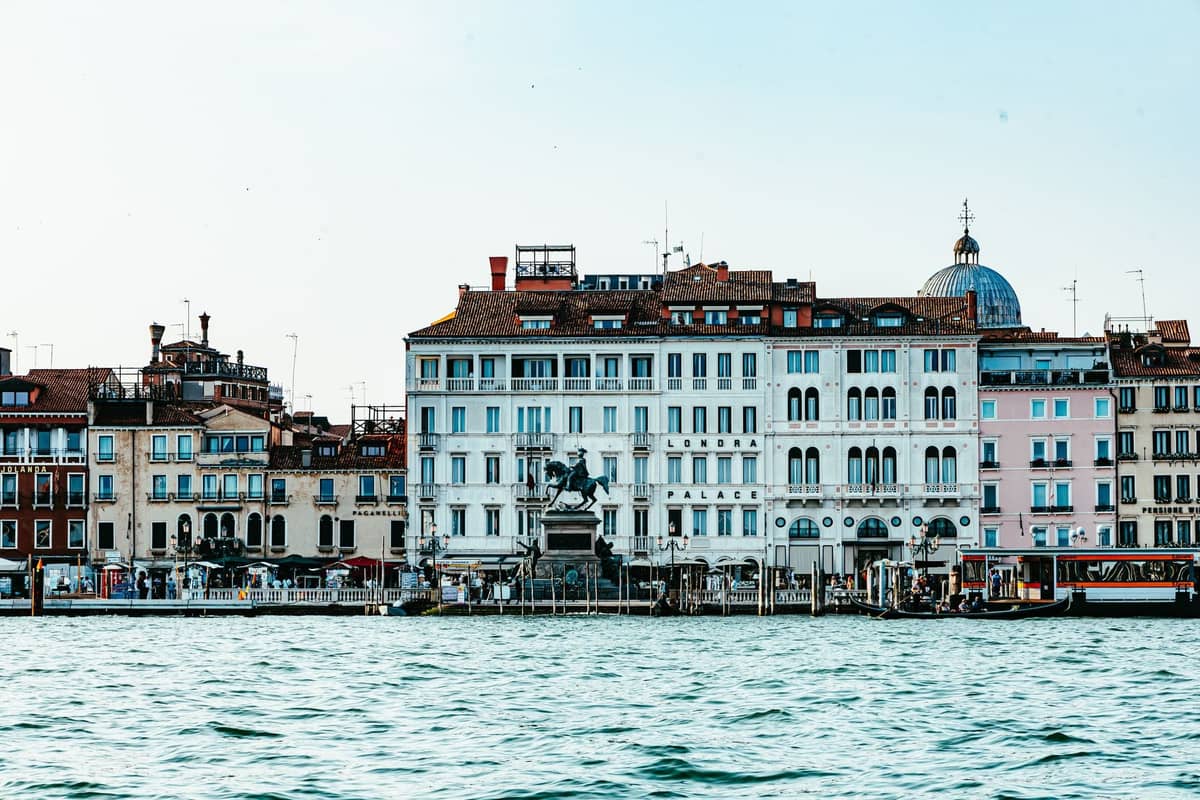
Riva degli Schiavoni is a broad stone waterfront promenade running approximately 850 metres along the southern edge of Venice's Castello sestiere. It follows the Bacino di San Marco, the wide tidal basin where the Grand Canal meets the open lagoon, from the Ponte della Paglia beside the Doge's Palace eastward to the rio di Ca' di Dio near the Arsenale. It is not a hidden corner of Venice. It is one of the city's most immediately legible spaces: wide, flat, perpetually open, and oriented toward water on one side and a dense wall of historic buildings on the other.
The promenade is a public thoroughfare with no ticket booth, no gate, and no closing time. What it offers is something deceptively simple: a long, unobstructed walk along the edge of a lagoon that has been one of the Mediterranean's great commercial waterways for over a thousand years. That context is what separates Riva degli Schiavoni from an ordinary seafront.
💡 Local tip
Arrive before 8am for a dramatically different experience. The Riva is almost empty at dawn, the water is still, and the light across the lagoon toward San Giorgio Maggiore is at its most photogenic. By mid-morning, tour groups and vaporetto arrivals fill the promenade completely.
A Thousand Years of Waterfront History
The quay traces its origins to the 9th century, when Venice was consolidating its position as the dominant trading power of the northern Adriatic. Its location directly in front of the Doge's Palace was no accident: this was the formal face of the Republic of Venice, the point where trade, diplomacy, and civic power converged at the waterline. The quay underwent significant modernisation in the 16th century and again between 1780 and 1782, by which point Venice's political power was fading but its urban infrastructure remained formidable.
The name itself encodes a piece of that commercial history. "Schiavoni" is a Venetian corruption of "Slavic" or "Dalmatian," referring to the merchants from across the Adriatic, primarily from Croatia and the Dalmatian coast, who docked their vessels here and established a trading presence in the city. The same community is commemorated nearby at the Scuola Dalmata dei Santi Giorgio e Trifone, just a short walk into Castello, which still contains one of the finest cycles of Carpaccio paintings in existence.
This part of Castello was, in effect, Venice's international port district. Merchant galleys from the eastern Mediterranean unloaded here. Pilgrims heading to the Holy Land boarded ships at these docks. By the time the Republic fell to Napoleon in 1797, the Riva had served as a commercial gateway for nearly nine centuries. Today, the Arsenale di Venezia, the vast former naval shipyard that once produced warships at an industrial scale, sits just beyond the eastern end of the promenade — a reminder of the military power that backed all that trade.
Tickets & tours
Hand-picked options from our booking partner. Prices are indicative; availability and final rates are confirmed when you complete your booking.
Private gondola ride and dinner in Venice
From 145 €Instant confirmationFree cancellationPrivate Gondola Ride on Grand Canal in Venice
From 149 €Instant confirmationFree cancellationPrivate speed boat transfer from Marco Polo Airport to Venice
From 300 €Instant confirmationFree cancellationDoge's Palace Private Tour With a Local Guide
From 105 €Instant confirmationFree cancellation
What You See Walking the Riva
The western anchor of the Riva is the Ponte della Paglia, a small bridge immediately adjacent to the Bridge of Sighs. Most visitors pause here before continuing east, and the resulting cluster of people photographing the Bridge of Sighs from the bridge makes this specific spot one of the most congested in Venice. If you want a clear view without bodies in the frame, arrive before 9am or wait for a winter weekday.
Moving east from the Ponte della Paglia, the promenade opens up. To your left, the lagoon stretches south toward the Lido and, across the water, the island of San Giorgio Maggiore sits in the middle distance, Palladio's white church facade perfectly framed against the sky. This view across the Bacino is the visual heart of the Riva experience. At midday in summer, the light is harsh and flat. In the late afternoon, particularly from October through March, the low sun turns the water copper and throws the church's facade into relief. Photographers who plan for afternoon light on the lagoon side will leave with materially better images than those who aim for golden hour at dawn.
The buildings lining the landward side of the Riva include some of the most prestigious hotels in Venice, among them the Hotel Danieli, which occupies a 14th-century Gothic palace (the Palazzo Dandolo) with an interior courtyard worth pausing to look at. Between the grand hotels, the promenade's buildings also include smaller residences, souvenir stands, and the occasional cafe with outdoor seating directly on the waterfront. These are not cheap. Coffee and a pastry at a table on the Riva costs significantly more than the same items consumed standing at a bar counter two streets back into Castello.
How the Riva Changes Through the Day
Before 7am, the Riva belongs to locals: delivery workers, early commuters catching a vaporetto, and the occasional jogger navigating the smooth paving stones. The smell at this hour is salt water and, if the tide is low, the faintly mineral tang of exposed canal bed. The surface under your feet is broad Istrian stone, worn smooth over centuries, pale grey in overcast light and almost white in direct sun.
By 9am, the vaporetto stops at San Zaccaria begin discharging passengers arriving from the train station or their hotels. From this point through midday, the Riva functions as a transit corridor as much as a promenade. Tour groups move in formations of 25 people (the current maximum group size permitted by the municipality), and selfie sticks appear in numbers. The wider sections of the Riva handle the density reasonably well, but the area immediately in front of the Doge's Palace becomes genuinely difficult to move through at peak hours in spring and summer.
Evenings bring a different atmosphere. After 7pm, the tour groups have departed, the cruise passengers have returned to their ships, and Venetians who live in Castello begin their evening passeggiata. Children cycle where space allows. Elderly residents occupy benches facing the water. The restaurants and bars along the waterfront fill with a more mixed crowd. The Riva at 9pm on a warm October evening, with the lights of San Giorgio Maggiore reflecting off the Bacino, is one of those experiences that justifies the effort of reaching Venice in the shoulder season.
⚠️ What to skip
During acqua alta (high tide flooding), the Riva degli Schiavoni can flood. Elevated walkways (passerelle) are installed by the municipality, but movement along the promenade becomes slow and awkward. Check the Città di Venezia tide forecast app before visiting in autumn and winter. The MOSE barrier system reduces the frequency of major flooding events but does not eliminate all high-water occurrences.
Practical Walkthrough: Getting There and Moving Through
The most direct vaporetto access is San Zaccaria, served by lines 1, 2, 4.1, 4.2, 5.1, and 5.2. This stop places you immediately at the western section of the Riva, steps from the Ponte della Paglia and the Doge's Palace. If you are approaching from Piazza San Marco on foot, the walk from the square to the Riva takes roughly three minutes. From the Rialto area, allow 20 minutes on foot through the Castello lanes.
Walking the Riva from west to east takes about 15 minutes at a normal pace without stopping. Most visitors take 30 to 60 minutes, pausing for views, photographs, and perhaps a drink at one of the waterfront cafes. If you continue east beyond the formal end of the Riva, the promenade transitions into quieter quays that lead toward the Arsenale walls and eventually the Giardini della Biennale, the park district that hosts the Venice Biennale.
Accessibility is limited. While the Riva itself is wide and largely flat, the bridges at either end and the various smaller bridges crossing rio tributaries along the route all have steps. Wheelchair users and those with pushchairs should plan around these crossings carefully. The surface of the promenade is well-maintained stone, but it becomes treacherous when wet.
Wear comfortable shoes with grip. In summer, the pale Istrian stone reflects heat intensely, and the open lagoon-side of the Riva offers no shade whatsoever. Bring water, particularly if you are combining this walk with a visit to St. Mark's Basilica or the Doge's Palace immediately to the west.
Photography on the Riva
The Riva degli Schiavoni is one of the most photographed waterfronts in Europe, which makes it genuinely difficult to produce an image that does not look like every other image taken here. The classic compositions, the view of San Giorgio Maggiore across the Bacino, the Bridge of Sighs framed from Ponte della Paglia, gondolas moored in rows against the quay, are all valid and worthwhile. They are also all on the first page of any image search.
More interesting results tend to come from working the eastern sections of the promenade closer to the Arsenale, where crowds thin out and the architecture is less iconic but more varied. The moored vaporetti and working boats visible from the eastern Riva provide context that the postcard views from the western end lack. Fog in November and December turns the lagoon into a study in grey tones that can produce genuinely distinctive images, though you need patience, layered clothing, and a willingness to accept that the San Giorgio Maggiore views will disappear entirely on heavily overcast days.
What Sits Just Off the Riva
The Riva functions well as a spine from which to access the wider Castello neighborhood. The Scuola Dalmata dei Santi Giorgio e Trifone is a short walk north into Castello and is frequently overlooked by visitors who stay on the main tourist circuit. Inside is Vittore Carpaccio's extraordinary cycle of paintings depicting the lives of Saint George, Saint Tryphon, and Saint Jerome, completed between 1502 and 1507. It is one of the finest intact Renaissance interior decorative programs in Venice and is almost never crowded.
Further along the Riva's eastern extension, the Giardini della Biennale offer a rare patch of actual grass and mature trees in the Castello district, accessible without a ticket outside Biennale years. The national pavilions, built over more than a century from the late 19th century onward, are interesting architecturally even when closed. For those continuing further into eastern Castello, the neighborhood becomes progressively quieter, more residential, and less represented in standard guidebooks.
ℹ️ Good to know
From 3 April 2026, Venice applies a day-visitor access fee on selected high-attendance dates (hours: 8:30–16:00). Overnight guests and residents are exempt. Check the official portal at cda.ve.it for current dates and fees before your visit, as the list of applicable days is updated regularly.
Insider Tips
- The bench seating on the lagoon side of the Riva is in constant demand from late morning onward. If you want to sit facing San Giorgio Maggiore without standing, arrive early or return after 7pm when the tour groups have cleared.
- Coffee at the waterfront cafes on the Riva costs a premium for the view. Walk one block north into Castello toward Campo San Zaccaria and you will pay local bar prices for the same espresso.
- The Ponte della Paglia view of the Bridge of Sighs is clearest in winter, when the gondolas moored below the bridge are fewer and the tourist boats running under it are less frequent. January and February mornings offer the best combination of low crowds and clear water.
- The Riva is one of the few extended flat walks in central Venice, which makes it useful for anyone who finds bridge-climbing difficult. If you are managing mobility issues, this is one of the most accessible long walks in the historic city, provided you enter and exit from the main vaporetto stops rather than crossing bridges at the ends.
- Sunset from the eastern sections of the Riva, looking back west toward the Doge's Palace and San Marco, places those buildings in silhouette against the fading sky above the city. It is a compositionally different shot from the San Giorgio Maggiore view and one that fewer visitors make the effort to take.
Who Is Riva degli Schiavoni For?
- First-time visitors to Venice who want to orient themselves to the lagoon and get a sense of the city's scale from the water side
- Photographers working in early morning or late afternoon light, particularly in autumn and winter
- Travelers with limited mobility who want an extended flat waterfront walk without repeated bridge crossings
- Anyone combining a visit to the Doge's Palace and St. Mark's Basilica who wants a natural eastward extension into quieter Castello
- Evening walkers looking for a passeggiata route with lagoon views and a gradual transition from the tourist core into a more local neighborhood
Nearby Attractions
Other things to see while in Castello:
- Libreria Acqua Alta
Libreria Acqua Alta is a Castello bookshop where thousands of books are stored in a full-sized gondola, antique bathtubs, large waterproof bins, and small boats to protect them from Venice's seasonal floods. Free to enter, open daily, and genuinely unlike any other bookshop in the world.
- Arsenale di Venezia
The Arsenale di Venezia is one of the largest and most significant pre-industrial complexes in European history. Once the engine of Venetian naval supremacy, this 48-hectare compound of shipyards, armories, and rope-making facilities in the Castello district is partially open to visitors year-round, with greatly expanded access during the Venice Biennale.
- Basilica dei Santi Giovanni e Paolo (San Zanipolo)
The Basilica dei Santi Giovanni e Paolo, known locally as San Zanipolo, is the largest church in Venice and one of the most historically significant Gothic buildings in Italy. For nearly six centuries it served as the state funeral church of the Venetian Republic, and its interior holds the tombs of numerous doges (traditionally counted as around 25) alongside masterworks by Bellini, Veronese, and Vivarini.
- Giardini della Biennale
Spread across the eastern tip of the Castello sestiere, the Giardini della Biennale is a park of Napoleonic origin that transforms into the world's most prestigious contemporary art venue every two years. Thirty national pavilions plus the Central Pavilion, mature shade trees, and a waterfront promenade make it worth visiting whether or not the Biennale is running.